


The Federal Supreme Court’s decision on 1 October on the legislative procedure for the enactment of the enabling law of the Federation Council and the subsequent endorsement of a resolution to commence the enactment procedure by the CoR on 9 October gave new momentum to the issue.
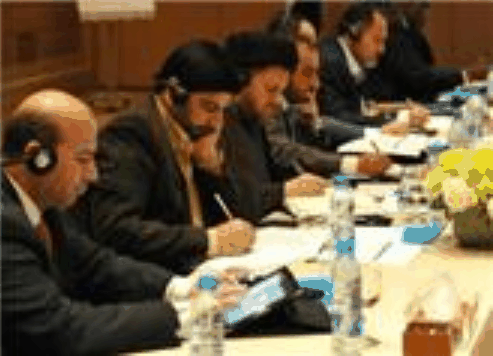
The ‘Roundtable on the Constitutional and Legislative Dimensions of the Federation Council’ organized by UNAMI and the CoR in Beirut on 8-10 December 2012 sought to capitalize on this.
Chaired by the First Deputy Speaker of the CoR, Dr. Qusay al-Suhail, and the Deputy Special Representative of the Secretary-General (DSRSG) for Political Affairs, Mr. Gyorgy Busztin, the three-day event provided representatives of political blocs and parliamentary committees with an opportunity to review key principles of the enabling law of the Federation Council and to study different models from countries with two legislative chambers in more depth.
The participants discussed the possible composition and powers of the Federal Council, the body’s relationship with the CoR, Council of Ministers and Governorate Councils, as well as whether it should have a veto on legislation.
Federalism expert George Anderson from the United Nations Department of Political Affairs in New York gave presentations on bicameral legislatures in federal and unitary regimes, international experiences of fiscal federalism, and on the role and membership of upper houses of parliament around the world.
All is about law enforcement, equality in the legislation without immunities and independence of the judicial system.
Debate new proposal of laws in the Parliament as much as you like, pass any law the majority or democratic part of the Parliament decides but enforce all laws and respect the onstitution and Parliament. All Iraqi citizens are equal in fornt of the law when it comes to rights and obligations.
Then, Iraq will have a chance to battle poverty, wars, corruption and channel the oil wealth to all the citizens of raq.