


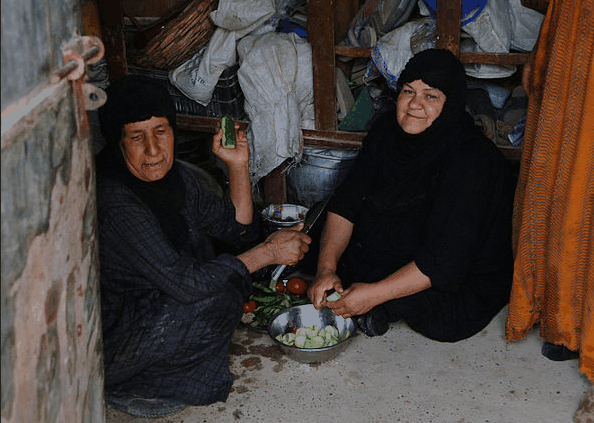
Women are victims
There are different forms of forced marriage. Some occur for material reasons, as a result of the financial needs of the girl's family. Meanwhile, interfamilial marriages, particularly between cousins, are widely practiced in Iraq’s tribal society, in addition to “bride exchanges.” Social researcher Mohamed Abdel Hassan, told Al-Monitor that in the case of the latter, “The woman becomes the price that must be paid for the desires of her brother or father, who wants to marry a woman of his choice.” During such “exchanges,” a woman may be forced to marry a man she doesn’t know, chosen by the family of the woman that her father or brother wishes to marry. Thus, women become “victims with no choices or rights,” according to Abdel Hassan.
Abdel Hassan said that forced marriage can take another form in line with tribal customs, which dictate that women pay the price for a mistake committed by men. He explained that in order to resolve a tribal feud in the case of murder, a woman from the killer’s family is often forced to marry a man from the family of the deceased. This is a disaster for the woman, since she can be forced to marry a man who hates her, because she is related to the person who killed his family member. This can expose her to the worst kinds of retaliatory humiliation and degradation.
Ibrahim al-Obeidi, an Iraqi lawyer, told Al-Monitor that “Forced marriage is one the issues that is not brought up in the courts unless the victim files a complaint. Then, she must prove that she was threatened or forced into marriage. Furthermore, the difficulty of appearing in court, filing a complaint against her father or her brothers, and the danger that she will be exposed to after the trial have pushed women to surrender and submit to 'reality.'”
Iraqi legal expert Ahmed al-Husseini told Al-Monitor that it seems the absence of legal immunity and assurances for women who file complaints is the reason behind the discrepancy between the number of lawsuits filed by victims and the prevalence of forced marriage in Iraqi society. Husseini noted the “dominance of tribal customs” within Iraqi society in general.
Abdel Hassan said that the courts neglect to make sure that women are consenting to getting married. The woman comes to court accompanied by her parents, and the judge asks the classic question: “Do you consent to this marriage?” According to Abdel Hassan, the answer will certainly be “yes,” since her parents, the ones forcing her to get married, are present. He noted, “The courts should rely on a specialized social worker who would examine all aspects of the marriage, to confirm that it was consensual, without coercion of any type.”
Dlovan Barwari is an Iraqi journalist who has written for The Washington Post. He is a founding member of the Network of Iraqi Reporters for Investigative Journalism.
Iraqi Women Victimized by Tribal Marriage Customs | Iraq Business News http://t.co/Hh73SzLOWU
When women are not treated equally as men there is something wrong. How men treat women is a reflection on the quality of the character of men. If women are treated badly it is because men have a low regard for themselves and poor self-esteem. And the problem with society at large is because men do not see each other as brothers.