


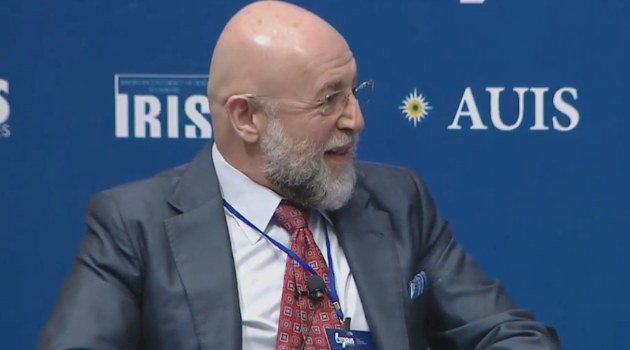
By Ahmed Tabaqchali, Chief Strategist of AFC Iraq Fund. Any opinions expressed are those of the author, and do not necessarily reflect the views of Iraq Business News.
The Market, the Economy, and the Iraqi Dinar's Devaluation
The market, as measured by the Rabee Securities U.S. Dollar Equity Index (RSISX USD Index), was down 18.4%. for the month, and 16.2% for the year. However, had the 13.3% devaluation of the Iraqi dinar versus the U.S. dollar not taken place, the RSIX USD Index would have been down about 5.8% for the month and not down 18.4% (ovals in the chart below).
As negative as the devaluation has been for the near-term performance of the equity market, however, it should be seen in the context of the two currency changes in the recent past. The economy and the market were in very different states in December 2020 and in February 2023, when the devaluation and subsequent revaluation, respectively, took place (orange lines in the chart below). Yet the effects of both currency changes were short-lived and did not alter the trajectory of the market in any meaningful way - as the market was beginning to discount two key dynamics that are driving the transformation of the economy: the cumulative positive effects of relative stability and of structural banking developments.
The Iraq investment thesis argues that, although the economy and the market are once again different, the effects of the current devaluation should be just as short-lived as those of December 2020 and February 2023, and that the market should ultimately continue to discount these two key dynamics as it has done over the last three years. This is because the transformation is a secular process that will unfold over the next few years, bringing with it high economic growth that will feed into higher corporate profits and ultimately higher stock market returns.
Nevertheless, as asserted here in the outlook for 2026 in "What Next After a Gangbuster Three-Year Rally?", two forces in 2026 would moderate these two key dynamics. The first was that a "new normal" for the banking sector would begin to take shape in 2026, in which the future growth trajectories of the top banks would be from a higher base and from a significantly improved financial position.
The second was the effect of lower oil prices (as expected then at the end of 2025) on government spending, and subsequently on the non-oil economy, given the central role of government expenditures. These moderating effects were amplified by the combination of the disruptions brought on by the war on Iran, the loss of oil revenues from the closure of the Strait of Hormuz, and the changes to the customs system at the start of 2026. These effects should be transitory - meaningfully dampening, but not derailing, the secular transformation of the economy, which should reassert itself once the economy adjusts to the new exchange rate. The adjustment, a function of the economy's high dollarisation rate, would affect all of its sectors, first by raising costs, through the 15.4% rise in the dollar, and second by dampening demand.
However, these are one-off effects to which the economy should adjust over the near term, as it did following the December 2020 devaluation, which raised dollar costs by 22.7% - and the economy is much healthier today, after three years of plenty, than it was in 2020, when it was adjusting to the disruptions brought by COVID-19, which came soon after the far larger disruptions of the ISIS conflict that ended in late 2017.
Technically, the RSISX USD Index's 18.4% fall for the month took it to just above the low end of its multi-year uptrend, thereby presenting the first serious test to the assertion made in here over the past two years that, from a technical analysis perspective, it continues to consolidate its gains within this uptrend. Interestingly, stripping away the effects of the devaluation, the index would be comfortably within its uptrend. Nevertheless, the next few weeks will determine whether the current uptrend holds, or whether its slope moderates, as the market reflects the economy's adjustment to the devaluation.
Rabee Securities U.S. Dollar Equity Index vs. Average Daily Turnover
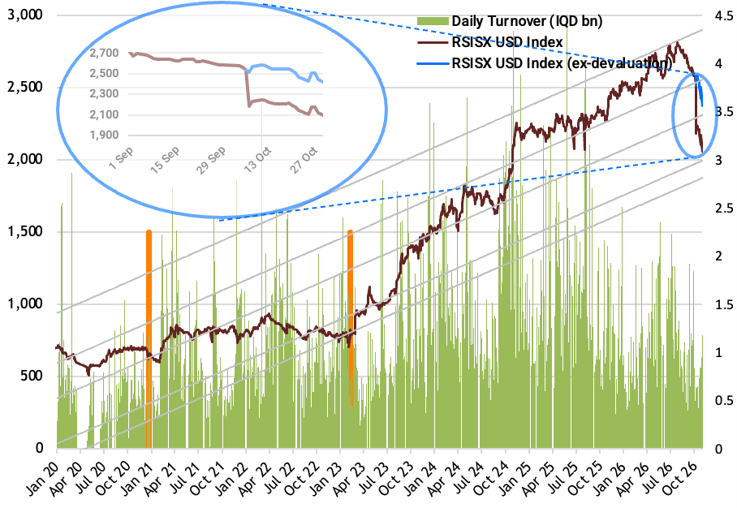 (Source: Iraq Stock Exchange, Rabee Securities, AFC Research, daily data as of October 29th
Note: The blue line assumes that no devaluation had taken place)
Devaluation: Background, Context, and Near-term Outlook
This section updates the data (on oil exports, their effect on budget projections, budget execution figures, and monetary conditions) included in the recent "Iraqi Dinar's Devaluation: Context and Near-term Outlook"
Oil Exports, Oil Revenues, and the 2026 Budget
The closure of the Strait of Hormuz in early March 2026, following the onset of the U.S.-Israel war on Iran, led to the effective shutdown of Iraq's oil exports, 95% of which had passed through the Strait before the war. This could have had an immediate impact on the government's ability to meet its expenditures, as about 90% of its revenues come from oil exports. This, in turn, could have hurt the wider economy, given the state's outsized role, both through its provision of goods and services and through the public-sector payroll.
However, this initial loss of oil exports did not represent an immediate hit to oil revenues, which continued to flow into March-April, benefiting from the roughly two-month lag between oil exports and the receipt of their revenues. Nevertheless, the loss of oil exports in March-May translated into sharply lower oil revenues for May-July, with the beginning of the oil export recovery in June and July reflected in the strong recovery of oil revenues in August and September (charts below).
Oil exports continued to recover, reaching about 68% of pre-war levels in August, an estimated 80% in September, and an estimated 94% in October. This export recovery should be reflected in continued growth in oil revenues in October-December, which, in dinar terms, would be boosted further by the devaluation. Partly offsetting the earlier drop in oil revenues was the strong growth in non-oil revenues, up 34% in January-September versus the same period in 2025, which benefited from the implementation of a new automated customs tariff system at the start of 2026.
Actual and Projected Oil Exports for 2026
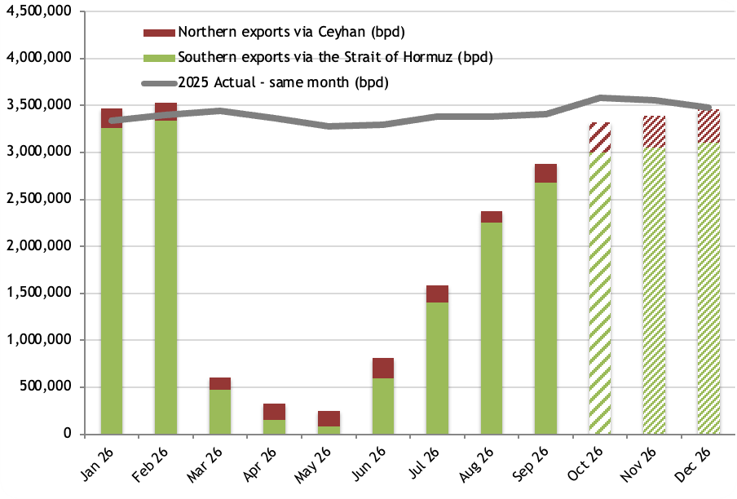 (Source: State Oil Marketing Organization for 2025, January-June and August-September; Iraq Oil Report for July; AFC Research estimates for October and projections for November-December [1])
Actual and Projected Revenues and Expenditures for 2026
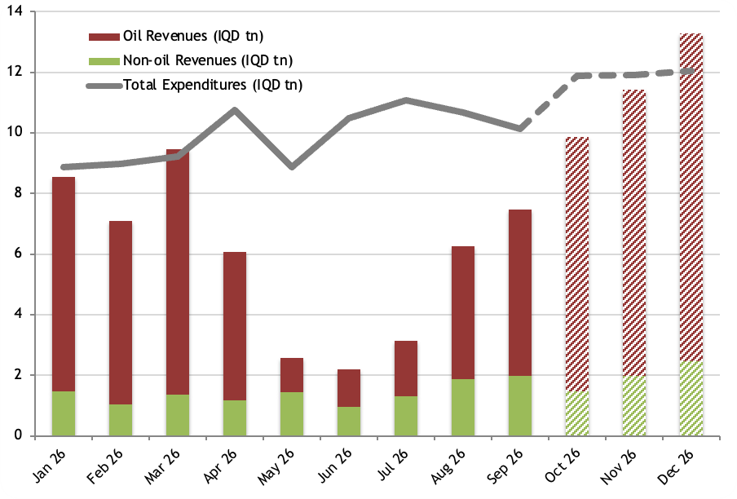 (Source: Ministry of Finance for January-September; AFC Research projections for October-December [1])
The state's expenditures are dominated by rigid current expenditures - made up of public-sector salaries, pensions, social security, benefits, and subsidies - which, reflecting the country's political economy, are exceptionally difficult to reduce even when oil revenues decline below expenditures. As such, the prior government, and the current government in office since May, continued with the usual cash-management toolkit - employed by all prior governments when oil revenues fall below expenditures - such as ad hoc cost savings and accumulating arrears to third parties, including domestic contractors and International Oil Companies (IOCs), together with the freezing of all new capital and investment spending projects.
Despite these measures, there was a gap between revenues and expenditures in 2025, which continued into 2026 (chart above), but which increased significantly in April-June, then began to narrow in August-September, and is projected to narrow further as the year comes to an end (table below).
Actual and Projected Figures for the 2026 Budget
 (Source: Ministry of Finance for January-September; Central Bank of Iraq for domestic debt to July, August-September estimated; AFC Research projections for October-December [1])
Foreign Reserves and the Exchange Rate
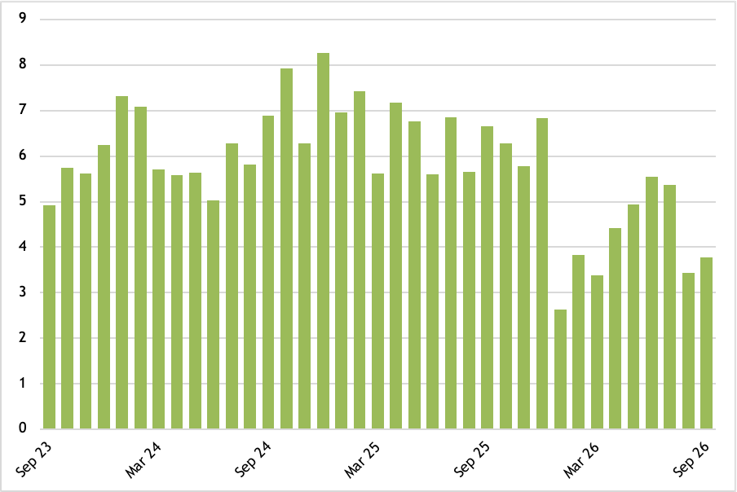
The government's continued spending, in particular its current expenditures, sustained domestic consumption, which in turn sustained the demand for imports. Surprisingly, this demand was relatively strong in the context of the disruptions brought by the closure of the Strait of Hormuz, as reflected in cross-border transfers (chart below), which are mostly used to pay for imports and are thus a proxy for domestic consumption. The application of the new automated customs tariff system at the start of 2026 had an initial depressing effect on demand, as reflected in the sharp drop in January, but demand recovered in subsequent months, with the drop in August being a function of new CBI procedures that constrained transfers.
Cross-Border Transfers (USD billion)
 (Source: Central Bank of Iraq, data as of the end of September 2026)
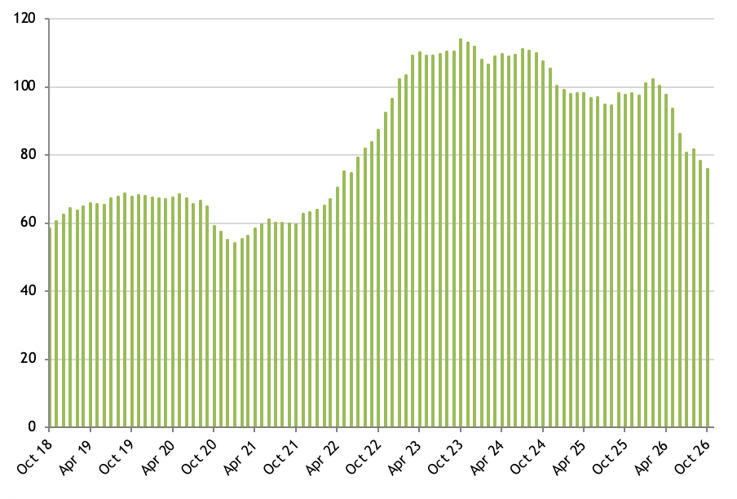
The continued drawdowns of foreign reserves to meet demand for cross-border transfers, not replenished by the conversion of oil revenues from dollars into dinars, led to a sharp decline in reserves, which by the end of September were down 23% from the levels at the end of 2025. [2] However, current levels are healthy, comfortably supporting around 12 months of imports, [3] and are much higher than those that prevailed prior to the 18.5% devaluation in December 2020. As such, the current decision to devalue the dinar was a proactive one, buying the government time to decide on fiscal reforms, which is in sharp contrast to the historic head-in-the-sand stance of the country's political elite during periods of crisis.
In the near term, the pressures on foreign reserves should ease substantially, as reserves should be replenished by the conversion of increased oil revenues in October-December into dinars, while demand for cross-border transfers should be dampened somewhat by the effects of the dinar's devaluation on domestic consumption.
Foreign Reserves (USD billion)
 (Source: Central Bank of Iraq, data as of October 15th)
Near-term Outlook
The near-term outlook for government finances, the economy, and foreign reserves is highly dependent on the continuation of the recovery in oil exports and on the continuation of the pause in the tit-for-tat attacks between the U.S. and Iran. While a few strong oil export months do not make a trend, especially in this highly fluid and dangerous period, current market expectations for future oil prices, as measured by Brent futures contracts, promise a measure of stability for all three.
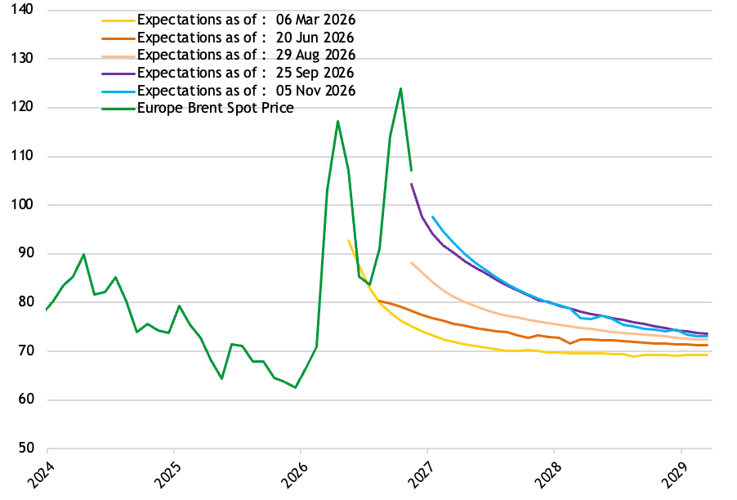
Expectations for future oil prices following the collapse of the Islamabad Memorandum of Understanding have consistently shifted higher, suggesting an acceptance that the current pause in the tit-for-tat attacks between the U.S. and Iran is evolving into a surreal new normal of no-war/no-peace (chart below).
Market Expectations for Future Oil Prices (USD per barrel)
As measured by Brent futures contracts
 (Source: U.S. Energy Information Administration, investing.com, AFC Research, data as of 5th November 2026)
As such, the combination of likely higher near-term oil prices, continued strong oil export recovery, and the 13.3% devaluation of the dinar would substantially improve the government's financial position for the year (budget table) and provide a measure of stability for the economy and foreign reserves - although reserves would still trend lower, albeit at a much slower rate.
The three positives of higher oil prices, continued strong oil export recovery, and the 13.3% devaluation of the dinar, while necessary, are not sufficient to sustain economic stability without addressing the budget's structural imbalances of rigid expenditures and revenue volatility. Nevertheless, they have provided the government with breathing space to decide on fiscal reforms, in particular those that could come with an IMF programme, such as the Stand-By Arrangement (SBA) signed in 2016, or, better still, the more substantial Extended Fund Facility (EFF). Any IMF programme would face extreme resistance from the public and the political elite, who together rejected the White Paper for Economic Reform, which came in response to the financial crisis of 2020 and aimed to address the economy's structural imbalances. [4] That said, the continued need for debt to augment oil revenues, irrespective of the future direction of oil prices, requires the issuance of foreign debt in the form of Eurobonds, which would not come without an IMF programme, to supplement domestic debt - as the issuance of domestic debt on its own will continue the pressure on foreign reserves, while foreign debt will increase them.
Despite domestic resistance to an IMF programme, the proactive decision to devalue the dinar - breaking the historic head-in-the-sand pattern - signals the seriousness of the government's tentative engagement with the Fund over recent months. That engagement has since solidified: at the close of the IMF-World Bank Annual Meetings in Bangkok on 17th October 2026, the IMF's Managing Director confirmed that the authorities had requested a programme, pledging "both money and policy support".
While such an engagement would likely take many months to conclude, the three positives outlined above have opened a window of up to a year for these discussions, as can be seen from the near-term implications of Brent crude prices under the assumption of continued oil export recovery. Current expectations imply an average Brent price of USD 96.3 per barrel (/bbl) for 2026, a projected average of USD 87.0/bbl for 2027, and USD 76.2/bbl for 2028, which, for Iraq under the current assumption of no-war/no-peace, means prices lower by about USD 32/bbl for the balance of 2026 and for 2027-2028. Assuming expenditures over the next two years are in line with those projected for 2026 (actual, not budgeted, as actual is always less than budgeted given the state's capacity constraints), this suggests that the budget's deficit for 2027 could be better than that of 2026, but that the deficit for 2028 could be worse. In the short term, this would allow domestic debt to fund the deficit without significantly eroding reserves, while in the medium-term foreign debt would be needed - all of which support the conclusion of an IMF programme. However, preliminary data on the proposed 2027 budget imply that the window for concluding the discussions between the IMF and the government could be shorter than the year suggested above.
Notes
[1] Methodology: Projections for oil exports assume incremental month-on-month increases from October's estimated levels. Blended oil prices assume discounts to Brent crude of USD 32 per barrel (USD/bbl) for southern exports and USD 5/bbl for northern exports. October reflects actual Brent spot prices; November and December are estimates based on ICE Brent futures (data as of 5th November 2026). Budget oil revenues are derived from projected export receipts (0.44 x current month + 0.56 x two months earlier), less a 15% haircut, and converted at 1,461 IQD/USD in October and 1,500 IQD/USD in November-December. Projected non-oil revenues assume full-year growth of 24%, down from 34% year-on-year in January-September. Projected expenditures assume continued cost controls; each month's projected expenditures are based on the average of the preceding three months and include oil capital expenditures (15% of oil revenues), which were minimal in January-September.
[2] Reserves are created when the Ministry of Finance (MoF) converts its dollar oil revenues into dinars: the Central Bank of Iraq (CBI) buys the dollars from the MoF and sells it the equivalent in dinars. Cross-border transfers, on the other hand, are the reverse transaction: the private sector, through the banks, sells dinars to the CBI and buys dollars from its reserves. Reserves therefore increase when the CBI buys more dollars from the MoF than it sells to the private sector, and decline when it sells more than it buys. See: (1) Ahmed Tabaqchali, "A Fistful of Dinars: Demystifying Iraq's Dollar Auction," LSE Middle East Centre, 18th April 2024, pp. 7-11, https://researchonline.lse.ac.uk/id/eprint/122652/; (2) Ahmed Tabaqchali, "The Empire Strikes Back: Trump 2.0 and Iraq's Dollar Accounts at the Federal Reserve," LSE Middle East Centre Blog, 4th March 2025, https://blogs.lse.ac.uk/mec/2025/03/04/the-empire-strikes-back-trump-2-0-iraqs-dollar-accounts-at-the-federal-reserve/.
[3] Reserves as of the end of September, divided by the 18-month average of cross-border transfers, would cover at least 12 months of transfers. A CBI official at the MERI Forum in Erbil on 13th October 2026 stated that reserves cover Iraq's imports for a year or more. See: Al-Mada, "Central Bank: Our Foreign Reserves Cover Iraq's Imports for a Full Year or More" (in Arabic), 14th October 2026, https://almadapaper.net/456706/.
[4] Ahmed Tabaqchali, "Missed Opportunities for Economic Reform," in Iraq 20 Years On: Insider Reflections on the War and Its Aftermath, Chatham House, 4th May 2023, https://www.chathamhouse.org/2023/03/iraq-20-years-insider-reflections-war-and-its-aftermath/missed-opportunities-economic.
Please click here to download Ahmed Tabaqchali's full report in pdf format.
Mr Tabaqchali (@AMTabaqchali) is the Chief Strategist of the AFC Iraq Fund, and is an experienced capital markets professional with over 25 years' experience in US and MENA markets. He is a board member of Arab Bank Iraq, a Visiting Fellow at the LSE Middle East Centre, Senior Fellow at the Institute of Regional and International Studies (IRIS), and a Senior Non-resident Fellow at the Atlantic Council.
His comments, opinions and analyses are personal views and are intended to be for informational purposes and general interest only and should not be construed as individual investment advice or a recommendation or solicitation to buy, sell or hold any fund or security or to adopt any investment strategy. It does not constitute legal or tax or investment advice. The information provided in this material is compiled from sources that are believed to be reliable, but no guarantee is made of its correctness, is rendered as at publication date and may change without notice and it is not intended as a complete analysis of every material fact regarding Iraq, the region, market or investment.




No comments yet.