



By Ahmed Tabaqchali, Chief Strategist of AFC Iraq Fund. Any opinions expressed are those of the author, and do not necessarily reflect the views of Iraq Business News.
Market Takes a Breather, While Oil Exports Continue to Recover
The market, as measured by the Rabee Securities U.S. Dollar Equity Index (RSISX USD Index), ended September down 4.8%, trimming its year-to-date gain to 2.7% - which follows a three-year increase of 224.5% through end-2025.
The Iraq Stock Exchange Goes Live on the Abu Dhabi Stock Exchange's Tabadul Platform
In a positive development for the Iraqi equity market, the Iraq Stock Exchange (ISX), on September 29th, became the eighth market to go live on the Tabadul platform, having signed the integration agreement on 22nd April 2025. Tabadul is the Abu Dhabi Stock Exchange (ADX)'s digital exchange network for a mutual market-access that essentially allows investors on a connected member exchange to trade directly on the ADX, and vice versa, through their local brokers, with settlement in local currencies.
Membership therefore offers more than trading access; it is designed to remove the complexities of registering with each exchange and settling trades. Each exchange, its depository and its qualified brokers must resolve these issues before a link goes live in both directions, hence the lag between signing and going live, and why only eight of Tabadul's eleven member exchanges are live so far.
In Iraq's case, the link that went live on September 29th gives ISX investors access to ADX-listed securities; however, trade-settlement details are yet to be ironed out, so trading access is effectively conditional on resolving these issues. Access to the ISX for ADX-side investors is expected to follow once trade-settlement issues on the ISX's side are resolved.
Trading values on Tabadul have grown since its launch in 2022; however, the platform does not yet have enough trading history across different market cycles to allow a full assessment of its benefits to connected exchanges. Nevertheless, for the Iraqi equity market, two-way connectivity - opening the ISX to a far larger investor base without the complexities of cross-border settlement - could be transformative for the ISX's trading volumes, which are dwarfed by those of the ADX.
In turn, this could provide a significant boost to ISX equity prices, should ADX investors seek exposure to Iraq's economic transformation. The ADX's investor base includes, in addition to the sizeable UAE-based investor community, many of the region's retail and high-net-worth investors, and many international institutional investors, especially those focused on emerging and frontier markets.
Over the last two months, the market's decline took the RSISX USD Index towards the low end of its multi-year uptrend, thereby testing the assertion made in our monthly updates over the past two years that, from a technical analysis perspective, it continues to consolidate its gains within this uptrend. Continued low trading volumes, as measured by daily turnover, support this assertion, suggesting a lack of selling pressure (chart below).
Rabee Securities U.S. Dollar Equity Index and Daily Turnover
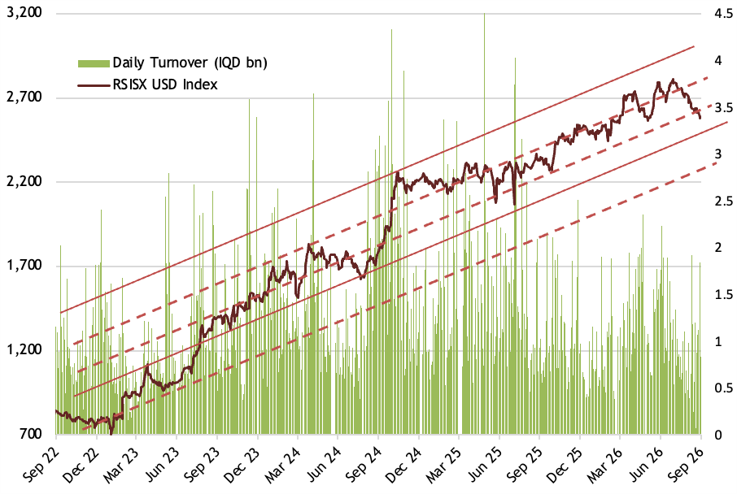 (Source: Iraq Stock Exchange, Rabee Securities, AFC Research, daily data as of September 29th.
Note: daily turnover is adjusted for block trades)
Iraq's Oil Export Recovery Picks Up Momentum
Iraq's oil export recovery through the Strait of Hormuz (green bars in the chart below) and Türkiye's Ceyhan port on the Mediterranean Sea (maroon bars) took combined exports to an estimated 75% of pre-war levels, versus August's estimated 68%*. Should this recovery continue, even at moderate rates, over the next few months, it would lead to meaningful improvements in Iraq's oil export profile for the rest of the year - well above what was assumed last month.
Actual and Projected Oil Exports for 2026
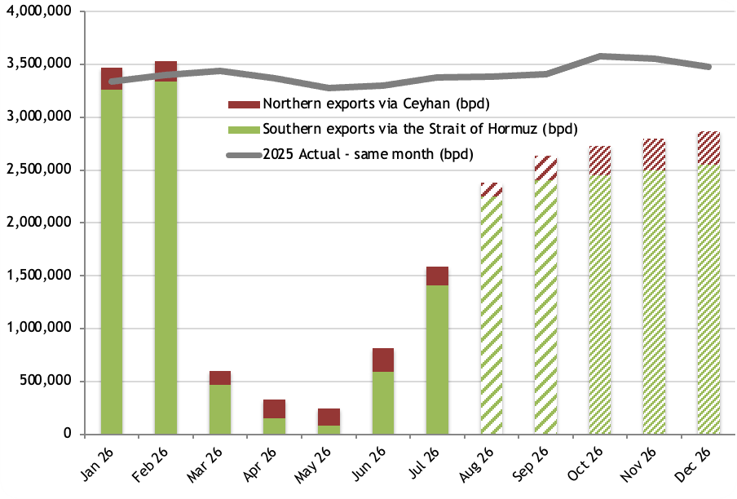 (Note: January-June are actual figures from the State Oil Marketing Organization (SOMO); July is based on data from the Iraq Oil Report (IOR); August and September are estimates; and October-December are projections**)
The two-month lag between oil exports and the receipt of their revenues*** means that the full benefit of revenues from the August-September export recovery will not be felt until October-November (chart below) - in much the same way that the revenue shock from the Strait of Hormuz's closure was not felt immediately. Non-oil revenues will continue to cushion, but cannot fully offset, the year-on-year drop in oil revenues; thus, the year's projected budget deficit will be much larger than in recent years.
The deficit will continue to be contained by tight cost controls, including the build-up of arrears, and funded by the issuance of domestic debt in the form of treasury bills (T-bills). In time, the meaningfully increased T-bill issuance will play a major role in developing the country's bond market. This should ultimately bring "bond market discipline", with the potential to correct the structural imbalances between current and investment spending that have been perpetuated in every budget over the last two decades.
Actual and Projected Revenues and Expenditures for 2026
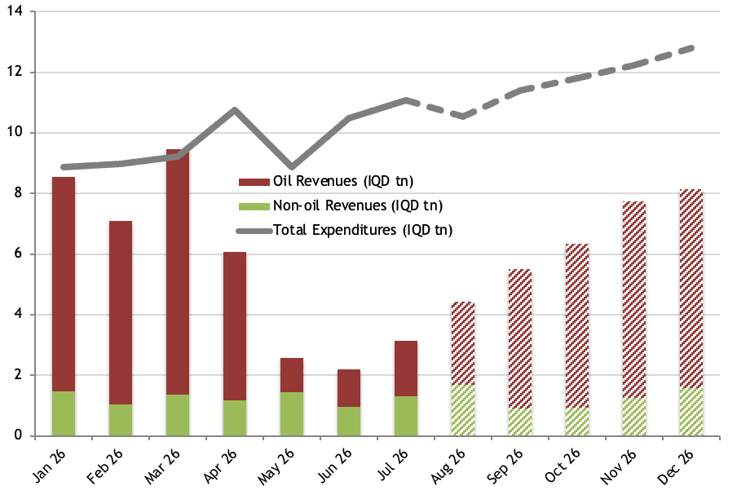 (Note: January-July are actual figures sourced from the Ministry of Finance; August-December are projections**)
Notwithstanding the positives of the recovery in oil exports, considerable risks remain for Iraq's economy and its equity markets, notably that the pause in the tit-for-tat attacks between the U.S. and Iran may collapse, starting a conflict that could escalate well beyond the control of the participants, both direct and indirect, and become an all-out war engulfing the region.
Notes:
(*) Last month, it was estimated that the recovery of Iraq's oil exports had reached about 60% of pre-war levels; however, recent reports indicate that the recovery was stronger than expected, leading to an upward revision of the estimate to 68%.
(**) Projections for oil exports assume incremental month-on-month increases from September's estimated levels. Blended oil prices for southern oil exports assume a discount of $31 per barrel ($/bbl) to Brent crude prices, while blended oil prices for northern oil exports assume a discount of $10/bbl to Brent (September reflects actual Brent spot prices; December reflects futures prices as of 2nd October 2026; October and November are interpolated between the two). Projected non-oil revenues assume continued growth, but at more moderate rates than those experienced in the first half of the year. Projected expenditures assume continued cost controls; each month's projected expenditures are based on an average of the preceding three months' figures and include estimates for oil capital expenditures, which were not made in the first half of the year.
(***) Based on an ongoing review of historical oil exports as reported by the Ministry of Oil, and oil revenues as reported by the Ministry of Finance, a two-month lag is the best single overall fit; for modelling, however, a better fit is a split of 44% same-month and 56% two-month-prior exports. This modelling will likely be refined, or changed, as work progresses and more granular data becomes available. Projected oil revenues are based on this split and are further scaled down as a precaution while the review is ongoing.
Please click here to download Ahmed Tabaqchali's full report in pdf format.
Mr Tabaqchali (@AMTabaqchali) is the Chief Strategist of the AFC Iraq Fund, and is an experienced capital markets professional with over 25 years' experience in US and MENA markets. He is a board member of Arab Bank Iraq, a Visiting Fellow at the LSE Middle East Centre, Senior Fellow at the Institute of Regional and International Studies (IRIS), and a Senior Non-resident Fellow at the Atlantic Council.
His comments, opinions and analyses are personal views and are intended to be for informational purposes and general interest only and should not be construed as individual investment advice or a recommendation or solicitation to buy, sell or hold any fund or security or to adopt any investment strategy. It does not constitute legal or tax or investment advice. The information provided in this material is compiled from sources that are believed to be reliable, but no guarantee is made of its correctness, is rendered as at publication date and may change without notice and it is not intended as a complete analysis of every material fact regarding Iraq, the region, market or investment.




No comments yet.