


By Edwin Dorsey for Sunday's Idea Brunch. Re-published with permission by Iraq Business News.
Idea Brunch with Ahmed Tabaqchali of AFC Iraq Fund
Welcome to Sunday's Idea Brunch, your interview series with great off-the-beaten-path investors. We are very excited to interview Ahmed Tabaqchali!
Ahmed is currently Chief Strategist of Asia Frontier Capital's Iraq Fund and is a capital markets professional with over 30 years of experience in US and MENA markets. Before AFC, he was an Executive Director at NBK Capital, the investment banking arm of the National Bank of Kuwait, and held senior institutional sales roles at WR Hambrecht + Co., KeyBanc, Jefferies International, and Dean Witter International. He is a board member of Arab Bank Iraq, and of Iraq Fund for Higher Education (IFHE)/Baghdad Business School (BBS). He is also a non-resident Senior Fellow at the Atlantic Council, and a Senior Fellow at the Institute of Regional and International Studies (IRIS) at the American University of Iraq-Sulaimani (AUIS).
This interview was conducted with help from Sam Wilkins.
Ahmed, thanks for doing Sunday's Idea Brunch! Can you tell readers a little about your background and the trajectory that led you to investments in Iraq and the AFC Iraq Fund?
Thank you for the invitation and for the opportunity to discuss the AFC Iraq Fund and the Iraq Investment story... You cannot get more off the beaten track than you would with Iraq, whether it's an off-the-beaten-track travel experience of 5,000 years of human history, the birthplace of writing, literature, and urban civilization; or an off-the-beaten-track investment opportunity in one of the last ultimate frontier markets that has the potential to become a major regional market.
The old Iraqi oral folklore phrase "Whoever drinks the water of the Tigris is bound to return to it" aptly describes the trajectory that led me to the AFC Iraq Fund. I left Baghdad in 1976/77, as a teenager, and met my AFC colleague, Ruchir Desai, upon my return about 37 years later in Erbil in 2013. Ruchir was attending an Iraq investor conference, as part of AFC on-the-ground investing, and I was working as part of an advisory team on an IPO of one of Iraq's three major mobile operators. Soon afterward, I met my partner and friend Thomas in London a number of times over the year, and we teamed up to launch the AFC Iraq Fund in June/July 2014 within a few weeks of the fall of Mosul to ISIS a few months earlier. Given the extent of the extremely negative news coverage and predictions of the end of Iraq, I was convinced that the time was right for launching such a fund, and Thomas agreed wholeheartedly - a year later, the AFC Iraq Fund was launched in June 2015.
However, a great deal has happened in between that has shaped me as a person, and crucially is relevant to the AFC Iraq Fund - in terms of the investment thesis and its follow-through. As a son of a career diplomat, I lived and studied all over the world from New Zealand, Far East Asia, the Middle East, including Northern Africa, and to Western Europe with my academic qualifications attesting to this diversity - primary and intermediate school Baccalaureates from Iraq, high school Baccalaureate from Algeria, GCSE "A" levels in the UK, two Bachelor degrees in New Zealand, and finally a master's degree in the UK. My late father instilled in me from a young age the attitude best encapsulated by "In Rome, do as the Romans do", and as such I immersed myself in all the wonderful cultures that I lived in, and have always been at home in all the places that I lived in - in fact, when I think of home, it's both Iraq and the UK (in alphabetical order).
I started my career as an institutional stockbroker working for US investment banks based in London, servicing UK and European institutional investors on US investments. However, I wasn't a typical institutional broker, in that I conducted my own research, especially in technology (starting in the 1990s, before investing in technology was a thing !!!), but broadened it to include other market sectors and commodities. As my understanding of markets grew. Working in US markets from the early 1990s shaped my understanding of economics, markets, and investments across the equity market spectrum - spanning micro-caps to large caps, market sectors, as well as trading of securities on the different US exchanges, including working in risk arbitrage and portfolio trading. After which I went to the GCC, first in the UAE and then in Kuwait, and worked on Index and ETF creation, retail, high net worth, and institutional research and brokerage in the GCC markets, as well as in Egypt. These experiences played, and continue to play a crucial role in shaping the AFC Iraq Fund's investment thesis and its execution - for instance, stock vs company, market structure, bid-offer spreads, level of institutional flows, investor base, level of foreign versus domestic investors, as well as political risk that is key to investing in the Middle East. All of these are extremely relevant to understanding and investing (both the process of stock selection and the mechanics of trading, including building and exiting positions), as well as cash management in a young, shallow market like Iraq that has the potential to be among the largest in the Middle East.
You've called Iraq an "anomaly" in the Middle East. Can you tell us what you mean by that?
In the region, Iraq is a market anomaly with significant upside potential if conditions normalize. On so many levels, it has major-league firepower, yet it plays in the minor leagues in so many of them. This is more so when one considers its superior (vis-à-vis its neighbors) upside potential as a function of geographic and natural resource wealth in the post-Strait of Hormuz world - as outlined in "Oil Deals Galore and a Diminishing Perceived Risk Premium"
In oil, its reserves and production potential are second only to Saudi Arabia, yet its stock market (as a function of its economic transformation) has not been transformed as Saudi Arabia's stock market had - in both absolute terms, and a percentage of GDP, its stock market is a fraction of its neighbors, including the non-oil producing countries. Even a partial catch-up, should conditions begin to normalize, would see its market capitalization double or triple at least - granted a big if, but possible.
Unlike many countries in the region that either have a large population or large oil wealth, Iraq has both - among the top oil reserves in the world, a large population estimated at 46 million in 2026 that is projected to reach 72 million by 2050. The youth are a big feature of its current and future population profile, as its population is broad at the base, i.e., an expansive population pyramid.
Thus, its domestic market alone can support its industries/businesses for decades to come, given the catch-up opportunities of decades of conflict that laid waste to its capital and infrastructure (physical and human). For example, its real estate market is booming, reflecting unmet current, let alone future, demand for housing/accommodation. For example, I left Baghdad as a teenager in the late 70s when its population was about 3 million, while its population is estimated at 8 million in 2026, with the larger metropolitan area estimated at about 11 million. Yet its housing infrastructure in 2017, when I began to move there, massively lagged this population growth, let alone future growth. It's no wonder that its real estate market is booming, with houses and buildings demolished daily to be replaced by towers. Interestingly, the mortgage market is in its infancy, but some banks are beginning to respond to this opportunity. I could go on and on about so many sectors, especially the potential of its tourism sector and its spillover effects on the economy, given its rich heritage. As Gerard Russell writes in his book Heirs to Forgotten Kingdoms: "In the landscape of recorded history, Iraq is Everest: just as Everest makes other mountains seem small, Iraq makes even ancient history seem recent by comparison." But I will stop here.
You have written before about the difference between perceived risk and actual risk in investing in Iraq. Do you think this is expanding or contracting? How do you communicate to your investors that real risk is still high, while maintaining that it isn't as high as they may think?
On the surface, the difference, or delta, between the two is still very high, as can be seen from the early coverage of the Iran war and the closure of the Strait of Hormuz - which effectively shut off 95% of Iraq's oil exports. Almost all coverage was of the devastating consequences on Iraq's economy from such a loss, and so, not for the first time, the country's obituary was being prepared - compounding the gloom were voices within Iraq, in the person of the foreign minister, who warned of "financial catastrophe" if the war continues. In the meantime, life continued as normal in Iraq.
Beneath the surface, the picture is mixed. For starters, investment interest, as pointed out in a response to an earlier question, is almost non-existent, and so here the gap is still very wide. However, in the real economy, things are different in that companies from regional countries such as Jordan and Egypt, but not the GCC, have been heading to Iraq, and following them, their employees. Most of the time, I fly to Baghdad from London through Amman, or just from Amman, via Royal Jordanian, which flies about 3 daily flights between Amman and Baghdad, and most of these are almost full in both economy and business class. I am told the same is true of flights from Dubai and other regional capitals. Foreigners are far more visible in Baghdad, either as visitors or employees of regional companies. Jordanian banks, some of which were present in Iraq for years through stakes in major Iraqi banks, are investing and focusing on Iraq, attracted by the development of its banking industry over the last few years - either through new Iraqi set-up banks like Arab Bank Iraq (set up as an Iraqi company, with majority ownership by Arab Bank; plus I should note that I was invited to join the board of Arab Bank Iraq when it was set up), or setting up branches. For Egyptian firms, Iraq has become the top destination for their corporate investments abroad, with firms spanning real estate development (a sector that is booming in Iraq driven by decades of underinvestment, and so the gap between demand and supply is massive, and is growing due to population growth), and supporting industries like construction, civil engineering and so on; plus, another major sector is in Fast-Moving Consumer Goods (FMCG), attracted by the high consumption of Iraqis. I should add that many other regional firms are doing the same as Egyptian and Jordanian companies (i.e., from Türkiye, Lebanon, ... etc).
The main point to highlight is that companies in these countries are familiar with the risks and challenges of operating in frontier markets, as well as being familiar with the region's political risks - and so for them arbitraging of the delta between perceived risk and real risk provides significant opportunities; and so the delta is narrowing here.
I expect that one of the consequences of the oil-focused deals, especially pipelines, is that more and more international companies will be doing the same as part of these projects' build-up, but also on the economic opportunities from the build-up. Such developments are bound to lead up to investor demand for Iraq - as happened elsewhere in frontier and emerging markets.
For me, the communication mode of the interplay between perceived risk and real risk is not to understate the former nor overstate the latter, but to provide coverage of living and travel experience in Iraq, like what my colleague Thomas and I did on our tour of Baghdad and southern Iraq, marking the AFC Fund's 10-year anniversary. Plus, I frequently include a section on being in Baghdad during market reports or writing market reports with a focus on developments in Iraq and so. The aim has been and continues to be showing what the country is like.
Can you please tell us about your research process and your favorite ideas or themes today?
My investment process, given the current state of Iraq's economic development, is by necessity top-down that starts by identifying the forces driving the transformation of its economy, understanding them, and then focusing on the best companies that are well positioned to benefit/ride this transformation. This is coupled with understanding the mechanics of building positions in the portfolio and ultimately exiting them.
Of the 100+ listed companies on the ISX, about 10 can be owned by institutional investors due to float and both stock and market liquidity. The nature of being an open-ended fund, even with our funds' two share classes of 3 and 6 months' notice, a key consideration for me, is the ability of being able to exit a stock or a position in a stock, should I have a large redemption, with minimum effect on the price of the stock and the market - and thus on the portfolio and other investors in the fund. The same holds for building positions in stocks.
Plus, not all sectors of the economy are represented in the stock market, which limits stock ideas and favored sectors. However, in our case, the banking sector, is the area that I am most bullish on, and that is well represented in the stock market. Our investment thesis for the banking sector was outlined in early 2022 in "Banks & the Iraq Investment Thesis". The thrust of the argument is "The investment thesis for banks is based on the opportunity for the group to grow earnings multiple times from current levels as the country moves towards a full adoption of banking and away from the dominance of cash as both a store of value and a means of economic exchange. The key element in the economy's adoption of banking is the growth in bank lending, resulting in an expansion in the money circulating in the economy (i.e., broad money), and consequently an increase in non-oil GDP. Over time, as banks' earnings grow substantially, this should lead to meaningful increases in their valuations." The thesis got a significant boost later in 2022 by a potent combination of recent fundamental and technical developments that promises to accelerate the adoption of banking and bring about a transformation of the sector and its role in the economy. Such a transformation should lead to sustainable, strong earnings growth, particularly for the top-quality banks, as outlined in "Banks End a Second Year with a Bang".
From the first investments in the AFC Iraq Fund in mid-2015, we (working closely with my partner and friend Thomas Hugger), started building the banking sector's positions by picking up the best positioned banks. Over time, following the performance of each of the banks (fundamental), we concentrated in three names that we know have executed their strategies effectively, and believe are able to ride the banking adoption wave over the next few years (a wave is multiple years, at least over a decade in the making). Other names could join these three either by significantly expanding their weights in the portfolio or as new entrants. The three names are: the Bank of Baghdad (BBOB), the National Bank of Iraq (BNOI), and Mansour Bank (BMNS). All successfully rode the wave of 2022 that led to the acceleration in the adoption of banking, as can be seen from this table:
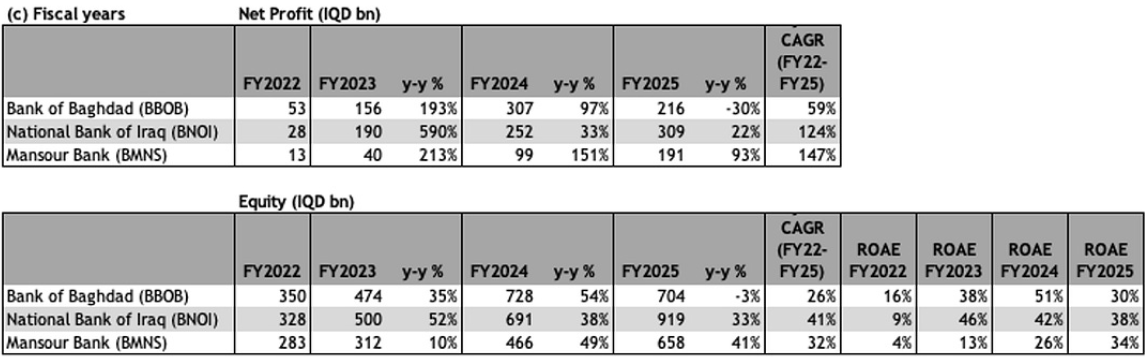 The immediate driver of the growth was fee and commission income from international transfers (most domestic consumption is satisfied by imports) that was a direct function of the fundamental developments in 2022 (as described multiple times in our newsletters and market reports). As wonderful as it was, that was unsustainable from the start, as I wrote often, but it was a catalyst that played a crucial part in moving the banks to a new normal that was taking shape in 2025. Interestingly, the equity of these banks would have been much larger were it not for the humongous dividends (cash and stock) they paid out. However, each bank followed a different path (set by each bank's management well before 2022), which can be very simplistically described as universal banking with a strong retail element as pursued by BNOI, corporate banking as followed by BMNS, and services with focus on fee income as pursued by BBOB; with the success of each strategy clear in 2025's numbers - in which the spectacular growth in fee and commission income slowed down significantly, partly a consequence of large numbers and increased competition squeezing margins.
This worsened in 2026, as seen in the first 3 quarters of 2026 (graph), by the combination of the disruptions brought on by the war on Iran, the loss of oil revenues from the closure of the Strait of Hormuz, and the changes to the customs system at the start of 2026.
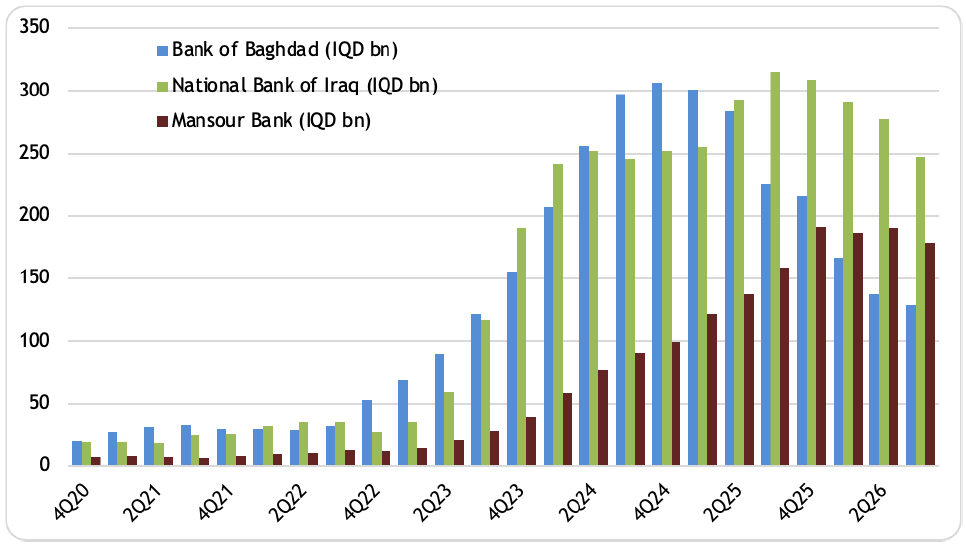
Trailing Twelve Months Earnings. (Sources: Banks' quarterly financial statements as disclosed to the Iraq Stock Exchange (ISX), compiled by Rabee Securities; author's calculations, data as of Q3/2026)
I continue to be very bullish on the three banks, as there is a lot more to the next stage of their growth than what the headline figures in the table above show, in particular the composition of their earnings and the trajectory of each component that to a different extent follows the contours of the banking investment thesis - as will be highlighted in an upcoming report/s on the sector that I am working on and will publish soon. However, I take the portfolio approach in choosing a favorite, in that the weighting choice of each reflects the nature of its earnings growth (composition, acceleration, de-acceleration ... etc) as well my view on how the market is reacting/discounting to these earnings - I believe, this is the value-add that I bring in understanding Iraq, its economy, the sector's evolution, and the companies in the sector.
Much of Iraq's perceived value is in oil, and Iraq's Prime Minister Al-Zaidi's July Washington visit produced commercial agreements that Baghdad valued at more than $60 billion, including an emphasis on opening foreign investment to Iraqi banks. How have these 2026 developments affected investment strategy for you and AFC's Iraq Fund?
Oil plays a huge role in Iraq; in the makeup of the state, the state's role in the economy and society, as well as society's relationship with the state. Thus, it's not surprising that the world perceives Iraq's value in oil. However, Iraq is much more than oil; it is a large country with a large, young population and natural resource wealth that extends beyond oil. Most recently, despite this conventional wisdom that sees Iraq primarily through the oil lens, a measure of the Iraqi equity market, the RSISX USD Index continued to make new all-time highs as oil prices were hitting five-year lows - at the end of 2025, Brent crude was down 15.3% for the year, while the RSISX USD Index was up 13.7%, and the AFC Iraq Fund was up 16.9%. Thus, emphasizing that the Iraq investment thesis is more than simply oil, that although it is a significant part of the story, nevertheless there are other factors at play too - in particular, the relative domestic stability and the secular transformation of Iraq's economy after decades of conflict.
Nevertheless, oil, or more accurately the interest in oil, holds a major bearing on foreign investor flows into Iraq, and thus on the AFC Iraq Fund, and your question on the Iraqi Prime Minister's (PM) visit to the United States, and the deals signed during that visit, is timely. Our PM received a warm reception in the White House, including an impromptu lunch. The U.S. President was the first foreign leader to congratulate the PM in person on his election win, two months earlier, and claimed credit for a key role in the PM's selection. The new PM is a successful young businessman whose business background and lack of political experience appealed to the President; as such, it's no wonder that the President cited the "tremendous chemistry" between the two during the visit.
The visit focused solely on business, which fits with a highly transactional U.S. administration, laying the foundation for successful outcomes. But before I answer your question on the major commercial agreements made during PM Al Zaidi's Washington visit, let me frame that in context.
Following the invasion of Iraq in 2003, all eyes, in particular, big oil's eyes, were on the country's known world-class oil fields, as well as its potential oil production profile - it was the first time for international oil companies (IOCs) to return since their expulsion in 1972 when Iraq nationalized its oil industry. During that time, most oil producing countries expanded production; but Iraq first held back by the eight-year Iran-Iraq, then by 12+ years sanction regime following the invasion of Kuwait, not only lagged but production declined and exploration ended. Crucially, its potential (reserves and production) was believed to be much larger than was known, as no major exploration had taken place since the 1970's. As such, big oil was back from 2009 onwards, after which in 2012 the International Energy Agency (IEA) produced a comprehensive review of the country's energy sector, in which it outlined a base scenario, seeing massive growth in production to 2035, in which Iraq would supply up to 45% of global production, needing energy investments of around $530 billion. These bullish projections turbocharged early foreign interest in investing in post-conflict Iraq, with the opening of the Iraq Stock Exchange (ISX) to foreigners in 2007; foreign interest peaked in early 2013 with the Asiacell IPO, which raised about $1.3bn. However, everything went sour following the fall of Mosul to ISIS in June 2014, in which oil production's growth was strong, but less than the IEA base scenario; while the ISX started a seven-year bear market, in which it declined 66.6% from monthly peak to bottom and foreigners largely exited the market. However, the double whammy of the ISIS conflict and the collapse in oil prices, largely brought about by the rise of the U.S.'s shale production, was not to blame. Many reasons can be cited, but largely the underlying causes were Iraq's own political and social dynamics, as well as the collapse of the country's institutional capacity to function after almost four decades of conflict. The commercial contracts signed during PM Zaidi's Washington visit, in which around 48 agreements were signed or agreed to in principle, of which the majority were oil deals with U.S.-based International Oil Companies, almost hark back to these heydays of international interest in Iraq following the U.S.'s invasion in 2003. Supporting these deals was JPMorgan's announcement that it would open an Iraq branch to finance these U.S. business projects.
The theme now encompasses much more than oil production; it builds on that to include developing a network of pipelines to export its oil that would first complement the Strait of Hormuz and, second, bypass it during potential future closures, ultimately becoming fully viable routes on their own merits. As such, Iraq's medium-term oil exports would need to grow substantially beyond the 3,400,000 barrels per day (bpd) it exported pre-Strait closure to ensure the network's economics are viable and sustainable; that would entail large oil flows. As such, the deals signed cover developing and meaningfully growing its oil production, as well as building the infrastructure to support the construction, services, and maintenance of these pipelines, including parallel transportation infrastructure that would accompany increased commercial activity. Iraq's geography, not its political economy, provides it with unique advantages in that it can access three major maritime routes, in addition to the existing route through the Strait of Hormuz, where each of the three routes goes through one country only - in other words, two routes to the Mediterranean Sea, one through Türkiye and the other through Syria, and one route to the Red Sea through Jordan. The silver lining of the current crisis with the closure of the Strait of Hormuz for Iraq (despite the fact that it, by October, managed to reach pre-closure exports) is that it created powerful incentives and a big need for integrating its economy with those of its neighbors, or at a minimum working closely together on multiple common projects, all of which would involve significant investments, but all of which will come with increased economic activities and opportunities for its and its neighbors' growing populations.
The question that comes to mind in making the case today is: why would it be different this time? After all, I am making the case that this time is not only replay of the past, but potentially much bigger - especially when so much can go wrong before and during the implementation phases of these deals, as history of the earlier interest post-2003 painfully shows. External factors can delay or, at worst, upend these projects, much as the ISIS invasion did then, and the Iran war (or is it no-war/no peace, that can become a war) could do now. But, as I said earlier, the underlying reasons for those failures were largely due to Iraq's own political and social dynamics. In particular, the collapse of the country's institutional capacity to function after almost four decades of conflict meant that many of the projects and plans then were, for the most part, pipe dreams at best. The country has developed significantly since then, not-evenly and not in a straight line, but it has - crucially its bureaucracy is functional today, or as I say during moments of exasperation with its functioning, is that this bureaucracy is "competently incompetent".
In fact, when I was working on the Iraqi telecom company IPO in 2013/14, I came across some frontier market funds that began investing in Iraq, as well as some dedicated Iraq funds. At the time, I fully agreed with the thrust of their Iraq investment thesis, yet I felt that the timelines were on the optimistic side, in that the investment thesis did not account for the time needed to repair the damage that the four decades of conflict had brought to its physical, institutional, and human capital. The timelines needed, after these four decades or so, were measured in decades not years - as witnessed by the development of the country's banking system, that is beginning to come to take place in the last few years (as I have written in our market letters) but this is happening almost two decades after major regional and international banks made massive investments in Iraq's banking system (either bought majority stakes in Iraqi banks or established branches in the country) attracted by the country's banking potential soon after the 2003 invasion - this potential is real, but only began to take shape in 2023-26.
I think that, in the changed world after the closure of the Strait of Hormuz and the massive disruptions to the economies of both energy-consuming and producing nations, the chances of success are high for the current crop of deals, particularly the pipeline agreements. Moreover, the increased direct engagement of foreign business, IOCs and supporting/complementary companies, should lead to foreign investor interest in Iraq - which over the last few years has largely exited, and which has shunned the market despite the three-year gangbuster rally - in which the ISX was up 224.5%, and the AFC Iraq Fund up 252.6% by the end of 2025. Should such an interest materialize, then it would have a massive effect on the market's volume and direction - the market lacked significant fresh inflows for a number of years.
What would have to change for Iraq to become a mainstream frontier market? What would you like the AFC Iraq Fund to look like in 10 years?
Iraq still has significant structural defects and challenges, whose resolution is years, if not decades, in the making. However, despite its significant shortcomings as both an economy and a market, it is not essentially different from many markets in the region. In my experience of the GCC from the early 2000's, or Egypt around 2010, these challenges and shortcomings are not essentially different from those in these markets (of course with differences in the political economy, societal makeup, nature of the economy ... and so on) - what I mean in essence is that once foreign investor interest takes place, then it's followed by rational analysis of the opportunities, obstacles, rewards and costs; which would be followed by risk-pricing and investor inflows based on that pricing. This brings me back to the pricing of the Iraq risk, as argued before, which is at the core of the AFC Iraq Fund investment thesis in arbitraging the delta between the real Iraq risk, high as it is, versus the perceived risk, which is much higher still. Thus, the risk-reward proposition of the AFC Iraq Fund argues that as this delta narrows, asset prices - priced at the perceived risk - should rise, reflecting the real risk, and thus the ongoing economic transformation. Crucially, this should come in two steps: the first is assessing/pricing assets at the real risk; then, once that is done/or being done, it would begin with the discounting of the country's ongoing economic transformation (first powered by catching up/rebuilding after years of conflict, then by the demographic bulge of a young, growing country).
What I would like to see, and will work towards, is for the AFC Iraq Fund to capture the returns of this opportunity, in which by the end of another 10-years, that dynamics of perceived and real risk are a thing of the past; and that the story is discounting the future trajectory of the economy, that is still strongly influenced by oil, but that the demographic bulge is driving an economy that has increasingly adopted banking, and subsequently the credit growth that comes with that, driving other sectors of the economy, almost an echo of the dynamics of the baby-boomer transformation of the US economy following World War II.
Ahmed, thank you for the great interview! What is the best way for readers to follow or connect with you?
Thank you for having me on! The best way for interested readers to reach out is to email me at [email protected] or [email protected] and view our website here.
________
Thank you for reading! Sunday's Idea Brunch is entirely reader-supported and we are grateful for your support. If you liked this interview, please consider hitting the heart button, tweeting it out, or forwarding it to a friend and encouraging them to subscribe.
This newsletter is not investment advice and is for informational purposes only. You can reach the publisher by email at [email protected] or on Twitter @StockJabber. This article is for premium subscribers of Sunday's Idea Brunch newsletter. If this article was forwarded to you, please consider becoming a premium subscriber to receive interviews like this twice a month. Learn more here.



No comments yet.