


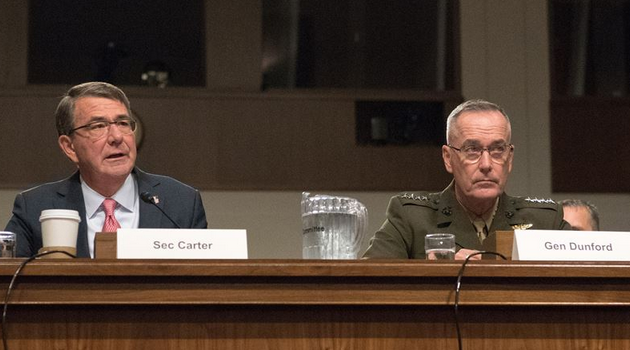
There are abundant challenges. On the nation-state side, Dunford said, Russia, China, Iran and North Korea continue to invest in military capabilities that reduce America’s military advantage. “They are also advancing their interests through adversarial competition that has a military dimension that falls short of armed conflict,” he said. “Examples include, Russian actions in Ukraine, North Korea’s nuclear saber rattling, Chinese activities in the South China Sea and Iran’s malign activities across the Middle East.”
No Direct Confrontation
Each of these nations stays away from direct confrontation with the United States, Dunford said. Instead, he added, they use economic coercion, information operations, cyber capabilities, unconventional warfare and force posture, as semi-military strategies.
“Meanwhile, non-state actors such as ISIL and al-Qaida remain a threat to our homeland, the American people, our partners and our allies,” the chairman said.
The joint force, Dunford said, “is engaged and responding to each of these strategic challenges,” the chairman said. “We’re focused on deterring potential adversaries and we’re prepared to respond should deterrence fail. We also remain firmly committed to defeating ISIL and its affiliates wherever they may emerge.”
And the joint force needs to be ready to engage any challenges moving forward, the chairman said.
“As the secretary said, we don’t have the luxury of choosing between the challenges that we face today, or the challenges that we most assuredly will face tomorrow,” Dunford said. “To meet tomorrow's requirements, we must take action today.”
Dunford said the U.S. nuclear enterprise is aging and needs modernization. “At the same time, we must develop and enhance the capabilities in the increasingly contested domains of space and cyber,” he said. “And we must also do all that while we preserve the edge in our conventional capabilities.”
(Source: US Dept of Defense)
Comments are closed.