


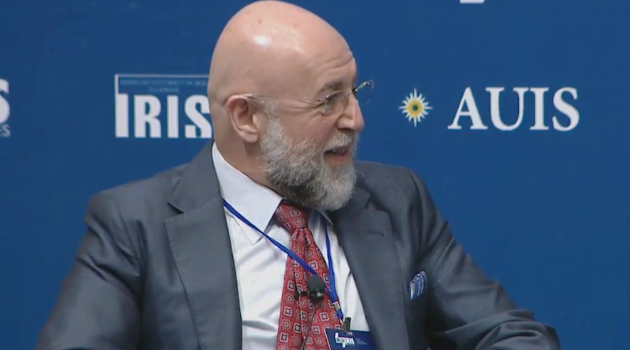
By Ahmed Tabaqchali, Chief Strategist of AFC Iraq Fund. Any opinions expressed are those of the author, and do not necessarily reflect the views of Iraq Business News.
Buy the Rumour, Sell the News; yet the Market Rises Further
The market, as measured by the Rabee Securities U.S. Dollar Equity Index (RSISX USD Index), closed the month up 5.7%, an all-time monthly closing high, and is up 8.9% for the year.
The draft announcement of the Islamabad Memorandum of Understanding between the U.S. and Iran, aimed at ending the US-Israel war on Iran, acted as a catalyst for the market to rise further - its initial 0.9% monthly increase accelerated to 7.8% following the draft's announcement, before profit-taking pared it down to an increase of 5.7%.
While, on the surface, such an increase on good news would be expected given the dangers that the war and the closure of the Strait of Hormuz posed to Iraq, yet unlike many other markets, it was discounting a near-term end to the war in the immediate aftermath of the war's start, and in the months since then. As such, the end of hostilities, if not the war, should have led to a sell-off, or at least a pullback to the lower end of its three-year uptrend (chart below) - in line with the market dynamic of "Buy the rumour, sell the news", as the good news should have been priced in.
This was not the first time for such a seemingly bewildering market behaviour for the Iraqi equity market, as its current behaviour is similar to that following the attack of 7th October 2023, and the subsequent war on Gaza. In both cases, the market continued to go higher despite the escalation of hostilities - in the first case it was during the series of Israeli and Iranian attacks and counterattacks, while in the second it was during the intensification phase of the current war. Crucially, Iraq is not insulated from the potential negative effects of the war, as it's almost in the eye of the storm, from both geographic and economic perspectives.
As such, the obvious question is: what gives? The logical answer, as asserted here in the past, most recently in "What Next After a Gangbuster Three-Year Rally ?", is that the market in looking through these conflicts, is discounting the economy's significant structural transformation, following the decades of conflict, driven by two key dynamics - the cumulative positive effects of the country's relative stability and the acceleration of banking adoption, that are in the early stages of their transformation of the economy.
Moreover, Iraq's extensive history of over four decades of conflict has made it, and by extension its people and businesses, "anti-fragile" - as can be witnessed by anyone who visited the country in the last few years, or in the strong earnings growth of some of the top companies listed on the Iraq Stock Exchange (ISX) as expressed in the humongous dividends paid-out by these companies.
The market's action, from a technical analysis perspective, continues to be that of consolidating its three-year gains, and that a continued consolidation or a pullback should be within its multi-month uptrend (chart below).
Rabee Securities U.S. Dollar Equity Index and Daily Turnover
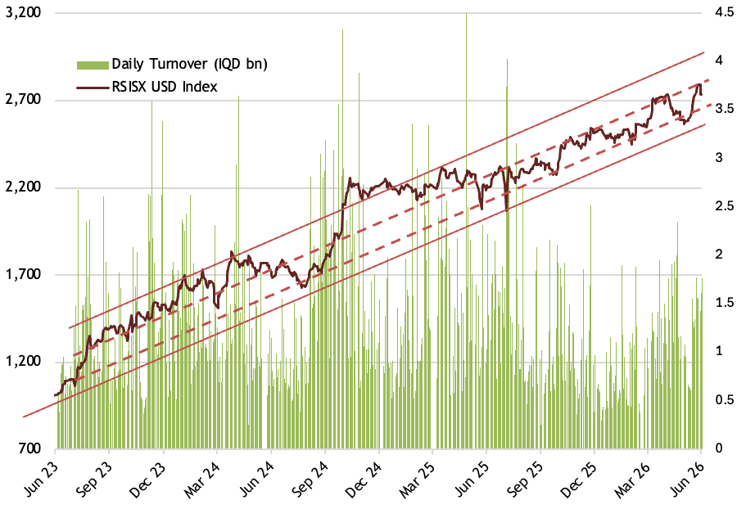
(Source: Iraq Stock Exchange, Rabee Securities, AFC Research, daily data as of June 30th.
Note: daily turnover adjusted for block trades)
While being fully cognizant of the effects of the geopolitical risks on Iraq's economy, the argument made in the outlook for 2026, is still valid, in that both of the two key dynamics, discussed here are in the early stages of their transformation of the economy, a process that should continue to unfold over the next few years. However, considerable risks remain, in that the current pause in the U.S.-Israel war on Iran, following the signing of the Islamabad memorandum, would collapse reigniting a conflict that could escalate considerably beyond the control of participants, direct and indirect, and become an all-out war engulfing the region, filled with all the nightmare scenarios that popped up a few months ago in the media, by experts and "experts".
Please click here to download Ahmed Tabaqchali's full report in pdf format.
Mr Tabaqchali (@AMTabaqchali) is the Chief Strategist of the AFC Iraq Fund, and is an experienced capital markets professional with over 25 years' experience in US and MENA markets. He is a board member of Arab Bank Iraq, a Visiting Fellow at the LSE Middle East Centre, Senior Fellow at the Institute of Regional and International Studies (IRIS), and a Senior Non-resident Fellow at the Atlantic Council.
His comments, opinions and analyses are personal views and are intended to be for informational purposes and general interest only and should not be construed as individual investment advice or a recommendation or solicitation to buy, sell or hold any fund or security or to adopt any investment strategy. It does not constitute legal or tax or investment advice. The information provided in this material is compiled from sources that are believed to be reliable, but no guarantee is made of its correctness, is rendered as at publication date and may change without notice and it is not intended as a complete analysis of every material fact regarding Iraq, the region, market or investment.


Comments are closed.