


By Ahmed Tabaqchali, Chief Strategist of AFC Iraq Fund.
Any opinions expressed are those of the author, and do not necessarily reflect the views of Iraq Business News.
Market at an All-time High, Oil Prices Crashing, What Gives?
The market, as measured by the Rabee Securities U. S. Dollar Equity Index (RSISX USD Index), closed at an all-time high for the month, with a 3.0% increase, and is up 3.3% for the year. The market was closed in the first week of the month in observance of the Eid holidays, and so it missed out on the global market mayhem in response to the unveiling of the U.S.'s "reciprocal" tariffs on its trading partners.
Once trading resumed, it, to some extent, joined its global peers in being down 1.0% for two days until the announcement of the 90-day suspension of tariffs, after which it ticked upwards to close at an all-time monthly high -although the all-time daily high was mid-month (chart below).
The market's technical picture continues to be positive, and the consolidation of the last few weeks is likely to continue for some time, given the uncertainty over the direction of the world's economy from the evolving U.S. sanctions -a great deal of uncertainty remains, in which the positives of the 90-day tariff suspension, might be replaced by a U.S.-China trade war, or the 90 days will lapse before enough "beautiful" deals are agreed on.
Rabee Securities U.S. Dollar Equity Index and Daily Turnover
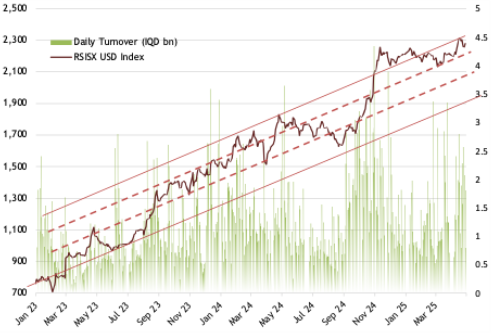 (Source: Iraq Stock Exchange, Rabee Securities, AFC Research, daily data as of April 30th.
Note: daily turnover adjusted for block trades1)
The market's action in closing at an all-time-high, stands in sharp contrast to those of other global markets, which have recouped their "liberation day" losses, yet remain down year to date. Moreover, it is remarkable considering the potential negative effects from Iraq's leverage to global oil demand. As argued in "Tariffs, Oil Prices, and the Budget", irrespective of the evolving U.S. tariff policy, their direct impact on Iraq is almost zero, as oil constitutes almost all of its exports to the U.S., which are exempt from reciprocal tariffs, but, the impact will be indirect and felt through a lower Iraqi oil price as a consequence of expected lower global demand for oil.
On the one hand, this negative is aggravated by increased supply in the form of OPEC+'s aggressive unwinding of its prior production cuts for May and June, that probably will be repeated for the next few months as well. On the other hand, the positives are the U.S.'s increasing tough line against Iranian oil (crude, and products) exports to China, which would more than offset OPEC+'s increased production, should they be fully implemented, so is the potential decline of high-cost U.S. shale production, as well as the low levels of global oil stocks.
However, there is a great deal of uncertainty over how these factors will play out as well as on the direction of the global economy, with the result that oil markets are in unchartered territory, and so oil prices continue to head lower, with Brent crude trading at four-year lows. Mirroring these concerns, the IMF, as part of lowering its global growth forecasts for 2025-26 in response to the U.S.'s tariffs, lowered those for oil exporters even more reflecting the added effects of lower oil prices, with its forecasts for Iraq lowered more than those of its peers among oil exporters (table below).
IMF's Iraq's growth forecasts for 2025-26 versus growth figures for 2023-24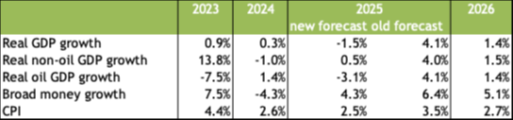 (Source: IMF May 2025 Regional Economic Outlook for the Middle East and Central Asia; old forecast refers to IMF's October 2024 forecast, while new forecast is that of May 2025)
The obvious question is: what gives? Especially considering that investors on the Iraq Stock Exchange (ISX), whether locals or the handful of foreigners, are fully aware of the effects of lower prices on Iraq, and should have reacted negatively without waiting for the oil market's weird dynamics or for the IMF's forecast downgrade. The logical answer, as asserted here in the past, most recently in "What Next After Two Gangbuster Years?", is that Iraq's economy is undergoing a significant structural transformation, following the country's decades of conflict, driven by two key dynamics -the cumulative positive effects of the country's relative stability and the acceleration of banking adoption instead of cash and informality that dominated the economy, that are in the early stages of their transformation of the economy.
One such manifestation of the increased adoption of banking, last discussed under a year ago in "An Unfolding Structural Economic Transformation", is the significant growth, year-over-year and month-over-month, in the monthly values of Iraqi Dinar (IQD) transactions through cards (prepaid, debit, and credit) and e-wallets (chart below). These are at the early stages of the transition to the use of the banking system in the payments for transactions, and while from a small base, the trends are clear and mirror, with a time lag, those that took place elsewhere in emerging and frontier economies. It is this increased adoption of banking, that stands out as a positive in the IMF's updated forecasts, as seen through the figures for broad money growth (table above). While they were lowered from 6.4% to 4.3%, they still show solid growth as a reflection of the increased adoption of banking and the role that banks play in the expansion of the money supply.
Card and E-wallet Monthly IQD Transactions
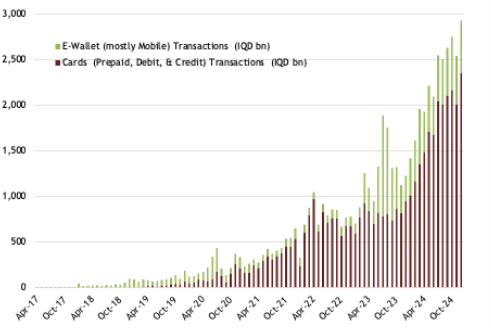 (Source: CBI, AFC Research, data as of the end of December 2024)
Finally, the market's positive performance, despite such negatives, should be seen in the context of a market that last peaked in January 2014, followed by a brutal seven-year bear market in which the RSISX USD Index was down 25.4% in 2014, 22.7% in 2015, 17.4% in 2016%, 11.8% in 2017, 15.0% in 2018, 1.3% in 2019, and 5.4% in 2020 -for a cumulative decline of 66.6%; and only surpassed the 2014 peak over a decade later in October 2024.
Nevertheless, the negative effects of lower oil prices on the economy will become a negative headwind, reversing the positive tailwind of the past two years. Yet, the secular positives of the economic transformation should overcome the drag from the cyclical negatives and thus continue to drive the market's direction.
The equity market, as measured by the Rabee Securities U. S. Dollar Equity Index (RSISX USD Index), having surpassed its 2014 peak by 10.3% by the end of April, has the potential to rally further reflecting the powerful dynamics discussed here over the last few months. However, risks remain given Iraq's recent history of conflict, extreme leverage to volatile oil prices, especially in the current uncertain global environment, as well as the risk that a widening of the current Middle East conflict will not be contained and evolve to destabilise the region.
Notes:
- Daily market turnover is first adjusted by removing block, pre-arranged trades conducted during the special session following the regular trading session; subsequently, it is adjusted further by removing high-volume trades during regular market hours that show a pattern consistent with those of pre-arranged trades. High-volume trades are defined as those that are significantly higher than a given stock's average daily turnover; and as such are subjective. Moreover, trading volumes, and trading turnovers are used interchangeably here, and defined as the values of trading turnovers in Iraqi dinars (IQD)
Please click here to download Ahmed Tabaqchali's full report in pdf format.
Mr Tabaqchali (@AMTabaqchali) is the Chief Strategist of the AFC Iraq Fund, and is an experienced capital markets professional with over 25 years' experience in US and MENA markets. He is a Visiting Fellow at the LSE Middle East Centre, Senior Fellow at the Institute of Regional and International Studies (IRIS), and a Senior Non-resident Fellow at the Atlantic Council.
His comments, opinions and analyses are personal views and are intended to be for informational purposes and general interest only and should not be construed as individual investment advice or a recommendation or solicitation to buy, sell or hold any fund or security or to adopt any investment strategy. It does not constitute legal or tax or investment advice. The information provided in this material is compiled from sources that are believed to be reliable, but no guarantee is made of its correctness, is rendered as at publication date and may change without notice and it is not intended as a complete analysis of every material fact regarding Iraq, the region, market or investment.
Comments are closed.