


DNO Stock Surges on RAK Petroleum Bid Talk
Posted on 15 July 2010 .
Iraqi oil producer DNO International ASA (DNO.OL) leapt to a 14-month high on Wednesday, following reports that Emirates-based RAK Petroleum may bid for the 70 percent in the Norwegian company it does not already own.
DNO was the first Western company to drill for oil in Iraq following the U.S.-led invasion and although it cannot export due to Iraqi disagreements over how to divide up revenues, it has repeatedly been the subject of takeover talk.
Britain's Daily Telegraph newspaper reported that RAK Petroleum had made an offer to buy DNO shares at 11 crowns per share, citing what it called 'well-placed market sources'.
Trade in DNO shares was suspended after they jumped 7.3 percent to 8.945 crowns. After the resumption, they touched 9.39 crowns -- up 12.7 percent on the day and the highest level since May 2009 -- before dipping to 8.8 crowns by 1500 GMT.
"I will not comment on rumours and speculation," DNO Chief Executive Helge Eide told Reuters in a brief telephone interview.
RAK Petroleum was not available for comment.
The Daily Telegraph said there could be a counter-offer from other companies. DNO's main asset is the Tawke oilfield in Kurdish northern Iraq, a reservoir estimated to hold 220 million barrels of oil.
CHATTER OR INTEREST?
"The chatter doing the rounds is that there is a potential counter bidder from the U.S.," said the UK paper. "Goldman Sachs is said to be advising the mystery suitor, while Enskilda bank is working for DNO International."
Goldman Sachs and SEB Enskilda representatives declined to comment, according to Reuters.
Some analysts questioned the reported bid price at 11 crowns per share, a valuation which priced in more cash flow from Iraqi activities than other foreign oil firms were due to receive.
A takeover attempt by RAK would not be a surprise, however, given increasing interest by the Ras Al Khaimah-registered company in running Oslo-based DNO.
In June, RAK -- the biggest single shareholder in DNO with a 30 percent stake -- gained two seats on DNO's five-strong board, including one for former U.S. ambassador to Iraq and Afghanistan, Zalmay Khalilizad.
Shares in RAK Petroleum are "closely held by public entities and individuals in the United Arab Emirates and Saudi Arabia," the company said on its website. Its business is to "to build an upstream business focused geographically in the Middle East and North Africa through both drilling and strategic acquisitions."
Data from Reuters Trader showed JP Morgan as the buyer of nearly 43 percent of the volume of DNO shares traded on Tuesday.
Nornet, a Nordic online trader for retail investors, was second with over 14 percent of the volume. The biggest sellers were Nomura with 35 percent and UBS at 23 percent.
(Sources: Daily Telegraph, Reuters)
Posted in Iraq Oil & Gas News Comments Off on DNO Stock Surges on RAK Petroleum Bid Talk

Iraq Oil Revenues 95% of State Income
Posted on 15 July 2010 .
Revenues from oil sales account for 95 percent of Iraq's income, Oil Minister Hussein al-Shahristani said on Tuesday, underlining the war-battered nation's reliance on crude to rebuild its economy.
Shahristani said Iraq raised 171 billion dollars from sales between 2006-2009, which accounted for all but five percent of the government's income during those years.
Shahristani said the following amounts were raised from oil:
- $30bn in 2006;
- $40bn in 2007;
- $60bn in 2008; and,
- $41bn in 2009.
The decline in revenues in 2009 was likely attributed to a fall in global crude prices in the second half of the year.
Iraq produces about 2.5 million barrels per day (bpd) of crude, of which it exports 1.85 million, according to Shahristani.
Last year, Iraq held two auctions of its oil fields for development, the first time foreign energy firms have had the opportunity to plant a foot firmly in the country since its energy sector was nationalised in 1972.
Some 10 deals were agreed at the auctions, and one more signed since will, if fully realised, ramp up Iraq's oil output five-fold to 12 million bpd, putting it on a par with the world's top producer Saudi Arabia.
At 115 billion barrels, Iraq has the world's third-largest proven oil reserves, behind only Saudi Arabia and Iran.
However, there has been little exploration or development of fields in the past three decades because of wars and a UN embargo imposed on Iraq in 1990 following now executed dictator Saddam Hussein's invasion of Kuwait.
(Source: AFP)
Posted in Iraq Oil & Gas News Comments Off on Iraq Oil Revenues 95% of State Income
First Flight from Jeddah to Baghdad
Posted on 15 July 2010 .
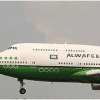
After more than 20 years, Saudi Arabia will restore aviation links with Iraq - the first flight from Jeddah to Baghdad will be by the Kingdom's privately owned Alwafeer Air on Thursday.
Alwafeer Air will initially operate a weekly flight from Jeddah to Baghdad and two flights a week from Jeddah to Basra, said Saleh A. Bogary, the airline's marketing director.
Bogary said Alwafeer had been contracted by Saudi Arabian Airlines to operate flights to Iraq following an agreement endorsed by Saudi and Iraqi aviation authorities. "The first flight carrying some 450 passengers will leave King Abdulaziz International Airport (KAIA) on July 15," he said.
"In fact, a test flight landed at Baghdad airport on Sunday ahead of the resumption of full-fledged commercial operations," said Bogary.
Flights between the two countries stopped after Saddam Hussein's invasion of Kuwait in 1990, which sparked the first Gulf War. The attack soured relations and led to the indefinite suspension of air links. Even after Saddam's ouster in 2004, relations remained frosty. The only flights that come to the Kingdom from Iraq at present carry pilgrims for the annual Haj.
Bogary said Alwafeer would have enough passenger load as it would fly Iraqi pilgrims as well as regular passengers.
The first flight to Basra would leave Jeddah on July 25. The airline will operate a Boeing 747, which can carry up to 450 passengers.
"Plans are also afoot to operate a flight to Sulaymaniyah, a governorate of Iraq, in the Kurdistan region," said Bogary.
(Source: Arab News)
Posted in Iraq Transportation News Comments Off on First Flight from Jeddah to Baghdad
Iraq Kurds Say to Crack Down on Fuel Smuggling
Posted on 13 July 2010 .
Iraq's northern Kurdish region is cracking down on fuel oil smuggling through the area and across Iraq's borders, the government of the semi-autonomous region said on Sunday.
The Kurdish Regional Government (KRG) issued a statement in response to a New York Times story on Friday that said hundreds of millions of dollars worth of crude and refined products were smuggled through the mountains of Iraqi Kurdistan every year.
The sales were blunting the impact of U.S. sanctions on fuel sales passed into law earlier this month that aim to curb supplies to the Islamic Republic, the NYT reported.
The KRG said that the only crude exported from the Kurdish region flowed through the official route, Iraq's northern pipeline to the Turkish Mediterranean terminal of Ceyhan.
Still, smugglers had shipped fuel oil refined outside the Kurdish region over the Kurdish region's borders, according to the statement. Subsidised fuel oil sales elsewhere in Iraq, while designed to support the economy, had created an opportunity for profiteering, the KRG said.
"The KRG is committed to working with the Federal Government to eliminate permanently all such profiteering in fuel oil, not only in the KRG but also along the entirety of Iraq's international borders," the statement said.
Among the measures would be mandatory licensing of all fuel oil tankers entering the Kurdish region, the statement said.
Iraqi Oil Minister Hussain al-Shahristani said only the central government, through the State Oil Marketing Organisation (SOMO), had the right to export Iraqi crude.
"Any other arrangements to export oil to any country is smuggling," Shahristani told reporters at an investment conference in Baghdad. "It's forbidden by Iraqi laws and we will be taking action if we are made aware of it."
Subsidies throughout the region have created opportunities for smuggling, and sources in top oil exporter Saudi Arabia said on Sunday that it was investigating the export of products intended for domestic use.
Posted in Iraq Oil & Gas News Comments Off on Iraq Kurds Say to Crack Down on Fuel Smuggling
259 Foreign Firms in Erbil Construction Fair
Posted on 13 July 2010 .
The Second Fair for Municipalities, Constructions, and Ceramics was opened on Monday, 12th July, in Erbil city.
“The fair will last for one week,” a source from the fair told Aswat al-Iraq news agency on Sunday.
He noted that 259 foreign firms from 10 countries are participating in the fair.
AK News reports that Iran, Turkey, Syria, UAE, Saudi Arabia, France, Jordon, Germany, Bulgaria, Romania and Iraq will all be represented.
The event was organised by Pyramids Company in partnership with the Kurdistan Regional Government (KRG).
(Sources: Aswat al-Iraq, AK News)
Posted in Construction & Engineering In Iraq Comments Off on 259 Foreign Firms in Erbil Construction Fair

Platts Survey: OPEC Pumps 29.12m bpd in June
Posted on 11 July 2010 .
The 12-member Organization of the Petroleum Exporting Countries' (OPEC) crude oil production output averaged 29.12 million barrels per day (b/d) in June, down 160,000 b/d from an estimated 29.28 million b/d in May, according to a just-released Platts survey of OPEC and oil industry officials and analysts.
Lower volumes from Iraq and Nigeria accounted for 110,000 b/d of the 160,000 b/d overall drop.
Excluding Iraq, which does not participate in OPEC output agreements, the 11 members bound by quotas (OPEC-11) pumped 26.74 million b/d in June, down 90,000 b/d from May's 26.83 million b/d, the survey showed.
But despite the lower volumes in June, the OPEC-11 overproduced their 24.845 million b/d target by 1.895 million b/d. The latest estimates suggest that compliance with the 4.2 million b/d of output cuts agreed in late 2008 increased to around 57.3% in June from 52.7% in May but remained well below the almost 82% achieved in March 2009.
"This is the Goldilocks market for now, not too hot, not too cold," said John Kingston, Platts global director of news. "Yes, OPEC is producing more than the International Energy Agency's call for OPEC crude for full-2010, but that's to be expected in the second quarter, when markets traditionally build inventories. Stocks are healthy from a consumer's perspective, but not so bulging that it is causing market anomalies. This stability is reflected in the narrow range prices have traded in for several weeks now."
Saudi Arabia and Kuwait boosted output, by 20,000 b/d and 10,000 b/d respectively, to produce 8.27 million b/d and 2.3 million b/d.
Elsewhere, volumes dropped by between 10,000 b/d and 70,000 b/d.
Iraqi output fell by 70,000 b/d to 2.38 million b/d in June from 2.45 million b/d in May as a result of weather-related export loading delays and a bomb attack on the northern pipeline network.
Nigerian volumes fell back to 2.01 million b/d from 2.05 million b/d, a drop of 40,000 b/d.
For other oil, energy and related information, visit Platts online at www.platts.com.
Posted in Iraq Oil & Gas News Comments Off on Platts Survey: OPEC Pumps 29.12m bpd in June
Is Iraq an economic battleground?
Posted on 28 June 2010 .
Before launching his war to topple Saddam Hussein's regime, George Bush, the former US president, promised a strong independent Iraq. Instead the country has become a bloody battleground for regional and international forces, not to mention al-Qaeda. Today US, Israeli, Turkish, Saudi Arabian and Syrian forces compete to shape Iraq's political landscape.
Sometimes this competition is fought with brute force and sometimes by proxy through Iraqi political parties and armed groups. The prize is Iraq's geopolitical value as a lynchpin of Gulf stability and its huge oil reserves.
While on the economic front, US companies have all but surrendered their quest to monopolize Iraq's oil; Chinese companies have signed at least three deals in recent weeks, and have emerged as Iraq's single largest investor in the oil and gas sector. Concerned Iraqi nationalists condemn this interference but predict that Iraqi nationalism will eventually sweep away all this meddling.
A spokesman from A.A.I.B. Insurance Brokers, a company specialising in Iraq observes; perhaps we should remember the words of Deng Xiaoping the Chinese politician who led the country to towards a market economy during the 80-‘s and early 90’s with his "socialist market economy" model. He is generally credited with advancing China into becoming one of the fastest growing economies in the world for over thirty years and vastly raising the standard of living of hundreds of millions of Chinese. He once said “I don't care if it's a white cat or a black cat. It's a good cat so long as it catches mice."
So in the case of Iraq, it’s not important what colour the cat is - which companies develop the oil and gas sector. What is important is that extra employment is created, oil exports are boosted, and substantial funds flow into the coffers of the Iraqi Finance Ministry.
The people need to see that the oil and gas sector is refurbished and developed quickly, safely and efficiently.

Autralians in talks over $700m Off Shore contract
Posted on 16 June 2010 .
Dubai-based construction firm Al Habtoor Leighton Group is in discussions over a $700 million offshore project in Iraq as it seeks more business outside the difficult UAE market, its CEO said on Tuesday.
Al Habtoor, an affiliate of Australia's Leighton Holding, is also eyeing a new infrastructure contract in Saudi Arabia and two in Oman by year-end, the firm's chief executive and managing director Laurie Voyer told Reuters.
"The company is very keen to take on more business outside the UAE," Voyer said at the Reuters Global Real Estate and Infrastructure Summit in Dubai.
Al Habtoor has said it hopes to generate about 50 per cent of its revenues by early 2012 from the UAE, down from around 80 per cent currently.
He said the firm would also look to slow its expansion plans into Libya in order to establish itself in other Gulf Arab countries.
Al Habtoor is in discussions over an offshore pipeline and SPM (single point mooring) project in Iraq in what would be its first contract there, and hopes to hear whether it is successful by the end of July, Voyer said.
"We're putting together a business case at the moment and (getting) a better understanding what it might take to move into Iraq," he said.
Construction firms have been rapidly expanding operations outside the UAE, where house prices in Dubai, the emirate hardest hit by the financial crisis, plunged some 60 percent from their peaks in 2008, and billions of dollars worth of projects were put on hold or cancelled.
Saudi Arabia
Al Habtoor is eyeing a second contract in Saudi Arabia by year-end and hopes to have its own trading license in the kingdom in September, which Voyer said would help the firm win more business there.
"All of the metrics that you look at say there is a lot of work out there, but 85 per cent of the work is given to local companies. It's very difficult for a company like us to get the other 15 per cent," he said.
It won its first contract in Saudi Arabia last year in a joint venture with Saudi Arabian building firm Al Rajhi Projects.
Al Habtoor's total order book is expected to rise to around Dh30 billion ($8.17 billion) over the coming year from around Dh22 billion.
Its projects include the $1.8 billion St Regis Hotel and the $1.4 billion Khalifa Port projects in Abu Dhabi.
Posted in Iraq Banking & Finance News 1 Comment

Higher Oil Prices Boost Iraqi Budget
Posted on 14 June 2010 .
Iraq expects to cover a projected budget deficit of about $18 billion this year by selling oil at higher-than-expected prices, Finance Minister Baqir Jabr al- Zubaidi said.
“We will cover the budget with the difference in oil prices,” Zubaidi said in an interview today in Istanbul, where he’s attending an Arab-Turkish forum. The Iraqi budget is based on oil prices at $62.5 per barrel, and in agreements already made “we sold at $74,” he said.
The government also plans to sell domestic bonds valued at about $4 billion this year, al-Zubaidi said. About $2.4 billion of those bonds have already been sold. The minister said Iraq doesn’t plan to sell on international markets.
Iraq holds the world’s third-largest oil reserves, with 115 billion barrels, behind Saudi Arabia and Iran. The International Monetary Fund forecasts that its economy will expand 7.3 percent this year and 7.9 percent in 2011.
IMF and Iraqi authorities are projecting average production of 2.6 million barrels of oil a day and exports of 2.1 million barrels a day this year. Next year, those projections rise to 2.9 million and 2.3 million.
Al-Zubaidi said the government expects the economy to expand about 10 percent next year and is targeting a growth rate of 12 percent in 2012 and 14 percent the following year.
He said the budget may expand from about $70 billion this year to $100 billion by 2013 and $150 billion within seven years, driven by revenue from oil bids.
The Iraqi central bank cut its key interest rate by 1 percentage point to 6 percent in April to fuel growth.
Posted in Iraq Banking & Finance News Comments Off on Higher Oil Prices Boost Iraqi Budget
French Navy Makes First Call in 32 Years
Posted on 09 June 2010 .
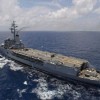
A French navy ship with 95 sailors on board docked Tuesday at the southern Iraqi port of Umm Qasr, in the first such visit in 32 years amid French efforts to "revive" ties with Baghdad.
The two-day stop by the Ducuing, a military dispatch ship, began with a reception organised by the Iraqi navy, who offered their French counterparts Qouzi, a traditional Iraqi dish made of freshly-slaughtered sheep and rice.
"The purpose of this visit is to revive and rebuild the friendly relations of old between the French and Iraqi armed forces," Ducuing commander Captain Jean-Olivier Grall told AFP.
"The French army and navy are ready to cooperate with the Iraqi navy. This can occur in several areas as part of training and regional cooperation," he added.
The ship and its 95 sailors arrived in Umm Qasr, at the southernmost tip of Iraq and where the Iraqi navy has deployed extensive security measures in a bid to prevent possible attacks, from the Saudi Red Sea port of Jeddah.
"We are honored to resume this tradition, we are the first in 32 years to dock here," Grall said. "We are rediscovering a place that has been somewhat overlooked."
His counterpart Rear-Admiral Adel Hassoun also hailed the occasion.
"We are very pleased with this visit," he said. "It is all part of developing relations between the French and Iraqi navies."
"In the future, we hope to develop strategic relations with the French navy, which is a very experienced force."
( AFP )
Posted in Iraq Industry & Trade News Comments Off on French Navy Makes First Call in 32 Years