


Joint Statement by US and Iraq Higher Coordinating Committee
Posted on 30 November 2011 .
The United States of America and the Republic of Iraq are committed to forging a strong partnership based on mutual interests that will continue to grow for years to come. Our two nations are entering a new phase in our relationship. We have a historic opportunity to strengthen our ties beyond security and build a multi-faceted relationship through trade, education, culture, law enforcement, environment, energy, and other important areas.
Three years ago, our nations signed the Strategic Framework Agreement (SFA), affirming both sides’ desire to establish long-term bonds of cooperation and friendship. The SFA is a lasting agreement, and one that serves as the foundation on which we are building a durable and mutually beneficial relationship. Today, we gather again in Baghdad to reaffirm our commitment to this important partnership and to the principles of cooperation, sovereignty, and mutual respect articulated in the SFA.
Vice President Joe Biden and Prime Minister Nuri al-Maliki convened the SFA’s Higher Coordinating Committee on November 30. Together, they affirmed the significant accomplishments under the SFA thus far and charted a course for further joint efforts.
Cultural and Education Cooperation
The Republic of Iraq seeks the cooperation of the United States in its efforts to build a stronger higher education system, expanding English language programs, and preserving Iraq’s rich cultural heritage, especially through assistance in conserving archeological sites such as the Babylon historical site, which the United States has helped preserve, and through support to the Iraqi Institute for Conservation of Antiquities and Heritage.
Posted in 'Your Country' - United States, Iraq Industry & Trade News, Politics, Security Comments Off on Joint Statement by US and Iraq Higher Coordinating Committee

Shell Signs $17bn Iraqi Gas Deal
Posted on 28 November 2011 .
Shell, Mitsubishi and the Iraqi government have finally signed the $17.2 billion deal on Sunday to capture flared gas at Iraq's southern oilfields.
The 25-year project is intended to boost production of badly needed electricity and reduce the environmental damage caused by flaring, as well as opening up the possibility of gas exports.
It will harness more than 700 million cubic feet per day of gas from the oilfields of Rumaila, Zubair and West Qurna, increasing eventually to 2 billion cubic feet per day.
The goal of 2 billion cubic feet per day capacity is linked to peak production at the southern fields, which is expected by 2017, Deputy Oil Minister Ahmed al-Shamma told Reuters.
"This day represents a historic change in the Iraqi oil industry ... the best utilisation of (associated) gas to meet the increasing needs for gas in Iraq," Luaibi said at a signing ceremony attended by Shell Chief Executive Peter Voser.
The Shell deal will involve the creation of the Basra Gas Company joint venture, in which the government will hold 51 percent, Shell 44 percent and Mitsubishi 5 percent.
Existing facilities are currently handling 370 million cubic feet of gas per day from seven southern fields.
The project may include the construction of an LNG export facility with a maximum capacity of 600 million cubic feet per day. Exports are possible once Iraq's domestic needs are met.
Officials say the project requires investment of $17.2 billion -- $12.8 billion to rehabilitate existing facilities and build new ones, and $4.4 billion for the LNG export unit.
The Shell-Mitsubishi partnership expects an internal rate of return on the project of 15 percent on an initial investment of $6.98 billion, while SGC plans to put in $3.7 billion of public funds initially and fund the rest through gas sales.
(Sources: Reuters, Wall Street Journal)
Posted in Construction & Engineering In Iraq, Iraq Oil & Gas News, Iraq Public Works News Comments Off on Shell Signs $17bn Iraqi Gas Deal
Kurdistan Investment Board to Devolve Powers to Provinces
Posted on 28 November 2011 .
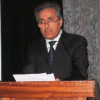
The Chairman of Kurdistan's Investment Board said that the board will adopt a more strategic approach and devolve investment licensing powers to its three provincial directorates.
Minister Herish Muharam, speaking at the 'Iraq: Untapped Opportunities' conference in London, said, "To increase the efficiency of our Investment Board, we are delegating more of our operations to the provincial level, so that we can focus on our vision, and on the strategies that we need to achieve our vision."
At the conference, Minister Muharam outlined five key sectors for investment - industry, agriculture, banking, tourism and health - and invited British companies to participate in Kurdistan's vision.
He added "We used leading international consultants to help us develop strategies for electricity, water and road transport. We hope that foreign companies will help us to implement these strategies. In the Kurdistan Region (we) are no longer looking for the cheapest suppliers and trading partners. There is a growing recognition that quality represents value for money."
Lord Howell of Guildford, Minister of State at the Foreign and Commonwealth Office, also addressed the Middle East Association's (MEA) 'Iraq Untapped Opportunities' conference. He said, "With the Arab Spring we see the desire for reform and democracy. In Iraq, the people have chosen democracy. In the national election in 2009, voter turnout was 64% which is excellent by international standards."
Lord Howell said that the October British trade delegation to Erbil was the largest delegation led by UKTI to anywhere in the world, with 86 people representing 70 companies and organisations. He spoke of his pride in the UK's role in liberating the Iraqi people from tyranny. He said, "But now the nature of our bilateral relationship has changed. We are now developing broad-based bilateral relations in education, culture, and democratic development. Fundamental to this relationship is developing trade links."
Ms Bayan Sami Abdul Rahman, the KRG’s Representative to the UK, said, "Kurdistan is a good-news story. Since 2006, Kurdistan has attracted $16bn of investment in non-oil and gas sectors. This is a testament to the region's dynamic development and the Investment Board's efforts to help domestic and international investors."
Dr Hussein Al Shahristani, Iraq's Deputy Prime Minister for Energy; Dr Khairallah Hassan Babiker, Iraq's Minister of Trade; and Baroness Emma Nicholson, a member of the House of Lords and Executive Chair of the Iraqi-British Business Council, also spoke at the conference at the Dorchester Hotel.
Posted in Investment, Iraq Industry & Trade News Comments Off on Kurdistan Investment Board to Devolve Powers to Provinces
Hyundai Wins $396m Iraq Power Deals
Posted on 25 November 2011 .
Reuters reports that Iraq has signed contracts worth $396 million with South Korea's Hyundai Engineering to build two new power plants.
Laith al-Mamury, head of investments and contracts at the electricity ministry, said the plants will have a total capacity of 1,752 megawatts.
There will be five units of 292 MW each in Rumaila, with a total value of $308 million, and a separate deal worth $88.5 million for a single 292 MW gas unit at Taza in Kirkuk province.
The gas units were bought from Siemens in a contract signed in 2008.
The Rumaila contract is expected to be completed in 21 months while the Taza deal should be finished within 18 months.
Iraq finalised a $1.08 billion contract with China's CMEC last week to build a 1,260 MW plant in Salahaddin province.
(Source: Reuters)
Posted in Construction & Engineering In Iraq, Iraq Public Works News Comments Off on Hyundai Wins $396m Iraq Power Deals

GE Opens New Offices in Iraq
Posted on 25 November 2011 .
GE marked the opening of its dedicated office in Erbil, the capital of the Kurdistan Region of Iraq, with the first GE Day. The event underlined the company’s focus on strengthening public private partnerships, highlighted by the recent multi-million dollar, multi-year agreement with Mass Global Investment Company to support power distribution in Northern Iraq. GE also committed to enhancing localization by creating new jobs and promoting knowledge transfer through training programs.
At the GE Day, over 200 government dignitaries and customers were present and a high profile panel discussion was held on the importance of ‘Public Private Partnerships to Drive the Growth of Kurdistan’ was held attended by His Excellency Nawzad Hadi, the Governor of Erbil; Nisar Talabany, the Advisor to the Kurdish Government; Diyar Babon, Director General of Kurdish Ministry of Electricity; Ahmed Mufti, Energy Expert to the Kurdish Government; Herish Muharam, Head of the Investment Board of the Kurdistan Region; and Nabil Habayeb, GE’s President & CEO of GE For MENAT.
One of the world’s leading technology providers in energy, aviation, healthcare, transportation and capital, GE put the spotlight on how the private and public sectors can work together to support the growth aspirations of the Kurdistan Government in line with its Strategic Plan, and how these partnerships can promote the economic welfare and well-being of the Kurdish people.
John Rice, Vice Chairman and President & CEO for GE’s Global Growth and Operations, who attended the GE Day, said: “The business friendly policies of the Kurdish government and the focus on infrastructure development are strong drivers for businesses, and have already brought about a transformational change to the region in a short span of time. In driving Kurdistan’s economic growth, public private partnerships have a central role to play, as envisaged by the Government’s Strategic Plan.
“With the opening of our office in Erbil, we are further underlining our commitment to support Kurdistan’s onward journey of development by bringing our advanced technologies, promoting localization and transferring advanced skill-sets.”
Posted in Construction & Engineering In Iraq, Politics 2 Comments
Iraq signs $349m Power Deal with Greece's Metka
Posted on 24 November 2011 .
Reuters reports that Iraq signed a $349 million contract with Greek power plant builder Metka, a subsidiary of the Mytilineos Group, on Wednesday.
The Shat-Al-Basra Power Plant Project will be a gas-fired, 1,250-MW power plant in southern Iraq.
It comprises 10 units of 125 MW each, which were purchased from General Electric in a contract signed in 2008.
Deputy Electricity Minister Salam Qazaz said the ministry plans to add 22,000 megawatts of production capacity across Iraq over the next three years, which would triple the current capacity.
(Sources: Reuters, Metka)
Posted in Construction & Engineering In Iraq, Iraq Public Works News 1 Comment
Lafarge to Triple Cement Production at Karbala
Posted on 24 November 2011 .
Lafarge plans to triple cement production over the next two to three years at its plant in Karbala, according to Bloomberg.
Eric le Blan, Acting Chief Executive Officer of Lafarge's partner MerchantBridge, told the agency that production at Karbala would increase from 576,000 tons of cement per year to at least 1.8 million tons by 2013 or 2014.
Demand for building materials in Iraq is expected to increase dramatically as the country develops its infrastructure and build 2.5 million homes by 2015. Annual demand for cement in Iraq is about 20 million tons at present and is expected to rise to at least 35 million tons by 2015, versus current domestic production of about 5 million tons a year.
The company expects to start breaking even in January.
MerchantBridge completed a $220 million deal with Lafarge in 2010, the world’s biggest cement company, under which they took over the Karbala plant on a 15-year lease from the government. Production at the time was about 300,000 tons.
MerchantBridge plans to pursue additional investments in Iraq next year, including in the electricity market, where multibillion dollar projects are under way to help resolve power shortages, le Blan said.
(Source: Bloomberg)
Posted in Construction & Engineering In Iraq Comments Off on Lafarge to Triple Cement Production at Karbala
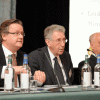
British Companies Urged to Act Now at Middle East Association Iraq Conference
Posted on 24 November 2011 .
British companies need to move fast if they are to gain a foothold in Iraq and avoid losing out to their competitors.
This was the clear message given at the Middle East Association’s ‘Iraq: Untapped Opportunities’ conference held on 22nd November at the Dorchester Hotel, London.
Supported by the National Investment Commission of Iraq, UK Trade & Investment and Allurentis, the event was sponsored by Shell, Parsons Brinckerhoff, Petrofac and Mott MacDonald and attended by over 230 business and government representatives. A strong Iraqi delegation attended, led by HE Dr Hussein al-Shahristani, Iraqi Deputy Prime Minister for Energy and including HE Dr Khairallah Hassan Babiker, Minister of Trade; HE Mr Herish Muharam, Chairman of the Kurdistan Regional Board of Investment; and Dr Abbas Al Sa’adi, Adviser and General Director of Legal Directorate of the General Secretary of the Council of Ministers.
Opening the conference Middle East Association Director General Charles Hollis commented that Iraq is now entering a more stable phase, and opportunities for business are growing. “We need to replicate the UK success in the Kurdistan region throughout the whole of the country,” he said, adding that the Association is looking to organise a trade mission to Baghdad and Basra within the next twelve months.
In a keynote speech, HE Dr al-Shahristani urged British companies to participate in Iraq’s unprecedented reconstruction and development programme “for the benefit of all parties.” He underlined the Iraqi government’s commitment to creating a conducive environment for foreign investors through the generous benefits and incentives offered by Iraq’s investment law. Highlighting Iraq’s huge economic potential he noted that Iraq’s real growth rate has been more than 7% per annum over the last four years, and is expected to grow even faster over the next decade, with GNP in 2010 standing at $150 billion. Iraq is looking to invest $200 billion over the next six years in the oil and gas sector alone, with a need for new technology and modern management skills. Iraq’s goals “cannot be achieved without international companies” he said. He stressed that the opportunities are not limited to the energy sector, highlighting telecommunications, transport, housing, financial services and tourism as areas offering opportunities.
Posted in Construction & Engineering In Iraq, Investment, Iraq Banking & Finance News, Iraq Commodities & Mining News, Iraq Education and Training News, Iraq Industry & Trade News, Iraq Oil & Gas News Comments Off on British Companies Urged to Act Now at Middle East Association Iraq Conference

UNDP Boosts Support for Iraqi People
Posted on 18 November 2011 .
The United Nations Development Programme (UNDP) has announced that it is boosting its partnership with the Government of Iraq and the Iraqi people.
"We have tripled the number of our staff based in Iraq to 44 with further increases planned in the next year. Each and every one of them is committed to improving the lives of Iraqis through an enhanced partnership with the Government of Iraq and its people" said Ms. Amat Al Alim Alsoswa, Director of the Regional Bureau for Arab States of UNDP, during a meeting with the press in Baghdad.
The announcement to increase UNDP’s staff presence in Baghdad comes as UNDP is getting ready to undertake the first annual review jointly with the Government on its four-year country programme in Iraq which focusses on strengthening democratic governance, combating poverty, empowering women and youth, promoting environmental protection and supporting the revitalisation of Iraq's economy.
UNDP has worked to support the Government and people of Iraq for more than 35 years now. Since 2003, it has actively supported the transition towards reconciliation, peace and stability in the areas of democratic governance, poverty reduction, restoration of basic services such as water and electricity, crisis prevention and recovery, energy and environment, and the Global Fund to Fight HIV/AIDS, TB and Malaria.
Most recently, UNDP contributed to strengthening the democratic process in Iraq primarily through the 2010 national elections. With continued work on anti-corruption, rule of law, justice, human rights, public sector reform, disaster risk reduction, environment and climate change.
“I am proud of the progress Iraq has achieved in overcoming years of conflict and violence and getting onto the right development track." said Alsoswa.
(Source: UNDP)
Posted in Iraq Public Works News Comments Off on UNDP Boosts Support for Iraqi People
Siemens to Build 3 Electrical Transformer Stations
Posted on 18 November 2011 .
Azzaman news agency reports that Iraq's Ministry of Electricity has struck a deal with Siemens for the construction of three electrical transformer stations.
The deal, said to be worth $76 million, is the latest in a series of contracts by the ministry to upgrade the national grid and increase the supply of electricity, which is currently less than half the total demand.
The three stations will all be in southern Iraq, and will take two years to complete.
Iraq imports electricity from both Iran and Turkey at a cost of hundreds of millions of dollars per year.
(Source: Azzaman)
Posted in Iraq Public Works News Comments Off on Siemens to Build 3 Electrical Transformer Stations