



Reef Subsea Wins Cable Deal
Posted on 18 September 2013 .
Reef Subsea Dredging and Excavation (D&E) has secured a number of substantial contracts in the Middle-East and Asia Pacific as the company continues to grow its global footprint.
The Middle-East contracts will involve two teams from the company’s UK workforce managing subsea excavation work in Saudi Arabia and Iraq. The work in the Al Khafji field in Saudi Arabia, on behalf of Technip and Khafji Joint Operations (KJO), is a shore approach cable excavation in shallow waters. Specialist personnel will also be deployed for the post-lay burial of the 165mm composite cable.
The second contract is the first project for Reef Subsea in Iraqi waters working with Leighton Offshore as part of the Iraqi Crude Oil Expansion programme (ICOEEP). The work involves post lay burial of a fibre optic cable in excess of 50km in length in Iraq’s largest producing oil field.
Reef Subsea’s specialist controlled flow excavation tools, the T4000 (pictured) and Twin R2000, will be deployed for both projects, as these can work effectively on live cables and pipelines without compromising the subsea assets integrity. The company has two sets of equipment based in Abu Dhabi for operations in the UAE and surrounding areas.
Niels-Henrik Brodtkorb, Managing Director, Reef Subsea Dredging and Excavation, commented:
"These substantial contract wins in the Middle East and Asia allows us to demonstrate the capabilities of our versatile subsea excavation tools.
"Our employees are highly skilled at operating these tools and bring a huge amount of experience to operations in these global industry projects.
"Increasing our presence and equipment capabilities across the world will allow us to further strengthen our reputation as a leader in subsea dredging and excavation.”
(Source: Reef Subsea)
Posted in Construction & Engineering In Iraq, Iraq Oil & Gas News, Iraqi Communications News 5 Comments

Iraq Looks to Foreign Investment To Boost Oil Capacity
Posted on 09 June 2013 .
By Omar al-Shaher for Al-Monitor. Any opinions expressed are those of the author, and do not necessarily reflect the views of Iraq Business News.
Technip, a French company specializing in the management of energy producing installations, received a “significant contract” in the second phase of the oil refinery project in the Iraqi province of Karbala, in what seems to be an actual manifestation of Iraq’s desire to rely on foreign investments in order to remedy the shortfall experienced by its refineries in satisfying domestic needs for petroleum derivatives.
Technip issued a statement in which it said that the Iraqi State Company for Oil Projects awarded it a “significant contract for project management consultancy services for the engineering, procurement and construction phase of the Karbala refinery.”
In a statement obtained by Al-Monitor, the French company characterized the contract as a “prize” awarded by Iraq, following the company’s execution of the Karbala refinery’s basic engineering design, which was initiated in 2010 and had an output goal of 150,000 barrels per day.
Technip describes itself as a world leader in project management, engineering and construction for the energy industry, employing more than 36,000 people working on projects in 48 countries around the world.
Iraq suffers from chronic shortages in oil derivatives resulting from its refineries' inability to satisfy local consumer needs, particularly for mineral oil and gasoline, which forces it to import these derivatives from neighboring countries, notably Iran.
The Deputy Oil Minister for Downstream Refineries Fayadh Nima said that Iraq’s refineries now produced approximately 800,000 barrels per day.
In an interview with Al-Monitor, he said, “Iraq has three main refineries and 10 smaller ones, which produce around 800,000 barrels per day.” He emphasized that his country’s needs surpassed the output capacity of these refineries combined.
Posted in Iraq Oil & Gas News Comments Off on Iraq Looks to Foreign Investment To Boost Oil Capacity

Technip Wins Contract for Karbala Refinery
Posted on 06 June 2013 .
Iraq's State Company for Oil Projects (SCOP) has awarded French company Technip a significant contract for project management consultancy (PMC) services for the engineering, procurement and construction (EPC) phase of the Karbala refinery.
This award follows the front-end engineering design (FEED) executed by Technip in 2010.
The scope of work will cover two phases:
- phase 1: issue of enquiries for the EPC contract, bids clarification, evaluation and contracts finalisation with the EPC contractors; and,
- phase 2: overall management of the EPC contract execution.
Technip’s operating center in Milton Keynes, United Kingdom will execute phase 1 of the project, which is scheduled to be completed in the second semester of 2013.
Riccardo Moizo, Technip’s Senior Vice President for PMC, stated:
“We are delighted to have been awarded this project by SCOP and to participate in developing and enhancing Iraq’s refinery capabilities. This is a significant contract for Technip’s newly created PMC business unit and we believe it will open up opportunities in the near future.”
(Source: Technip)
Posted in Construction & Engineering In Iraq, Iraq Oil & Gas News Comments Off on Technip Wins Contract for Karbala Refinery

Iraq's Refinery Capacity, Opportunities for Investment
Posted on 27 June 2012 .
Delegates to CWC‘s Iraq Petroleum 2012 conference in London last week received an update on the country's refining capacity and plans from H.E.. Dr Bayazeed Hassan Abdullah, MP, member of the Oil and Energy Committee of the Iraqi Parliament.
He said the twelve existing refineries have a combined capacity of up to 886,000 barrels per day:
- Baiji [Bayji, Beiji] Refinery in Salahadin (pictured), with a capacity of 310k bpd;
- Doura Refinery in Baghdad, 210k bpd;
- Basra Refinery, 140k bpd;
- Diwaniya Refinery, 20k bpd;
- Kasak Refinery in Ninewa, 10k bpd;
- Haditha Refinery in Anbar, 16k bpd;
- Six other small refineries (Kirkuk, Syniah-Baiji, Najaf, Samawa,Nasiriyah, Maysan), with a combined capacity of between 30k and 180k bpd.
However, these plants are running at an average of 65% of design capacity, or 565k bpd, and they produce too much heavy fuel oil; only Baiji, Doura and Basrah refineries produce gasoline. As a result, Iraq continues to import refined petroleum products.
Plans for modernizing and expanding these existing refineries to produce more and better quality fuels are already underway.
In addition, four new refineries with a total capacity of 740k bpd are planned and will open for private investment:
Posted in Construction & Engineering In Iraq, Iraq Oil & Gas News Comments Off on Iraq's Refinery Capacity, Opportunities for Investment
Design of Kerbala Refinery Needs to be Changed
Posted on 19 April 2012 .
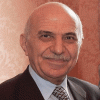
Iraq's deputy oil minister, Ahmed Shamma (pictured), told the Iraq Refinery conference in London on Tuesday that the FEED (front end engineering and design) of Iraq's 140,000 barrel a day Kerbala refinery will have to be changed to reduce the fuel oil output of the proposed plant, reports Dow Jones.
The Kerbala plant, one of four major new refineries planned by the Iraqi government, was originally designed to supply large volumes of fuel oil to a nearby power plant, but that plant has now decided to use natural gas instead.
A consortium including Italy's Saipem and Eni made a preliminary agreement in July to develop the Kerbala refinery; the agreement was only valid for an initial six months and Shamma described talks with the consortium as "interrupted".
French engineering company Technip did FEED for the Kerbala project, but according to the report, Shamma did not say if they would be doing the redesign.
Dialogue continues with one potential investor in a 150,000 barrel a day refinery in Missan province, Shamma said. There have been initial talks over plans for a 140,000 barrel a day refinery in Kirkuk and a 300,000 barrel a day plant in Nassiriya, he said.
The total investment to build the four plants could range between $24 billion and $27 billion, he said.
Iraq will encourage private companies to invest in domestic refineries, particular international operators, by allowing them to sell fuel they produce at international prices and market it in their own retail network, Shamma said.
Iraq's refining throughput averaged 567,000 barrels a day last year and is expected to reach between 600,000 and 620,000 barrels a day this year, thanks to work to improve existing plants, said Shamma. Capacity should reach 750,000 barrels a day by the start of 2013, due to an expansion of the Basra refinery, he said.
(Source: Dow Jones)
Posted in Construction & Engineering In Iraq, Iraq Oil & Gas News Comments Off on Design of Kerbala Refinery Needs to be Changed
Alstom Awarded $550m Power Contract
Posted on 02 November 2011 .
French engineering group Alstom has been awarded a contract to build an electrical power plant worth $550 million in Iraq, reports Reuters.
The award of the Mansuriyah plant contract was announced as part of a visit to Iraq by French Trade Minister Pierre Lellouche.
"The Iraqi Deputy Prime Minister confirmed ... the award of the Mansuriyah electrical power plant contract to Alstom for a total value of $550 million," a statement from Lellouche's office said.
Oil services group Technip will also sign two agreements relating to Iraqi oil fields on Wednesday, the statement said.
Alstom is already taking part in other projects in Iraq such as the Nineveh power plant and the Baghdad metro.
(Source: Reuters)
Posted in Construction & Engineering In Iraq, Iraq Public Works News Comments Off on Alstom Awarded $550m Power Contract
Contracts Awarded at Badra Oilfield
Posted on 14 February 2011 .
Gazprom Neft has completed the tendering process for the front end engineering design (FEED) for the Badra oil field in Iraq, with the contract being awarded to French Technip, according to Penn Energy.
The project preparation is expected to be completed by June 2011.
The tender award decision has also been taken for the road and well site construction, as well as for the construction of a permanent camp. The Iraqi ALMCO was selected as the contractor in both cases.
In January 2011, the mobilisation of manpower and equipment was completed, and geological engineering surveys and future roads laying-out were launched.
In accordance with the latest instructions of the Ministry of Oil of the Republic of Iraq, the ITT submissions for well drilling and integrated project management in terms of well construction were delivered to the state Iraqi North Oil Company (NOC) and the Ministry of Oil for approval and declaration of winners. The commencement of works is scheduled for April – May 2011.
Posted in Iraq Oil & Gas News Comments Off on Contracts Awarded at Badra Oilfield

PetroChina Invites 7 Contractors to Bid for Halfaya
Posted on 26 December 2010 .
PetroChina has invited seven contractors to submit the bidding documents for engineering, procurement and construction work on the first phase of development at the Halfaya oilfield in Iraq in the first week of 2011, the Norway-based energy newspaper Upstream has reported.
The report said the companies invited to participate in the tender include the UK-listed Petrofac, France's Technip, CH2M Hill of the U.S., China Petroleum Engineering Construction Company (CPECC), Daqing Engineering & Construction of China, and Malaysia's KNM and Malaysia Marine & Heavy Engineering.
According to the report, CPECC could have an upper hand over other bidders thanks to its status as PetroChina's sister company under the umbrella of China National Petroleum Corporation (CNPC).
Under the development and production service contract signed with Missan Oil Company in January of 2010, a PetroChina-led consortium aims to kick off production of 70,000 barrels per day from Halfaya in its first phase of commercial production.
PetroChina has a 37.5 percent stake in Halfaya, with 25 percent hel d by Iraqi's South Oil Company, 18.75 percent by Malaysia's Petronas and another 18.75 by French giant Total.
(Source: istock Analyst)
Posted in Iraq Oil & Gas News, Tenders Comments Off on PetroChina Invites 7 Contractors to Bid for Halfaya
France Builds Business Centre in Iraq to Lure Firms
Posted on 19 July 2010 .
France has taken a leap ahead of its rivals in the race to tap investment opportunities in Iraq by building a heavily fortified business centre and boutique hotel where businessmen can sleep, eat and work in safety, according to a report from Reuters.
The complex, financed by private companies, is near the French embassy in Baghdad's once glamorous Abu Nawas neighbourhood; it has room for 20 offices -- half of which have already been claimed by major firms -- and 10 bedrooms for visiting would-be investors.
"We say this is the time to come back to Iraq," said Julien Kerdoncuf, deputy head of the embassy's economic department.
The firms say "yes", he said, speaking in English, but note that the security situation remains a concern, as Sunni Islamist insurgents continue a campaign of suicide bombings and killings.
"And what we say is: 'Listen, we'll take care of that, we'll arrange everything, you get offices, you get swimming pools, you get hotel accommodation, you get food over there, and security is everywhere, everything you need, so you do not have an excuse not to come'. It is time to come -- and actually they are coming, that is the big deal."
The companies that have installed themselves in the French business centre include Lafarge (LAFP.PA: Quote), a pioneer of investment in Iraq, which already has cement plants in semi-autonomous Iraqi Kurdistan and has just started a $200 million renovation of an Iraqi state-owned cement plant in Kerbala.
Others are oil contractor Technip SA (TECF.PA: Quote) and engineering firm Alstom (ALSO.PA: Quote).
Oil major Total (TOTF.PA: Quote), which has partnered with China's CNPC to develop Iraq's giant Halfaya oilfield, plans to move from Baghdad's Green Zone government and diplomatic enclave to the business centre, French diplomats said.
Emerging from war, Iraq is trying to shake off years of violence, sanctions and economic decline by opening up its vast oil reserves -- the world's third largest -- and attracting foreign investment and expertise to help it rebuild.
But while it has signed 11 deals with global oil companies to develop its richest fields, projects outside the energy sector have rarely gone beyond aspirations. Lingering violence and political uncertainty, four months after an inconclusive election, are keeping most western investors on the sidelines.
Of those brave enough to invest so far, Iranian, Turkish and Gulf companies lead the pack, especially in Shi'ite tourism, housing and banking.
The United Arab Emirates is the biggest investor in large projects, with total pledges of $37.7 billion, while Lebanon tops the list of investment deals below $1 billion, according to a report last year by Dunia Frontier Consultants.
GROUND FLOOR
France opposed former President George W. Bush's 2003 U.S.-led invasion of Iraq. Now as a fragile peace returns, it is getting in on the ground floor, said Ambassador Boris Boillon.
In addition to Lafarge, which produces 60 percent of the cement sold in Iraq, car maker Renault (RENA.PA: Quote) has signed an agreement to assemble trucks in two plants, one south of Baghdad and the other in the Kurdish region.
Boillon said apart from the issue of security, Iraq suffered from an excess of red tape and corruption that could undermine profitability. The Iraqi government was also moving too slowly to approve plans and projects and put them in motion.
"I am not exaggerating if I say there are 50 (French) companies now waiting for an Iraqi decision to create a plan, a project. Iraq was considered too dangerous before. Now the question is not of security, it is more about economic profitability," he said.
"Now it is important to send the right messages regarding profitability, the struggle against corruption and bureaucracy."
Eric Noel, international sales director for defence, space and security for Communication & Systemes, used the dining room of the business centre recently to host officials from the Iraqi Communications Ministry with which CS signed a deal a year ago.
"Of course security is a major concern," Noel said. "It has been improving in recent years and months, however it requires a lot of planning ... to move around."
(Source: Reuters)
Related articles:
Posted in Iraq Industry & Trade News, Iraq Oil & Gas News 2 Comments