


A New Look at Bank Valuations
Posted on 23 May 2012 .
In a post from March of last year, I noted that Iraqi bank stocks did not seem particularly attractive on a valuation basis. PE’s were high and growth was unspectacular.
This is no longer the case for the entire sector. While share prices have gone pretty much nowhere, 2011 was a stellar year for earnings growth at many of the banks. On a PE/growth basis, some of them are now quite cheap.
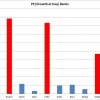
The chart shows PE/growth based on the PE’s reported in Rabee Securities’ weekly report for May 18, 2012 and 2011 net profit growth. In computing the growth rates, I have adjusted 2010 earnings upward by the 2010-2011 percentage changes in average equity.
This adjustment raises the 2010 figures to what they would have been had the banks been as well capitalized in 2010 as they were in 2011, assuming no change in return on equity. In cases where average equity grew faster than earnings, adjusted earnings growth will be negative even when the unadjusted number is positive. This was the case for BIBI, BMFI, and BUND, for example. In these cases, PE/growth is not a meaningful metric.
Also included, for the sake of comparison, are the majority shareholders of BBOB, BDSI, and BMNS—Burgan Bank (BURG), HSBC, and Qatar National Bank (QNBK), respectively. (Note that the growth rate used for the Burgan Bank calculation is based on profit before provisioning rather than net profit.)
PE/growth for all of the Iraqi banks in the chart was well below 0.50. (A value of 1.00 would make them fully valued by this criterion.) In two cases, the ratio is less than 0.15—BDSI (0.07) and BMNS (0.11). These names can’t get much cheaper than this.
Posted in Investment, Mark DeWeaver on Investments and Finance 1 Comment

New Air Routes from Qatar to Iraq
Posted on 02 May 2012 .
Myanmar and Iraq are among the highlights of Qatar Airways' announcement of launch dates for new routes in the Middle East, Africa and Asia with capacity hikes being introduced to a number of other international destinations from the carrier's Doha hub.
Speaking at Arabian Travel Market (ATM), the Middle East's premier travel trade event taking place in Dubai this week, Qatar Airways Chief Executive Officer Akbar Al Baker unveiled the expansion plans covering a wide network of markets across the carrier's global network.
Scheduled flights to Iraq will begin on May 23 with Erbil in the north, followed two weeks later by services to the capital Baghdad on June 7. Each route will be served with four-flights-a-week non-stop from Doha.
"Today's announcement reflects the importance Qatar Airways places on expanding its portfolio of destinations and frequency on existing routes to provide passengers with more choice, more flexibility and more travel options," said Al Baker, addressing a packed press conference at the Dubai Convention and Exhibition Centre.
Posted in Iraq Transportation News Comments Off on New Air Routes from Qatar to Iraq

Qatar National Bank (QNB) Takes Majority Stake in Mansour Bank
Posted on 24 April 2012 .
Qatar National Bank (QNB) Group announced that it has obtained the approval of the Central Bank of Iraq to increase its stake in Mansour Bank in Iraq from 23% to 51%.
As a result of this stake increase, QNB Group will augment its representation on the Mansour Bank’s Board of Directors in proportion to its ownership.
In accordance with the memorandum of understanding, signed between the two banks, QNB Group will effectively manage Mansour Bank and provide it with needed technical and logistical support. This will enhance Mansour Bank’s abilities to offer a wide range of advanced products and services in the Iraqi market, benefiting from the support from QNB Group’s international network.
Mansour Bank began its operations in the second half of 2006, initially providing services through its head office in Baghdad, thereafter increasing its presence to seven branches and one office, covering a number of provinces in Iraq and employing 186 staff.
QNB Group provides specialized services through its subsidiaries and wholly-owned companies, including QNB International Holdings, which is headquartered in Luxembourg, QNB Capital, registered in the Qatar Financial Centre, QNB Banque Privée (Suisse) the full service private banking subsidiary of the QNB Group in Geneva Switzerland; and QNB Financial Services, which offers best-in-class financial brokerage services to retail and institutional clients allowing access to local, regional and international markets.
QNB Group has achieved strong financial results for the first quarter of 2012 with a net profit of QR2.0 billion, up by 17.4% compared to the same period last year. Total assets increased by 28.2% since 31 March 2011 to reach QR311.1 billion, the highest ever achieved by the Group.
In line with QNB Group’s international expansion plans, the Group has recently acquired a 49% stake in the Bank of Commerce & Development, one of Libya’s leading private sector banks. The Group is currently present in more than 24 countries around the world through branches, subsidiaries and associates. The Group, which employs nearly 7,000 staff, provides an array of banking services to a global standard through 335 branches & offices with an ATM network of more than 650 machines.
As a result of QNB Group’s continuous strong performance, the Bank was recently named one of the World’s 50 Safest Banks and one of the Safest Banks in the Middle East, according to the latest update published by Global Finance in April 2012. QNB Group is rated the number 1 brand in the MENA region, with a world ranking of 114, of the world's top 500 banking brands, from 189 in 2011.
Posted in Iraq Banking & Finance News Comments Off on Qatar National Bank (QNB) Takes Majority Stake in Mansour Bank

Iraq to Strike New Gas Deal with Iran
Posted on 14 April 2012 .
Iran's Mehr news agency reports that Iraq will soon sign a deal with Iran to start importing 25 million cubic meters (mcm) of natural gas per day in 2013.
The Iranian gas will be used to power four Iraqi electricity plants.
The giant South Pars gas field (pictured) in the Persian Gulf is shared by Iran and Qatar. The Iranian share has about 14 trillion cubic meters of gas, or about eight percent of the total world reserves, and more than 18 billion barrels of liquefied natural gas resources.
(Source: Tehran Times)
(Photo credit: Alireza824)
Posted in Iraq Oil & Gas News Comments Off on Iraq to Strike New Gas Deal with Iran

Dunia Weekly Iraq Market Tracker
Posted on 10 April 2012 .
Advertising Feature
Iraq Business News is delighted to bring you the latest Iraq Market Tracker report from Dunia Frontier Consultants. The market tracker highlights the activities and market performance of a basket of publicly traded firms who derive a significant percentage of their revenues from operations in Iraq, but are traded on foreign exchanges: a proxy Iraq play as much as practicable. It also identifies and analyzes the primary political and security events that occur in country that have market-moving implications.
Click here to access the report.
Companies Mentioned:
Abu Dhabi National Energy Company (Taqa), Exxon, WesternZagros
Action Calls:
- Erbil-Baghdad escalation continues: Not likely to blow up now, but watch for indications that red lines are being crossed.
- Taqa doubles down in Kurdish region: One sign of faith in Kurdish future. Will it pay off like WesternZagros?
Headlines:
- VP Hashemi Leaves Kurdistan for Qatar, KSA Visits: His return could signal of KRG strength and defiance.
- Potential Violence Looming after Attempted Hit: Reminder that Arab street can target Kurds too.
Calendar Events Discussed:
- April ? - proposed date for National Reconciliation Conference
- April 20 - Rewritten contract terms expected for 4th Oil and Gas Auction
Click here to access the report, or to add your email address to Dunia's mailing list to receive the Iraq Market Tracker via email.
Posted in Investment, Iraq Industry & Trade News, Iraq Oil & Gas News, Politics Comments Off on Dunia Weekly Iraq Market Tracker
Minister for Construction: "We Need International Companies"
Posted on 09 April 2012 .
Iraq's Minister for Housing and Construction, Mohammed Sahib al-Darraji, spoke to Gavin Jones for Iraq Business News:
The Ministry of Housing and Construction is responsible for building over 2 million houses between now and 2015, as well as several thousand kilometres of highway and several dozen schools, hospitals and various other infrastructure projects; it's a massive task and as the Minister of Construction told me yesterday “we cannot do this by ourselves - we need international companies to get involved”.
One example of this is Danish engineering consultancy COWI, which is about to sign a contract to design and build a 500 km highway from Baghdad to the Turkish border, connecting Basra to Baghdad to Turkey, and making one of the first significant steps in reconnecting the Silk Road.
Consulting firm Mackenzie & Mackenzie was appointed last year and has started a Public Private Partnership. One of the first steps will be a privatisation programme for the state-owned assets of the Ministry of Industry and the Ministry of Construction, with the Ministry of Construction determined to be in the lead for setting up international joint-ventures with the 9 state-owned companies they have – the first one scheduled to be sold this year.
Posted in Construction & Engineering In Iraq 4 Comments
Qatari Jets, KRG and Iraqi Airspace Sovereignty in the Hashemi Case
Posted on 04 April 2012 .
The following article was published by Reidar Visser, an historian of Iraq educated at the University of Oxford and currently based at the Norwegian Institute of International Affairs. It is reproduced here with the author’s permission. Any opinions expressed are those of the author, and do not necessarily reflect the views of Iraq Business News.
There are many interesting aspects to the recent departure by Vice-President Tareq al-Hashemi from Erbil in the Kurdistan Regional Government (KRG) area of Iraq to Doha, the capital of Qatar.
Among those aspects is one that has yet to receive the attention it deserves: The means of travel used by Hashemi – who is sought by the central government in an alleged criminal case - from Erbil to Doha. Most accounts simply state that Hashemi arrived in Doha on 1 April en route from Erbil. Some Kurdish interior ministry officials even went on record saying they had no knowledge about Hashemi’s departure.
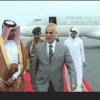
The picture of Hashemi arriving in Doha, published by the website of the vice-president, is clear enough. It shows Hashemi stepping out of a Qatar Airways jet, apparently onto a red carpet and with ministers waiting to welcome him.
So, Hashemi arrived with Qatar Airways. It is true that they have announced plans for an Erbil–Doha service. But that service will not commence until May. Also, it will be operated by Airbus 320s. The aircraft on the picture looks slimmer than an Airbus, perhaps more like a Bombardier?
Posted in Politics, Security Comments Off on Qatari Jets, KRG and Iraqi Airspace Sovereignty in the Hashemi Case

After the Baghdad Summit: Implications Regionally and in Iraq
Posted on 02 April 2012 .
The following article was published by Reidar Visser, an historian of Iraq educated at the University of Oxford and currently based at the Norwegian Institute of International Affairs. It is reproduced here with the author’s permission. Any opinions expressed are those of the author, and do not necessarily reflect the views of Iraq Business News.
The Arab League summit in Baghdad is over and it is time to take stock.
Given the essentially international character of the summit in Baghdad, it is natural to start with the regional implications. And, in many ways, the degree of representation at the level of heads of state is a useful indicator of how things went. Altogether, 10 countries were represented by their rulers: Tunisia, Libya, Sudan, Djibouti, Somalia, Comoros, Palestine, Lebanon and Kuwait in addition to Iraq.
In one way, those who came to Baghdad can be crudely summarized as the “Maghreb Spring” countries (Tunisia, Libya), the very poor in need of any help they can get (Comoros, Sudan, Somalia, Djibouti, Palestine), and “others” not so easily classified (Kuwait and Lebanon). The absence of most of the GCC leaders can be attributed to continued aversion to the Maliki government in Iraq, whereas the failure of the rulers of Egypt and Yemen to show up may reflect the messiness of their own domestic situations as much as any clear policy on Iraq.
But there is more to this than the apparent preference of poor republics for building ties with the new Iraq. True, the gap between Iraq and the Gulf countries remains wide, but if the Iraqi government can build ties with non-GCC countries, it could form an alternative regional bloc within the Arab League. The one obvious disappointing absence for Iraq in this respect must have been that of Algeria.
Posted in Politics Comments Off on After the Baghdad Summit: Implications Regionally and in Iraq
Iraq Seeks Arab Debt Forgiveness
Posted on 29 March 2012 .
Iraq has asked its Arab neighbours to forgive its pre-invasion debts, urging them to follow the United Arab Emirates and Algeria which have already written off what they were owed, according to Reuters.
"We've asked Saudi Arabia, Kuwait, Qatar, Libya, Jordan, Sudan, Egypt and Morocco to help Iraq in closing up its debt situation," Iraqi Finance Minister Rafie al-Esawi [Rafie al-Issawi, Rafi Hiyad al-Issawi, Rafia al-Issawi] said on the first day of the Arab League Summit in Baghdad.
The Paris Club of 19 rich creditor nations agreed in 2004 to write off 80 percent of some $40 billion debt to help Iraq recover from the 2003 U.S.-led invasion. Debt forgiveness talks with non-Paris Club nations are still under way.
"It needs more cooperation from Arab countries regarding the cancelling of debt," Esawi said, thanking the UAE and Algeria for agreeing to cancel 100 percent of debts.
Iraq's external debt was between $130 billion and $140 billion in 2003, much of which was settled through the 2004 Paris Club agreement.
That deal required Iraq to seek similar settlements with all its other creditors. But some commercial creditors won legal judgements and have refused to comply with the settlement.
Saudi Arabia last year was owed $30 billion by Iraq and Kuwait is owed around $22 billion in additional to war reparations for the 1991 Iraqi invasion of Kuwait.
China has written off 80% of the debt it was owed by Iraq.
(Source: Reuters)
Posted in Iraq Banking & Finance News Comments Off on Iraq Seeks Arab Debt Forgiveness

Korek Awaits Spectrum Allocation to Launch 3G
Posted on 16 March 2012 .
Korek Telecom hopes to launch a third-generation (3G) network later this year, but is waiting for the Iraqi government to allocate the necessary spectrum, the operator's chief executive said on Wednesday, according to Reuters.
The company, in which France Telecom and Kuwait's Agility own stakes, claims a 70 percent market share in Kurdistan.
Yet its overall share of Iraqi mobile subscribers is just 13 percent and launching 3G, which would allow for faster Internet connections on mobile phones, could help it win customers from 2G operators Asiacell, an affiliate of Qatar Telecom, and Zain Iraq, part of Kuwait's Zain.
"The promise of the regulator and the ministry is that we should have 3G soon, so we are waiting for them to figure it out," Ghada Gebara, Korek chief executive, told Reuters by telephone. "They are serious about it, so it's just a question of time."
"We already have the right to use any technology we want in our licence, the idea is to get the right frequency," she said.
The government has yet to decide whether it will charge a fee for the new spectrum, Gebara said, adding extra fees would raise tariffs and slow down investment in new technologies to increase internet penetration.
"The more money you pay, it's the customer that will pay," she said.
(Source: Reuters)
Posted in Iraqi Communications News 3 Comments