


Iraqi Oil: Resource Curse or Glorious Blessing?
Posted on 31 August 2012 .
Our Expert Blogger Ahmed Mousa Jiyad talks to Robert Tollast about Iraq’s energy revolution.
RT: The involvement of major US IOC’s such as Exxon and Chevron in Iraqi Kurdistan has sparked a war of words between Baghdad and Erbil. Possibly concerned about a breakdown in relations between the KRG and Baghdad, the US State Department has warned US IOC’s to be cautious, as a US State Department spokesperson recently said:
We speak about it in Iraq. With regard to our own companies, we continue to tell them that signing contracts for oil exploration or production with any region of Iraq without approval from the federal Iraqi authorities exposes them to potential legal risk, and we continue to tell them – obviously, they’ll make their own business decisions, but unless and until we have federal legislation in Iraq governing these things, something that we’ve been urging, that there are risks for them. So that’s our message to our companies.
This has provoked a furious response from Kurdistan’s Minister for Natural Resources, Ashti Hawrami. Is it correct to say that US IOC’s should pay more attention to Iraqi politics and be a lot more careful?
AMJ- This question covers a plethora of issues.Firstly, it is my humble view that all IOCs should be careful and refrain from getting involved in the internal politics of any country, especially Iraq, and this is particularly true for IOCs with an unfavourable image in the national memory of Iraqis. They are oil companies and they should work as operators to develop the upstream petroleum sector as stipulated in their related service contracts, and thus should not assume any political or diplomatic function- it is not their job to do so. Politics should not be their preoccupation especially when their involvement in domestic politics will add more “fuel on the fire,” to borrow the title of an excellent book by Greg Muttitt.
Second, there is nothing new in the above position of the American administration on the issue under discussion. This citation reconfirms the content of a letter from the American President to Mr. al-Maliki answering the request of the latter for intervention in the ExxonMobil case with the KRG. However, misquotation, misinterpretation and different interpretations become probable depending on who reads this statement, how and why; and this applies to both sides of the isle. Nevertheless, this does not change the fact that production sharing contracts signed by IOCs with the KRG carry serious and daunting legal risks and face very serious uncertainties.
Third, with regards to ExxonMobil I believe the company might have made a grave error of judgement. The views expressed by my contacts among many Iraqi and non-Iraqi professionals suggest that ExxonMobil acted probably out of arrogance, short-sightedness, a misreading of Iraqi national memory and a disrespect for sovereignty with a covert and overt agenda.
We have to remember that ExxonMobil (along with Shell) did not win West Qurna 1 (giant Iraqi oil field- WQ1) during the first bidding round held in June 2009. It did so only after its competitor (Russia’s Lukoil) announced its decision to accept the ministry of oil’s remuneration fees of $1.9/barrel in October 2009. Then and only then ExxonMobil acted quickly by accepting the same term, which it refused in June, and proposed a higher production plateau target or PPT of 2.350 million barrels a day (mbd.) The ministry favoured ExxonMobil over Lukoil!
Posted in Ahmed Mousa Jiyad Comments Off on Iraqi Oil: Resource Curse or Glorious Blessing?
Halfaya On Stream 15 Mths Ahead of Schedule
Posted on 19 June 2012 .
State-owned China National Petroleum Corporation (CNPC) says the first phase of Iraq's Halfaya oilfield has started operating at 100,000 bpd, 15 months ahead of schedule.
The company says it has already started preliminary work on the second phase of development at the field, which will bring the capacity to 200,000 bpd.
Iraq signed a 20-year oil production agreement in 2010 to develop Halfaya with CNPC, France's Total and Malaysian state company Petronas, for a fee of $1.40 per barrel. CNPC has a 37.5 percent interest in the consortium. The Halfaya project is CNPC's largest overseas investment unit for which it also acts as the operator.
Last year, CNPC completed the first phase of the Al-Ahdab oilfield in Iraq, with a capacity of 60,000 bpd. CNPC, the parent of PetroChina, also received its first cargo of crude oil as payment for helping to develop Iraq's Rumaila oilfield last year.
China's crude oil imports from Iraq rose 17 percent on year to 5.95 million tonnes, or 359,000 bpd, in the first four months of this year.
(Sources: CNPC, Reuters)
Posted in Iraq Oil & Gas News Comments Off on Halfaya On Stream 15 Mths Ahead of Schedule
Al-Ahdab Oilfield Three-Years Ahead Of Schedule
Posted on 30 December 2011 .
Capacity at Al-Ahdab oilfield reached 120,000 bpd on Friday, three years ahead of schedule, according to Reuters.
The one-billion barrel field in Wassit Province, central Iraq, is being developed by Chinese firm CNPC. The firm started production at 60,000 bpd in summer, six months ahead of schedule and it has doubled it far faster than expected.
CNPC is the first foreign oil company to sign an oil service contract in the post-Saddam era. It renegotiated an old development deal for Al-Ahdab back in March 2009. It collected its first payment this week for work on the field: 650,000 barrels of crude oil.
Output for the field is intended mostly for export, but it will also fuel local power stations to ease fuel shortages.
(Sources: Reuters; AFP)
Posted in Iraq Oil & Gas News Comments Off on Al-Ahdab Oilfield Three-Years Ahead Of Schedule

Honeywell Has $360m Worth of Contracts in Iraq
Posted on 30 November 2011 .
Honeywell has said it currently has $360m worth of contracts in Iraq, Dow Jones has reported.
The US-based engineering firm has a contract with China National Petroleum Corporation (CNPC) to develop process control systems and fire and gas detection systems at the Ahdab oil field, Tarek Nahl, the company's Middle East sales manager, told the news service.
Honeywell is also upgrading a control and process system at the 140,000 barrels-a-day Baiji refinery, 200km north of Baghdad, Nahl said.
It also has contracts with the country's state South Oil Co to develop process and control and fire and gas detection systems at the Subba/Luhais oil field in southern Iraq, and is developing a process control system for Basra's crude oil export pipeline project currently under construction.
(Source: Dow Jones, AME Info)
Posted in Iraq Oil & Gas News Comments Off on Honeywell Has $360m Worth of Contracts in Iraq
Oil Output to be Increased at al-Ahdab
Posted on 27 September 2011 .
Iraq's Oil Ministry has formally approved a proposal to raise production at the al-Ahdab oil field to 200,000 bpd.
The Chinese National Petroleum Company (CNPC) that started exploring the field in June.
It is considered to be CNPC's largest oil investment in the Middle East and the first oil field to be newly explored in Iraq for 20 years, according to AKnews.
CNPC signed contracts for Ahdab in 2008 after previous agreements with the regime of Saddam Hussein in 1996 were put on hold by UN sanctions. The state-owned company invests $3 billion USD (3.5 trillion IQD) for this 23-year contract.
China, desperately in need of energy for its growing economy, makes only 1% profit with its investment in Ahdab, according to Chinese officials. However, a Chinese oil executive told the New York Times that Ahdab was a good way to "get a foot in the door" of the Iraqi oil industry.
(Source: AKnews)
Posted in Iraq Oil & Gas News Comments Off on Oil Output to be Increased at al-Ahdab

Shahristani and Maliki in Federalism Crossfire
Posted on 09 September 2011 .
The following article was published by Reidar Visser, an historian of Iraq educated at the University of Oxford and currently based at the Norwegian Institute of International Affairs. It is reproduced here with the author’s permission. Any opinions expressed are those of the author, and do not necessarily reflect the views of Iraq Business News.
A recent statement by the governorate council of Wasit had an extraordinary tone: The council “rejected” the appointment of Vice Premier Hussein al-Shahristani as acting electricity minister (after Raad al-Ani “resigned” subsequent to being forced out), alleging that Shahristani had created problems for Wasit in the past through his opposition to several electricity schemes and his management of the disputed Ahdab oilfield, where a Chinese company is involved. The conflict between the local council and the oil ministry (previously headed by Shahristani) has been festering since 2009 and includes serious accusations by local politicians for example to the effect that Chinese prisoners are doing underpaid work at the oilfield.
The statement would seem like an unprecedented attempt by a provincial council to interfere in the workings of the central government. But it is very real, and reflects intense intra-Shiite disagreement ranging from the very personal to key political issues like the question of the basic structure of the Iraqi state. At the time the Wasit federalism project first emerged around June 2010, it was reportedly supported by ISCI and resisted by Sadrists and State of Law, with the rest of the council (the Shahristani bloc, the Iraqi constitutional party, Iraqiyya and independents) uncommitted. Unfortunately, the few existing recent press reports on the subject are somewhat ambiguous in that they identify a key pro-federal leader as “Mahdi Husayn al-Musawi, deputy speaker of the Wasit governorate assembly”. This seems to be a mix-up of names since the governor is Mahdi Hussein al-Zubaydi (State of Law) whereas the deputy speaker is Mahdi Ali Jabbar al-Musawi (same bloc but previously the Tanzim al-Iraq faction and with a track record of conflict with Shahristani over Ahdab in the past). In any case, these developments clearly suggest that disagreement over federalism is creating challenges for Maliki as well as for Shahristani in Wasit. It is noteworthy that also in Wasit, ISCI is apparently playing a lead role in forcing the rest of the Shiites towards a remorseless approach in the de-Baathification question, in April this year even challenging a decision by the de-Baathification commission to reinstate former Baathists in the education sector.
Posted in Politics Comments Off on Shahristani and Maliki in Federalism Crossfire

Al-Ahdab Oil Contract has Many Flaws
Posted on 26 July 2011 .
Ahmed Mousa Jiyad is an independent development consultant, scholar and Associate with Centre for Global Energy Studies (CGES). He was formerly a senior economist with the Iraq National Oil Company and Iraq’s Ministry of Oil, Chief Expert for the Council of Ministers, Director at the Ministry of Trade, and International Specialist with UN. He is now based in Norway. The opinions expressed are those of the author, and do not necessarily reflect the views of Iraq Business News.
A recent ceremony for Al-Ahdab oilfield commencement of commercial production was attended by former minister of oil Dr. Shahristani, now the deputy prime minister for energy affairs, and his successor, Mr. Abdul Karim al-Luaibi. This is significant development from more than one aspect:
- The contract for this oilfield was converted from a production sharing contract-PSC concluded under former régime in 1997 into a service contract concluded in November 2008. Practically, the contract serves as a base, with modifications, for the “model” service contracts that followed for the three bid rounds concluded so far. Thus an end to the PSCs in Iraq’s upstream petroleum was consolidated;
- It also signifies a needed achievement for the ministry and the Shahristani strategy of opening of the sector before the IOCs, as the ministry been heavily criticized for not delivering substantial results;
- The early local resentments seems to be fading away and this field alone would secure three important privileges for the governorte/province of Wasit: more revenues through the known “petrodollars” allowances for every barrel of produced oil; the oil and gas produced from the oilfield will be used for generating power in the Zubeidiyah power station which is being set up by China, also in Wasit; and a place at the Federal Oil and Gas Council when this council is established under the proposed Federal Oil and Gas Law currently under consideration.
That said and though it is surely welcoming and encouraging news to see the development of this oilfield is coming on stream, however, AlAhdab contract with CNPC requires serious attention with highly justified revision.
I have since January 2010 reputedly exposed the weaknesses and problems with Al-Ahdab contract and how, in comparative sense, it works against the Iraqi interests. Credible information indicates that the negotiating team at that time was “instructed” from the office of the prime minister to accept these unfavourable terms.
To be specific, this contract has many flaws regarding the following variables, which has significant financial implications for the Iraqi interests:
The “signature bonus” was extremely insignificant amount (of only 3 million dollars) that is not commensurate with the corresponding signature bonus paid for the oilfields under the second bid round taking into consideration the envisaged Production Plateau Target-PPT, as measure of proportionality.
With original 115 thousands barrels per day-tbd PPT for AlAhdab, which is between 110 tbd for Najmah and 120 tbd for Qaiyarah oilfields, CNPC should pay 100 million dollars NOT 3 million dollars. Upgrading the PPT to 200 tbd as recent data indicates, the signature bonus should be even higher. This is the least to ask, considering that another Chinese oil company had paid $2.2 billion signature bonus for two exploration blocks only in Angola.
The payment “cap” for petroleum cost and remuneration fee was fixed at 100% of the “deemed revenues”. This implies that CNPC gets its investment and remuneration fees first, and unless there is surplus in the deemed revenues, Iraq would not get any revenues from the field. Therefore, the payment “cap” ought to be reduced to 50% of the “deemed revenues”.
Level of “commercial production”, which decides the commencement of payment could be specified at 25000bd (again somewhere between that for Najmah and for Qaiyarah oilfields as reference points) or proportionately higher if the 200 tbd PPT is adopted.
Unpaid dues carry “LIBOR+3” interest. Due to this Iraq paid in July 2010 some $250 million as its 25% share in the investment requirements to “avoid paying the interest”. So far the development cost mounts to $1.5 billion, meaning Iraq has already paid $375 million in cash.
These unmet payments should be interest free, similar to the provisions of the model contracts for rounds 1 and 2. Therefore, the “LIBOR+3” interest on these unpaid dues should be deleted from AlAhdab contract.
The overhead charges for AlAhdab is 2% compared with 1% for all other contracts. Hence this charges should be cut to that paid by other IOCs.
The corporate income tax of (15%) should be amended to become (35%) and the provisions relating to “stabilization” should also be amended to that effect to be in line with other service contracts.
The R-factor should also be adjusted to be in line with those applied for green- fields offered under the 2nd bid round. The remuneration fee will thus be reduced from the maximum of $6/b to a minimum of $1.2/b, instead of the current minimum of $3/b. The scale of R-factor would also be adjusted from 4 to 5 levels accordingly.
Unfortunately, the parliament had missed good opportunity few months ago to remedy these shortcomings, safeguard Iraqi interests and assert its authority and constitutional role, and thus
continues in pacifying itself and accepting circumvention by the executive branch.
continues in pacifying itself and accepting circumvention by the executive branch.
On 27 March 2011 the Parliament voted to abrogate a former law, of 1997, that ratified the Development and Production Contract and the Memorandum of Understanding related to AlAhdab oil field signed in Baghdad on 4 June 1997 between MoO and CNOC and CNI, represented by Alwaha Co. (China).
The parliament, in my view, should have insisted that AlAhdab Contract of 2008 must also be revised and if approved then ratified by law, and thus the parliament should have seen that contract before abrogating the old law. Thus, not only the parliament had missed excellent opportunity to set powerful legal precedence for having all other contracts enact by law, the parliament had in fact gave its consent to remain passive and be on the sidelines of effective authority regarding such oil contracts.
Ahmed Mousa Jiyad,
Iraq Development Consultancy and Research (I/DC&R)
Norway.
26th July 2011
Posted in Ahmed Mousa Jiyad 1 Comment
Production at Al-Ahdab reaches 60,000 bpd
Posted on 25 July 2011 .
The governor of Iraq's Wasit [Wassit] province, Mahdy al-Zubaidy, has announced that production at the al-Ahdab oilfield has reached 60,000 barrels per day (bpd).
According to a report from Bloomberg, he went on to say that the field’s output capacity will increase to 120,000 bpd by the end of the year, while Oil Minister Abdul Kareem al-Luaibi [Elaibi] told reporters to expect 200,000 bpd by the middle of next year.
In November 2008, the state-run China National Petroleum Corp. (CNPC) won a $3.5 billion contract to develop al-Ahdab. Iraqi officials estimate Al-Ahdab contains about 1 billion barrels of oil.
(Source: Bloomberg)
Posted in Iraq Oil & Gas News Comments Off on Production at Al-Ahdab reaches 60,000 bpd
Iraq and China Strengthen Relationship
Posted on 19 July 2011 .
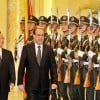
Iraq has asked China to set up a fund to help with the reconstruction of the war-battered country, Iraqi government spokesman Ali al-Dabbagh said on Monday during a visit to Beijing by Iraqi Prime Minister Nuri al-Maliki.
Reuters reports that he also said Baghdad was keen to get Chinese companies investing in the country, which was China's seventh largest supplier of oil last year.
The United States has spent $54 billion in relief and reconstruction efforts since the 2003 invasion, and it and the Iraqi government have spent billions more in Iraqi money, but ordinary people have seen little improvement.
The Iraqi government, which gets most of its $72 billion budget from oil revenues, says it is committed to improving basic services, but progress is painfully slow.
"We are asking the China side to make a fund, for ... reconstruction and to guarantee and assure the investment in Iraq for Chinese companies," Dabbagh told reporters in Beijing.
"Koreans they did the same; they had to create a fund [with] which they support their companies to work in Iraq. Germany is going to make such a thing. Iraq is requesting from China to have such (a) fund," he added, speaking in English.
Chinese oil firms from have been working hard to rebuild their presence in Iraq since several big contracts signed by Chinese oil firms were cancelled in 2003 following the toppling of former president Saddam Hussein.
In 2008, the state-owned China National Petroleum Corporation (CNPC) successfully renegotiated a contract originally signed by the previous regime to develop the al Ahdab oilfield, becoming the first country to sign an oil service contract in Iraq under the new U.S.-backed regime.
CNPC completed construction of the first phase of the oilfield in June this year, and it is also developing Iraq's Halfaya oilfield with France's Total and Malaysia's Petronas. CNPC also has a 37 percent stake in a service contract to develop the Rumaila oilfield, which pumps out almost half of Iraq's total oil output.
Posted in Iraq Industry & Trade News, Iraq Oil & Gas News Comments Off on Iraq and China Strengthen Relationship

Maliki Goes to China in Search of Investment
Posted on 13 July 2011 .
Iraqi Prime Minister Nouri al-Maliki will travel to China this week in a bid to attract Chinese investors to Iraq, an advisor to the PM told AKnews on Tuesday.
Ali al-Mousawi said that Maliki will head a trade delegation, following an official invitation from the Chinese government.
Mousawi said Chinese companies are already heavily engaged in investment in Iraq, “but research shows that China is interested in entering in Iraqi market in a much more significant way. This put the onus on Iraqis to coordinate with Chinese companies…especially in the energy sector.”
He added that the visit will not focus purely on economics: “China is a permanent member of the Security Council and is influential in the formation of international decisions, so politics will inevitably come up.”
China is heavily involved in several sectors in Iraq, including electricity, water, manufacturing and, most significantly, oil. In June, China’s largest oil company China National Petroleum Corporation (CNPC) opened the first major new oil field in Iraq in 20 years at al-Ahdab in southern Iraq.
(Source: AKnews)
Posted in Iraq Oil & Gas News Comments Off on Maliki Goes to China in Search of Investment