


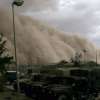
Iran, Iraq pay $1.2 bn to Battle Sandstorms
Posted on 04 October 2011 .
A top Iranian environment official said on Monday that Tehran and Baghdad will jointly invest $1.2 billion [1.4 trillion Iraqi dinars] in a project to reduce the number of sand dunes in a bid to cut the number of sandstorms.
"In order to reduce gravel levels we have signed an agreement with a foreign company worth $1.2 billion to cover a million hectares (2.47 million acres) of Iraqi soil in the next five years," the official IRNA news agency quoted the head of Iran's Environmental Protection Organisation as saying.
According to the report from AFP, the name of the foreign firm was not given.
"This initiative began with 500 hectares and in our negotiations (with Iraq) it was decided to either use fossil materials (petroleum products) or biological ones to stabilise the dunes," Mohammad Javad Mohammadi-Zadeh added.
Some have blamed sandstorms on Iraq which has been hit by desertification and deforestation because of dam construction and declining agriculture.
In mid-April, 20 of Iran's 31 provinces had to close schools and government offices, and flights to and from some western cities were cancelled because of sandstorms mostly originating in neighbouring Iraq.
The problem of sandstorms from Iraq has been blamed on two decades of on-off wars, with officials there saying the number of palm trees has fallen by two thirds from around 36 million to just 12 million.
In September 2010, Iran, Iraq, Syria, Qatar and Turkey signed an accord in Tehran aimed at tackling the sandstorms problem over the next five years.
(Source: AFP)
Posted in Agriculture Comments Off on Iran, Iraq pay $1.2 bn to Battle Sandstorms
Iraqi Stock Market in the Spotlight
Posted on 27 September 2011 .
With most Middle East stock markets having been dragged down by the turmoil unleashed by the Arab spring and a sputtering global economy, some adventurous fund managers have started exploring opportunities in the tiny Iraqi market, according to a report from Bloomberg.
The Iraqi Stock Exchange, or ISX, says its main market index has surged some 65% so far this year, making it one of the world's best-performing markets. Though many doubt the accuracy of the ISX's main index, fund managers who follow the country agree that Iraqi share prices have risen about 15% in 2011—still outperforming most global peers.
Investors have been attracted by the relative political stability following the formation of Prime Minister Nouri al-Maliki's coalition government last year, as well as the promise of higher oil revenues and the reconstruction of the economy. The International Monetary Fund estimates that Iraq's economy will grow at 9.6% this year and likely expand by 12.6% in 2012.
"Foreign buying has picked up in the past 18 months or so with inflows estimated at about $130 million in this period," said Shwan Ibrahim Taha, chief executive of Rabee Securities, whose weekly stock market reports are published by Iraq Business News.
"The fact that it is one of the best performing markets this year, with further potential upside as the economy develops, is definitely whetting investor appetite," he said.
The Iraqi bourse's gains this year compare well to the performance of other indices in the region. Saudi Arabia, the Middle East's biggest market, is down some 7% so far this year. Egypt, the most open market in the region, has dropped 38% in the wake of the January revolution that toppled former President Hosni Mubarak.
Posted in Investment 1 Comment
Iraq's Biggest Construction and Electricity Trade Fair
Posted on 26 September 2011 .
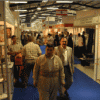
Last week Erbil hosted for the fourth time the Project Iraq construction trade exhibition, together with the Elenex Iraq energy and electricity show. This year's construction fair was the largest so far, attracting exhibitors from 20 countries and thousands of visitors.
Project Iraq 2011, the 4th International Trade Exhibition for Construction & Environmental Technology for Iraq, was held concurrently with Elenex Iraq 2011, the first exhibition entirely dedicated to energy, taking place at the Erbil International Fairground from 19-22 September.
At the opening of the exhibitions, the Kurdistan Regional Government (KRG) ministers for Housing and Reconstruction and for Electricity welcomed all the participants. Minister Kamaran Ahmed Abdullah and Minister Yasin Sheikh Abu Bakir Mawati said that they were delighted that the trade shows are betting bigger every year, attracting visitors from all over Iraq.
The speakers at a press conference to launch the trade show included Engineer Nahro A. Assadi, deputy Minister, Ministry of construction & Housing, Mr. Hama Amen Hawramy, Advisor of the Minister of Electricity, Mr. Aziz Abdo, Director General of Trading in the Ministry of Trade and Industry , Mr. Fady Jreissati, representing IFP Iraq, The conference was attended by a number of government representatives, diplomats and business leaders, and enjoyed strong media coverage.
Mr. Jreissati gave an overview of the exhibitions and their importance, praising government efforts towards economic development and accelerated growth all over Iraq and in the Kurdistan region particularly. He expressed his gratitude to the representatives of the Kurdistan Regional Government, in particular the Ministries of Electricity and Construction and Housing, for their support to the company's events, and commended the management of Erbil International Fairground, proudly underlining its cooperation with IFP Iraq.
Posted in Construction & Engineering In Iraq, Iraq Industry & Trade News Comments Off on Iraq's Biggest Construction and Electricity Trade Fair
Aberdeen City Council to Encourage Energy Investment in Iraq
Posted on 18 September 2011 .
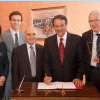
Aberdeen City Council has announced a new initiative to encourage North-east companies to explore business opportunities in Iraq.
Upper Quartile, an Edinburgh-based economic development consultancy, will manage the programme, which will target the oil and gas sector, academic institutions and other contractors.
Seminars will be held over the coming months to inform firms of the economic, political and security issues they need to consider before developing a presence in Iraq. Companies will be invited to attend meetings with Upper Quartile’s experts and get the chance to meet key officials from Scotland and Iraq.
Iraq produces two million barrels of oil per day and aims to increase to 12 million within seven years to propel them to second place among the world’s oil-producing nations. Capital spending in oil-field services in 2011 is estimated to be five times that of Saudi Arabia, Bahrain, the United Arab Emirates, Oman, Qatar and Kuwait combined.
In 2010, foreign firms and investors reported over $42 billion in investments, service contracts and commercial activities across Iraq – up almost 50% on 2009. The top sector was new housing, which accounted for 33% of all foreign commercial activity in 2010, followed by transportation infrastructure, electricity and industry, and oil and gas production. Contracts on offer are expected to push the oil services market to $8 billion by 2014.
Aberdeen City Council Enterprise, Planning and Infrastructure director Gordon McIntosh said: “Aberdeen-based companies have a long history of innovation in the oil and gas business and of developing oil and gas production abroad. Their unrivalled experience, therefore, coupled with committed investment can play an important part in rebuilding an economy, whilst also offering profitable business opportunities in the medium and long term.”
Gavin Jones, co-founder and managing director of Upper Quartile, said: “Iraq possesses vast hydrocarbon reserves, but it lacks the infrastructure and expertise to support large-scale commercial extraction and export. It is therefore an ideal time for established Scottish companies to use their skills to help unlock the country’s enormous potential.”
Iraq’s business marketplace remains in post-conflict phase, characterised by few entrants and risk aversion, but companies which can build relationships with senior Iraqis can expect significant rewards.
Iraq has 16 oil sector companies. Oil exports account for 96% of the country’s economy and in the first seven months of this year Iraq earned more than $48bn in revenue.
Production is set to increase substantially over the next few years. In the short term, however, infrastructure is unable to support this growth and Iraq needs to invest in its export terminals, ports, ageing pipelines, storage capacity, and water and power supplies.
For further information on Aberdeen City Council’s new initiative visit http://www.aberdeencity.gov.uk/iti
Posted in 'Your Country' - United Kingdom, Iraq Industry & Trade News, Iraq Oil & Gas News Comments Off on Aberdeen City Council to Encourage Energy Investment in Iraq
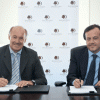
Hilton Worldwide To Open Hotel in Erbil
Posted on 07 September 2011 .
Hilton Worldwide is set to open its first hotel in Erbil, the flourishing capital city of Iraqi Kurdistan, under a management agreement with New York based real estate developer The Claremont Group. Comprising of 200 serviced apartments, DoubleTree Suites by Hilton Erbil is expected to open at the end of 2013.
The new hotel will be strategically located on Erbil's central thoroughfare, close to the recently expanded Erbil International Airport and the Ainkawa district, one of the city's main retail and entertainment centres.
Rob Palleschi, global head, DoubleTree by Hilton brand said, "I'm delighted to be bringing our brand to such an important city in the Middle East. DoubleTree by Hilton has built its success on providing high standards of service and quality facilities in gateway cities, which makes it the ideal choice for Erbil's thriving community."
Tailored for the needs of long-staying guests, the hotel will feature a business centre, health club, swimming pool, eight meeting rooms, two restaurants and a lobby lounge and bar. Around 200 jobs will be created at the hotel and the company's focus will be on employing people locally.
"Erbil's commercial status is increasing year on year and the city has a growing reputation as an up and coming tourist destination. We have every confidence that the DoubleTree Suites by Hilton Erbil will prove popular with the growing number of business and leisure travellers,' commented Rudi Jagersbacher, area president, Middle East & Africa, Hilton Worldwide
National Geographic recently listed Kurdistan, Iraq, amongst their Top 20 best trips describing it as 'an oasis of peace and stability with ancient cities, snowcapped mountains and bustling bazaars' and the New York Times travel section also listed Kurdistan in their 41 places to visit for 2011 saying 'the biggest lure is the opportunity for authentic cultural encounters'.
Stephen Lari, Principal of The Claremont Group, said 'There is so much potential in Kurdistan and particularly the city of Erbil. We've seen travel to the region grow considerably over the past couple of years. If that trend is going to continue then further infrastructure is required to support the industry. Hotels are key to that, and with Hilton Worldwide we know we have the right brand and management partner to make this hotel an integral part of the travel industry in the region'.
He added: "We'd like to commend the leadership of the Kurdistan Regional Government for fostering the secure and pro-investment environment that has been the catalyst for the region's steady growth and prosperity. By making the first major American-sponsored investment in the region's hospitality sector, we are firm believers in the Kurdistan success story"
Hilton Worldwide currently operates 53 properties across the Middle East and Africa and has 36 hotels in the development pipeline. So far this year the company has signed a total of 14 new hotels into the pipeline across the UAE, Saudi Arabia, Qatar and now Iraq.
(Source: Hilton Worldwide)
Posted in Construction & Engineering In Iraq, Iraq Industry & Trade News, Leisure and Tourism in Iraq 2 Comments

Iraq Mobile Telcos Unlikely to Make IPO Deadline
Posted on 17 August 2011 .
Iraq's three main mobile phone companies - Zain Iraq, Asiacell and Korek - appear unlikely to meet a month-end deadline to list on the local stock exchange, raising the chances of them being penalised, according to Reuters.
The companies are required by Iraqi law to launch initial public offerings on the Iraq Stock Exchange (ISX) by 31st August as part of the 15-year, $1.25 billion operating licences they secured in 2007.
None of the three limited companies has yet become a shareholding firm, a key requirement and the first main step towards going public on the local bourse.
"They must meet the requirement to be a shareholders' company before anything," ISX Chief Executive Taha Abdulsalam told Reuters. "After that, we will talk about listing."
He said that after becoming shareholding companies, the firms would need approval from the ISX board and Iraq's securities commission in order to be listed; the ISX board decision could take 24 hours, while the securities commission may take up to a week to give their consent. It would then take 2-3 weeks before the companies would be ready to trade.
He concluded that it was impossible for the companies to list on the bourse by the end of August.
"We still insist that they have to reach the licence conditions within the deadline of 31 August," CMC Commissioner Ahmed Alomary told Reuters. "Otherwise they will receive penalties."
Zain Iraq is a unit of Kuwait's Zain, while Asiacell is an affiliate of Qatar Telecom (Qtel), and Korek is part-owned by France Telecom SA and Kuwait's Agility.
There are now around 23 million mobile phone subscribers in the country, according to the Communications and Media Commission (CMC), which regulates telecommunications in Iraq.
(Source: Reuters)
Posted in Iraqi Communications News Comments Off on Iraq Mobile Telcos Unlikely to Make IPO Deadline
Foreign Investors Flock to Iraq
Posted on 29 July 2011 .
By David Rosenberg, for The Media Line. Reproduced with permission by Iraq Business News.
It was just another day in Iraq on July 15.
In the city of Kerbaba; two car bombs killed a total of seven people and wounded 19. An American solider was killed in Baghdad while in another part of the capital an Iraqi policeman was injured by a sticky bomb placed under a vehicle. More bombs wounded soldiers in Samarra and in Mosul.
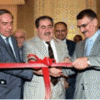
But July 15 also saw the grand re-opening Baghdad's renowned Al-Rasheed Hotel after a $65 million renovation. Britain’s Harlow International undertook the construction work while Holland’s Kempinski Hotel group will manage it.
"The rebuilding of infrastructure, including palaces and airports, is evidence of the ability of Iraqis to achieve what they want,” Foreign Minister Hoshyar Zebari said at the ribbon-cutting ceremony.
Even as Iraq suffers an upsurge of violence – June alone saw 155 civilians killed in attacks, the most since January – foreign investors are flocking to the country. Dunia Frontier Consultants, a Washington DC-based consulting firm, estimates that foreigners were responsible for $45.6 billion in investments, service contracts and other business in Iraq in the first half of the year. That was double the amount the same time in 2010.
Where others see carnage, chaos and corruption, investors see a potentially oil-rich economy whose population of some 30 million is desperate for housing, roads, consumer products and services.
“What you have is a country that produces oil, which makes it very attractive for the hydrocarbon industry to invest there. It’s a country with a very large population,” Daniel Broby, chief investment officer at London’s Silk Invest, told The Media Line. “The middle class suffered a lot of problems but they are educated and there is a lot of home ownership, so banking and telecommunications industries are very attractive for foreign investment.”
Driven by high energy prices, Iraq’s economy will grow 12.5% this year, according to the International Monetary Fund. Iraq’s Oil Ministry said in June alone petroleum brought in $7.17 billion as exports averaged 2.273 million barrels a day at an average price of more than $105 a barrel.
With the government’s coffers swelling, Planning Minister Ali Al-Shukri told Reuters on Monday Iraq is looking to raise its 2012 investment budget by 50% to as much as 60 trillion Iraqi dinars ($51 billion).
Posted in Investment, Iraq Banking & Finance News, Iraq Industry & Trade News 1 Comment
Iraq, Iran, Syria Sign $10 billion Gas Deal
Posted on 25 July 2011 .
The Iranian Shana news agency reports that senior oil officials from Iran, Iraq and Syria have signed a trilateral deal on gas trade in Iran on Monday.
The deal, reportedly worth 10 billion dollars [12 trillion Iraqi dinars] involves the construction of a 5,000-kilometer (3,100-mile) pipeline to transfer Iran’s gas from the South Pars gas field to Europe via Iraq, Syria, Lebanon and the Mediterranean region. The pipeline will take three to five years to build.
The deal was signed by Iran’s acting minister of petroleum Mohammad Aliabadi, Iraq oil minister Abdolkarim Luaibi [Elaibi], and Syrian oil Minister Sufian Allaw, who visited some South Pars gas field phases following the signing ceremony.
The managing director of the National Iranian Gas Company (NIGC), Javad Oji, said an international consultant would be chosen to determine the appropriate route, as well as a financier.
Oji said the South Pars gas field is a reliable source of gas in comparison to the Nabucco pipeline, adding the field holds 16 trillion cubic meters of recoverable gas reserves and has the potential to provide gas up to 80 years at current levels of production.
Referring to satisfactory negotiations with European countries, NIGC’s managing director said: Currently 80 kilometers of the 56 inch sixth Iran’s gas trunkline (IGAT 6), that is intended to transfer gas to our partners, have been completed and construction of the remaining part is underway and is forecast to be completed in the next two years.
In connection with the development of the new phases of South Pars gas field that is shared with Qatar and Iran’s independent gas fields, Mr. Oji noted that Iran’s gas production capacity would double in the next two or three years while domestic gas consumption is expected to fall following changes to the subsidies law. Eventually, Iran will have the potential to export 200 to 250 million cubic meters of gas per day.
Referring to getting permissions from transit countries, NIGC’ chief said: Up to now more than 20 expertise sessions have been held with Turkey, Iraq and Syria on gas exports via their territories and fortunately all of them have given written permissions on the issue. Switzerland would be the first country in Europe to receive Iran’s gas.
According to Oji the project will be funded in the form of BOO and BOT and up to now 15 European companies have expressed an interest in marketing Iran’s gas exports.
"Apart from this pipeline, Iraq is willing to take 20 million cubic meters of gas per day from Iran for a 5 to 10 year period pending development of its own oil and gas fields", Oji told reporters.
(Source: Shana)
Posted in Iraq Oil & Gas News 1 Comment
Iraq's Assets Subject to Seizure?
Posted on 01 July 2011 .
The passing of control of the Development Fund for Iraq (DFI) to the Iraqi government may make the assets vulnerable to seizure.
A lawyer for Kuwait Airways told Bloomberg in an interview that “the class of assets against which we can seek enforcement has expanded.”
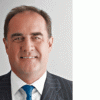
Christopher Gooding (pictured), a partner at London-based Fasken Martineau, said:
“Despite pleas to the contrary, Iraq is an extremely rich country ... Its trading assets are available worldwide, and it remains our intention to seize Iraqi assets whenever and wherever they are available.”
Iraq amassed about $130 billion in debt under Hussein; it owes Kuwait about $21 billion and carries a significant debt to Qatar and Saudi Arabia. It continues to pay into the UN compensation fund.
“For anyone with unpaid debts with Iraq, this is a very significant development,” Stephen Fietta, a solicitor at Volterra Fietta in London, said in an interview.
Most legal jurisdictions recognize the ability of creditors to seize debtors’ assets as a means of debt enforcement. A sophisticated creditor may be able to track Iraqi cargo and try to seize it as it enters a port, or upon its discharge, he said.
“The risk might be minimized if the legal title was transferred by the Iraqi government before the oil was shipped,” Fietta said. “So there are ways around this, but the constant risk of seizure and enforcement can become a real headache for sovereign debtors, just as for private ones.”
(Sources: Bloomberg, UPI)
Posted in Iraq Industry & Trade News, Iraq Oil & Gas News Comments Off on Iraq's Assets Subject to Seizure?
Kuwait Beverage Firm to Target Iraqi Market
Posted on 18 June 2011 .
Kuwait's Arabian Beverage Company (ABC), which distributes water, juice and dairy products in the Gulf region, plans to boost production and also aims to penetrate the Iraqi market this year, according to Reuters.
The company, owned by Kuwaiti conglomerate Bukhamseen Holding [Bukhamsin], founders of Kuwait International Bank and Abu Dhabi listed First Gulf Bank, wants to creatae a strong base in the region as it competes with rivals such as Kuwaiti Danish Dairy Company and Saudi's Al Marai Company.
ABC will double its water production capacity to 240 million units per year to feed demand in the Gulf market and also increase its fleet to about 800 trucks in three years, Elie Abdo, ABC's deputy general manager for business development told Reuters.
'Currently we have around 420 distribution trucks in Kuwait, Saudi Arabia, Bahrain and Qatar... and for the next three years we will stay focused on this region,' Abdo said.
On the Iraq foray, Abdo said ABC had entered the Iraqi market shortly after the US led invasion in 2003, but through a different brand name and distributors based there.
'Now we plan to penetrate the Iraqi market in October this year through the ABC brand...and that operation alone could need up to 500 trucks for distribution,' he revealed.
(Source: Reuters)
Posted in Iraq Industry & Trade News Comments Off on Kuwait Beverage Firm to Target Iraqi Market