



Parliament Speaker outlines post-IS plan
Posted on 13 October 2016 .
By Mustafa Saadoun for Al Monitor. Any opinions expressed here are those of the author and do not necessarily reflect the views of Iraq Business News.
Salim al-Jabouri is the fifth Sunni Arab figure to become speaker of the parliament during the three post-2003 parliamentary terms. Jabouri belongs to the Islamic Party, which is said to be the Iraqi wing of the Muslim Brotherhood. He hails from Diyala province, which is witnessing political and demographic conflicts between Shiites, Sunnis and the Kurds.
Jabouri became parliament speaker in July 2014, succeeding his former ally and current rival, Osama al-Nujaifi. He has become one of the key players in Iraqi politics.
Al-Monitor interviewed him at his private office in central Baghdad's protected Green Zone. The text of the interview follows:
Al-Monitor: Where do the Sunnis stand in the [future] post-Islamic State [IS] phase? What are your plans as Sunni leader for this phase?
Jabouri: We have had a great deal of suffering and displacement, and our main goal now is to have the displaced return to their homes and to rebuild the mindset of many of them, especially those who had to drop out of schools and universities. There was a clear political imbalance. On the one hand, there were policies that led to breeding extremism, joining terrorist groups, promoting extremist slogans and clashing with the state.
On the other hand, there was another approach whereby state-building requires stability and security, which, in turn, require the state to believe in stability, justice and freedom.
Moving forward, the parties representing Sunni provinces should find political consensus either as a single entity or as several entities. We are in favor of decentralization within the framework of the provinces, whereby each province turns into a region and an understanding is found with the political parties and the other components within a single state.
Al-Monitor: Do you mean consensus among the Sunni blocs or between Sunni blocs and other parties?
Jabouri: We will first seek internal consensus among the Sunni parties, and then we will look for a partner we can reach an understanding with within the same state.
Posted in Politics, Security Comments Off on Parliament Speaker outlines post-IS plan
Coalition Strikes Hit ISIL Terrorists in Syria, Iraq
Posted on 13 October 2016 .
U.S. and coalition military forces continued to attack Islamic State of Iraq and the Levant terrorists in Iraq and Syria on Tuesday, Combined Joint Task Force Operation Inherent Resolve officials reported yesterday.
Officials reported details of the latest strikes, noting that assessments of results are based on initial reports.
Strikes in Syria
Attack, fighter and remotely piloted aircraft conducted 11 strikes in Syria:
- Near Abu Kamal, a strike engaged an ISIL tactical unit and destroyed a vehicle.
- Near Raqqah, a strike engaged an ISIL tactical unit and destroyed a vehicle and a vehicle bomb.
- Near Dayr Az Zawr, four strikes destroyed 11 ISIL oil tanker trucks, six oil wellheads, three vehicles, a front-end loader and a crane.
- Near Manbij, a strike suppressed an ISIL tactical unit.
- Near Mara, four strikes engaged four ISIL tactical units and destroyed three fighting positions and a vehicle.
Strikes in Iraq
Attack and fighter aircraft conducted seven strikes in Iraq, coordinated with and in support of Iraq’s government:
- Near Fallujah, a strike engaged an ISIL tactical unit.
- Near Mosul, four strikes destroyed two ISIL mortar systems, an ISIL-held building, a weapons cache, a supply cache and a tunnel.
- Near Qayyarah, two strikes engaged an ISIL tactical unit and a staging area, and destroyed two command-and-control nodes.
Task force officials define a strike as one or more kinetic events that occur in roughly the same geographic location to produce a single, sometimes cumulative, effect. Therefore, officials explained, a single aircraft delivering a single weapon against a lone ISIL vehicle is one strike, but so is multiple aircraft delivering dozens of weapons against buildings, vehicles and weapon systems in a compound, for example, having the cumulative effect of making those targets harder or impossible for ISIL to use. Accordingly, officials said, they do not report the number or type of aircraft employed in a strike, the number of munitions dropped in each strike, or the number of individual munition impact points against a target. Ground-based artillery fired in counterfire or in fire support to maneuver roles is not classified as a strike.
Part of Operation Inherent Resolve
The strikes were conducted as part of Operation Inherent Resolve, the operation to eliminate the ISIL terrorist group and the threat they pose to Iraq, Syria, and the wider international community. The destruction of ISIL targets in Syria and Iraq further limits the terrorist group's ability to project terror and conduct operations, officials said.
Coalition nations that have conducted strikes in Syria include the United States, Australia, Bahrain, Canada, France, Jordan, the Netherlands, Saudi Arabia, Turkey, the United Arab Emirates and the United Kingdom. Coalition nations that have conducted strikes in Iraq include the United States, Australia, Belgium, Canada, Denmark, France, Jordan, the Netherlands and the United Kingdom.
(Source: US Dept of Defense)
Posted in Security Comments Off on Coalition Strikes Hit ISIL Terrorists in Syria, Iraq
Coalition Strikes Target ISIL Terrorists in Syria, Iraq
Posted on 12 October 2016 .
U.S. and coalition military forces continued to attack Islamic State of Iraq and the Levant terrorists in Iraq and Syria on Monday, Combined Joint Task Force Operation Inherent Resolve officials reported on Tuesday.
Officials reported details of the latest strikes, noting that assessments of results are based on initial reports.
Strikes in Syria
Attack, bomber and fighter aircraft conducted eight strikes in Syria:
- Near Abu Kamal, a strike damaged a supply route.
- Near Hawl, a strike engaged an ISIL tactical unit and destroyed a fighting position.
- Near Dayr Az Zawr, three strikes destroyed three ISIL oil wellheads and an oil tanker truck and damaged two supply routes.
- Near Manbij, three strikes engaged three ISIL tactical units and destroyed six fighting positions and two vehicles.
Strikes in Iraq
Attack, fighter and remotely piloted aircraft conducted nine strikes in Iraq, coordinated with and in support of Iraq’s government:
- Near Beiji, two strikes engaged an ISIL tactical unit and destroyed three fighting positions, two weapons caches, two bunkers and a tunnel entrance.
- Near Haditha, a strike destroyed three ISIL vehicles.
- Near Kisik, a strike engaged an ISIL tactical unit, destroying an ISIL-held building, a fighting position, a heavy machine gun and three tunnels. A trench and another tunnel were damaged, and a second tactical unit was suppressed.
- Near Mosul, four strikes engaged an ISIL tactical unit, a staging area, six headquarters buildings, two media centers, a vehicle bomb facility and a weapons facility, destroying two ISIL-held buildings, a command-and-control node, an anti-air artillery system and a weapons cache.
- Near Sinjar, a strike engaged an ISIL tactical unit and destroyed five fighting positions.
Task force officials define a strike as one or more kinetic events that occur in roughly the same geographic location to produce a single, sometimes cumulative, effect. Therefore, officials explained, a single aircraft delivering a single weapon against a lone ISIL vehicle is one strike, but so is multiple aircraft delivering dozens of weapons against buildings, vehicles and weapon systems in a compound, for example, having the cumulative effect of making those targets harder or impossible for ISIL to use. Accordingly, officials said, they do not report the number or type of aircraft employed in a strike, the number of munitions dropped in each strike, or the number of individual munition impact points against a target. Ground-based artillery fired in counterfire or in fire support to maneuver roles is not classified as a strike.
Part of Operation Inherent Resolve
The strikes were conducted as part of Operation Inherent Resolve, the operation to eliminate the ISIL terrorist group and the threat it poses to Iraq, Syria, the region and the wider international community. The destruction of targets in Syria and Iraq further limits ISIL's ability to project terror and conduct operations, officials said.
Coalition nations that have conducted strikes in Syria include the United States, Australia, Bahrain, Canada, France, Jordan, the Netherlands, Saudi Arabia, Turkey, the United Arab Emirates and the United Kingdom. Coalition nations that have conducted strikes in Iraq include the United States, Australia, Belgium, Canada, Denmark, France, Jordan, the Netherlands and the United Kingdom.
(Source: US Dept of Defense)
Posted in Security Comments Off on Coalition Strikes Target ISIL Terrorists in Syria, Iraq
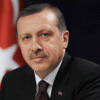
Turkey's "Brash Behaviour" Riles Iraq
Posted on 12 October 2016 .
By Fehim Taştekin for Al Monitor. Any opinions expressed here are those of the author and do not necessarily reflect the views of Iraq Business News.
Turkey has been officially uninvited — in no uncertain terms — to the liberation of Mosul, Iraq.
When rumors began piling up recently that Turkey — after launching Operation Euphrates Shield in Syria — also has plans to intervene on the Iraqi front with Operation Tigris Shield, diplomatic channels between Ankara and Baghdad caught fire.
Baghdad was already unhappy with Turkey, believing Ankara is more interested in the post-Islamic State (IS) future of Mosul rather than helping to liberate it. Baghdad was also concerned about Turkey training Sunni-dominated Al-Hashd al-Watani forces at Bashiqa training camp 25 kilometers (15 miles) from Mosul.
So when Turkey's parliament decided Oct. 1 to extend for a year its military operations in Iraq and Syria, the Iraqi parliament responded with a blunt, unfriendly warning.
The warning called for summoning the Turkish ambassador, branding Turkish forces in Iraq as occupiers, prosecuting those responsible and denouncing Turkish President Recep Tayyip Erdogan’s pronouncements. It also called for reviewing trade and economic relations with Turkey and initiating immediate action with the United Nations to expel Turkish troops.
Turkey's Foreign Ministry responded in similarly harsh language: “We denounce the decision of the Iraqi parliament. We strongly condemn the ugly accusations directed to our president.”
Tension between Ankara and Baghdad escalated after Iraqi Prime Minister Haider al-Abadi warned that the presence of Turkish soldiers in Iraq could lead to a regional war.
Turkey’s Deputy Prime Minister Numan Kurtulmus contributed to the squabble. “Where was the Iraqi government when [IS] occupied Mosul in one day?” he asked, referring to the takeover in June 2014.
Many people wondered what had prompted the Iraqi parliament's bad-tempered action.
Posted in Politics, Security Comments Off on Turkey's "Brash Behaviour" Riles Iraq
Counter-ISIL Strikes Continue in Syria, Iraq
Posted on 11 October 2016 .
U.S. and coalition military forces continued to attack Islamic State of Iraq and the Levant terrorists in Syria and Iraq on Sunday, Combined Joint Task Force Operation Inherent Resolve officials reported on Monday.
Officials reported details of yesterday’s strikes, noting that assessments of results are based on initial reports.
Strikes in Syria
Attack, bomber and fighter aircraft conducted eight strikes in Syria:
- Near Abu Kamal, a strike damaged two supply routes.
- Near Shadaddi, two strikes engaged an ISIL tactical unit and destroyed three fighting position and a vehicle.
- Near Dayr Az Zawr, two strikes damaged four ISIL supply routes.
- Near Mara, two strikes engaged an ISIL tactical unit and destroyed a vehicle and a fighting position.
- Near Palmyra, a strike destroyed an ISIL headquarters facility.
Strikes in Iraq
Rocket artillery and attack, fighter and remotely piloted aircraft conducted eight strikes in Iraq, coordinated with and in support of the Iraqi government:
- Near Mosul, four strikes engaged an ISIL tactical unit and a staging area; destroyed a training camp, a mortar cache, a logistical node, a sniper position, a supply cache and a tunnel; and damaged another tunnel.
- Near Sinjar, three strikes engaged two ISIL tactical units and destroyed three fighting positions, two vehicles, a mortar system and a logistical node.
- Near Sultan Abdallah, a strike destroyed an ISIL mortar system.
Task force officials define a strike as one or more kinetic events that occur in roughly the same geographic location to produce a single, sometimes cumulative, effect. Therefore, officials explained, a single aircraft delivering a single weapon against a lone ISIL vehicle is one strike, but so is multiple aircraft delivering dozens of weapons against buildings, vehicles and weapon systems in a compound, for example, having the cumulative effect of making those targets harder or impossible for ISIL to use. Accordingly, officials said, they do not report the number or type of aircraft employed in a strike, the number of munitions dropped in each strike, or the number of individual munition impact points against a target. Ground-based artillery fired in counterfire or in fire support to maneuver roles is not classified as a strike.
Part of Operation Inherent Resolve
The strikes were conducted as part of Operation Inherent Resolve, the operation to eliminate the ISIL terrorist group and the threat it poses to Iraq, Syria, the region and the wider international community. The destruction of targets in Syria and Iraq further limits ISIL's ability to project terror and conduct operations, officials said.
Coalition nations that have conducted strikes in Iraq include the United States, Australia, Belgium, Canada, Denmark, France, Jordan, the Netherlands and the United Kingdom. Coalition nations that have conducted strikes in Syria include the United States, Australia, Bahrain, Canada, Denmark, France, Jordan, the Netherlands, Saudi Arabia, Turkey, United Arab Emirates and the United Kingdom.
(Source: US Dept of Defense)
Posted in Security Comments Off on Counter-ISIL Strikes Continue in Syria, Iraq
Military Strikes Hit ISIL Terrorists in Syria, Iraq
Posted on 07 October 2016 .
U.S. and coalition military forces continued to attack Islamic State of Iraq and the Levant terrorists in Syria and Iraq yesterday, Combined Joint Task Force Operation Inherent Resolve officials reported today.
Officials reported details of yesterday’s strikes, noting that assessments of results are based on initial reports.
Strikes in Syria
Attack, bomber, fighter and remotely piloted aircraft conducted nine strikes in Syria:
- Near Raqqah, three strikes destroyed nine ISIL oil tanker trucks, seven oil truck trailers, four oil pump jacks, an oil storage tank and a front-end loader.
- Near Ayn Isa, a strike engaged an ISIL tactical unit and destroyed a front-end loader.
- Near Dayr Az Zawr, two strikes destroyed an ISIL oil well head and damaged two supply routes.
- Near Manbij, two strikes engaged two ISIL tactical units, destroying three fighting positions and two heavy machine guns. A mortar position was suppressed.
- Near Mara, a strike engaged an ISIL tactical unit.
Strikes in Iraq
Attack, fighter and remotely piloted aircraft, as well as rocket artillery, conducted 18 strikes in Iraq, coordinated with and in support of Iraq’s government:
- Near Al Huwayjah, two strikes engaged an ISIL tactical unit and destroyed a vehicle.
- Near Baghdad, a strike engaged an ISIL tactical unit.
- Near Haditha, a strike engaged an ISIL staging area.
- Near Hit, a strike engaged an ISIL tactical unit, destroying two ISIL-held buildings, a vehicle and a weapons cache. A second ISIL-held building was damaged.
- Near Mosul, six strikes engaged four ISIL tactical units and destroyed three vehicles, a weapons cache, two supply caches, a command-and-control node, a mortar system and an anti-air artillery system.
- Near Qayyarah, a strike destroyed an ISIL mortar system and a fighting position.
- Near Ramadi, two strikes engaged an ISIL tactical unit and destroyed two vehicles, two bunkers and a tunnel entrance.
- Near Rawah, a strike destroyed an ISIL vehicle.
- Near Sultan Abdallah, a strike destroyed an ISIL vehicle.
- Near Tal Afar, two strikes engaged two ISIL tactical units and destroyed two ISIL-held buildings and a vehicle.
Additionally, due to a delayed strike assessment, two strikes conducted near Dayz Ar Zawr in Syria on Oct. 4 were not reported on the Oct. 5 strike release. The correct assessment reads:
Strikes in Syria
- Near Dayz Ar Zawr, two strikes destroyed three ISIL oil well heads and an oil pump jack and damaged six supply routes.
Task force officials define a strike as one or more kinetic events that occur in roughly the same geographic location to produce a single, sometimes cumulative, effect. Therefore, officials explained, a single aircraft delivering a single weapon against a lone ISIL vehicle is one strike, but so is multiple aircraft delivering dozens of weapons against buildings, vehicles and weapon systems in a compound, for example, having the cumulative effect of making those targets harder or impossible for ISIL to use. Accordingly, officials said, they do not report the number or type of aircraft employed in a strike, the number of munitions dropped in each strike, or the number of individual munition impact points against a target. Ground-based artillery fired in counterfire or in fire support to maneuver roles is not classified as a strike.
Part of Operation Inherent Resolve
The strikes were conducted as part of Operation Inherent Resolve, the operation to eliminate the ISIL terrorist group and the threat it poses to Iraq, Syria, the region and the wider international community. The destruction of targets in Syria and Iraq further limits ISIL's ability to project terror and conduct operations, officials said.
Coalition nations that have conducted strikes in Syria include the United States, Australia, Bahrain, Canada, Denmark, France, Jordan, the Netherlands, Saudi Arabia, Turkey, the United Arab Emirates and the United Kingdom. Coalition nations that have conducted strikes in Iraq include the United States, Australia, Belgium, Canada, Denmark, France, Jordan, the Netherlands and the United Kingdom.
(Source: US Dept of Defense)
Posted in Security Comments Off on Military Strikes Hit ISIL Terrorists in Syria, Iraq
Counter-ISIL Strikes Target Terrorists in Syria, Iraq
Posted on 06 October 2016 .
U.S. and coalition military forces continued to attack Islamic State of Iraq and the Levant terrorists in Syria and Iraq on Tuesday, Combined Joint Task Force Operation Inherent Resolve officials reported on Wednesday.
Officials reported details of yesterday’s strikes, noting that assessments of results are based on initial reports.
Strikes in Syria
Attack, fighter and remotely piloted aircraft conducted 14 strikes in Syria:
- Near Abu Kamal, four strikes destroyed three ISIL oil-well heads, six supply routes and an oil pump jack.
- Near Shadaddi, two strikes destroyed two ISIL front-end loaders.
- Near Ayn Isa, a strike engaged an ISIL tactical unit and destroyed a vehicle.
- Near Dayr Az Zawr, two strikes destroyed four ISIL oil collection pools, three oil well heads and two vehicles.
- Near Mara, five strikes engaged three ISIL tactical units, destroying three fighting positions and a mortar system. A heavy machine gun firing position was suppressed.
Strikes in Iraq
Attack, bomber, fighter and remotely piloted aircraft conducted 14 strikes in Iraq, coordinated with and in support of Iraq’s government:
- Near Hit, a strike engaged an ISIL tactical unit.
- Near Kisik, two strikes engaged an ISIL tactical unit, destroying a vehicle, a tunnel and a weapons cache. A mortar firing position was suppressed.
- Near Mosul, six strikes engaged an ISIL tactical unit, destroying three fighting positions, an oil tanker truck, an ISIL-held building, an explosives cache, a weapons cache, a command-and-control node and a vehicle. An oil tanker truck was damaged.
- Near Qayyarah, two strikes engaged an ISIL tactical unit, destroying an ISIL-held building. A repeater tower power generator was damaged.
- Near Ramadi, three strikes engaged an ISIL tactical unit, destroying a tractor, a vehicle, a vehicle bomb, a supply cache, a tunnel and an ISIL-held building. A second ISIL-held building was damaged.
Task force officials define a strike as one or more kinetic events that occur in roughly the same geographic location to produce a single, sometimes cumulative, effect. Therefore, officials explained, a single aircraft delivering a single weapon against a lone ISIL vehicle is one strike, but so is multiple aircraft delivering dozens of weapons against buildings, vehicles and weapon systems in a compound, for example, having the cumulative effect of making those targets harder or impossible for ISIL to use. Accordingly, officials said, they do not report the number or type of aircraft employed in a strike, the number of munitions dropped in each strike, or the number of individual munition impact points against a target. Ground-based artillery fired in counterfire or in fire support to maneuver roles is not classified as a strike.
Part of Operation Inherent Resolve
The strikes were conducted as part of Operation Inherent Resolve, the operation to eliminate the ISIL terrorist group and the threat it poses to Iraq, Syria, the region and the wider international community. The destruction of targets in Syria and Iraq further limits ISIL's ability to project terror and conduct operations, officials said.
Coalition nations that have conducted strikes in Syria include the United States, Australia, Bahrain, Canada, Denmark, France, Jordan, the Netherlands, Saudi Arabia, Turkey, the United Arab Emirates and the United Kingdom. Coalition nations that have conducted strikes in Iraq include the United States, Australia, Belgium, Canada, Denmark, France, Jordan, the Netherlands and the United Kingdom.
(Source: US Dept of Defense)
Posted in Security Comments Off on Counter-ISIL Strikes Target Terrorists in Syria, Iraq
Military Strikes Continue Against ISIL Terrorists in Syria, Iraq
Posted on 05 October 2016 .
U.S. and coalition military forces continued to attack Islamic State of Iraq and the Levant terrorists in Syria and Iraq on Monday, Combined Joint Task Force Operation Inherent Resolve officials reported on Tuesday.
Officials reported details of yesterday’s strikes, noting that assessments of results are based on initial reports.
Strikes in Syria
Attack, fighter and remotely piloted aircraft conducted 16 strikes in Syria:
- Near Abu Kamal, two strikes destroyed three oil well heads and two oil tanker trucks.
- Near Shadaddi, three strikes engaged two ISIL tactical units and destroyed two fighting positions and a vehicle.
- Near Raqqah, two strikes destroyed three ISIL oil-well heads, an oil storage tank and an oil drum cache.
- Near Dayr Az Zawr, three strikes destroyed 11 ISIL petroleum, oil and lubricants equipment assets, nine oil tanker trucks and two oil-well heads.
- Near Idlib, a strike engaged an ISIL tactical unit and destroyed a vehicle.
- Near Manbij, a strike destroyed an ISIL machine gun.
- Near Mara, four strikes engaged three ISIL tactical units and destroyed two fighting positions and a command-and-control node.
Strikes in Iraq
Attack, bomber, fighter and remotely piloted aircraft, as well as rocket artillery, conducted 10 strikes in Iraq, coordinated with and in support of Iraq’s government:
- Near Hit, two strikes engaged two ISIL tactical units and destroyed 11 vehicles, five ISIL-held buildings, four weapons caches, two vehicle bombs and a heavy machine gun.
- Near Mosul, four strikes engaged two ISIL tactical units, two staging areas, a vehicle bomb-making factory, a weapons factory and a weapons logistics facility, destroying four vehicles, two weapons caches, two supply caches, a command-and-control node and two ISIL-held buildings.
- Near Qayyarah, a strike destroyed two ISIL vehicles.
- Near Ramadi, a strike engaged an ISIL tactical unit and destroyed a vehicle.
- Near Sinjar, a strike engaged an ISIL tactical unit and destroyed a heavy machine gun.
- Near Sultan Abdallah, a strike destroyed an ISIL repeater tower power supply system.
Task force officials define a strike as one or more kinetic events that occur in roughly the same geographic location to produce a single, sometimes cumulative, effect. Therefore, officials explained, a single aircraft delivering a single weapon against a lone ISIL vehicle is one strike, but so is multiple aircraft delivering dozens of weapons against buildings, vehicles and weapon systems in a compound, for example, having the cumulative effect of making those targets harder or impossible for ISIL to use. Accordingly, officials said, they do not report the number or type of aircraft employed in a strike, the number of munitions dropped in each strike, or the number of individual munition impact points against a target. Ground-based artillery fired in counterfire or in fire support to maneuver roles is not classified as a strike.
Part of Operation Inherent Resolve
The strikes were conducted as part of Operation Inherent Resolve, the operation to eliminate the ISIL terrorist group and the threat it poses to Iraq, Syria, the region and the wider international community. The destruction of targets in Syria and Iraq further limits ISIL's ability to project terror and conduct operations, officials said.
Coalition nations that have conducted strikes in Syria include the United States, Australia, Bahrain, Canada, Denmark, France, Jordan, the Netherlands, Saudi Arabia, Turkey, the United Arab Emirates and the United Kingdom. Coalition nations that have conducted strikes in Iraq include the United States, Australia, Belgium, Canada, Denmark, France, Jordan, the Netherlands and the United Kingdom.
(Source: US Dept of Defense)
Posted in Construction & Engineering In Iraq Comments Off on Military Strikes Continue Against ISIL Terrorists in Syria, Iraq
Counter-ISIL Strikes Hit Terrorists in Syria, Iraq
Posted on 04 October 2016 .
U.S. and coalition military forces continued to attack Islamic State of Iraq and the Levant terrorists in Syria and Iraq on Sunday, Combined Joint Task Force Operation Inherent Resolve officials reported on Monday.
Officials reported details of yesterday’s strikes, noting that assessments of results are based on initial reports.
Strikes in Syria
Attack, fighter and remotely piloted aircraft conducted 20 strikes in Syria:
- Near Abu Kamal, a strike destroyed seven ISIL oil storage tanks and two oil wellheads.
- Near Shadaddi, three strikes engaged two ISIL tactical units and destroyed a vehicle.
- Near Raqqah, five strikes destroyed two ISIL oil pump jacks, two oil wellheads, a crane and an oil tanker truck. Four supply routes were damaged.
- Near Dayr Az Zawr, three strikes destroyed an ISIL oil tanker truck and damaged four supply routes.
- Near Manbij, a strike engaged an ISIL tactical unit and destroyed a fighting position.
- Near Mara, seven strikes engaged five ISIL tactical units and destroyed three fighting positions, two vehicle bombs, a heavy machine gun and a vehicle.
Strikes in Iraq
Attack, fighter and remotely piloted aircraft, as well as rocket artillery, conducted 14 strikes in Iraq, coordinated with and in support of Iraq’s government:
- Near Beiji, a strike destroyed an ISIL weapons cache and damaged a vehicle.
- Near Hit, a strike destroyed an ISIL heavy machine gun.
- Near Kisik, a strike destroyed two tunnel entrances and suppressed a mortar firing position.
- Near Mosul, four strikes engaged an ISIL tactical unit and destroyed two ISIL headquarters buildings and a front-end loader.
- Near Ramadi, two strikes engaged an ISIL tactical unit and a staging area, and destroyed four vehicles, a fuel truck, three ISIL-held buildings, a weapons cache, a supply cache and a mortar system.
- Near Rawah, a strike destroyed an ISIL vehicle storage area.
- Near Sultan Abdallah, two strikes engaged an ISIL tactical unit, destroying five ISIL-held buildings and four repeater tower generators. A light machine gun was suppressed.
- Near Tal Afar, two strikes engaged two ISIL tactical units, destroying two tunnel entrances, two ISIL-held buildings and a vehicle. A sniper firing position was suppressed.
Task force officials define a strike as one or more kinetic events that occur in roughly the same geographic location to produce a single, sometimes cumulative, effect. Therefore, officials explained, a single aircraft delivering a single weapon against a lone ISIL vehicle is one strike, but so is multiple aircraft delivering dozens of weapons against buildings, vehicles and weapon systems in a compound, for example, having the cumulative effect of making those targets harder or impossible for ISIL to use. Accordingly, officials said, they do not report the number or type of aircraft employed in a strike, the number of munitions dropped in each strike, or the number of individual munition impact points against a target. Ground-based artillery fired in counterfire or in fire support to maneuver roles is not classified as a strike.
Part of Operation Inherent Resolve
The strikes were conducted as part of Operation Inherent Resolve, the operation to eliminate the ISIL terrorist group and the threat it poses to Iraq, Syria, the region and the wider international community. The destruction of targets in Syria and Iraq further limits ISIL's ability to project terror and conduct operations, officials said.
Coalition nations that have conducted strikes in Syria include the United States, Australia, Bahrain, Canada, Denmark, France, Jordan, the Netherlands, Saudi Arabia, Turkey, the United Arab Emirates and the United Kingdom. Coalition nations that have conducted strikes in Iraq include the United States, Australia, Belgium, Canada, Denmark, France, Jordan, the Netherlands and the United Kingdom.
(Source: US Dept of Defense)
Posted in Security Comments Off on Counter-ISIL Strikes Hit Terrorists in Syria, Iraq
Strikes Target ISIL Terrorists in Syria, Iraq
Posted on 03 October 2016 .
U.S. and coalition military forces continued to attack Islamic State of Iraq and the Levant terrorists in Syria and Iraq on Saturday, Combined Joint Task Force Operation Inherent Resolve officials reported on Sunday.
Officials reported details of yesterday’s strikes, noting that assessments of results are based on initial reports.
Strikes in Syria
Attack, fighter and remotely piloted aircraft conducted 10 strikes in Syria:
- Near Ar Raqqah, two strikes destroyed two oil pump jacks and damaged two supply routes.
- Near Dayr Az Zawr, a strike destroyed four oil well heads and four oil tanker trucks.
- Near Manbij, five strikes engaged four ISIL tactical units and destroyed three fighting positions and a vehicle.
- Near Mar’a, two strikes engaged two ISIL tactical units and destroyed four fighting positions and a vehicle.
Strikes in Iraq
Attack, bomber, fighter, and remotely piloted aircraft, as well as rocket artillery, conducted nine strikes in Iraq, coordinated with and in support of Iraq’s government:
- Near Al Huwayjah, a strike destroyed an ISIL modular oil refinery.
- Near Al Qaim, a strike destroyed an ISIL homemade explosives cache.
- Near Bayji, a strike engaged an ISIL tactical unit, and destroyed a mortar system and a supply cache.
- Near Hit, a strike destroyed a mortar system and a weapons cache.
- Near Kisik, a strike engaged an ISIL tactical unit and destroyed a staging area.
- Near Mosul, two strikes destroyed two ISIL tactical units and destroyed six ISIL-held buildings, four tunnel entrances, and a command and control node.
- Near Ramadi, a strike engaged an ISIL tactical unit and destroyed an ISIL-held building.
- Near Tal Afar, a strike engaged an ISIL tactical unit, destroyed a mortar system and suppressed a mortar firing position.
Task force officials define a strike as one or more kinetic events that occur in roughly the same geographic location to produce a single, sometimes cumulative, effect. Therefore, officials explained, a single aircraft delivering a single weapon against a lone ISIL vehicle is one strike, but so is multiple aircraft delivering dozens of weapons against buildings, vehicles and weapon systems in a compound, for example, having the cumulative effect of making those targets harder or impossible for ISIL to use. Accordingly, officials said, they do not report the number or type of aircraft employed in a strike, the number of munitions dropped in each strike, or the number of individual munition impact points against a target. Ground-based artillery fired in counterfire or in fire support to maneuver roles is not classified as a strike.
Part of Operation Inherent Resolve
The strikes were conducted as part of Operation Inherent Resolve, the operation to eliminate the ISIL terrorist group and the threat it poses to Iraq, Syria, the region and the wider international community. The destruction of targets in Syria and Iraq further limits ISIL's ability to project terror and conduct operations, officials said.
Coalition nations that have conducted strikes in Syria include the United States, Australia, Bahrain, Canada, Denmark, France, Jordan, the Netherlands, Saudi Arabia, Turkey, the United Arab Emirates and the United Kingdom. Coalition nations that have conducted strikes in Iraq include the United States, Australia, Belgium, Canada, Denmark, France, Jordan, the Netherlands and the United Kingdom.
(Source: US Dept of Defense)
Posted in Security Comments Off on Strikes Target ISIL Terrorists in Syria, Iraq