


Iraq Oil Projections Adjusted Down
Posted on 07 June 2011 .
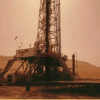
Iraq will cut its 'overambitious' oil targets, the oil minister, Abdul-Kareem Luaibi [Elaibi] said on Tuesday.
AKnews reports that the country had planned to up output to 12 million barrels per day (bpd) by 2017, but now aims for 8 million bpd within 13 or 14 years.
Independent experts had challenged the ability of Iraq’s infrastructure - including pipe lines, storage and its ports – to cope with such an increase.
The move will mean the government will have to renegotiate deals made with international companies.
Iraq’s output for May was 2.225 million bpd.
"We are studying several scenarios for more economic production rates, we can reduce the production and increase the period to reach the plateau targets," the minister told Reuters.
"In general, the oil companies will not be hurt ... We can increase the period to reach the plateau targets to 13-14 years.”
Iraq has had three rounds of contract awarding since 2003. The 2009 contracts were handed out on the understanding that the 12 million bpd target would be met. Companies, which are paid per barrel they produce, may not be happy about the government’s readjustment.
Twelve more oil fields are due to be offered in a fourth round of auctions due to be held in January 2012.
(Sources: AKnews, Reuters)
Posted in Iraq Oil & Gas News 1 Comment

A Russian suitor for Warka?
Posted on 01 June 2011 .
In March ISX-listed Qimma Financial Investment (VQUF) announced that Warka Bank’s majority shareholder, Saad Al Bunnia, had appointed it to “begin a formal auction process following a due diligence report carried out by Price Waterhouse Coopers.” The announcement, which was posted on Qimma’s website, went on to say that Mr. Bunnia was “interested in entertaining offers” from banking groups “such as Russia’s Alfa Bank or UK-based Standard Chartered.” (Hat tip to “Kickabuck” for sending me this link.)
It’s hard to know what to make of this. For starters, while the one-paragraph announcement is worded like something copied from a news agency, it does not appear to have appeared anywhere else. Oddly, it also does not even explicitly say what Mr. Bunnia is selling, though presumably this would be a majority stake in the bank. And if an auction were being organized, you’d think that Warka itself would have made some official statement to this effect.
The mention of Alfa Bank as a possible buyer gives the story a ring of truth however. It seems a funny thing for someone to make up—why not just claim that Citibank might bid? And it’s also easy to believe that the Russian lender would be interested in an Iraqi acquisition. With cash and book equity both over USD 3 bn at the end of 2010, it shouldn’t be hard for it to take up the unsubscribed shares from Warka’s failed rights issue. (There's more on the rights issue here and here.) Its owners should also have little trouble seeing opportunity in a country that, like Russia in the 1990s, has huge unexploited oil reserves and is in the midst of becoming reintegrated into the global economy.
Another point in favor of the story: Alfa Bank is not without Iraqi connections. It has a close relationship with Russian natural gas giant Gazprom, which leads the consortium that won the Badra oil field concession in 2009. In 2002, the two companies entered into a strategic cooperation agreement including, among other things, “the implementation of joint projects,” “provision of short-term financing to Gazprom,” and “the participation of Alfa Bank in project financing schemes for Gazprom.”
For over a year, rumor had it that Standard Chartered would be taking over Warka. After such a long time, however, you have to wonder if perhaps the British bank isn’t really that interested after all. Could a Russian bank turn out to be a better match?
Posted in Investment, Mark DeWeaver on Investments and Finance Comments Off on A Russian suitor for Warka?
Iraq Oil: Highest Production In Decades
Posted on 24 May 2011 .
As widely reported, anticipation is building around the current preparation by the Iraqi Government for the auction of oil and gas exploration in January 2012. The auction will tender 12 exploration blocs covering 31,500 square miles and will be awarded to international companies interested in investing in the region.
With Iraq seeking increasing support from international oil, gas and service companies for its economic development, CWC is hosting its fifth annual Iraq Petroleum conference in London with a view to bringing together the key decision makers in this important industry.
Iraq Petroleum will take place between 12-14 July and will be a platform designed to help companies plan their strategy and develop a full understanding of the types of upstream contracts available for development. The conference will also focus on Kurdistan’s natural resources as the region’s additional capacity comes on stream.
The conference brings together government and industry experts, providing a forum to explore Iraq’s resource and business potential. Key Iraqi Government officials supporting Iraq Petroleum 2011 include H.E. Thamir Ghadhban, Chairman of the Advisory Commission to the PM of Iraq; H.E Ali Al Dabagh, Minister of State, Iraqi Government Spokesman; H.E. Haider Al Abadi; Dr. Adnan Al Jananbi and many other international government figures will be presenting as well as answering key questions.
Other senior industry experts include Mounir Bouaziz, Vice President Commercial, MENA NBD & LNG, Shell; Einar Erfjord, Country Manager Iraq, Statoil offering an industry perspective.
Iraq Petroleum 2011 is represented by industry support from Upstream Principle Sponsor: Crescent Petroleum, Service Principle Sponsor: Baker Hughes, and conference sponsors ExxonMobil, Statoil, Total, OXY, Oil Serv, IAG, Huawei, Oilve Group, Mott MacDonald, Mubadala, Standard Chartered, Technology Partners and SKA.
Further information is available via http://www.cwciraqpetroleum.com
Posted in Investment, Iraq Oil & Gas News Comments Off on Iraq Oil: Highest Production In Decades
Iraq Petroleum 2011, 12‐14 July, London
Posted on 29 April 2011 .
Following the announcement by the Iraqi Ministry of Oil that 12 exploration blocs, including the first sea exploration bloc, will be tendered in next year’s auction and alongside the current influx of hundreds of companies to Iraq, the development of its oil and gas industries look set to continue.
The latest edition of CWC’s Iraq Petroleum conference in July, therefore, will focus on the upstream opportunities and the next phase of development of this activity.
Abd Al‐Karim Laibi [Luaibi, Elaibi], Iraq’s Federal Minister of Oil recently commented “Iraq expects more than double the oil production capacity over the next four years.”
Iraq Petroleum 2011 features a post conference workshop, with Clyde & Co organising a negotiator roundtable discussion focusing on Iraq’s oil and gas contracts. This one day interactive workshop will update investors on the upcoming fourth bid round, the right joint ventures and will take delegates through a step by step guide on forming joint ventures and managing the after contract signature challenges.
Conference sponsors to date include upstream principle sponsor Baker Hughes, service principle sponsors Crescent Petroleum, and conference sponsors ExxonMobil, Statoil, Total, OXY, Oil Serv, IAG, Huawei, Oilve Group, Mott MacDonald, Standard Chartered, Technology Partners and SKA.
Posted in Iraq Oil & Gas News Comments Off on Iraq Petroleum 2011, 12‐14 July, London
Iraq Offers 12 New Oil Blocks in 4th Round
Posted on 25 April 2011 .
Iraq's Oil Ministry announced on Monday the launch of the fourth round of oil licences for 12 sites in the provinces of Nineveh [Ninawa], Anbar, Diyala, Wasit [Wassit], Basra, Najaf, Muthanna, Qadisiya, and Babil, indicating that the majority of areas include gas and oil.
Iraq formally invited international energy firms to compete for these new exploration blocs, but delayed the auction from November until January of next year.
The Iraqi Oil Minister Abdul Karim al-Luaibi [Elaibi] said during a press conference held at the ministry that the 12 sites include:
- one in Nineveh province with an area of 7300 square kilometers;
- a second site in Nineveh and Anbar with an area of 8000 km2 and in which gas is likely to be present;
- third, fourth, and fifth sites in Anbar with areas of 7,000 - 8,000 km2 and 9,000 km2 in which gas is likely to be found;
- a sixth site in Najaf and Anbar with an area of 9000 km and in which gas might be present;
- a seventh site in Qadisiyah, Babil, Najaf, Muthanna with an area of 6000 kms and in which oil is likely to be present;
- An eighth site in Diyala and Wasit on an area of 6,000 km2 with a high probability of the presence of gas;
- a ninth location in Basra with an area of 900 km2;
- a tenth site Muthanna and Dhiqar [Dhi Qar] with an area of 5500 kms and in which oil is likely to be present;
- locations 11 and 12 in Muthanna and Najaf with an area of 16,000 km and in which gas is likely to be present.
"The companies that will participate in the fourth round of oil licenses are the companies that contracted with the ministry during the first and second licensing round as well as companies that the ministry didn't sign oil contracts with."
The ministers said in March that the blocks contain a combined 29 billion cubic meters of gas and 10 billion barrels of crude.
(Sources: Reuters, Bloomberg, AKnews)
Posted in Iraq Oil & Gas News 1 Comment
Iraqi Deadline For New Oil Licences - Documents Attached
Posted on 21 April 2011 .
Iraq has set a deadline of 19th May for international oil companies (IOCs) to register to compete for the fourth oil bidding round, scheduled to be held later this year.
Please click here to download the pre-qualification form.
According to Dow Jones, Iraq had pre-qualified around 45 international companies for its three bidding rounds held over the last 22 months. Almost half of these firms, including oil majors, won deals in Iraq.
The ministry said pre-qualified companies which didn't win deals in the previous three licensing auctions need to update their documents, while new companies have to submit a complete set of documents.
The full text of the Ministry's statement follows on the next page:
Posted in Iraq Oil & Gas News Comments Off on Iraqi Deadline For New Oil Licences - Documents Attached

Kuwait Airways to Pursue Iraqi Assets
Posted on 07 April 2011 .
According to a report from The National, lawyers for Kuwait Airways have vowed to seize international assets owned by the Iraqi government following a recent court ruling in its long-running dispute with Iraqi Airways.
A UK court ruling has granted Kuwait Airways the right to file proceedings against the Iraqi government and ministries of transport and finance as it seeks to recoup assets to satisfy judgments worth almost US$1.3 billion for the theft of planes and engines during the Iraqi invasion of Kuwait in 1990.
"We will very soon be hunting for state of Iraq assets as well as Iraqi Airways assets," said Christopher Gooding, a lawyer representing Kuwait Airways, who added the judgment "expands the range of assets available for enforcement".
Until recently, a UN mandate has covered Iraq's financial assets to shield its oil and other revenues from billions of dollars in international claims stemming from the era of Saddam Hussein. The report says that from July 1, the country will no longer be immune from financial claims, including those made by Kuwait Airways.
The Kuwaiti airline has also been pursuing the case in Canada, where court judgments cleared the way to seize buildings owned by Iraq as well as an aircraft order for regional jets from Bombardier, which is based in Montreal.
Iraq's international assets are "substantial", Mr Gooding said. This includes property and assets related to its oil and gas business, including tankers. "We are actively considering immediate options," he said.
The long-running case forced the Iraqi government to announce last year it would dissolve Iraqi Airways to side-step its legal obligations, although the Iraqi carrier continues to operate.
Last week, Hoshiar Zibary [Zebari], Iraq's foreign minister, and ministers of transport and finance went to Kuwait to discuss the airline dispute and other pending issues related to the First Gulf War, hoping to find a resolution, or at least to "lay a road map to settle them", according to the Kuwait daily Al Watan.
Kuwait Airways, which has made a loss for several years, is in the process of converting into a private-sector shareholding company, depending on how fast the country's sovereign wealth fund organises an auction to offer 26 per cent of the carrier's shares to a strategic investor, Al Watan reported. The Kuwait Investment Authority will hold a 24 per cent stake in the new company, while the remaining 50 per cent will be offered for public subscription.
(Source: The National)
Posted in Iraq Transportation News Comments Off on Kuwait Airways to Pursue Iraqi Assets
IMF Suggests Stable Iraqi Dinar
Posted on 30 March 2011 .
A report on Monday by the International Monetary Fund (IMF) suggests that the Iraqi dinar is currently fairly valued at 1170 dinars to the US dollar:
"The CBI [Central Bank of Iraq] will continue to aim at keeping inflation low, predominantly by maintaining a stable exchange rate. The low level and the relative stability of inflation do not suggest any significant over- or under-valuation of the Iraqi dinar. Also, a stable exchange rate continues to provide a solid anchor for the public’s expectations in an otherwise highly uncertain environment and in an economy with a very low level of financial intermediation."
The report continues, "Meanwhile, the CBI will continue to keep its policy interest rate positive in real terms. To enhance mobilization of domestic financing, limitations on state-owned banks’ use of government deposits for investing in Treasury bills have been reduced, while the pension fund has also been allowed to invest in Treasury bills and to participate in auctions directly."
It also allows for the possibility of an upward drift in the value of the dinar over the years:
"Staff supports the CBI’s policy of managing the exchange rate of the Iraqi dinar to keep inflation low. A stable exchange rate continues to provide a solid anchor for the public’s expectations in an otherwise highly uncertain environment. Over time, rising oil revenues could put upward pressure on the real exchange rate, which would warrant allowing greater exchange rate flexibility."
Posted in Iraq Banking & Finance News 5 Comments

4th Mobile Phone Licence Could Go for $2bn
Posted on 16 March 2011 .
Iraq's communications minister said he expected the country's planned fourth mobile phone licence to fetch between $1 billion to $2 billion [2.4 trillion Iraqi dinars] in an auction expected by the end of this year.
According to Reuters, Mohammed Allawi said the expected cost for the licence, including installations and infrastructure costs, could be in the range from $1 to $2 billion, correcting an earlier statement he made on Wednesday.
Forty percent of the licence would go to an operator, 35 percent to the public and 25 percent to the Communications Ministry. Iraq's mobile phone market, which did not exist under Saddam Hussein, has mushroomed since the 2003 U.S.-led invasion that toppled him.
The country held an auction in 2007 in which Kuwait's Zain, AsiaCell and Korek Telecom -- based in the northern Kurdish area -- bought 15-year licences for $1.25 billion each.
Allawi said he welcomed Monday's news about a deal in which France Telecom and Kuwaiti logistics group Agility will buy a 44 percent stake in Korek, but said this did not detract from the need for a fourth mobile phone operator in Iraq.
"France Telecom is going to expand Korek, give it more cover," he said. "Regarding the fourth licence, the most important thing about it is that we are going for more advanced technology. At present we have no 3G in Iraq, we have no 4G. We have only GSM."
Eight years after the U.S. invasion, Iraq's infrastructure is still badly battered and landline and internet penetration remain low.
Third-generation (3G) technology would allow data-hungry consumers to surf the internet and download music to handsets quickly on the go.
(Source: Reuters)
Posted in Iraqi Communications News 1 Comment
Akkas Gas Deal Delayed Again
Posted on 26 February 2011 .
The long-awaited signing of the deal to develop Iraq's Akkas gas field in Anbar province has been delayed again.
An Iraqi Oil Ministry spokesman said it was delayed because of disagreements about what the local government gets from the deal, according to Associated Press reports.
An initial agreement to develop the 5.6 trillion cubic foot Akkas gas field in Anbar province was due to have been signed on Thursday in Baghdad.
A consortium led by Korea Gas Corp. (KOGAS) along with Kazakhstan's KazMunaiGas bid in October to develop the field.
But after hours of delays as reporters waited at the Oil Ministry, spokesman Asim Jihad told The Associated Press that the signing was postponed because officials in Anbar province want more control over how the revenue is spent.
Anbar officials protested on the day of the auction, saying they wanted more jobs from the deal.
(Sources: Associated Press, Reuters)
Posted in Construction & Engineering In Iraq Comments Off on Akkas Gas Deal Delayed Again