


Gas Auction Postponed, but Terms Sweetened
Posted on 02 August 2010 .
Iraq is about to sweeten the contract terms for its third bidding round for its three prized natural gas fields, in an attempt to entice international companies to enter the auction, according to a report in the Wall Street Journal.
Unlike oil deals for the first and second bidding rounds for oil fields last year, winning companies won't need to pay 'signature bonuses' to the Iraqi government for the three natural gas fields on offer, a company executive said on the sidelines of two-day roadshow held by the Iraqi oil ministry in Istanbul.
International oil companies have had to pay bonuses of between $100 million and $500 million for deals they won in the first and second licensing auctions.
Iraq has also delayed the bidding by a month, with it now scheduled to be held Oct. 1, according to a reporf from Reuters.
Iraq's oil minister, Hussein al-Shahristani, said that one of the incentives for interested companies would be to allow them to export 50% of the natural gas produced from these fields. The Iraqi government will commit to purchasing half of the gas produced.
However, for some companies the export clause is a "negative condition," said another company official. Iraq hasn't the infrastructure to export gas from these fields, he said. So if half of the produced natural gas would be for exports, pipelines, reservoirs and gathering stations for exports would need to be built. Companies also need to look for customers for the Iraqi gas, he added.
Bloomberg reports that developers will be paid on the basis of barrels of oil equivalent, and will not be involved in setting the prices of gas exports.
The three natural gas fields to be bid for are:
- the Akkas field in Anbar province, near the Syrian border, which the oil ministry puts at 5.6 trillion-cubic feet of gas reserves. Discovered in 1998, Akkas already has six wells, and Iraq is interested mainly in exporting associated gas produced there along with oil. There was a single bid for this field last year, from a consortium of five companies led by Italy’s Edison, but it was rejected;
- the Mansouriya field in Diyala, with 4.5 trillion-cubic feet of reserves. There were no bids for this last year. Discovered in 1979, this would be used first for domestic consumption, then later for exports, possibly supplying the proposed Nabucco pipeline; and,
- the Siba field, located in Basra province, with 1.13 trillion-cubic-feet of reserves and three existing wells. Discovered in 1968, Siba was withdrawn from a previous auction last year.
Fifteen international companies have so far shown interest in taking part in the third bidding round, reports the Wall Street Journal. Sabah Abdulkadhem al-Saaidi, head of the legal and commercial section at the oil ministry's petroleum contracts, also said that Aug. 20 would be the last date for companies to register for the natural gas bidding round.
The roadshow in Istanbul was reportedly attended by companies including Total of France, Italy's Edison, South Korea's KOGAS, India's Oil & Natural Gas Corp Japan Oil, Gas and Metals National Corp (JOGMEC), Itochu Corp, Russia's TNK-BP (half-owned by BP), Kuwait Energy, Turkey's state-run TPAO, and Kazakh KazMunaiGaz
It is believed that companies like Total, Royal Dutch Shell, and KOGAS are favoured because of their experience; the state energy companies may also take stakes of up to 25% in the projects, similar to the earlier oil contracts.
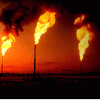
Despite huge gas reserves estimated at 112 trillion cubic feet—the fifth highest in the region, according to U.S. Energy Information Agency data—Iraq is producing 1.65 billion cubic feet a day of gas, some 700 million cubic feet a day of which is flared due to lack of infrastructure.
The goal is to fuel turbines ordered for new power stations with gas instead of crude, and the fields on offer could start commercial production in one to two years.
(Sources: Wall Street Journal, Reuters, Bloomberg)
Related articles:
Posted in Iraq Oil & Gas News 1 Comment
Baghdad Puts Gas Trio on Table
Posted on 08 June 2010 .
08 June 2010 - Upreamonline.com
Iraq plans to offer three gas fields with combined in-place resources of 25 trillion cubic feet of gas to international bidders “in the coming months”, according to Iraqi Oil Minister Hussain Shahristani.
The Akkas, Mansuriyah and Siba fields are expected to whet the appetite of major players including Shell, Total and Kogas – 15 companies have been shortlisted.
Iraq takes 99.3% of the revenues from its oil and gas field operations, Shahristani said in his keynote address to the Petronas-managed Asia Oil & Gas Conference.
The gas fields will be offered on 20-year technical service contracts, similar to those in the first two bidding rounds when oil acreages were tendered. Gas from the fields will be used for power generation and petrochemicals, Shahristani said.
Akkas and Mansuriyah had earlier been offered, the former attracting a sole bid from Edison while Mansuriyah failed to elicit any proposals. Siba had originally been included in Iraq’s second round last December but was later withdrawn.
Shahristani added that “no large-scale bid rounds were planned in the future, at least not in the near future”.
Posted in Iraq Oil & Gas News Comments Off on Baghdad Puts Gas Trio on Table
Iraq Plans Power Boost After Gas Fields Auction
Posted on 10 May 2010 .
Doha, 10 May 2010 - Reuters
Iraq plans to boost power capacity to 27,000 megawatts in four years after opening its gas sector to foreign investment and sealing a gas capture deal with Royal Dutch Shell, a minister said on Sunday.
The OPEC member would need to invest at least $3 billion to $4 billion per year to reach that target, Iraq’s Electricity Minister Karim Waheed told Reuters on Sunday.
He did not say how Iraq plans to raise such funds. It has struggled to finance its previous power generation plans.
Reaching the ambitious power capacity target would depend mainly on finalising a venture with Shell to capture and use gas now being burned in the southern oilfields around Basra, and on output from three gas fields, which Iraq is auctioning off in September, Waheed said.
‘This depends on both the gas fields — the announcement for the third round — and on capturing the burned gas deal with Shell,’ he said in an interview on the sidelines of an energy conference in Qatar.
Waheed said if Iraq does not come to an agreement with Shell, the ministry will have to rethink its power plans.
Iraq is close to signing a final deal between its South Gas Company, Shell and Japan’s Mitsubishi, after it sent the final draft of the agreement to the cabinet for approval, Iraqi Oil Minister Hussain Al Shahristani said on Thursday.
Shahristani also said that Iraq will invite 45 international companies, which were prequalified for two oil auctions last year, to bid to develop Akkas gas field in Iraq’s western desert, Mansuriyah gas field in eastern Iraq and Siba in the southern oil hub of Basra.
Waheed said he expects the gas fields now being tendered to start producing in two to three years.
TENDERS
Iraq plans to issue new tenders next week for installing turbines as part of the ministry’s plans to boost electricity capacity, Waheed said.
In 2008, it said it had agreed a 1.5 billion euro ($2.03 billion) deal with Siemens for 16 gas turbines and a deal with General Electric worth $3 billion for 56 turbines. The turbines are expected to add nearly 9,000 megawatts of capacity over the next few years.
Iraq scrambled for ways to finance the purchase after a plunge in oil prices in 2008 deprived it of revenues and forced it to slash its 2009 budget three times. It had offered investors stakes in the electricity turbines it has ordered, and said it would repay investors from future electricity sales.
In March, the finance minister said Iraq raised $2.1 billion from local banks via a one-year treasury bond issue to fund electricity projects.
‘Next week, we will tender for bids for installing turbines at two more sites, at Baiji for six turbines of 160 MW and Kirkuk for one turbine of 260 MW,’ Waheed said.
‘Some 38 companies will participate and compete for the deals. Just to install the turbines, we’ve already bought the turbines.’
Waheed put Iraq’s available power capacity at 9,000 MW, and installed capacity at 11,000 to 12,000 MW. Demand is estimated to be at least 12,000 MW.
Frequent fuel shortages and constant maintenance are a main reason behind the shortfall in available power capacity in Iraq, where dilapidated infrastructure has been hit hard by years of war, insurgency attacks and underinvestment.
Seven years after the U.S.-led invasion, Iraq’s national grid still only supplies a few hours of power each day. Intermittent electricity is one of the public’s top complaints.
Baghdad, the capital, is expected to enjoy about eight hours of electricity a day when temperatures hit 50 degrees Celsius in the summer, Waheed said.
With the new power plans, Baghdad, with current 3,000 MW of power available, could finally have 24 hours a day of electricity in two years.
Posted in Construction & Engineering In Iraq, Iraq Oil & Gas News Comments Off on Iraq Plans Power Boost After Gas Fields Auction
Iraq's Economic Tipping Point
Posted on 20 April 2010 .
The big political news in recent days was the announcement that votes are to be re-counted in the Baghdad district, which accounts for 70 of the parliament's 325 seats.
With Iyad Allawi's Iraqiya party having apparently defeated incumbent Prime Minister Nouri al-Maliki's State of Law coalition by just two seats, any changes to the result could be very significant. The outcome will not be known for up to three weeks, however, as roughly 2.5 million votes must be manually re-counted, and it is still possible that re-counts will also be ordered in other districts.
Meanwhile, the Iraqi Oil Ministry has gone ahead with the tendering process for three gas fields – Akkas, Siba, and Mansuriya – inviting fifteen major oil companies to bid. Considering this, and the upsurge in business activity throughout the country, Upper Quartile's Adrian Green commented that “Iraq has truly reached an economic tipping point”.
And while the price of natural gas has fallen by a third since the start of the year, and by 70% over the past two years, it is no less politically sensitive. The Gas Exporting Countries Forum held its annual meeting this week in Algeria, and some members are pushing for it to be become the OPEC of the gas industry, with all that that implies for supply and pricing. Iraq is not yet a member of this club, but this round of contracts may move it a step closer.
Upper Quartile and AAIB work closely with businesses in the energy and infrastructure sectors. To see how they can assist your business in Iraq, please contact Gavin Jones or Adrian Shaw.
Posted in Blog 2 Comments
Iraq Announces New Gas Tenders
Posted on 19 April 2010 .
(Source: Petroleumworld.com)
Iraq Prepares New Gas Field Licensing, Cuts Oilfield Signatory Bonuses Retroactively
Iraq's Oil Ministry has released plans to tender three gas fields—previously part of the first and second licensing rounds—to 15 invited companies and has named Shell, Total, and KOGAS as frontrunners, while also confirming that signatory bonuses for the renegotiated West Qurna-1 and Zubair oilfields have been slashed.
IHS Global Insight Perspective
Significance
Iraq will invite 15 oil companies to bid for the Akkas, Siba, and Mansuriya gas fields later this year, and has already named Shell, Total and KOGAS as preferred bidders at this stage, while the ExxonMobil/Shell West Qurna-1 oilfield project and the Eni-led Zubair development are seeing their signatory bonuses slashed significantly now that the election has passed.
Implications
Oil companies said that Iraq's financial terms were significantly improved as contracts from the first licensing round were renegotiated in late 2009 and the second (more successful) licensing round was drawing near, although full details of the improvements have remained elusive. Meanwhile, Iraq needs to get some core gas fields onstream, mainly to raise north and central gas feedstock availability for power generation—but pronouncing frontrunners before the tender might prove controversial.
Outlook
As IHS Global Insight has previously written, lower signatory bonuses—reducing upfront risk exposure—were understood to be under discussion early on in the contract renegotiations at West Qurna-1 and Zubair, although too politically risky to present in Iraq before the election as the government was loath to appear to be giving in to corporate interests.
Gas Trio Re-Offered
Fifteen oil companies—expected to be mainly among the companies that pre-qualified for Iraq's first and second licensing rounds—will be invited to bid for three strategic gas fields in Iraq. The Akkas and Mansuriya gas fields were initially offered as part of Iraq's first licensing round in mid-2009, but failed to be awarded, while the Siba field was initially to be offered as part of the late 2009 second licensing round, but was removed as that round's focus changed somewhat under political pressure to encompass more border-area fields in the north and east.
The Akkas field has been thought for a long time to be the closest to development, with large expectations in 2007 and 2008 that the field would be offered to bidders on a singular project basis, given its relatively fast development and export revenue-generating potential. The Akkas field is located in Western Iraq, on the border with Syria, and has always been seen primarily as an export field, given the proximity to Syrian gas pipelines on the other side of the border and the expense of reaching Iraq's domestic market through the construction of a pipeline traversing the Western Desert into central Iraq. In the 1990s and early 2000s Total and Shell expressed interest in the field, but a consortium of Italy's Edison, Malaysia's Petronas, China's CNPC, KOGAS, and Turkey's state-owned TPAO was the only bidder for the field in the first licensing round, which thus failed to meet the government's maximum remuneration level.
The Siba field has previously been eyed by Kuwait as a source of imports, but after having initially sounded optimistic about a bilateral deal in the post-2003 war environment, the Iraqi government earmarked the field for domestic supplies. Mansuriya in the north could, in theory, be interesting for potential future gas exports across Turkey on to Europe—currently being prepared from some gas fields in Iraqi Kurdistan under the leadership of Dana Gas, OMV and MOL—but domestic demands for gas feedstock for Iraq's power generation, as the rebuilding of the electricity sector gathers pace, are likely to make exports from Mansuriya a relatively distant prospect for now.
| Iraqi Gas Fields On Offer | ||
| Gas Field | Reserves (tcf) | Production Capacity (mmcf/d) |
| Mansuriya | 3.3 | 330 |
| Akkas | 2.1 | 350 |
| Siba | . . | 125 |
Jumping the Gun
In a staggering pre-judgement of any competitive bidding, Sabah Abdul Kadhim, legal and commercial chief of the Oil Ministry's Petroleum Contracts and Licensing Directorate (PCLD) told Reuters that "we are keen to select international companies with experience with gas and which have gas projects across the world", adding however that "Shell, Total and KOGAS will be at the top of the list because they have good experience in the gas industry and gas operations worldwide". Thus jumping the gun, Kadhim might find himself the centre of criticism, as any suggestions that Iraqi contracts have not been completely competitively awarded (for example, at Shell's South Gas Project) have drawn significant—and often damaging—disapproval. Currently the attempts and negotiations to form a new Iraqi government in the aftermath of the March elections mean that the focus is elsewhere, but the politicisation of the oil industry is likely to return as a new government settles in—and with it attempts by parliamentarians to gain influence over oil policies and supervise the privatisation process. Being mentioned as a frontrunner by one of the licensing round's organisers before it has even started is thus probably not a blessing at all for the companies and could well backfire if they do indeed secure any contracts.
Cutting Bonuses
Meanwhile, Reuters is reporting that Iraq's Oil Ministry has also agreed to slash signatory soft-loan bonuses on two of the flagship projects significantly, albeit turning the remaining sums into unrecoverable payments. The long-term soft loan initially required will be cut from US$400 million at ExxonMobil's and Shell's West Qurna-1 project, to US$100 million, while the US$300-million soft-loan signatory bonus to be paid by the Eni-led consortium developing Zubair also will be cut to US$100 million—in both cases being changed into a straight non-refundable signatory bonus, according to Kadhim.
The contracts for the deals in question were signed in January and renegotiated (both mega-fields were initially unsuccessfully offered in the first licensing round) during the latter part of 2009, indicating that there has been an understanding regarding this term improvement since before the definitive signing. As oil companies came back to the Oil Ministry and renegotiated some of their failed first-round bids just ahead of the second licensing round, oil executives indicated that Iraq had relented on its excessively tight terms and helped forge compromises that made the contracts more attractive. Iraqi Oil Ministry personnel and Oil Minister Hussein al-Shahristani, however, maintained that Iraq had not eased terms in any material way, fearing a domestic political backlash ahead of the March elections if the Iraqi government was to be seen as going to oil companies cap in hand and caving in to their economic demands. While little since then has emerged on exactly what had made the contracts significantly more attractive—apart from certain changes to how taxes were applied—rumours of the signatory bonuses being cut prevailed.
Outlook and Implications
The signatory bonuses were always relatively unpopular, demanding that the companies pay large sums upfront at a time when political risk and legal uncertainty ahead of the 2010 elections still loomed large and the fear of political parties winning and later changing or scrapping the contracts as completely illegal could not be ruled out. Hence scrapping them, or lowering them significantly, was always going to have a huge impact on the companies' risk exposure as they approached the planning and waiting time between the early 2010 signings of their contracts and the deadline for full deployment, some time after the likely installation of a new government. For the Iraqi government and Oil Ministry political considerations were always at the heart of their financial negotiations, and the need for secrecy surrounding the concessions that would make deals possible were always clear—and impressed upon their counterparties.
Iraq's gas plans show that the Oil Ministry now is moving forwards with its attempts to tie up some of the remaining loose ends from its first and second licensing rounds. Iraq will need to raise its gas production fast in order to meet domestic demand from its electricity sector as it is rebuilt, and although a lot more associated gas is likely to be produced as the oil mega-projects begin, both Siba and Mansuriya have the geographical capacity to act as early stable producers—and later as buffers—while oil companies decide on how much associated gas they need for reinjection and how much they can spare. In the case of Akkas, however, exports remain the most cost-efficient option, given that the field is much closer to Syrian pipelines then to Iraqi demand and domestic markets. Appearing to jump the gun and declare three companies as frontrunners for the late 2010 auction—even if misinterpreted—might cause both the Oil Ministry and the named companies some level of later aggravation.
Posted in Iraq Oil & Gas News 2 Comments
Iraq Plans New Licensing Auction for 3 Gas Fields
Posted on 15 April 2010 .
15 April 2010 ( Dow Jones )
The Iraqi Oil Ministry is planning to hold this year a third licensing auction to develop three discovered gas fields Akkas, Mansouriya and Siba, a senior official at the ministry said Wednesday.
Abdul Mahdy al-Ameedi, director-general of the Ministry's Petroleum Contracts and Licensing Directorate, told Dow Jones Newswires that out of the 44 international companies pre-qualified for last year's first and second bidding rounds, only 15 will be invited to submit bids for the gas fields.
He didn't name them, but described them as "the large integrated firms which can develop both oil and gas fields and those specialized in developing gas fields."
Ameedi said he expected the licensing auction for these three fields to take place by the end of this year. The Oil Ministry is offering a 20-year long technical service contracts similar to those awarded during the first and second bidding rounds.
Iraq awarded 10 oil deals to international companies during the first and second bid rounds last year with the aim of boosting its crude oil production to 12 million barrels a day in six to seven years. Iraq is currently producing 2.4 million barrels a day.
Among the companies which won oil deals are Royal Dutch Shell PLC, BP PLC, Exxon Mobil Corp, Italy's giat Eni SpA, Russia's Lukoil OAO France's Total, Japan Petroleum Exploration Co., China National Petroleum Corp. and Malaysia's Petronas.
Both Akkas and Mansouriya fields were included in the first bid round last June.
A consortium led by Italy's Edison SpA, which was the sole bidder for the 4 trillion-cubic-feet untapped Akkas field in the western Anbar province, was rejected because it sought $38 for each extra barrel of oil equivalent produced while the ministry offered a maximum fee of $8.50 a barrel.
None of the 33 participating companies submitted a bid for the untapped 3.3 trillion-cubic-feet Mansouriya gas field located in the restive Diyala governorate in eastern Iraq.
Siba gas field, with estimated proven reserves of more than 3 billion cubic meters in Basra governorate near the border with Iran, was dropped from the list of oil and gas fields listed in the second bid round which took place last December.
Ameedi said it was decided to offer these gas fields for development because Iraq desperately needs gas to feed its power generators which are providing less than half of the country's need.
The announcement of the new bid round came only a few days after a senior Iraqi oil official said that a Shell gas development project was in trouble. Shell failed last month to sign a 25-year deal with Baghdad to produce gas from southern oil fields which is currently being flared. Both Iraq and Shell agreed to extend negotiations for another six months.
Iraq, which has proven natural-gas reserves of 3.15 trillion cubic meters, has a daily natural-gas production of 1.64 billion cubic feet, 70% of which is flared.
Posted in Iraq Oil & Gas News 1 Comment