


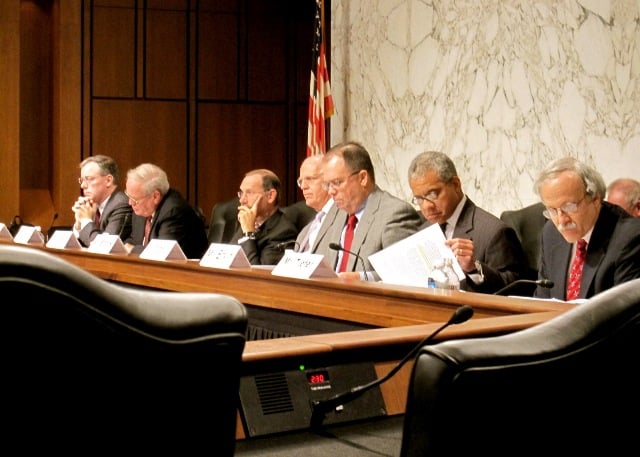
Co-Chair Christopher Shays, a former U.S. Representative for Connecticut, said, “The Commission finds the government is over-relying on contractors. Even if you think having more than 260,000 contractor employees at work in Iraq and Afghanistan, at times outnumbering the military they support, is reasonable, there are still problems. Some contractors have been performing tasks that only federal employees should perform, while others are doing work that is permissible but still too risky or inappropriate for contractors. And overall, there is simply too much contracting for the federal contract-management and oversight workforce to handle. From every angle, that’s over-reliance.”
The co-chairs said fraud and abuse are problems in wartime contracting, but the biggest challenge is waste. Thibault said, “We have founds billions of dollars of waste stemming from a variety of shortcomings—poor decision making, vague contract requirements, lack of adequately trained federal oversight people in the field, duplicative or unnecessary work, failure to revise or recompete contracts, unsustainable projects, inadequate business processes among contractors, and delayed audits. There are many causes, and no simple solution.”
Based on research and hearing testimony, the Commission estimates that waste and fraud have amounted to at least $31 billion, and possibly as much as $60 billion, during the operations in Iraq and Afghanistan. The final report warns that at least as much additional waste may develop if host countries cannot or will not sustain U.S.-funded projects and programs after the United States hands them over or reduces its support.
Shays said the Commission report lays blame at the doorsteps of both government and the contracting industry. “Many of the convictions and guilty pleas for bribery, kickbacks, theft, and other offenses involve federal civilians and members of the military,” he said. “Likewise, poor performance shows up both in government and contractor operations. We’ve had soldiers injured or electrocuted because of faulty wiring in base showers, and we’ve had federal officials tolerating a far greater supply of contract labor than was needed for military-vehicle maintenance. There is plenty of blame to go around.” Shays called attention to a key paragraph in the executive summary of the Commission’s final report:
Comments are closed.