


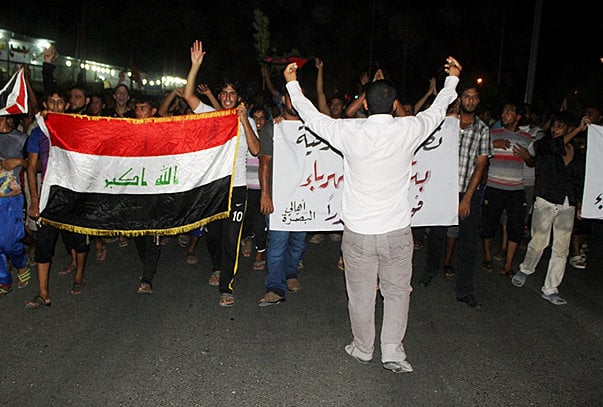
Last week, a group of protesters marched to the city government offices and pelted the buildings with stones, while others set fire to tyres that security forces had used to make barricades to stop them.
One protester, manual labourer Hussein Musafer, explained why his patience had run out. "When it gets hot, prices also rise for fuel and ice. We can’t afford it – we are poor. Officials need to be aware of our suffering. They won’t know if we stay at home, so I’ve taken to the streets."
Housewife Um Hamadi also took part in demonstrations, saying that the power cuts made observing the fast unnecessarily arduous.
"While we deprive ourselves of water through the day, officials are depriving us of air," she said.
Iraq's electricity shortages date as far back as the 1991 Gulf War, when United States air strikes damaged power stations. The electricity industry’s infrastructure continued to crumble during the years of United Nations sanctions that followed.
After Saddam Hussein was ousted in 2003, the international community invested heavily in restoring the power network, but armed violence, mismanagement and corruption has meant that electricity distribution remains intermittent at best.
Domestic production of around 2,700 megawatts a day is less than one-third of the country’s actual demand.
Outages occur in every part of Iraq, and power is typically available for four or five hours a day, sometimes less. The effects are particularly hard for people in the south, the hottest part of the country. Daytime temperatures in Basra can rise above 55 degrees Celsius.
Comments are closed.