


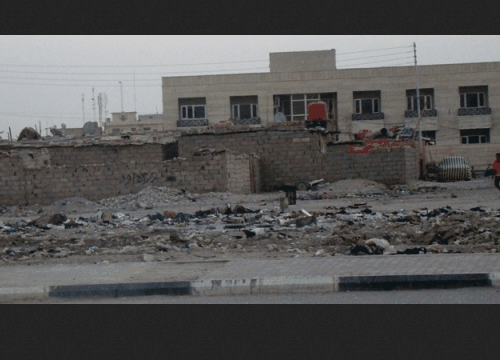
Construction worker Fuad Abdul-Mahdi lives with his wife and baby in one of the shanty towns in Ashar in central Basra. “I bought my house from one of the people living there and I have expanded it a little bit. About a year ago police raided the town; they fired their guns in the air and they tried to demolish the houses here,” Abdul-Mahdi says. “They told us we had to leave and that only the people who were originally here were entitled to any kind of compensation. They told us we had to leave because we were living on state land that was about to be used for development projects.”
However Abdul-Mahdi says he won’t leave his home. “Let them demolish the place around us,” he says angrily. “I borrowed money from friends and relatives to buy this place and I won’t leave it just like that.”
Mention the local committee tasked with removing their homes and the people living in the shanty towns get angry. Some of the locals who have been here longest recall former Basra governor, Sheltagh Aboud Sherad’s promises of financial payouts if they left the state land. These promises were never kept, they say. Of course, nobody here will talk explicitly about the support from certain parties in the area, if the squatters vote for them. However there’s a feeling amongst them that they’re not going to be going anywhere soon and that, as one says, “this is a long story”.
There is also significant prejudice against the squatter families in the area. Locals say the squatters compete with locals for jobs and tap into the local power and water networks for free. They also assume that the squatter villages are out of control, lawless and refuges for drug dealers and other criminals.
And they call them “Hawasem”. It means “decisive” in Arabic and is the word that former Iraqi leader Saddam Hussein used to use to describe the war he said he would fight against the US military. Now it’s used in an ironic way, to describe the shanty towns and a variety of illegal acts.
Lubnan Park (or Lebanon Park) in the centre of Basra is often seen as an example of this. Once built, some of the squatter houses are divided in two and sold to another family. “We cannot control this area,” acknowledged Sabah al-Zubaidi, an official from the Kut al-Hajjaj neighbourhood in which the park is located. “A year ago, we think there were around 250 families living in this area. We recounted them recently because of security concerns and now we find there are 450 families there. We believe that because of high demand for accommodation among the displaced, that the houses are being divided in two,” al-Zubaidi explains.
Comments are closed.