


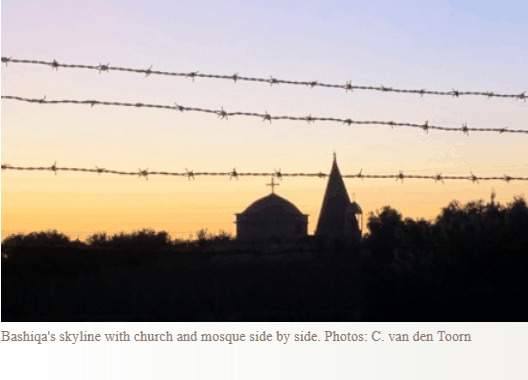
“There are two things we don’t care about in Bashiqa - religion and politics,” one of Bashiqa’s religious leaders told NIQASH. And by “care about”, he meant that these things would never affect the strength of local, communal ties.
These kinds of dynamics have maintained peace in Bashiqa during Iraq’s most contentious periods. One man recalled how, during the reign of Saddam Hussein and his Baath political party, the local Bashiqi Baathists would alert the local Communist Party members when a crackdown or a raid was planned.
A Christian man told how he and his wife shared their one room apartment with a Yazidi man who deserted the army during the Iraq-Iran War in the 1980s, and the deserter’s wife, for an entire year.
In 2007 when a busload of Yazidi workers from Bashiqa was massacred in Mosul by extremists who were allegedly Islamic, Bashiqi Yazidis protected their own local mosque in case “someone from the outside decided to take revenge,” one local man told me.
Throughout history of the town, people in Bashiqa were always Bashiqi first.
However recent changes have challenged the local peace and the communal identity in more ways than one. Bashiqa’s new status as a disputed territory and its inclusion in the semi-autonomous region of Iraqi Kurdistan’s controversial oil contract with Exxon Mobil is one example.
Since 2003, Bashiqa has also become a disputed territory - that is, land that Iraqi Kurdistan says belongs to Iraqi Kurdistan but which Baghdad says belongs to Iraq; Mosul, Kirkuk and other parts of the state of Ninawa are also disputed territories.
Comments are closed.