


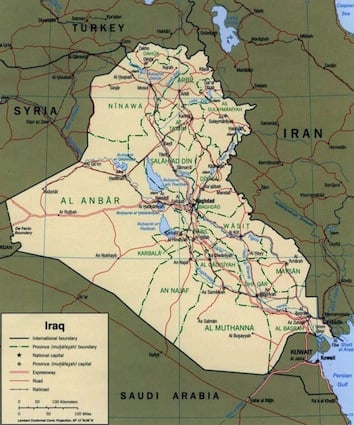
Further west and south clashes erupted in Falluja, after militants attacked a federal police headquarters killing an as yet unknown number, and the day ended with a VBIED exploding in a parked car in central Najaf, killing three people.
With the ISF in a stronger position, having a score of brokered truces in place, the focus of violence shifted west and south during the latter part of the week. Typically, Friday prayers (26 April) provided a rich target list with IEDs killing at least 20 more people in Baghdad, in a series of bomb blasts that targeted mainly Sunni mosques. Later on Friday, a car bomb killed seven in a busy shopping area in the south of the city and in the capital's Shi'ite stronghold of Sadr City, a motorcycle bomb exploded near a kiosk selling falafel, killing five. As yet no group claimed responsibility for any of the attacks with retaliatory attacks from both Sunni insurgents and Shia militias taking place daily, however one cannot rule out the possibility of insurgent groups such as the Sunni ISI deliberately targeting Sunni locales in an attempt to further stoke Sunni anxieties at a point in time where they feel most vulnerable and where ISI wish to gain further legitimacy in the eyes of the protest movement.
Friday Prayers also saw tens of thousands of Sunni Muslims pour onto the streets of Ramadi and Falluja in Al-Anbar, in their biggest show of strength since the outbreak of protests last year. In Ramadi the preacher, wearing military fatigues with his cleric's turban, gave security forces 24 hours to quit the city, warning he would not be responsible for whatever happened after that. On Saturday 27 April a curfew was imposed in the city of Ramadi after militants killed five soldiers who authorities said were returning from holiday to their units. Protesters said they had been sent to attack them after influential Sunni leaders proclaimed the need to mobilise an army to protect Sunni interests in Anbar – "In order to keep Anbar a safe place for the Sunnis, we decided to form an army called the Army of Pride and Dignity with 100 volunteers from each tribe to protect our province," said Sheikh Saeed Al-Lafi, a spokesman for the protest movement. This was subsequently given further support when influential Sunni cleric Sheikh Abdul Malik Al-Saadi, who had previously taken a conciliatory stance and urged restraint, set about congratulating the "honorable Iraqi mujahideen (holy warriors)" on the proclaimed creation of the regional army.
Of late the GoI had quite effectively neutralized the protest movement however last week's army raid on the protest camp in Hawija, near Kirkuk has reignited Sunni discontent and reignited the Sunni heartland tinderbox that is Al-Anbar.
Further afield, violence erupted along the Tigris River Valley as at least four members of a government-backed Sunni "Sahwa" militia were killed when gunmen opened fire at a checkpoint in Awja, outside Tikrit. Police and militants battled in Baiji, a former bastion of Sunni jihadist al Qaeda, about 180 km north of Baghdad and in the Abu Ghraib district of Baghdad, four soldiers were killed early on Saturday in clashes with unidentified gunmen.
Of note and of some concern given historic sensibilities was the confirmation that Kurdish security forces had also deployed beyond the formal boundary of their autonomous region overnight on Saturday, a move they said was to protect civilians in the oil-rich territory over which both the Kurds and Baghdad claim jurisdiction. The situation remains febrile and little is clear about whether the KRG is genuine in deploying to protect the interests of its civilians. Commentators have also suggested that the move could also be construed as opportunist territory grabbing at a time when security situation is extremely fluid and the ISF is engaged on many fronts and spread thinly.
Comments are closed.