


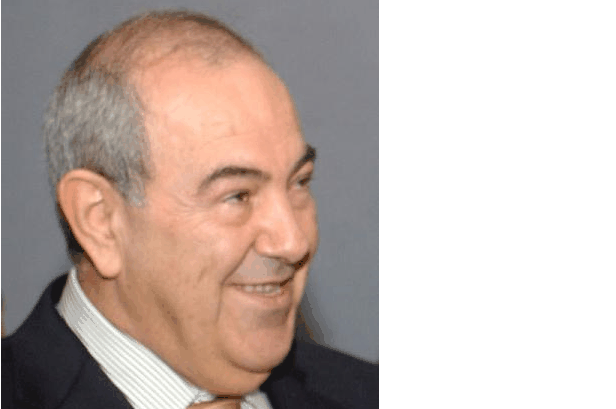
The leaders of the various Iraqi factions had held a series of meetings in Erbil in 2010, resulting in a power-sharing agreement whereby Maliki became prime minister and the Kurdish veteran politician Jalal Talabani became president. For his part, Allawi headed the council that was supposed to coordinate the process of making important decisions in the country. Allawi said Maliki disregarded this agreement, however, as soon as he received the support of the parliament for a second term.
Allawi firmly believes that Iran — the Shiite eastern neighbor of Iraq — objected to him being placed at the head of the government again. “Iran is determined to confiscate Iraq’s political decision,” said Allawi, who added that he visited Syrian President Bashar al-Assad in 2010 during negotiations to form the Iraqi government. “Assad literally told me: ‘Iran will not allow you to take over as prime minister in Iraq; and, if you want that, you need to go to Tehran and speak to the officials there.’ I absolutely refused to go to Iran, because I do not want [to hold] a position in Iraq that is given to me by another state.”
Allawi denied that his Iraqiya List allies objected to him holding the post of president of the republic during negotiations to form a government in 2010. “All Iraqiya leaders told me that they do not mind if I take over this post, but I refused, because this will provoke our brothers, the Kurds,” he said.
Asked by Al-Monitor about the news reporting that Maliki proposed that he [Allawi] holds the post of president, with the powers of the commander in chief of the armed forces, he replied, “When we went to Erbil to sign the US-sponsored agreement to form a government led by Maliki, we worked on achieving a true partnership in managing the country.
“Maliki, Massoud Barzani and I signed a document that includes pledges to bring about this partnership; the US ambassador in Iraq was a witness on that." He added, “Once we got to parliament to bring this document into reality, the partners turned against us.”
There is no smoke without a fire.
The Sunnis are obviously discriminated and obviously have a dream of getting things better for them, perhaps coming back to good old days, or?
Why no trying a federal state approach like the KRG is doing for El-Anbar and Ninewa?
In principle any major region could become a self ruling region if fair engagement rules were created between the central and the regional governments. If it is working in so many other countries like Switzerland, Germany and the USA. Is democracy in Iraq so difficult to accept?
Unfortunately, Iraq is the Ali Baba country with so many thieves but there is no reason why things should continue the way they are. Changes no matter in which name, the Iraqi spring or the other spring are major challenges for all rulers of Iraq but the citizens have a voice and should stop thinking that it is useless, there is no hope unless we become a part of the theft to other less fortunate Iraqis citizens.
All is about your family, children, grandchildren and what you want to leave after you to them. An Ali-Baba thieve society or something better than you ever had? Is it worth a try?