



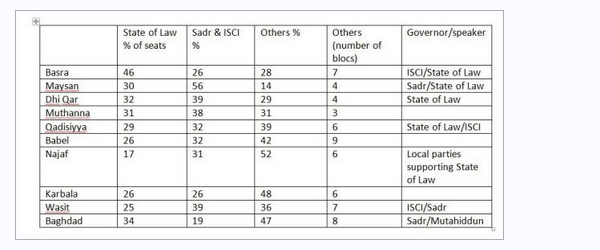
Second, there are competitive governorates. These include Najaf (local parties backed by State of Law in both top positions), Wasit (ISCI governor/Sadrist speaker), Baghdad (Sadrist governor/Mutahiddun speaker) and Dhi Qar (State of Law in both top positions). In these governorates, the votes on new government were characterised by boycotts and loud protests by the losers, highlighting the extent to which competition among the Shiite parties remains intense. The Baghdad outcome – where Maliki’s candidates also received a strong popular mandate in the shape of personal votes and a large number of seats – is another particularly interesting example that ISCI and the Sadrists are prepared to go to lengths to challenge Maliki. The inclusion of the Sunni-secular Mutahhidun bloc of parliament speaker Usama al-Nujayfi makes the development even more interesting in that it approximates the logic that has sometimes manifested itself at the national level in challenges to Maliki’s premiership. Conversely, though, there is the example of the Sunni-majority Salahaddin – one of the first governorates to elect a new government after the latest elections – where a governor from a local bloc with a reasonably good relationship to Maliki was confirmed in power despite challenges from more anti-Maliki forces in the various Iraqiyya factions.
What remains are Karbala, Diyala, Babel and Muthanna. It will be interesting to see which of the two tendencies above – consensus or political majority – will prevail. As the table of results so far shows, there is no neat and easy correlation between seat results, political fragmentation and who gets the governorship:
So far, it seems ISCI in particular is finding back to the dexterity in coalition-building that characterised the party in 2005, when relatively modest electoral performance was translated into massive political influence through key positions in local government. That said, ISCI was also the party that got most heavily punished at the next local and national elections (2009 and 2010 respectively), meaning it may not be the biggest catastrophe for Maliki to have fewer incumbent governors come parliamentary elections time in 2014. Perhaps more crucial to the future of his premiership will be the outcome of delayed local elections in Anbar and Nineveh who vote on Thursday 20 June. Here, given the Sunni majorities, Maliki’s stakes are more indirect. However, the extent to which Sunni radicalism prospers in these areas as a spillover from the Syria conflict may be a key factor in Maliki’s chances of forming a viable electoral coalition for 2014.
Comments are closed.