


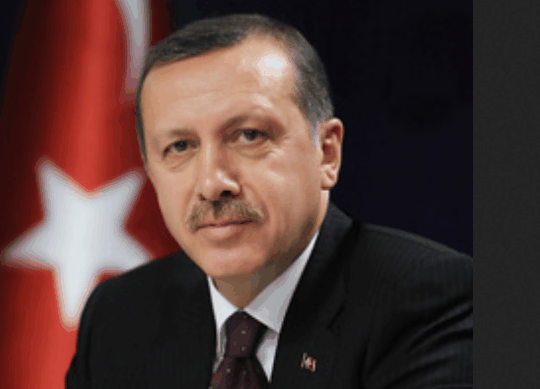
He pointed to the economic relations that prospered during the rule of Erdogan, the arrival of hundreds of Turkish companies to work in the region, and the influx of thousands of workers to work in Kurdish cities in the Iraqi Kurdistan, noting that “the Turkish opposition wants to abort these gains under the pretext of cutting some trees in one of the public squares of Istanbul.”
Turkish-Kurdish relations, both at the economic and political levels, have developed significantly as of late, and the most important development in these relations may be Erdogan’s visit to the city of Erbil at the end of March 2011, and his participation in the inauguration ceremonies for Erbil International Airport, the Turkish consulate in Erbil and two Turkish banks. During his visit, Erdogan met with Iraqi Kurdistan Region President Massoud Barzani.
According to the statistics of the Ministry of Trade and Industry in the Kurdistan Regional Government (KRG), out of a total of 2,250 foreign companies operating in the region, about 50% are Turkish companies, not to mention thousands of Turkish workers who are working on construction projects, in the hotel and restaurant sectors or business centers in the Kurdistan region of Iraq.
The KRG has strong ties in the oil sector with the Turkish government and companies. Chief among these are those relating to the extension of the oil pipeline that will connect the region's oil wells with the Turkish port of Ceyhan, which will hopefully be completed by the end of 2014.
The KRG says that it will finish an oil pipeline to directly link the region’s wells to the outside world by the end of 2014, or the beginning of 2015 at the latest. Previously, the region’s wells had been linked to the Iraqi-Turkish pipeline that connects Kirkuk with Ceyhan.
Economists and analysts of the Turkish-Kurdish developments confirm that these relationships will be affected if the internal demonstrations and protests in Turkey manage to topple Erdogan's government.
Comments are closed.