


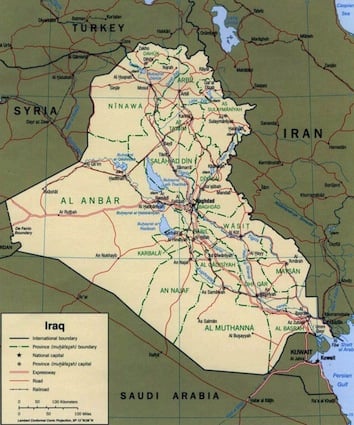
Gun attacks and a bombing killed at least seven more people in Iraq on Sunday 11 August. The government backed ‘Sahwa’ militia once again was targeted after gunmen opened fire at a checkpoint killing two and wounding two in the town of Buhriz, about 60 km northeast of Baghdad. Further north, gunmen attacked a busy park in the town of Balad, killing two and wounding three and to the south of the capital, three anti-terrorism squad officers were killed and nine wounded by a roadside bomb in the town of Mahaweel, 60 km from Baghdad.
Many commentators have suggested that these figures are somewhat conservative as the reporting period has been confused and plagued by contradictions from the ISF who remain keen to play down their losses, which have been heavy of late. For example Iraq's Interior Ministry said media reports about the attacks in Baghdad that killed 50, many of whom were ISF, had been exaggerated in a way that would give a morale boost to attackers. It said 21 people had been killed across Iraq in the multiple attacks and that a recent security crackdown called "Avenge the Martyrs" had been effective.
Monday 12 August saw at least 16 people killed and 41 wounded in a suicide bomb attack on a crowded cafe in Balad, 80 km north of Baghdad, which has borne the brunt of some of the worst violence in Balad in around five years.
Further afield two roadside bombs - one planted near a playground and another near a school - also killed six people and wounded dozens, many of them children, in the town of Muqdadiya, 80 km northeast of the capital. As mentioned earlier those blasts underlined a shift in tactics by insurgents, who are increasingly targeting not only military checkpoints and marketplaces, but also cafes and recreational areas used by families and children as part of their campaign to wholly undermine the Government’s promise that will be able to protect Iraqi society across the sectarian divide.
The ISI claimed responsibility for the weekend attacks and further warned the government to stop arresting suspected militants or face more violence. "The Islamic State deployed some of its security efforts in Baghdad and the southern province and other places to deliver a quick message," ISIL said, according to the SITE Monitoring group, which tracks jihadist websites.
The renewed violence prompted a statement from Washington condemning the attacks and offering to work closely with Baghdad to confront al Qaeda and other groups (there remains a USD$10M reward for information leading to the killing or capture of Abu Bakr al-Baghdadi, the AQI leader), a move that is seen as an absolute necessity by many who consider that the ISF are in dire need of a capability uplift in order to deal with the threat of an emboldened Sunni insurgency.
DTN Iraq: Weekly Security Update 07 – 14 August 2013: By Tom Walker, Director, Assaye Risk COUNTRY OVERVIEW Th... http://t.co/BxacmSUjHJ