


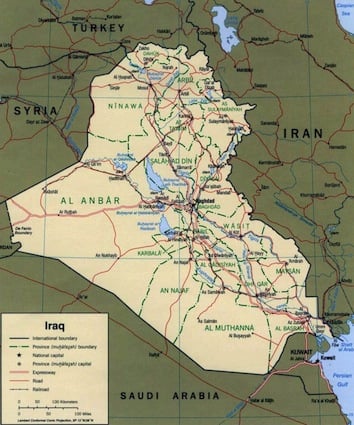
Once again the reporting period has been confused. There have been increasing number of attacks against Sunni targets but it remains difficult to determine if we are seeing an increase in Shiite counter-attacks or whether Sunni groups are deliberately targeting their own in an attempt to draw the more moderate elements away from their belief in the Iraqi nation. It is likely that we are witnessing a mixture of both. In line with last weeks commentary this past month has seen a significant increase in Shia militia mobilization and many parts of Baghdad are littered with the ‘red flag’ of revenge. In the wake of numerous killings of Shia last week the red flag of revenge flies over many houses in Baghdad's Shi'ite stronghold of Sadr City, where residents are mourning the victims of a triple bombing that killed 85 people at a funeral in the same place at the weekend.
The deterioration of security is undermining Shi'ite Prime Minister Nuri al-Maliki, who is also commander-in-chief of the armed forces, and who won the last election by presenting himself as the man who restored a measure of stability to Iraq.
"Logic dictates that the more attacks by al Qaeda, the less credibility will be left for Maliki," said former general Shakir Salman, a military analyst who advises Iraq's defence ministry.
"It's just like a boxing match, whoever punches more scores higher points."
Trained and equipped by Washington at a cost of nearly $25 billion (15 billion pounds) and more than a million strong, Iraq's security forces have yet to master foes who fought the U.S. military in the years after the invasion that toppled Saddam Hussein in 2003.
More than 5,500 people have been killed in violence this year and so far, the killing has been largely one-sided. Shi'ite militias, most of which disarmed, joined the reconstituted army and police or entered the political process in recent years, have refrained from retaliating for attacks by Sunni insurgents, but in Sadr City, where the Shi'ite Mehdi Army militia still has a strong presence, people are losing patience.
Rivals of Maliki, both Sunni and Shi'ite, are likely to seize upon the worsening security outlook to thwart any ambition he may have of seeking a third term in next year's elections.
In response, the government is looking at plans to create a state-backed Shi'ite militia to combat al Qaeda and prevent local groups taking matters into their own hands, officials say.
The idea is to combine elements from the Asaib al-Haq and Kata'ib Hezbollah militias, which ceased fighting in Iraq after 2011, as well as members of the former Mehdi army, which Maliki defeated in a U.S.-backed offensive in 2008.
Mehdi Army leader Muqtada al-Sadr has since become a potent force in mainstream politics and will have great deal of influence over how much more the Shia community can absorb and how much more they resist the temptation to retaliate in force, placing him in a strong position politically.
Weekly Security Update 19 – 26 September 2013 | Iraq Business News http://t.co/VQLzDOPaBI
RT @iraqbiznews: Weekly Security Update 19 - 26 September 2013:
By Tom Walker, Director, Assaye R... http://t.co/e6DVLEYGkD