


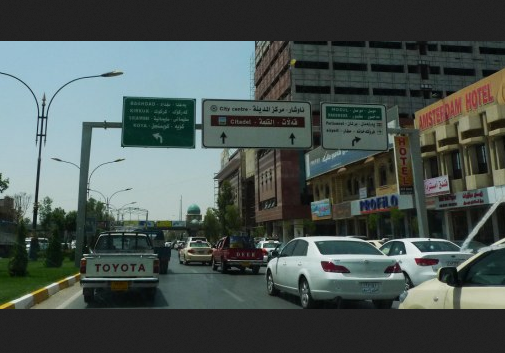
The result was a number of recommendations such as a committee to follow up on checkpoints’ work and the replacement of heavy concrete barriers with plastic barriers, in order to ease the flow of vehicles. Those manning the checkpoints were also exhorted to work harder to process more cars during peak flows.
The latest estimates say there are well over 1 million cars on Baghdad’s streets, consuming about US$2.68 million worth of petrol daily (as based on local fuel prices, per litre). Oil Ministry spokesman Assem Jihad says that his Ministry distributes 15 million litres a day across the whole nation with about half of that going to Baghdad. “But cars here use more fuel than they should because they move so slowly,” Jihad notes.
As news website Middle East Online reported recently in a story on plans to reduce Baghdad’s traffic jams: “The six million-odd residents of Baghdad are heavily dependent on their personal cars, with little in the way of public transport aside from minibuses and taxis”.
Taxi driver Abbas Jassim said that in 20 years on Baghdad’s roads he had never really minded the congestion. It was the checkpoints that made his life so difficult.
“They are not checkpoints,” he fumed. “They are delay points! Sometimes the security forces just stand in the middle of the street and don’t inspect any cars. But still they force all the cars to go through, one by one.”
Another taxi driver, Hamid Qassim, explains why the cabbies have to charge fares the way they do. The checkpoints are to blame, he says. “It depends on how long a trip takes. If it takes more than half an hour we need to increase the price,” he told NIQASH.
It has become very difficult for locals to get to any appointments on time. So much so that, if you ask around, it’s hard to find anyone getting anywhere punctually.
Comments are closed.