


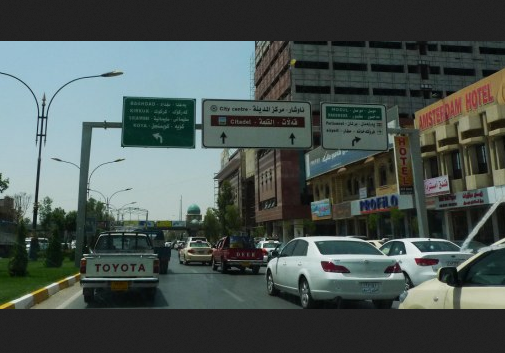
“I have to leave my house at 6:30am in order to get to the office on time, at 8:30am,” says Maysa Sabah, a member of staff at the Ministry of Culture. “I have to pass through seven checkpoints and many traffic intersections. I actually prefer to take a taxi earlier in the week. It makes me really tired.”
Although it’s obviously hard to prove, some locals now say that the traffic jams are having an impact on Baghdadis’ mental and physical health. Queuing for hours causes tension, stress, high blood pressure and heart disease, they say. It’s quite common to see people getting involved in fist fights on the streets too, next to their cars near checkpoints.
"Being stuck in traffic can cause all sorts of health problems,” agrees Baghdad doctor, Salam al-Khafaji. “The main reason though is the environmental pollution – you’re breathing in exhaust fumes for longer.”
A spokesman for Baghdad’s traffic police, Najm Abdullah Jaber, was quick to admit that the checkpoints and various road closures were causing big problems in the city. “It’s become a real problem,” Jaber told NIQASH. “But we can’t sacrifice security by removing the checkpoints.”
But it’s not all about the checkpoints either. “There are an estimated 1.5 million cars in Baghdad,” Jaber added, “and the city wasn’t built to cope with that many vehicles. There is also a need for more roads and bridges.”
Meanwhile MP Mathhar al-Janabi, who is a member of the Parliamentary committee on security and defence, was demanding that some of the security checkpoints be dismantled and removed. He – and doubtless many other Baghdadis – think they may only be slightly better than useless; they don’t seem to have prevented the recent rash of violence, which has included car bombings, in the city. They also use outdated and arbitrary methods of inspection.
“The explosions haven’t stopped which is enough evidence of the checkpoints’ ineffectiveness for me,” al-Janabi told NIQASH. “The checkpoints only delay our people, they do not protect them.”
Comments are closed.