


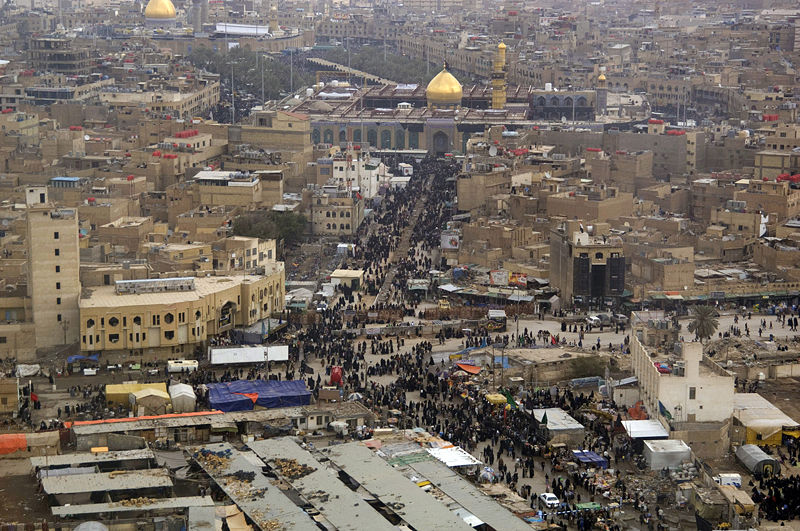
It’s not about the money, says local professor of economics, Odeh Hussein. “Karbala is a comparatively small province and if the money it was allocated had been used sensibly, the province would have made great progress.”
The problem lies in the fact that most of the contracts signed by contractors in Karbala have a flaw, Hussein explains. No penalty is defined if the contractors do not fulfil their obligations. So that means they are able to delay or postpone their work as they wish. “Now half of the projects are under way and the other half sits unfinished,” Hussein notes. “And because of the flaw in the contracts, neither the local or federal government is able to do anything about it.”
Hussein then gave the example of the equally small province of Maysan in southern Iraq. They were able to make a real breakthrough in the area of reconstruction and service provision because of different methods of contracting.
There is also the issue of corruption, the professor says. Iraq came 171st out of 177 countries on Transparency International’s Corruption Perceptions index. The index “ranks countries based on how corrupt a country’s public sector is perceived to be”.
Most Iraqis believe that a lot of the construction, or other, projects are given to companies that either don’t exist or which are incompetent – often those companies are seen as being close to decision makers and high ranking officials. “All of this has an impact,” Hussein says. For one thing, the slow pace of progress makes investors less likely to want to put money into Karbala.
And Hussein feels that the construction sector must be one of the most corrupt. People often speak about bribes offered to decision makers. Additionally a lot of Iraq’s wealth has been spent on construction projects over the past decade yet somehow nothing is ever achieved.
“It would be safe to assume that reconstruction was the most corrupt sector because of the amount of money spent on this sector,” Hussein told NIQASH.
Comments are closed.