


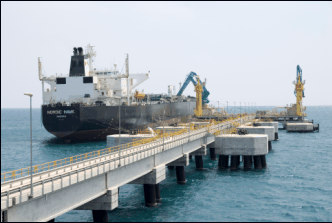
It appears the KRG has decided to put the bar high just before negotiations with other Iraqi forces to form a new government, and to impose a fait accompli through bypassing Baghdad's refusal for the region to export its oil independently. This is done in the hope that Maliki or any of his competitors’ need for Kurdish support will force them to adapt to the new situation.
So far, it seems that this step has deepened the crisis in relations between Baghdad and Erbil. The Iraqi government announced on May 23 that it was prosecuting the Turkish government for violating an agreement between the two sides not to deal with any party other than the federal government when it comes to exporting oil through Turkish territory.
Furthermore, Baghdad announced that the Iraqi Oil Ministry will boycott any party proven to import "looted" Iraqi oil from the Kurdistan region. In contrast, KRG Prime Minister Nechirvan Barzani has threatened to take additional unilateral steps if Baghdad does not respond to the KRG's demands. He added that Baghdad has only delivered 10% of the region's share of the federal budget, which the Kurds stress should be 17%.
As a kind of reassurance, most Kurdish statements indicate that Iraqi Kurdistan will adhere to treating the exported oil as Iraqi oil, and thus would only deduct the region's share of the proceeds and send the remaining amount to Baghdad. However, Mouayed Tayyib, the spokesman for the Kurdistan Alliance bloc, argued that the region would retain all revenue from the oil if Baghdad insisted on nonpayment of what the Kurds considered the dues owed to them by the Iraqi government.
However, at a time when the KRG is directing blame at Maliki alone, to the extent of declaring that if he remains at his post this would lead to the division of Iraq, this step may be more harmful to his opponents than to Maliki himself. Both preceding and following the April 30 elections there was a lot of talk about the possibility of a front — comprising Shiite, Sunni and Kurdish powers — to prevent Maliki remaining in office for a third term.
Iraqs most precious resources are water and oil. The confict with the kurds is naive and very closed to high incompetence.
To force the kurds to submission is a very difficult and expensive game. The issue is becoming more and more an "ego/chauvinist" problem.
What could happens to the kurds when Baghdad cut the salaries of ALL public functions? A collapse of the kurdish society? Of course, when import/exports in Kurdistan decreases by 50%, all public servants do not get their salaries for more than 3 months, which alternatives do the kurds have? Total submission or fight for an alternative solution.
Imagine what happens in Europe when they had a financial crisis in Greece or the result of decreasing their GDP by 25% in one single year. Or think what happened to the USA when the Public Sector were about to be fired since there was no budget, nor money for the public functions. All those citizens in USA and Europe perceived those situations as a major crisis threatening their existence.
And the kurds by those measures have been more resilient and are getting their act together by visiting foreign countries, finding buyers for iraqi oil (from Kuristan) at higher prices that SOMO ever fixed.
Getting reassurances from France, Germany, Italy, UK and Turkey (all NATO members) that they will buy the iraqi oil from Kurdistan. And what does the central government in Baghdad? Nothing or rather looking at their navels and fat bellies?
To foment iraqi resistance against Baghdad is a very bad move for Iraq. To destroy all sorts of bridges to etnical minorities is even worse.
Is there any decent politician or reliigous leader with common sense who can save Iraq from division, split and internal war? Speak up now because the time is becoming more and more scarce.
The problem of potable, drinking water in Bagdad and Basra which is far more expensive than the finest Basra Light Oil is scaring more than the oil dispute with the kurds.
Iraq is very much depending on the good faith and goodwill from Turkey, Iran, Syria and the North of Iraq or Kurdistan for having drinking water for the population. If things continue as it seems then 30-50% of the water coming from the main rivers will decrease or consumed "up North". Why is not Baghdad building desalinitation plants in Basra, like they do in Kuwait? Are we still counting with "free lunches" for all years to come in terms of good hearted neighbors to give us our drinking water? Is that the reason why we give the neighbouring countries bad names? Just to make sure that we pissed them off?
Therefore I believe that this "ego/chauvinist" approach will cause very serious problems to Iraq or until some decent poitician with common sense appears.