


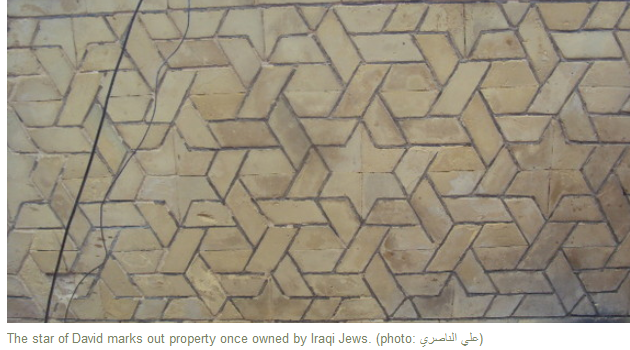
Cohen’s departure was preceded by many others. After the end of World War II in Europe, the lives of local Jews were under pressure thanks to ongoing conflicts between other Arab states in the Middle East and the new state of Israel. A fledgling Israel also became a draw card for Iraq’s Jews, thousands of whom left behind businesses and real estate in order to move there.
“My father worked with a Jewish goldsmith, Khadouri Haron, and learned the trade from him,” recalls Ihsan al-Faraj, a young, local artist. “We were one society,” he says. “But Haron left the city and sold all of his property and liquidated his business.”
Although modern history indicates that conditions were made very difficult for Iraqi Jews in the country after the establishment of the independent state of Israel in 1948, al-Tuwaili says that, as far as he knows, the Jews of Dhi Qar left voluntarily after 1948. There was no pressure from their neighbours; it was only political events at the time that caused them to leave.
Out of around 140,000 or so Iraqi Jews, by the early 1950s, only an estimated 15,000 were left behind. These numbers dwindled even further over the next decades and in 2003, there were less than 100 Iraqi Jews left in the country.
“When they left, the Jews often gave their property to their friends in the city,” al-Tuwaili suggests. “Often they used a kind of mortgage system, selling their property for a certain price, on the condition that the sellers can buy the real estate back when they return.”
DTN Iraq: Remembering the Jews of Dhi Qar in City’s Architecture: This article was originally published by Ni... https://t.co/mIqxeov0DI
Remembering the Jews of Dhi Qar in City’s Architecture: This article was originally published by Niqash... https://t.co/iZIJSL0ZRZ #Iraq