


By John Lee.
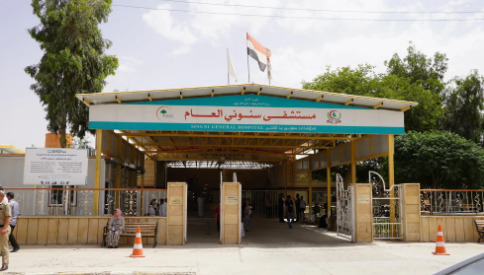
Médecins Sans Frontières (MSF) [Doctors Without Borders] has handed over its medical activities in the Sinuni General Hospital to the Ninewa Directorate of Health.
Full text of statement from MSF:
MSF hands over medical activities at Sinuni General Hospital in Sinjar
Five years after our first efforts to restore people's access to medical services in Sinuni district, in Iraq's Ninewa governorate, Médecins Sans Frontières (MSF) has handed over our medical activities in the Sinuni General Hospital to the Ninewa Directorate of Health and to another humanitarian organisation.
Located north of Mount Sinjar, in the northwest of Ninewa governorate, Sinuni town and the surrounding area came under the control of the Islamic State (IS) group from August to December 2014, when it was the scene of extreme acts of violence, mainly targeting the Yazidi community. Today, the people of Sinuni have come a long way on their journey towards recovery.
MSF teams started working at Sinuni General Hospital in August 2018.
"When we arrived, the hospital was only providing very basic services, with limited supplies and few medical or technical staff," says Baroj Hussein, MSF head of mission advisor in Iraq. "Even water and electricity supplies were not constantly available."
"We were warmly welcomed in Sinuni," says Hussein. "The community already knew us very well, as we were providing our medical services in displacement camps and informal settlements where people from the community had taken shelter in the Kurdistan region."
MSF's aim in Sinuni was to restore healthcare services for the local community and for people returning to the area. We started by fully rehabilitating the hospital building and putting in place everything the hospital needed to function smoothly. Next, our teams started providing emergency medical care, maternity care, and care for children and newborn babies.
Following the end of the battle to retake Sinjar district from the IS group, displaced people started returning to their homes. Having a fully functioning hospital in the area was an incentive for them to return.
"Displaced people became more confident in coming back home because MSF was there, at a time when no other maternity services were available," says Khalfa Ilyas, MSF midwife supervisor at Sinuni General Hospital.
Most former residents of Sinjar region chose to return to Sinuni town, because it was relatively undamaged and because security was restored there sooner than elsewhere in the region.
"When we first set foot in Sinuni in early 2018, the place felt like a ghost town, despite some people having returned there," says Hussein. "People rarely ventured out in public, and life seemed to have come to a standstill. People had nothing and could not access anything as businesses and services were not restored."
Many people from the Yazidi community suffered immense psychological trauma during the time the region was under IS control and while displaced. Recognising that people in Sinuni required more than just physical healing, MSF introduced comprehensive mental health services. By providing counselling, psychological support and psychiatric care, our teams addressed these invisible wounds.
These activities were carried out both in the hospital and within the community, with MSF health promotion teams raising awareness about mental healthcare and making sure that local people knew how to access these services.
During the 2022 COVID-19 pandemic, we expanded our services by setting up a seven-bed isolation unit to treat patients with mild and moderate forms of the disease and to help stop the virus from spreading, while bringing in essential supplies.
"MSF entered the picture when the community had nothing," says Elias Musa Ali, a community member and former MSF watchman. "During the darkest days of the COVID-19 pandemic, when much-needed personal protective materials were scarce, MSF stepped in with vital supplies. The overall support MSF provided left an indelible mark on Sinuni."
Throughout their five years in Sinuni, MSF teams also focused on passing on their expertise, building capacity and investing in the training and professional development of local healthcare professionals.
(Source: MSF)
Comments are closed.