


By Aziz Al Nassiri.
This document explains the Iraqi University Ecosystem (IUE) project
Introduction: The business environment in Iraq is one of the most challenging in the region. Instability, lawlessness, corruption, absence of development plans, flight of capital, brain drain, diminution of the middle class, rentier economy, rapid population growth, global warming, Fourth Industrial Revolution. These and some other factors have combined to turn Iraq into a failed state. One particular outcome of the failed state in Iraq, is extremely high rates of unemployment. Youth unemployment in particular is a contributory factor to the causes outlined above. Therefore, we are in a vicious circle situation.
Goal: The IUE seeks to break the circle once and forever by creating an environment where a specific group of people (community), are able to somewhat isolate themselves from these factors and to work towards eradicating unemployment within the group. The IUE uses several approaches to achieve the goal. These approaches are in summary based on: Innovation, Professionalism, Entrepreneurship, Fair Trade, Crowdsourcing, Cooperation, and Collaboration. In applying these approaches, the IUE uses a variety of mechanisms and processes to focus the entire endevour on new job creation and assisting individuals in winning new job vacancies.
Vision: The IUE is a radical, sustainable, and self-financing initiative. The design embodies a number of influences:
- "Community Wealth Building" projects, particularly the "Preston Model". These are post Covid 19 global recovery models.
- Crowdsourcing approaches
- Fair trading
- Noninterference with the university's business of education
- Covering multiple professional life choices of individuals
- Personal first-hand experiences working for international corporates for over 25 years in UK, Europe and Gulf states, and in addition to being CEO of a respectable Iraqi company in Baghdad for 15 years. Moreover, of being an Iraqi activist working voluntarily on graduate unemployment issues since 2015 and having led several initiatives.
Community: It should be noted that the IUE creates a dynamically growing community. By choosing a well-established university, we are ensuring there is new blood (graduates and students) being added to the community annually. Hence the community is made up of the entire Alumni (since the university was established) in addition to today's students, faculty and none teaching staff too. Although the geography that the community occupies is predominantly within Iraq, experience have shown that on average some 30% of members are resident outside Iraq. Involvement of the Iraqi diaspora in this community is a strength factor in this project.
Organisation: The community is organized through a cooperative society (NGO) that is owned collectively. Membership includes individuals (Professionals) and entities (companies and organisations owned or managed by Alumni members). Every member of the community is expected to contribute (knowledge, experience, investment, voluntary work) to the community. Each member is to receive benefit from the community as well a providing benefit to others.
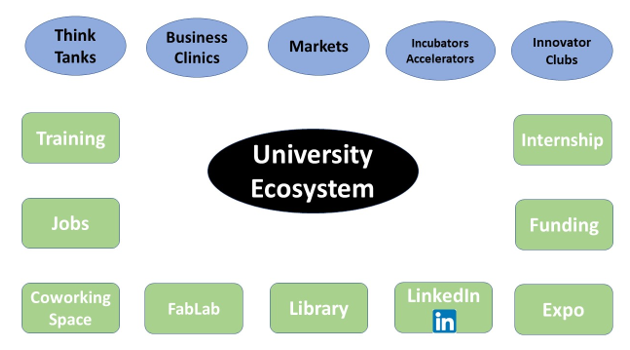
The community will establish a number of programs and activities such as:
- Employability: Intensive Soft business skills training available to all membership as well as employees of the member entities. Over 25 essential skills are covered by the program. Members are also encouraged to have active participation on LinkedIn. Indeed, LinkedIn is where the main group for the ecosystem is located.
- Professionalism: Training for accreditation on various additional skills and learnings associated with all professions covered educationally at the university. Facilities for taking international exams (e.g. Pearson Vue Exam Centre) is also an aim of the ecosystem.
- Business Growth: Encouraging inter-trading between entities (B2B), and trading with individuals (B2C) to create growth (therefore new jobs). Facilities include an online expo style exhibition. An online purchasing system with tendering capability. Additionally, the ecosystem provides Escrow and Arbitration services for all participants.
- Job Market: Entities are expected to announce their job vacancies within the community even though it is not mandatory to offer employment to applicants. The activity is provided via a dedicated exclusive online platform.
- Internships Market: Entities are also expected to offer Summer and post-graduation internship programs. The content of these programs is subject to standard best practice library to be offered by the ecosystem organisation. The activity to be offered via a dedicated online platform.
- Freelancer Market: Individuals offering professional or labour services can advertise and obtain bookings through a dedicated online resource.
- Think Tanks: These are made up of experts, passionates, entities, researchers, and academics, in a specific science/technology/industry topic. Their goal is to help establish businesses related to the topic. The businesses can be owned by others or by individual or entire team of the Thank Tank. Think Tanks can be initiated by individuals, and companies. These include companies with a special relationship with the university. Global companies operating in Iraq are also encouraged to initiate Think Tanks in their name to facilitate new innovations in their line of business. The Think Tank is expected to act as one or more of the following:
- A specialized incubator
- A subject matter expert resource for startups operating within the same space
- A franchise business owning a well planned and operated practice that is on offer to franchisees from the community
- Creating and managing a new Industry in Iraq based on the topic of the Think Tank (Blue Ocean strategy)
- Company Clinics: These are specialist teams offering consultancy services to companies within the community to help solve management and organizational issues. Business Process Re-engineering being one of the focus activities of the clinics.
- Product Clinics: Specialist innovation teams helping to improve products and services marketed by member companies.
- Incubators & Accelerators: These are standard fixtures these days in the innovation and entrepreneurship domains. Since nearly a third of the community is resident all over the world, it is envisaged there will be a physical and virtual pair of incubators and accelerators. These resources will develop and operate 2-3 programs annually for entrepreneurs.
- Innovator Clubs: These are dedicated gatherings (on campus for students and virtual for graduates). They are intended for would be entrepreneurs (pre incubation), inventors, and teams of innovators. The latter group will work on a "Cooperative Company" initiative, whereby a group of individuals work together to define a problem, design a solution, establish a company on paper to sell the solution, then actually register and launch the company collectively as a cooperative. In the case of the students' club, the program runs over 4 years (length of bachelor undergraduate education in Iraq). The intention is to launch these companies immediately post-graduation. The program is supervised by senior managers from groups of companies within the ecosystem. These companies are to also fund and own a percentage of these cooperatives.
- Startup Support: Programs to include coworking Space provided on campus by the university for startups. Regular competitions for funding (Shark Tank - Dragon's Den style). Hackathons.
- Fablab: A lab with multiple numerical and digital machinery for developing models of new products (prototypes) for both existing companies and startups. The lab is located on campus and connected with MIT worldwide FabLab community.
- Electronic Library: Contains all graduation projects, research papers and patents produced at the university over the years. The aim is to provide entrepreneurs with a source of readily available solutions to shorten the ideation phase of their journey. The Ecosystem guarantees authors rights in any resulting commercial
- Funding:
- Funding Startups: The ecosystem community operates investment wallets for equity investments. Member companies and individual investors from the community are encouraged to participate wallets that suit their investment capacity. Wallets range from $1000 to $1 m from each participant. There is also a CrowdFund wallet which based on $10 tickets. The crowdfund includes a lottery draw for the participants to encourage regular funding. All investment decisions are made by representatives chosen by wallet participants.
- Financing Ecosystem Operations: The Ecosystem must be self-financing to be able to survive in the harsh Iraqi business environment. Financing comes from levying small amounts on most marketplace trading activities. Similarly all activities and programs that generates revenues are also subject to small Ecosystem taxes. Companies are encouraged to spend some of their social responsibility budgets on sponsorship of Ecosystem activities. No direct contributions are collected from membership.
Implementation: So far there is 1 instance of implementation of the IUE with a public sector university, namely with the University of Technology (Baghdad). In addition 4 private sector universities have expressed desire to start their own ecosystems soon. The Iraqi Federal Ministry of Higher Education are actively requesting all Iraqi unoiversities to follow the example of the University of Technology by implementing their own instanses of the Ecosystem.
There are efforts currently underway to develop a version of the ecosystem for Iraqi Diaspora communities around the world, in particular where community size exceeds 200k. Change makers are encouraged to use the ideas expresssed in the Iraqi University Ecosystem as they are, or modified, in their own communities.
Author: Aziz Alnassiri
WhatsApp: +964 7901941405
Email: [email protected]
LinkedIn: https://www.linkedin.com/in/azizalnassiri/
September 2023
Comments are closed.