


By Sameedha Mahajan, Architect and Urban Designer. Any opinions expressed are those of the author(s), and do not necessarily reflect the views of Iraq Business News.
Introduction
For decades, Iraq has been grappling with conflict, political instability, and economic hardship. Millions have been displaced due to violence, wars, and terrorism, particularly in regions like Mosul and Anbar. Infrastructure damage, weak governance, and ongoing security threats have left many without stable housing or basic services. Environmental challenges such as desertification, water scarcity, and extreme heat have further exacerbated displacement, especially in southern Iraq. As the country rebuilds, I believe we need to move beyond temporary aid and embrace sustainable, community-driven housing solutions that foster resilience, integration, and long-term self-sufficiency.
Through my research and design practice, I have developed a people-centric approach that shifts the paradigm from aid dependency to self-governance. My design, the Community Kits initiative, introduces a model that empowers displaced communities by promoting resource-sharing, economic independence, and social cohesion. This approach unfolds through three key interventions:
- Community Kits, which equip families with essential tools to encourage communal collaboration.
- Women's Courtyards, safe communal spaces supporting skill-building and financial empowerment.
- The Community School, a modular learning and working environment designed to provide vocational training and employment opportunities.
Community Kits: A Self-Governance Model
Traditional rehabilitation models in Iraq have often relied on prolonged external aid, creating cycles of dependency. My approach seeks to empower displaced populations to take ownership of their development, reducing reliance on government or NGO assistance. In a country where conflict and displacement have resulted in stateless communities, enabling self-sufficiency at the grassroots level can promote social stability and integration.
Building upon the existing aid infrastructure provided by organizations like UNHCR, I have designed the Community Kit - a basic set of materials provided to each arriving refugee family. These kits, accessible only through collective participation among women, contain shared resources such as solar cookers, sewing machines, and gardening tools. By working together, women can use these tools to establish small businesses, cultivate food, and distribute household responsibilities. This approach not only fosters economic self-sufficiency but also strengthens social bonds within the community.
Beyond simply providing resources, my design redefines how displaced communities interact with space, time, and skills. A pictorial guide, developed as part of my research, illustrates how to use the Community Kit, empowering refugees to adapt tools to their needs without heavy reliance on architects or external aid.
Women's Courtyards
Displacement disproportionately affects women and children, making it essential to create safe, communal spaces. The design includes Women's Courtyards, designed as secure environments where women can engage in skill-building, childcare, and economic activities. 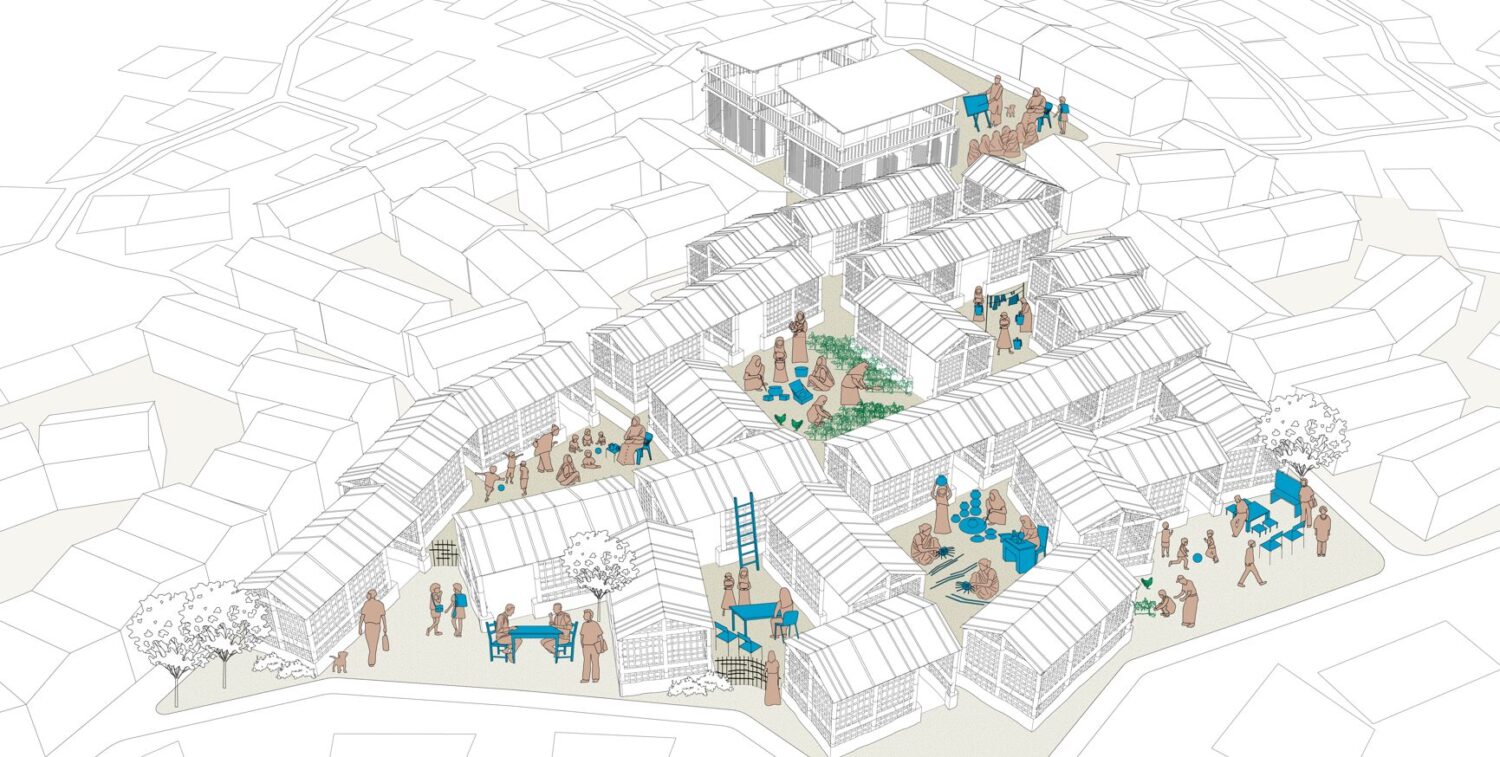 Drawing inspiration from traditional spatial relationships in informal settlements, this intervention aims to foster financial independence, particularly in sectors like handicrafts, textiles, and sustainable farming.
This design is split into two parts:
- The Individual Dwelling Unit & Communal Networks - By encouraging families to share their Community Kits, my proposal creates a network of communal spaces for women, shifting domestic activities like cooking and childcare into shared courtyards.
- The Community School - Building on these shared spaces, I have incorporated a structured environment for skill-building and income generation, helping displaced individuals transition from survival to stability.
As families collaborate using the Community Kit, they naturally carve out courtyards between shelters, transforming these spaces into vibrant hubs of daily activity. Women can now engage in collective cooking, gardening, and childcare, alleviating domestic burdens and freeing up time for economic participation. By moving essential functions outside, the shelters become more livable, enhancing overall well-being and resilience for displaced Iraqi families.
Click here to see a step-by-step guide.
The Community School
For displaced individuals in Iraq, access to education and vocational training is crucial for rebuilding their lives. My proposal culminates in the Community School, a modular, adaptable space designed to provide both education and employment opportunities.
Developed in partnership with UN Women and Women's Led Community Centers, these pop-up schools offer women access to formal education, skill training, and pathways to economic empowerment. This initiative builds on the Women's Courtyards, creating a larger, more structured environment for learning and entrepreneurship.
A key aspect of the design is its flexibility - the Community School can be adapted to various needs, featuring a mix of enclosed classrooms, open-air workshops, and semi-sheltered spaces. Whether used for digital skills training, sustainable agriculture, or eco-tourism initiatives, the space supports a dynamic, self-sufficient model that empowers displaced individuals to regain control over their futures.
By redefining the role of displaced individuals from aid recipients to active participants in their own development, my proposal offers a bold new vision for humanitarian architecture in Iraq. This approach challenges conventional aid structures, advocating instead for a model where resilience, empowerment, and community-led solutions take center stage.
Socio-Economic, Political, and Environmental Relevance
Iraq's displacement crisis is deeply linked to its socioeconomic, political, and environmental challenges. With ongoing post-conflict reconstruction, migration due to conflict and climate change, and overcrowded settlements, Iraq faces urgent housing issues. Sustainable, community-driven solutions are needed to address:
- Post-Conflict Housing Pressure: Returning families struggle with overcrowded camps. Community-led, sustainable housing can alleviate pressure on infrastructure.
- Environmental Resilience: Climate change, water shortages, and desertification require energy-efficient, climate-resilient housing.
- Socio-Economic Stability: Rapid urbanization and limited access to resources necessitate vocational training and economic integration for displaced populations.
- Political Challenges: Bureaucratic inefficiencies and lack of documentation slow resettlement. Local, community-driven efforts can support national policies.
- Social Cohesion: Empowering displaced communities fosters self-sufficiency and strengthens social bonds, contributing to stability and peaceful coexistence.
Conclusion
Iraq is at a critical juncture in addressing its displacement crisis. Traditional approaches to temporary shelters and resettlement programs are no longer sustainable. We need a paradigm shift toward sustainable, people-centric design.
My vision, centered around the Community Kit Initiative and Community Schools, offers a framework for housing solutions that are not only humane and functional but also self-sufficient and empowering. By integrating these initiatives, we can foster resilience, reduce dependency on state aid, and create pathways toward economic independence and social stability for displaced Iraqis.
I believe that true rehabilitation lies not in prolonged aid but in restoring agency and dignity to those who have lost everything. Through architecture, we can create opportunities for displaced communities to rebuild their lives-not as recipients of charity, but as active participants in shaping their own future.
Comments are closed.