

Iraq Stock Market Report
Posted on 27 November 2026 .
Advertising Feature
Rabee Securities Iraq Stock Exchange (ISX) market report (trading week ending: 26th November 2026.
Please click here to view a table of listed companies and their associated ticker codes.
| Rabee Securities' Market Indexes Change - Weekly | |||
| Index Code | Closings | Change (w/w) (%) | Change (YTD) (%) |
| IQD-RSISX | 2,399.2 | 2.78% | -6.16% |
| USD-RSISX | 2,048.7 | 2.78% | -18.51% |
| IQD-RSIHX | 1,416.5 | 1.76% | 1.66% |
| USD-RSIHX | 1,379.2 | 1.76% | -11.72% |
| IQD-RSIBX | 4,994.2 | 3.45% | -10.86% |
| USD-RSIBX | 4,862.8 | 3.45% | -22.59% |
| IQD-RSISXTR | 4,578.2 | 2.78% | 0.46% |
| USD-RSISXTR | 4,367.4 | 2.78% | -12.75% |
For the RS Market Index charts, please click HERE.
| ISX Market Summary of This Week | |||
| Trading Vol. (IQD mn)/w* | 8,840.6 | # of Comp. Listed on the ISX / # of Comp. on the OTC Market |
105 /28 |
| Trading Vol. ($ mn)/w* | 5.8 | # of Traded Companies | 65 |
| Traded Shares (mn)/w* | 21,074 | # of Companies (Up) | 31 |
| Total Trades (#/w)* | 5,247 | # of Companies (Down) | 14 |
| ISX Mcap (IQD bn) | 27,454 | # of Companies (Not changed) | 20 |
| ISX Mcap ($ mn) | 18,062 | # of Comp. Suspended from Trading (GA) | 4 |
| Market FX Rate**/ CBI Auction Price (IQD/$)*** |
1520 / 1510 | # of Comp. Suspended from Trading (ISC) | 9 |
| Top 5 Gainers* - Weekly | ||||
| Company Names | ISX Code | Closing Price(IQD) | Price Change (w/w) | Price Chg. (YTD) |
| Al-Ameen for Insurance | NAME | 0.770 | 24.2% | -6.1% |
| Al-Hilal Industries | IHLI | 1.400 | 15.7% | -20.5% |
| Iraqi for Seed Production (UCM) | AISP | 5.850 | 15.6% | 23.2% |
| Electronic Industries (UCM) | IELI | 1.420 | 12.7% | -38.0% |
| AL-Badia for General Trans. (UCM) | SBAG | 1.540 | 10.0% | 57.1% |
| Top 5 Losers* - Weekly | ||||
| Company Names | ISX Code | Closing Price(IQD) | Price Change (w/w) | Price Chg. (YTD) |
| Modern Construction Mat. (UCM) | IMCM | 0.760 | -12.6% | -17.4% |
| Gulf Ins. & Reins. | NGIR | 0.490 | -9.3% | -12.5% |
| AHliya For Insurance (NRM) | NAHF | 0.600 | -7.7% | -11.8% |
| Ready Made Clothes | IRMC | 2.130 | -5.3% | -11.6% |
| Amwaj Internat. Holding Real Estate | OMWJ | 119.500 | -4.7% | 9.6% |
| * Based on RS-adjusted prices for corporate actions. | ||||
| Top 5 Active by Weekly Trading Volume | ||||
| Company Names | ISX Code | Trading Vol. (IQDmn)/w | Trading Vol. ($'000)/w | Share in Total Trad. Vol.(%) |
| Erbil Bank for Invest. & Fin. (NRM) | BERI | 5,000.0 | 3,289.5 | 56.6% |
| Al-Mansour Bank | BMNS | 897.3 | 590.4 | 10.2% |
| Iraqi for Seed Production (UCM) | AISP | 592.3 | 389.7 | 6.7% |
| National Bank of Iraq | BNOI | 419.9 | 276.2 | 4.7% |
| United Bank | BUND | 287.0 | 188.8 | 3.2% |
| Distribution of No. of Weekly Trades and Trading Vol. by Sectors(1) | |||||
| Sector | No.of Trades/w | Trading Vol. (IQD mn)/w | Trading Vol. ('000 $)/w | Share in Total Trading Vol. (%) | |
| Banking | 2,451 | 7,057.4 | 4,643.0 | 79.8% | |
| Agriculture | 543 | 604.2 | 397.5 | 6.8% | |
| Industry | 662 | 520.7 | 342.6 | 5.9% | |
| Telecom | 672 | 288.6 | 189.9 | 3.3% | |
| Hotels&Tourism | 309 | 200.4 | 131.9 | 2.3% | |
| Services | 309 | 113.7 | 74.8 | 1.3% | |
| Holding Companies | 203 | 49.8 | 32.8 | 0.6% | |
| Insurance | 98 | 5.8 | 3.8 | 0.1% | |
| Investment | 0 | 0.0 | 0.0 | 0.0% | |
| Grand Total | 5,247 | 8,840.6 | 5,816.2 | 100.0% | |
(1) Excluding OTC market
Iraq Stock Exchange
-
- Erbil Bank for Investment & Finance (BERI): Cross transaction: 13.51 bn shares (4.5% of BERI's capital) (Nov. 22)
- New shares of Commercial Islamic Bank of Iraq (BCOI) from the capital increase started trading on Nov. 22
- Mamoura Real Estate Inv. (SMRI): Completed the capital increase procedures (Capital increase by 36.1% (55/First - rights issue))
- Babil Animal & Vegetable Prod. (ABAP): Will start distributing the 2024 cash dividend on Nov. 29 (Dividend: IQD0.4 per share, Yield: 4.2%)
- Gulf Insurance and Reinsurance (NGIR): The subscription for the capital increase started on Nov. 16 (Capital increase from IQD7.0 bn to IQD8.0 bn through a 14.3% rights issue)
- First 5G Call Completed in Iraq
- Sumer Commercial Bank (BSUC): Will be transferred from the Undisclosed Companies Market (UCM) to the Regular Market on Nov. 29
- National Chemical and Plastic Industries (INCP): Will be transferred from the Undisclosed Companies Market (UCM) to the Regular Market on Nov. 29
- UR International Insurance Company (NAUR) (OTC): Share deposit started on Nov. 23 on the ISX-OTC market
- Al-Warka Investment Bank (BWAI) (OTC): Subscription in the capital increase shares will start on Dec. 1 (Capital increase by 10.4% (55/First - rights issue))
Stocks that resumed / will resume trading:
-
- Al-Mashreq Al-Arabi Isl. Bank (BAMS): Original shares resumed trading on Nov. 23 after the AGM (Capital increase from IQD300.0 bn to IQD323.5 bn through a 7.8% bonus issue was approved; board members were elected)
Stocks that were suspended / will be suspended from trading:
-
- Dar Al-Salam for Insurance (NDSA): Was suspended from trading on Nov. 23 for the AGM (board members will be elected)
- AHliya For Insurance (NAHF): Suspended from trading on Nov. 25 for the AGM (board members will be elected)
https://rs.iq/
https://www.facebook.com/RabeeSecurities
https://www.instagram.com/rabeesec.ar/
https://twitter.com/RabeeSecurities
https://www.youtube.com/channel/UCF3INTzIEm1Nksk67c50MuA
Posted in Investment 0 Comments

Iraqi Seeks Buyers for Two Grounded Jumbos
Posted on 24 November 2026 .
By John Lee.
Iraqi Airways is offering for direct sale two Boeing 747 aircraft currently grounded at Tozeur-Nefta International Airport in Tunisia.
The sale has been authorised by the Prime Minister's Office (approval no. 2507756/3065, dated 27 February 2025). Key terms include:
- Each aircraft is valued at $900,000, based on international market listings
- A 20% initial deposit is required (certified cheque, bank guarantee, or wire transfer to the Iraqi Airways account)
- A 2% service fee applies to the total purchase value
- Buyers must settle full payment within five days of offer acceptance; failure to do so voids the sale and forfeits the deposit
- Aircraft are sold as-is, with no technical warranties
- All transfer, customs, transport, and tax costs are borne by the buyer
The two aircraft are:
- Boeing 747-200, registration YI-AGP, serial no. 22366, manufactured 1982, P&W JT9D-7F engines
- Boeing 747-SP, registration YI-ALM, serial no. 22858, manufactured 1982, P&W JT9D-7F engines
Preliminary applications may be submitted within 30 days by email at [email protected] or via WhatsApp at +964 770 694 9191 / +964 771 611 8559. No initial deposit is required at this stage.
A sales committee will be present at the Iraqi Embassy in Tunisia from 21 December 2026 to 5 January 2027. The first ten days will be open for receiving applications and answering queries (10:00-13:00 local time); the final five days will be used to evaluate bids and conclude the sale. The sale is not final until approved by the Minister of Transport.
The planes were last offered for sale in July 2023.
(Source: Iraqi Airways)
Posted in Iraq Industry & Trade News, Iraq Transportation News 0 Comments
Iraq Stock Market Report
Posted on 20 November 2026 .
Advertising Feature
Rabee Securities Iraq Stock Exchange (ISX) market report (trading week ending: 19th November 2026.
Please click here to view a table of listed companies and their associated ticker codes.
| Rabee Securities' Market Indexes Change - Weekly | |||
| Index Code | Closings | Change (w/w) (%) | Change (YTD) (%) |
| IQD-RSISX | 2,334.3 | 1.75% | -8.70% |
| USD-RSISX | 1,993.2 | 1.75% | -20.71% |
| IQD-RSIHX | 1,391.9 | 0.21% | -0.10% |
| USD-RSIHX | 1,355.3 | 0.21% | -13.25% |
| IQD-RSIBX | 4,827.6 | 2.70% | -13.83% |
| USD-RSIBX | 4,700.6 | 2.70% | -25.17% |
| IQD-RSISXTR | 4,454.4 | 1.75% | -2.25% |
| USD-RSISXTR | 4,249.2 | 1.75% | -15.12% |
For the RS Market Index charts, please click HERE.
| ISX Market Summary of This Week | |||
| Trading Vol. (IQD mn)/w* | 4,019.1 | # of Comp. Listed on the ISX / # of Comp. on the OTC Market |
105 /28 |
| Trading Vol. ($ mn)/w* | 2.6 | # of Traded Companies | 69 |
| Traded Shares (mn)/w* | 1,981 | # of Companies (Up) | 19 |
| Total Trades (#/w)* | 5,099 | # of Companies (Down) | 28 |
| ISX Mcap (IQD bn) | 27,413 | # of Companies (Not changed) | 22 |
| ISX Mcap ($ mn) | 18,035 | # of Comp. Suspended from Trading (GA) | 3 |
| Market FX Rate**/ CBI Auction Price (IQD/$)*** |
1520/ 1510 | # of Comp. Suspended from Trading (ISC) | 9 |
| Top 5 Gainers* - Weekly | ||||
| Company Names | ISX Code | Closing Price(IQD) | Price Change (w/w) | Price Chg. (YTD) |
| Erbil Bank for Invest. & Fin. (NRM) | BERI | 0.370 | 48.0% | 12.1% |
| Mosul Dam Tourist Village (NRM) | HTVM | 12.100 | 21.0% | -7.0% |
| Nat. Chem. & Plastic Ind. (UCM) | INCP | 1.910 | 11.0% | -6.8% |
| Electronic Industries (UCM) | IELI | 1.260 | 9.6% | -45.0% |
| Iraqi for Carton Man. (UCM) | IICM | 1.580 | 9.0% | -19.4% |
| Top 5 Losers* - Weekly | ||||
| Company Names | ISX Code | Closing Price(IQD) | Price Change (w/w) | Price Chg. (YTD) |
| Al-Ameen for Insurance | NAME | 0.620 | -17.3% | -24.4% |
| Nationality H. Furniture (NRM) | IHFI | 0.880 | -9.3% | -29.6% |
| Modern Animal & Agr. Prod. (UCM) | AMAP | 0.300 | -9.1% | -16.7% |
| Mosul Bank (UCM) | BMFI | 0.100 | -9.1% | -47.4% |
| Gulf Ins. & Reins. | NGIR | 0.540 | -8.5% | -3.6% |
| * Based on RS-adjusted prices for corporate actions. | ||||
| Top 5 Active by Weekly Trading Volume | ||||
| Company Names | ISX Code | Trading Vol. (IQDmn)/w | Trading Vol. ($'000)/w | Share in Total Trad. Vol.(%) |
| Al-Mansour Pharmaceutical Ind. | IMAP | 842.6 | 554.3 | 21.0% |
| Al-Mansour Bank | BMNS | 784.0 | 515.8 | 19.5% |
| National Bank of Iraq | BNOI | 687.7 | 452.4 | 17.1% |
| Asiacell Communications PJSC | TASC | 464.0 | 305.3 | 11.5% |
| Bank of Baghdad | BBOB | 294.9 | 194.0 | 7.3% |
| Distribution of No. of Weekly Trades and Trading Vol. by Sectors(1) | ||||||
| Sector | No.of Trades/w | Trading Vol. (IQD mn)/w | Trading Vol. ('000 $)/w | Share in Total Trading Vol. (%) | ||
| Banking | 1,951 | 1,982.0 | 1,304.0 | 49.3% | ||
| Industry | 1,108 | 1,144.1 | 752.7 | 28.5% | ||
| Telecom | 1,019 | 466.0 | 306.6 | 11.6% | ||
| Holding Companies | 403 | 152.6 | 100.4 | 3.8% | ||
| Agriculture | 248 | 138.2 | 90.9 | 3.4% | ||
| Services | 174 | 72.3 | 47.6 | 1.8% | ||
| Hotels&Tourism | 155 | 57.7 | 37.9 | 1.4% | ||
| Insurance | 41 | 6.1 | 4.0 | 0.2% | ||
| Investment | 0 | 0.0 | 0.0 | 0.0% | ||
| Grand Total | 5,099 | 4,019.1 | 2,644.2 | 100.0% | ||
(1) Excluding OTC market
Iraq Stock Exchange
- New shares of Credit Bank of Iraq (BROI) from the capital increase started trading on Nov. 15
- New shares of Commercial Islamic Bank of Iraq (BCOI) from the capital increase will start trading on Nov. 22
- Bank of Baghdad (BBOB): The managing director resigned
- Cihan Insurance Company (OTC): Listing approved on the ISX-OTC market
Stocks that resumed / will resume trading:
- Erbil Bank for Investment & Finance (BERI): Original shares Resumed trading on Nov. 15 after the AGM (Capital increase from IQD300.0 bn to IQD350.0 bn through a 16.7% rights issue was approved; board members were elected)
Stocks that were suspended / will be suspended from trading:
- Al-Mashreq Al-Arabi Isl. Bank (BAMS): Was suspended from trading on Nov. 16 for the AGM (Capital increase to IQD323.5 bn through a 7.8% bonus issue will be discussed; board members will be elected)
- Trust Inter. Islamic Bank (BTRU): Suspended from trading on Nov. 18 for the AGM (FY25 financial results will be approved; dividend distribution will be discussed; the merger with Elaf Islamic Bank and Al-Rajih Islamic Bank will be discussed; board members will be elected)
- Al-Mansour Pharmaceutical Ind. (IMAP): Will be suspended from trading on Nov. 30 for the AGM (Capital increase from IQD18.56 bn to IQD25.06 bn through a 35.0% rights issue will be discussed; board members will be elected)
https://rs.iq/
https://www.facebook.com/RabeeSecurities
https://www.instagram.com/rabeesec.ar/
https://twitter.com/RabeeSecurities
https://www.youtube.com/channel/UCF3INTzIEm1Nksk67c50MuA
Posted in Investment 0 Comments
Iraq Stock Market Report
Posted on 13 November 2026 .
Advertising Feature
Rabee Securities Iraq Stock Exchange (ISX) market report (trading week ending: 12th November 2026.
Please click here to view a table of listed companies and their associated ticker codes.
| Rabee Securities' Market Indexes Change - Weekly | |||
| Index Code | Closings | Change (w/w) (%) |
Change (YTD) (%) |
| IQD-RSISX | 2,294.1 | -3.36% | -10.27% |
| USD-RSISX | 1,958.9 | -3.36% | -22.08% |
| IQD-RSIHX | 1,389.1 | -2.46% | -0.31% |
| USD-RSIHX | 1,352.5 | -2.46% | -13.43% |
| IQD-RSIBX | 4,700.9 | -4.13% | -16.10% |
| USD-RSIBX | 4,577.2 | -4.13% | -27.14% |
| IQD-RSISXTR | 4,377.8 | -3.36% | -3.93% |
| USD-RSISXTR | 4,176.2 | -3.36% | -16.57% |
For the RS Market Index charts, please click HERE.
| ISX Market Summary of This Week | |||
| Trading Vol. (IQD mn)/w* | 4,893.0 | # of Comp. Listed on the ISX / # of Comp. on the OTC Market |
105 /28 |
| Trading Vol. ($ mn)/w* | 3.2 | # of Traded Companies | 67 |
| Traded Shares (mn)/w* | 5,118 | # of Companies (Up) | 7 |
| Total Trades (#/w)* | 5,666 | # of Companies (Down) | 36 |
| ISX Mcap (IQD bn) | 27,096 | # of Companies (Not changed) | 24 |
| ISX Mcap ($ mn) | 17,826 | # of Comp. Suspended from Trading (GA) | 2 |
| Market FX Rate**/ CBI Auction Price (IQD/$)*** |
1520 / 1510 |
# of Comp. Suspended from Trading (ISC) | 9 |
| Top 5 Gainers* - Weekly | ||||
| Company Names | ISX Code | Closing Price(IQD) |
Price Change (w/w) |
Price Chg. (YTD) |
| Mamoura Real Estate Inv. | SMRI | 2.500 | 22.0% | -14.1% |
| Economy Bank | BEFI | 0.220 | 4.8% | -31.3% |
| Ashur International Bank | BASH | 0.250 | 4.2% | 13.6% |
| Iraqi For Tufted Carpets | IITC | 17.500 | 2.3% | 4.8% |
| Kharkh Tour Amuzement City | SKTA | 4.550 | 1.1% | 2.9% |
| Top 5 Losers* - Weekly | ||||
| Company Names | ISX Code | Closing Price(IQD) |
Price Change (w/w) |
Price Chg. (YTD) |
| Nationality H. Furniture (NRM) | IHFI | 0.970 | -25.4% | -22.4% |
| Amwaj Internat. Holding Real Estate | OMWJ | 124.000 | -17.5% | 13.8% |
| AL-Kindi of Veterinary Vac. | IKLV | 2.490 | -12.6% | 1.6% |
| Al-Ameen Estate Inv. (NRM) | SAEI | 1.150 | -10.2% | -47.7% |
| Modern Construction Mat. (UCM) | IMCM | 0.910 | -9.0% | -1.1% |
| * Based on RS-adjusted prices for corporate actions. |
||||
| Top 5 Active by Weekly Trading Volume | ||||
| Company Names | ISX Code | Trading Vol. (IQDmn)/w |
Trading Vol. ($'000)/w |
Share in Total Trad. Vol.(%) |
| Asiacell Communications PJSC | TASC | 1,119.6 | 736.6 | 22.9% |
| Al-Mansour Bank | BMNS | 785.4 | 516.7 | 16.1% |
| National Bank of Iraq | BNOI | 415.2 | 273.1 | 8.5% |
| International Islamic Bank (NRM) | BINT | 391.3 | 257.4 | 8.0% |
| Al-Qurtas Islamic Bank (NRM) | BQUR | 384.8 | 253.2 | 7.9% |
| Distribution of No. of Weekly Trades and Trading Vol. by Sectors(1) | |||||
| Sector | No.of Trades/w |
Trading Vol. (IQD mn)/w |
Trading Vol. ('000 $)/w |
Share in Total Trading Vol. (%) |
|
| Banking | 2,163 | 2,344.7 | 1,542.5 | 47.9% | |
| Telecom | 1,245 | 1,122.3 | 738.4 | 22.9% | |
| Industry | 708 | 451.7 | 297.1 | 9.2% | |
| Hotels&Tourism | 136 | 345.6 | 227.4 | 7.1% | |
| Holding Companies | 619 | 195.8 | 128.8 | 4.0% | |
| Investment | 5 | 161.2 | 106.0 | 3.3% | |
| Services | 489 | 142.9 | 94.0 | 2.9% | |
| Agriculture | 276 | 125.7 | 82.7 | 2.6% | |
| Insurance | 25 | 3.1 | 2.1 | 0.1% | |
| Grand Total | 5,666 | 4,893.0 | 3,219.1 | 100.0% | |
(1) Excluding OTC market
Iraq Stock Exchange
- Modern Construction Mat. (IMCM) disclosed that there are no material events at present at the company that could have led to the decline of its share price, and that the reason is investors' speculation in trading the company's shares.
- Amwaj International Holding Real Estate Investment Company (OMWJ) disclosed that there are no material events that led to the decline of its share price during the Nov. 5 and Nov. 8 sessions, and that the reason is the result of supply and demand.
- New shares of Al-Qurtas Islamic Bank (BQUR) from the capital increase by 20.0% from IQD250.0 bn to IQD300.0 bn (56/Fourth - through external cash funded), amounting to 50.0 bn shares, started trading on Nov. 12.
Stocks that resumed / will resume trading:
- Modern Sewing (IMOS) resumed trading on Nov. 10 after holding its AGM on Nov. 2, in which they elected five original and five alternative board members.
- Ashur International Bank for Investment (BASH) resumed trading on Nov. 11 after holding its AGM on Nov. 5, in which they discussed and approved 2025 annual financial statements, decided to distribute an IQD0.03 cash dividend per share, corresponding to an 11.1% dividend yield, and approved moving to the merger path with another local bank instead of continuing as an independent bank.
- Babylon Hotel (HBAY) resumed trading on Nov. 12 after holding its AGM on Nov. 8, in which they discussed and approved 2025 annual financial statements, and decided to distribute an IQD3.5 cash dividend per share, corresponding to a 3.1% dividend yield.
- First Iraqi Islamic Bank Investment and Finance (BFIB) resumed trading on Nov. 12 after holding its AGM on Nov. 6, in which they discussed and approved 2025 annual financial statements, and electing one original and four alternative board members.
Stocks that were suspended / will be suspended from trading:
- ISX will suspend trading of AHliya For Insurance (NAHF) starting Nov. 25 due to the AGM that will be held on Nov. 30 to elect a new board of five original and five alternative members, following the resignation of the current original and alternative members. ISX will suspend trading of Ameen Al-Iraq Islamic Bank (BAME) starting Dec. 6 due to the AGM that will be held on Dec. 9 to discuss and approve 2025 annual financial statements, and dividend distribution, and the capital increase by 20.0% from IQD250.0 bn to IQD300.0 bn (56/Fourth - through external cash funded).
- ISX will suspend trading of Trust Inter. Islamic Bank (BTRU) starting Nov. 18 due to the AGM that will be held on Nov. 23 to discuss and approve the 2025 annual financial statements, dividend distribution, the merger of BTRU with Elaf Islamic Bank (BELF) and Al-Rajih Islamic Bank (BRAJ) and approving the merger procedures, and electing three alternative board members.
https://rs.iq/
https://www.facebook.com/RabeeSecurities
https://www.instagram.com/rabeesec.ar/
https://twitter.com/RabeeSecurities
https://www.youtube.com/channel/UCF3INTzIEm1Nksk67c50MuA
Posted in Investment 0 Comments

Tabaqchali: The Market, the Economy, and the Iraqi Dinar's Devaluation
Posted on 06 November 2026 .
By Ahmed Tabaqchali, Chief Strategist of AFC Iraq Fund. Any opinions expressed are those of the author, and do not necessarily reflect the views of Iraq Business News.
The Market, the Economy, and the Iraqi Dinar's Devaluation
The market, as measured by the Rabee Securities U.S. Dollar Equity Index (RSISX USD Index), was down 18.4%. for the month, and 16.2% for the year. However, had the 13.3% devaluation of the Iraqi dinar versus the U.S. dollar not taken place, the RSIX USD Index would have been down about 5.8% for the month and not down 18.4% (ovals in the chart below).
As negative as the devaluation has been for the near-term performance of the equity market, however, it should be seen in the context of the two currency changes in the recent past. The economy and the market were in very different states in December 2020 and in February 2023, when the devaluation and subsequent revaluation, respectively, took place (orange lines in the chart below). Yet the effects of both currency changes were short-lived and did not alter the trajectory of the market in any meaningful way - as the market was beginning to discount two key dynamics that are driving the transformation of the economy: the cumulative positive effects of relative stability and of structural banking developments.
The Iraq investment thesis argues that, although the economy and the market are once again different, the effects of the current devaluation should be just as short-lived as those of December 2020 and February 2023, and that the market should ultimately continue to discount these two key dynamics as it has done over the last three years. This is because the transformation is a secular process that will unfold over the next few years, bringing with it high economic growth that will feed into higher corporate profits and ultimately higher stock market returns.
Nevertheless, as asserted here in the outlook for 2026 in "What Next After a Gangbuster Three-Year Rally?", two forces in 2026 would moderate these two key dynamics. The first was that a "new normal" for the banking sector would begin to take shape in 2026, in which the future growth trajectories of the top banks would be from a higher base and from a significantly improved financial position.
The second was the effect of lower oil prices (as expected then at the end of 2025) on government spending, and subsequently on the non-oil economy, given the central role of government expenditures. These moderating effects were amplified by the combination of the disruptions brought on by the war on Iran, the loss of oil revenues from the closure of the Strait of Hormuz, and the changes to the customs system at the start of 2026. These effects should be transitory - meaningfully dampening, but not derailing, the secular transformation of the economy, which should reassert itself once the economy adjusts to the new exchange rate. The adjustment, a function of the economy's high dollarisation rate, would affect all of its sectors, first by raising costs, through the 15.4% rise in the dollar, and second by dampening demand.
However, these are one-off effects to which the economy should adjust over the near term, as it did following the December 2020 devaluation, which raised dollar costs by 22.7% - and the economy is much healthier today, after three years of plenty, than it was in 2020, when it was adjusting to the disruptions brought by COVID-19, which came soon after the far larger disruptions of the ISIS conflict that ended in late 2017.
Technically, the RSISX USD Index's 18.4% fall for the month took it to just above the low end of its multi-year uptrend, thereby presenting the first serious test to the assertion made in here over the past two years that, from a technical analysis perspective, it continues to consolidate its gains within this uptrend. Interestingly, stripping away the effects of the devaluation, the index would be comfortably within its uptrend. Nevertheless, the next few weeks will determine whether the current uptrend holds, or whether its slope moderates, as the market reflects the economy's adjustment to the devaluation.
Rabee Securities U.S. Dollar Equity Index vs. Average Daily Turnover
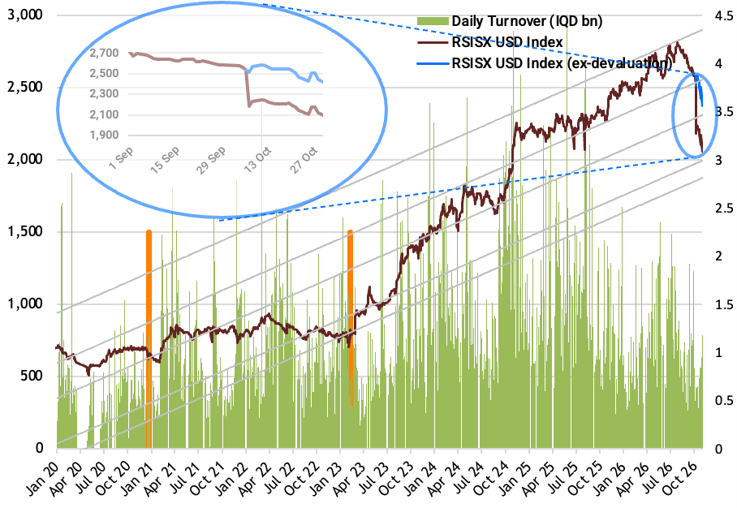 (Source: Iraq Stock Exchange, Rabee Securities, AFC Research, daily data as of October 29th
Note: The blue line assumes that no devaluation had taken place)
Devaluation: Background, Context, and Near-term Outlook
This section updates the data (on oil exports, their effect on budget projections, budget execution figures, and monetary conditions) included in the recent "Iraqi Dinar's Devaluation: Context and Near-term Outlook"
Oil Exports, Oil Revenues, and the 2026 Budget
The closure of the Strait of Hormuz in early March 2026, following the onset of the U.S.-Israel war on Iran, led to the effective shutdown of Iraq's oil exports, 95% of which had passed through the Strait before the war. This could have had an immediate impact on the government's ability to meet its expenditures, as about 90% of its revenues come from oil exports. This, in turn, could have hurt the wider economy, given the state's outsized role, both through its provision of goods and services and through the public-sector payroll.
However, this initial loss of oil exports did not represent an immediate hit to oil revenues, which continued to flow into March-April, benefiting from the roughly two-month lag between oil exports and the receipt of their revenues. Nevertheless, the loss of oil exports in March-May translated into sharply lower oil revenues for May-July, with the beginning of the oil export recovery in June and July reflected in the strong recovery of oil revenues in August and September (charts below).
Oil exports continued to recover, reaching about 68% of pre-war levels in August, an estimated 80% in September, and an estimated 94% in October. This export recovery should be reflected in continued growth in oil revenues in October-December, which, in dinar terms, would be boosted further by the devaluation. Partly offsetting the earlier drop in oil revenues was the strong growth in non-oil revenues, up 34% in January-September versus the same period in 2025, which benefited from the implementation of a new automated customs tariff system at the start of 2026.
Actual and Projected Oil Exports for 2026
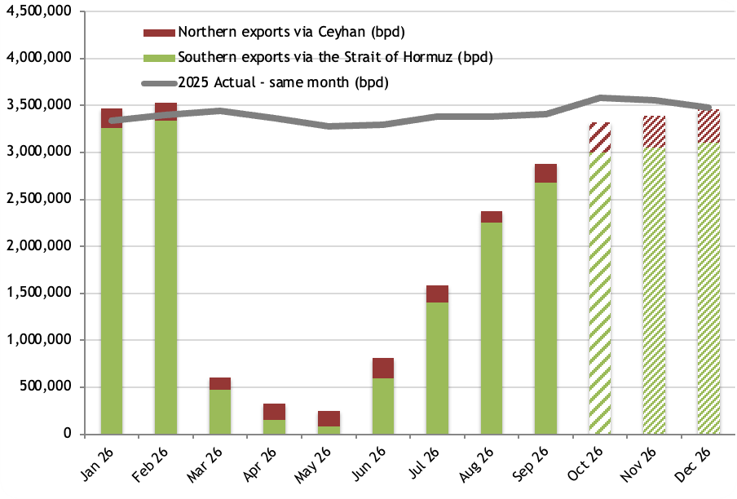 (Source: State Oil Marketing Organization for 2025, January-June and August-September; Iraq Oil Report for July; AFC Research estimates for October and projections for November-December [1])
Actual and Projected Revenues and Expenditures for 2026
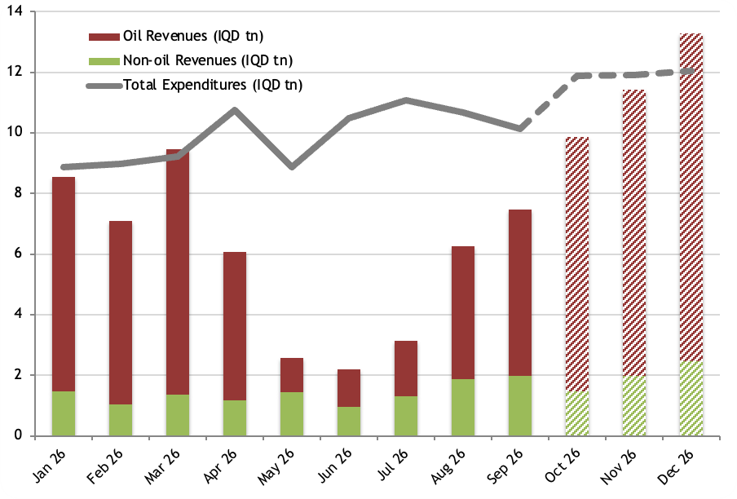 (Source: Ministry of Finance for January-September; AFC Research projections for October-December [1])
The state's expenditures are dominated by rigid current expenditures - made up of public-sector salaries, pensions, social security, benefits, and subsidies - which, reflecting the country's political economy, are exceptionally difficult to reduce even when oil revenues decline below expenditures. As such, the prior government, and the current government in office since May, continued with the usual cash-management toolkit - employed by all prior governments when oil revenues fall below expenditures - such as ad hoc cost savings and accumulating arrears to third parties, including domestic contractors and International Oil Companies (IOCs), together with the freezing of all new capital and investment spending projects.
Despite these measures, there was a gap between revenues and expenditures in 2025, which continued into 2026 (chart above), but which increased significantly in April-June, then began to narrow in August-September, and is projected to narrow further as the year comes to an end (table below).
Actual and Projected Figures for the 2026 Budget
 (Source: Ministry of Finance for January-September; Central Bank of Iraq for domestic debt to July, August-September estimated; AFC Research projections for October-December [1])
Foreign Reserves and the Exchange Rate
The government's continued spending, in particular its current expenditures, sustained domestic consumption, which in turn sustained the demand for imports. Surprisingly, this demand was relatively strong in the context of the disruptions brought by the closure of the Strait of Hormuz, as reflected in cross-border transfers (chart below), which are mostly used to pay for imports and are thus a proxy for domestic consumption. The application of the new automated customs tariff system at the start of 2026 had an initial depressing effect on demand, as reflected in the sharp drop in January, but demand recovered in subsequent months, with the drop in August being a function of new CBI procedures that constrained transfers.
Cross-Border Transfers (USD billion)
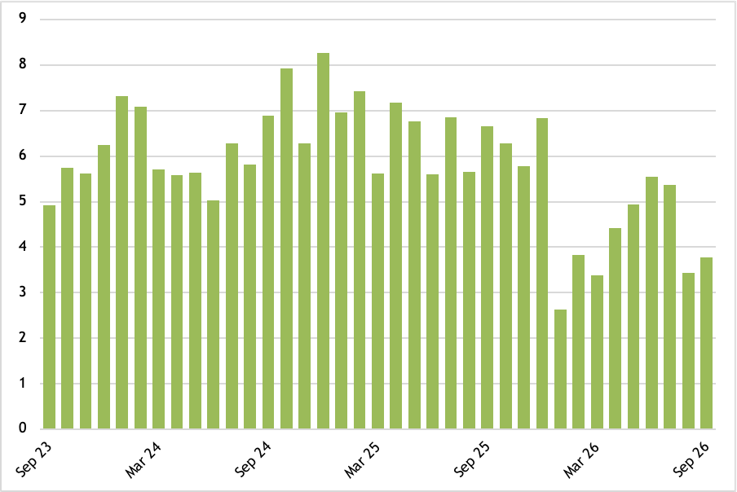 (Source: Central Bank of Iraq, data as of the end of September 2026)
The continued drawdowns of foreign reserves to meet demand for cross-border transfers, not replenished by the conversion of oil revenues from dollars into dinars, led to a sharp decline in reserves, which by the end of September were down 23% from the levels at the end of 2025. [2] However, current levels are healthy, comfortably supporting around 12 months of imports, [3] and are much higher than those that prevailed prior to the 18.5% devaluation in December 2020. As such, the current decision to devalue the dinar was a proactive one, buying the government time to decide on fiscal reforms, which is in sharp contrast to the historic head-in-the-sand stance of the country's political elite during periods of crisis.
In the near term, the pressures on foreign reserves should ease substantially, as reserves should be replenished by the conversion of increased oil revenues in October-December into dinars, while demand for cross-border transfers should be dampened somewhat by the effects of the dinar's devaluation on domestic consumption.
Foreign Reserves (USD billion)
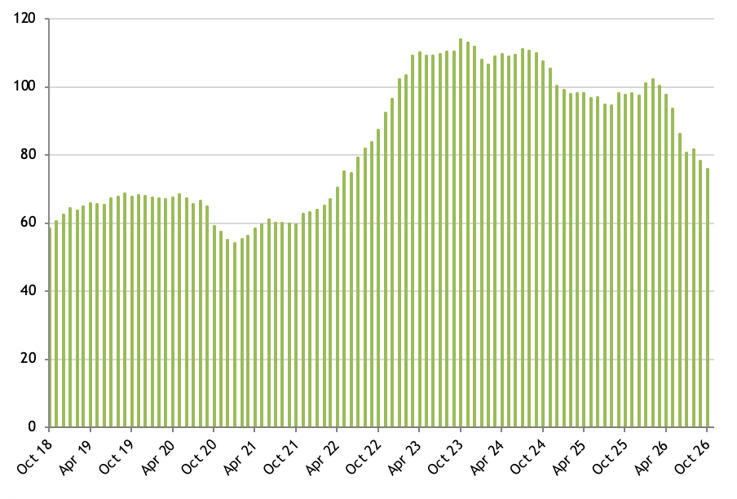 (Source: Central Bank of Iraq, data as of October 15th)
Near-term Outlook
The near-term outlook for government finances, the economy, and foreign reserves is highly dependent on the continuation of the recovery in oil exports and on the continuation of the pause in the tit-for-tat attacks between the U.S. and Iran. While a few strong oil export months do not make a trend, especially in this highly fluid and dangerous period, current market expectations for future oil prices, as measured by Brent futures contracts, promise a measure of stability for all three.
Expectations for future oil prices following the collapse of the Islamabad Memorandum of Understanding have consistently shifted higher, suggesting an acceptance that the current pause in the tit-for-tat attacks between the U.S. and Iran is evolving into a surreal new normal of no-war/no-peace (chart below).
Market Expectations for Future Oil Prices (USD per barrel)
As measured by Brent futures contracts
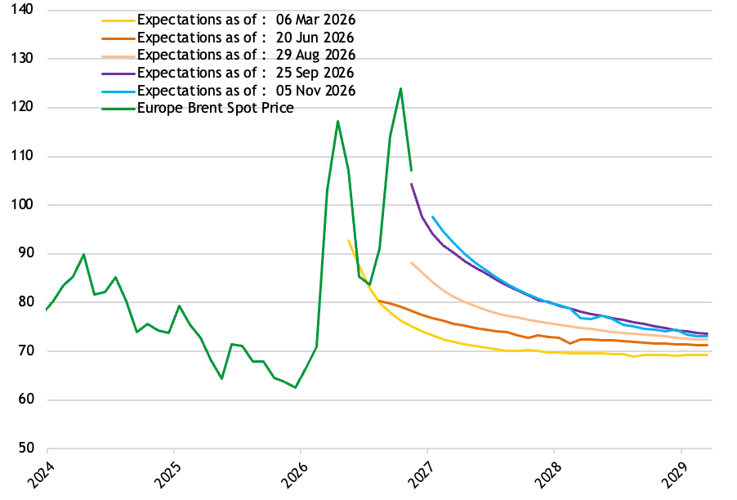 (Source: U.S. Energy Information Administration, investing.com, AFC Research, data as of 5th November 2026)
As such, the combination of likely higher near-term oil prices, continued strong oil export recovery, and the 13.3% devaluation of the dinar would substantially improve the government's financial position for the year (budget table) and provide a measure of stability for the economy and foreign reserves - although reserves would still trend lower, albeit at a much slower rate.
The three positives of higher oil prices, continued strong oil export recovery, and the 13.3% devaluation of the dinar, while necessary, are not sufficient to sustain economic stability without addressing the budget's structural imbalances of rigid expenditures and revenue volatility. Nevertheless, they have provided the government with breathing space to decide on fiscal reforms, in particular those that could come with an IMF programme, such as the Stand-By Arrangement (SBA) signed in 2016, or, better still, the more substantial Extended Fund Facility (EFF). Any IMF programme would face extreme resistance from the public and the political elite, who together rejected the White Paper for Economic Reform, which came in response to the financial crisis of 2020 and aimed to address the economy's structural imbalances. [4] That said, the continued need for debt to augment oil revenues, irrespective of the future direction of oil prices, requires the issuance of foreign debt in the form of Eurobonds, which would not come without an IMF programme, to supplement domestic debt - as the issuance of domestic debt on its own will continue the pressure on foreign reserves, while foreign debt will increase them.
Despite domestic resistance to an IMF programme, the proactive decision to devalue the dinar - breaking the historic head-in-the-sand pattern - signals the seriousness of the government's tentative engagement with the Fund over recent months. That engagement has since solidified: at the close of the IMF-World Bank Annual Meetings in Bangkok on 17th October 2026, the IMF's Managing Director confirmed that the authorities had requested a programme, pledging "both money and policy support".
While such an engagement would likely take many months to conclude, the three positives outlined above have opened a window of up to a year for these discussions, as can be seen from the near-term implications of Brent crude prices under the assumption of continued oil export recovery. Current expectations imply an average Brent price of USD 96.3 per barrel (/bbl) for 2026, a projected average of USD 87.0/bbl for 2027, and USD 76.2/bbl for 2028, which, for Iraq under the current assumption of no-war/no-peace, means prices lower by about USD 32/bbl for the balance of 2026 and for 2027-2028. Assuming expenditures over the next two years are in line with those projected for 2026 (actual, not budgeted, as actual is always less than budgeted given the state's capacity constraints), this suggests that the budget's deficit for 2027 could be better than that of 2026, but that the deficit for 2028 could be worse. In the short term, this would allow domestic debt to fund the deficit without significantly eroding reserves, while in the medium-term foreign debt would be needed - all of which support the conclusion of an IMF programme. However, preliminary data on the proposed 2027 budget imply that the window for concluding the discussions between the IMF and the government could be shorter than the year suggested above.
Notes
[1] Methodology: Projections for oil exports assume incremental month-on-month increases from October's estimated levels. Blended oil prices assume discounts to Brent crude of USD 32 per barrel (USD/bbl) for southern exports and USD 5/bbl for northern exports. October reflects actual Brent spot prices; November and December are estimates based on ICE Brent futures (data as of 5th November 2026). Budget oil revenues are derived from projected export receipts (0.44 x current month + 0.56 x two months earlier), less a 15% haircut, and converted at 1,461 IQD/USD in October and 1,500 IQD/USD in November-December. Projected non-oil revenues assume full-year growth of 24%, down from 34% year-on-year in January-September. Projected expenditures assume continued cost controls; each month's projected expenditures are based on the average of the preceding three months and include oil capital expenditures (15% of oil revenues), which were minimal in January-September.
[2] Reserves are created when the Ministry of Finance (MoF) converts its dollar oil revenues into dinars: the Central Bank of Iraq (CBI) buys the dollars from the MoF and sells it the equivalent in dinars. Cross-border transfers, on the other hand, are the reverse transaction: the private sector, through the banks, sells dinars to the CBI and buys dollars from its reserves. Reserves therefore increase when the CBI buys more dollars from the MoF than it sells to the private sector, and decline when it sells more than it buys. See: (1) Ahmed Tabaqchali, "A Fistful of Dinars: Demystifying Iraq's Dollar Auction," LSE Middle East Centre, 18th April 2024, pp. 7-11, https://researchonline.lse.ac.uk/id/eprint/122652/; (2) Ahmed Tabaqchali, "The Empire Strikes Back: Trump 2.0 and Iraq's Dollar Accounts at the Federal Reserve," LSE Middle East Centre Blog, 4th March 2025, https://blogs.lse.ac.uk/mec/2025/03/04/the-empire-strikes-back-trump-2-0-iraqs-dollar-accounts-at-the-federal-reserve/.
[3] Reserves as of the end of September, divided by the 18-month average of cross-border transfers, would cover at least 12 months of transfers. A CBI official at the MERI Forum in Erbil on 13th October 2026 stated that reserves cover Iraq's imports for a year or more. See: Al-Mada, "Central Bank: Our Foreign Reserves Cover Iraq's Imports for a Full Year or More" (in Arabic), 14th October 2026, https://almadapaper.net/456706/.
[4] Ahmed Tabaqchali, "Missed Opportunities for Economic Reform," in Iraq 20 Years On: Insider Reflections on the War and Its Aftermath, Chatham House, 4th May 2023, https://www.chathamhouse.org/2023/03/iraq-20-years-insider-reflections-war-and-its-aftermath/missed-opportunities-economic.
Please click here to download Ahmed Tabaqchali's full report in pdf format.
Mr Tabaqchali (@AMTabaqchali) is the Chief Strategist of the AFC Iraq Fund, and is an experienced capital markets professional with over 25 years' experience in US and MENA markets. He is a board member of Arab Bank Iraq, a Visiting Fellow at the LSE Middle East Centre, Senior Fellow at the Institute of Regional and International Studies (IRIS), and a Senior Non-resident Fellow at the Atlantic Council.
His comments, opinions and analyses are personal views and are intended to be for informational purposes and general interest only and should not be construed as individual investment advice or a recommendation or solicitation to buy, sell or hold any fund or security or to adopt any investment strategy. It does not constitute legal or tax or investment advice. The information provided in this material is compiled from sources that are believed to be reliable, but no guarantee is made of its correctness, is rendered as at publication date and may change without notice and it is not intended as a complete analysis of every material fact regarding Iraq, the region, market or investment.
Posted in Ahmed Tabaqchali, Investment 0 Comments
Iraq Stock Market Report
Posted on 06 November 2026 .
Advertising Feature
Rabee Securities Iraq Stock Exchange (ISX) market report (trading week ending: 5th November 2026.
Please click here to view a table of listed companies and their associated ticker codes.
| Rabee Securities' Market Indexes Change - Weekly | |||
| Index Code | Closings | Change (w/w) (%) | Change (YTD) (%) |
| IQD-RSISX | 2,373.8 | -3.81% | -7.15% |
| USD-RSISX | 2,027.0 | -3.81% | -19.37% |
| IQD-RSIHX | 1,424.0 | -2.85% | 2.20% |
| USD-RSIHX | 1,386.5 | -2.85% | -11.25% |
| IQD-RSIBX | 4,903.4 | -4.22% | -12.48% |
| USD-RSIBX | 4,774.4 | -4.22% | -24.00% |
| IQD-RSISXTR | 4,524.6 | -3.81% | -0.71% |
| USD-RSISXTR | 4,321.2 | -3.81% | -13.68% |
For the RS Market Index charts, please click HERE.
| ISX Market Summary of This Week | |||
| Trading Vol. (IQD mn)/w* | 9,467.8 | # of Comp. Listed on the ISX / # of Comp. on the OTC Market |
105/ 28 |
| Trading Vol. ($ mn)/w* | 6.2 | # of Traded Companies | 69 |
| Traded Shares (mn)/w* | 8,838 | # of Companies (Up) | 18 |
| Total Trades (#/w)* | 5,342 | # of Companies (Down) | 31 |
| ISX Mcap (IQD bn) | 28,411 | # of Companies (Not changed) | 20 |
| ISX Mcap ($ mn) | 18,692 | # of Comp. Suspended from Trading (GA) | 4 |
| Market FX Rate**/ CBI Auction Price (IQD/$)*** |
1520/ 1510 | # of Comp. Suspended from Trading (ISC) | 10 |
| Top 5 Gainers* - Weekly | ||||
| Company Names | ISX Code | Closing Price(IQD) | Price Change (w/w) | Price Chg. (YTD) |
| Amwaj Internat. Holding Real Estate | OMWJ | 150.300 | 34.2% | 37.9% |
| Rehab Karbala Company | HKAR | 0.450 | 28.6% | -25.0% |
| Nationality H. Furniture (NRM) | IHFI | 1.300 | 21.5% | 4.0% |
| AL-Kindi of Veterinary Vac. | IKLV | 2.850 | 15.9% | 16.3% |
| Dar Al-Salam for Insurance | NDSA | 0.700 | 6.1% | -7.9% |
| Top 5 Losers* - Weekly | ||||
| Company Names | ISX Code | Closing Price(IQD) | Price Change (w/w) | Price Chg. (YTD) |
| Iraqi Middle East Investment Bank | BIME | 0.060 | -14.3% | 0.0% |
| Modern Construction Mat. (UCM) | IMCM | 1.000 | -13.0% | 8.7% |
| Cihan Bank for Islamic & Finance | BCIH | 1.210 | -12.9% | -43.5% |
| Al-Ameen Estate Inv. (NRM) | SAEI | 1.280 | -12.9% | -41.8% |
| Al-Ameen for Insurance | NAME | 0.760 | -10.6% | -7.3% |
| * Based on RS-adjusted prices for corporate actions. | ||||
| Top 5 Active by Weekly Trading Volume | ||||
| Company Names | ISX Code | Trading Vol. (IQDmn)/w | Trading Vol. ($'000)/w | Share in Total Trad. Vol.(%) |
| Al-Qurtas Islamic Bank (NRM) | BQUR | 4,160.0 | 2,736.9 | 43.9% |
| Asiacell Communications PJSC | TASC | 1,791.2 | 1,178.4 | 18.9% |
| National Bank of Iraq | BNOI | 1,230.2 | 809.3 | 13.0% |
| Al-Mansour Bank | BMNS | 798.8 | 525.5 | 8.4% |
| International Islamic Bank (NRM) | BINT | 446.6 | 293.8 | 4.7% |
| Distribution of No. of Weekly Trades and Trading Vol. by Sectors(1) | |||||
| Sector | No.of Trades/w | Trading Vol. (IQD mn)/w | Trading Vol. ('000 $)/w | Share in Total Trading Vol. (%) | |
| Banking | 2,018 | 6,911.6 | 4,547.1 | 73.0% | |
| Telecom | 1,522 | 1,792.1 | 1,179.0 | 18.9% | |
| Industry | 678 | 340.4 | 224.0 | 3.6% | |
| Agriculture | 237 | 157.2 | 103.4 | 1.7% | |
| Holding Companies | 472 | 149.4 | 98.3 | 1.6% | |
| Hotels&Tourism | 156 | 70.9 | 46.7 | 0.7% | |
| Services | 194 | 41.6 | 27.3 | 0.4% | |
| Insurance | 65 | 4.6 | 3.0 | 0.0% | |
| Investment | 0 | 0.0 | 0.0 | 0.0% | |
(1) Excluding OTC market
Iraq Stock Exchange
- A cross transaction occurred on 4.0 bn shares of Al-Qurtas Islamic Bank (BQUR), valued at IQD5.6 bn, on Nov. 3, corresponding to 1.6% of BQUR's capital. The buyer was Al-Asima for Information Technology Holding Co., and the seller was Rezna Rasoul Mahmoud.
- The AGM of Erbil Bank for Investment & Finance (BERI), which was scheduled for Oct. 30, was postponed to Nov. 6, to be held at the Ramada Hotel in Sulaymaniyah.
Stocks that resumed / will resume trading:
- Iraqi Date Processing & Marketing (IIDP) resumed trading on Nov. 5 on the Undisclosed Companies Market (UCM) after holding its AGM on Oct. 25, in which they discussed and approved 2024 annual financial statements, and after the ISC decision on Oct. 26 ratifying the transfer of the company's classification and trading from the Regular Market to the UCM.
- Fallujah for Const. Mat. (IFCM) resumed trading on Nov. 3 after holding its AGM on Oct. 29, in which they discussed and approved the 2022, 2023 and 2024 annual financial statements.
Stocks that were suspended / will be suspended from trading:
- ISX suspended trading of Ashur International Bank for Investment (BASH) starting Nov. 2 due to the AGM that will be held on Nov. 5 to discuss and approve 2025 annual financial statements, dividend distribution, and moving to the merger path with a local bank instead of continuing as an independent bank.
- ISX suspended trading of Babylon Hotel (HBAY) starting Nov. 3 due to the AGM that will be held on Nov. 8 to discuss and approve 2025 annual financial statements, and dividend distribution.
- ISX suspended trading of First Iraqi Islamic Bank Investment and Finance (BFIB) starting Nov. 3 due to the AGM that will be held on Nov. 6 to discuss and approve 2025 annual financial statements, dividend distribution, and electing one original and nine alternative board members.
- ISX will suspend trading of Middle East Prod. & Marketing-Fish (AMEF) starting Dec. 7 due to the AGM that will be held on Dec. 13 to discuss and approve the annual financial statements for the fiscal year ended Mar. 31, 2026.
https://rs.iq/
https://www.facebook.com/RabeeSecurities
https://www.instagram.com/rabeesec.ar/
https://twitter.com/RabeeSecurities
https://www.youtube.com/channel/UCF3INTzIEm1Nksk67c50MuA
Posted in Investment 0 Comments
Iraq Stock Market Report
Posted on 30 October 2026 .
Advertising Feature
Rabee Securities Iraq Stock Exchange (ISX) market report (trading week ending: 29th October 2026.
Please click here to view a table of listed companies and their associated ticker codes.
| Rabee Securities' Market Indexes Change - Weekly | |||
| Index Code | Closings | Change (w/w) (%) | Change (YTD) (%) |
| IQD-RSISX | 2,467.8 | -1.71% | -3.48% |
| USD-RSISX | 2,107.2 | -1.71% | -16.18% |
| IQD-RSIHX | 1,465.8 | -1.27% | 5.20% |
| USD-RSIHX | 1,427.2 | -1.27% | -8.64% |
| IQD-RSIBX | 5,119.3 | -2.09% | -8.63% |
| USD-RSIBX | 4,984.6 | -2.09% | -20.65% |
| IQD-RSISXTR | 4,703.7 | -1.71% | 3.22% |
| USD-RSISXTR | 4,492.3 | -1.71% | -10.26% |
For the RS Market Index charts, please click HERE.
| ISX Market Summary of This Week | |||
| Trading Vol. (IQD mn)/w* | 18,884.0 | # of Comp. Listed on the ISX / # of Comp. on the OTC Market |
105 /28 |
| Trading Vol. ($ mn)/w* | 12.4 | # of Traded Companies | 64 |
| Traded Shares (mn)/w* | 53,755 | # of Companies (Up) | 18 |
| Total Trades (#/w)* | 5,521 | # of Companies (Down) | 33 |
| ISX Mcap (IQD bn) | 28,030 | # of Companies (Not changed) | 13 |
| ISX Mcap ($ mn) | 18,441 | # of Comp. Suspended from Trading (GA) | 4 |
| Market FX Rate**/ CBI Auction Price (IQD/$)*** |
1520 /1510 | # of Comp. Suspended from Trading (ISC) | 10 |
| Top 5 Gainers* - Weekly | ||||
| Company Names | ISX Code | Closing Price(IQD) | Price Change (w/w) | Price Chg. (YTD) |
| Elaf Islamic Bank | BELF | 0.340 | 36.0% | 21.4% |
| Iraqi Middle East Investment Bank | BIME | 0.070 | 16.7% | 16.7% |
| Iraq Noor Islamic Bank (NRM) | BINI | 0.230 | 15.0% | 27.8% |
| Al-Hamraa for Insurance (NRM) | NHAM | 3.300 | 14.6% | 587.5% |
| Al Janoob Islamic Bank (NRM) | BJAB | 0.960 | 6.7% | 6.7% |
| Top 5 Losers* - Weekly | ||||
| Company Names | ISX Code | Closing Price(IQD) | Price Change (w/w) | Price Chg. (YTD) |
| International Islamic Bank (NRM) | BINT | 0.140 | -17.6% | -30.0% |
| Iraqi For Tufted Carpets | IITC | 17.100 | -10.0% | 2.4% |
| Ashur International Bank | BASH | 0.270 | -10.0% | 8.0% |
| Gulf Ins. & Reins. | NGIR | 0.590 | -9.2% | 5.4% |
| Mosul Dam Tourist Village (NRM) | HTVM | 10.000 | -9.1% | -23.1% |
| * Based on RS-adjusted prices for corporate actions. | ||||
| Top 5 Active by Weekly Trading Volume | ||||
| Company Names | ISX Code | Trading Vol. (IQDmn)/w | Trading Vol. ($'000)/w | Share in Total Trad. Vol.(%) |
| Elaf Islamic Bank | BELF | 13,325.0 | 8,766.4 | 70.6% |
| Al-Mansour Bank | BMNS | 1,409.7 | 927.4 | 7.5% |
| International Islamic Bank (NRM) | BINT | 953.4 | 627.2 | 5.0% |
| Asiacell Communications PJSC | TASC | 938.3 | 617.3 | 5.0% |
| Bank of Baghdad | BBOB | 417.6 | 274.8 | 2.2% |
| Distribution of No. of Weekly Trades and Trading Vol. by Sectors(1) | |||||
| Sector | No.of Trades/w | Trading Vol. (IQD mn)/w | Trading Vol. ('000 $)/w | Share in Total Trading Vol. (%) | |
| Banking | 3,038 | 16,682.0 | 10,975.0 | 88.3% | |
| Telecom | 905 | 941.0 | 619.1 | 5.0% | |
| Industry | 449 | 532.0 | 350.0 | 2.8% | |
| Agriculture | 276 | 212.5 | 139.8 | 1.1% | |
| Services | 313 | 201.1 | 132.3 | 1.1% | |
| Holding Companies | 332 | 186.1 | 122.5 | 1.0% | |
| Hotels&Tourism | 165 | 125.4 | 82.5 | 0.7% | |
| Insurance | 43 | 3.9 | 2.6 | 0.0% | |
| Investment | 0 | 0.0 | 0.0 | 0.0% | |
(1) Excluding OTC market
Iraq Stock Exchange
- Three cross transactions occurred on 44.42 bn shares of Elaf Islamic Bank (BELF), valued at IQD13.32 bn, on Oct. 25, corresponding to 17.8% of BELF's capital.
- The ISX Board of Governors decided in its eighth session held on Oct. 25 to appoint Taha Ahmed Abdul-Salam as the Executive Director of ISX, effective Oct. 26, granting him the powers set out in Article (15/second, third and fourth) of the exchange's internal regulations.
- Amwaj International Holding Real Estate Investment Company (OMWJ) started trading on Oct. 26 on ISX's Regular Market as a new listing in the holding companies sector, with a capital of IQD25.05 bn, after completing the share deposit period that began on Oct. 5.
- The ISC approved transferring the trading of Iraqi Date Processing and Marketing (IIDP) from the Regular Market to the Undisclosed Companies Market (UCM), taking into consideration the company's AGM held on Oct. 25 and requiring the submission of the meeting minutes.
Stocks that resumed / will resume trading:
- Elaf Islamic Bank (BELF) resumed trading on Oct. 25 after holding its AGM on Oct. 22, in which they discussed and approved 2025 annual financial statements.
- Al Janoob Islamic Bank (BJAB) resumed trading on Oct. 25 after holding its AGM on Sep. 27, in which they discussed and approved 2025 annual financial statements, decided to distribute an IQD0.014 cash dividend per share, corresponding to a 1.5% dividend yield, and approved expanding the board of directors from seven to nine original members, with an equal number of alternate members. The AGM also included the election of nine original and nine alternate board members.
- Baghdad Hotel (HBAG) resumed trading on Oct. 26 after holding its AGM on Oct. 22, in which they elected five original and five alternative board members.
- AL-Kindi of Veterinary Vac. (IKLV) resumed trading on Oct. 29 after holding its AGM on Oct. 27, in which they discussed and approved 2025 annual financial statements, and decided to distribute an IQD0.05 cash dividend per share, corresponding to a 1.8% dividend yield.
Stocks that were suspended / will be suspended from trading:
- ISX suspended trading of Fallujah for Const. Mat. (IFCM) starting Oct. 26 due to the AGM that will be held on Oct. 29 to discuss and approve 2022, 2023 and 2024 annual financial statements, and dividend distribution for 2022.
- ISX suspended trading of Erbil Bank for Investment & Finance (BERI) starting Oct. 27 due to the AGM that will be held on Oct. 30 to discuss and approve increasing the capital from IQD300.0 bn to IQD350.0 bn through a 16.7% rights issue and electing alternative board members.
- ISX suspended trading of Modern Sewing (IMOS) starting Oct. 28 due to the AGM that will be held on Nov. 2 to elect five original and five alternative board members.
- ISX will suspend trading of Dar Al-Salam for Insurance (NDSA) starting Nov. 23 due to the AGM that will be held on Nov. 26 to elect a new board of seven original and seven alternative members.
- ISX suspended trading of Al-Qabas Company for Insurance (NQAB) (OTC) starting Oct. 25 due to the AGM that will be held on Oct. 25 to discuss and approve 2025 annual financial statements, and dividend distribution.
https://rs.iq/
https://www.facebook.com/RabeeSecurities
https://www.instagram.com/rabeesec.ar/
https://twitter.com/RabeeSecurities
https://www.youtube.com/channel/UCF3INTzIEm1Nksk67c50MuA
Posted in Investment 0 Comments
Iraq Stock Market Report
Posted on 23 October 2026 .
Advertising Feature
Rabee Securities Iraq Stock Exchange (ISX) market report (trading week ending: 22nd October 2026).
Please click here to view a table of listed companies and their associated ticker codes.
| Rabee Securities' Market Indexes Change - Weekly | |||
| Index Code | Closings | Change (w/w) (%) | Change (YTD) (%) |
| IQD-RSISX | 2,510.6 | -2.87% | -1.80% |
| USD-RSISX | 2,143.8 | -2.87% | -14.72% |
| IQD-RSIHX | 1,484.6 | -0.49% | 6.55% |
| USD-RSIHX | 1,445.6 | -0.49% | -7.47% |
| IQD-RSIBX | 5,228.5 | -4.15% | -6.68% |
| USD-RSIBX | 5,090.9 | -4.15% | -18.96% |
| IQD-RSISXTR | 4,785.3 | -2.87% | 5.01% |
| USD-RSISXTR | 4,570.3 | -2.87% | -8.70% |
For the RS Market Index charts, please click HERE.
| ISX Market Summary of This Week | |||
| Trading Vol. (IQD mn)/w* | 3,388.7 | # of Comp. Listed on the ISX / # of Comp. on the OTC Market |
104 /28 |
| Trading Vol. ($ mn)/w* | 2.2 | # of Traded Companies | 68 |
| Traded Shares (mn)/w* | 3,819 | # of Companies (Up) | 11 |
| Total Trades (#/w)* | 4,249 | # of Companies (Down) | 36 |
| ISX Mcap (IQD bn) | 25,604 | # of Companies (Not changed) | 21 |
| ISX Mcap ($ mn) | 16,845 | # of Comp. Suspended from Trading (GA) | 5 |
| Market FX Rate**/ CBI Auction Price (IQD/$)*** |
1520/ 1510 | # of Comp. Suspended from Trading (ISC) | 10 |
| Top 5 Gainers* - Weekly | ||||
| Company Names | ISX Code | Closing Price(IQD) | Price Change (w/w) | Price Chg. (YTD) |
| International Islamic Bank (NRM) | BINT | 0.170 | 70.0% | -15.0% |
| Al-Ataa Islamic Bank (NRM) | BLAD | 0.070 | 16.7% | -36.4% |
| Babylon Hotel | HBAY | 110.000 | 10.0% | 10.0% |
| Babil Animal & Vegetable Prod. (UCM) | ABAP | 8.600 | 9.6% | 0.0% |
| Nationality H. Furniture (NRM) | IHFI | 1.070 | 7.0% | -14.4% |
| Top 5 Losers* - Weekly | ||||
| Company Names | ISX Code | Closing Price(IQD) | Price Change (w/w) | Price Chg. (YTD) |
| Erbil Bank for Invest. & Fin. (NRM) | BERI | 0.130 | -38.1% | -38.1% |
| Al-Hamraa for Insurance (NRM) | NHAM | 2.880 | -24.2% | 500.0% |
| Rehab Karbala Company | HKAR | 0.360 | -10.0% | -40.0% |
| Al-Mosul for Funfairs | SMOF | 7.580 | -10.0% | -2.4% |
| Cihan Bank for Islamic & Finance | BCIH | 1.410 | -9.0% | -34.1% |
| * Based on RS-adjusted prices for corporate actions. | ||||
| Top 5 Active by Weekly Trading Volume | ||||
| Company Names | ISX Code | Trading Vol. (IQDmn)/w | Trading Vol. ($'000)/w | Share in Total Trad. Vol.(%) |
| Al-Mansour Bank | BMNS | 640.4 | 421.3 | 18.9% |
| Asiacell Communications PJSC | TASC | 585.6 | 385.2 | 17.3% |
| Modern Sewing | IMOS | 551.9 | 363.1 | 16.3% |
| International Islamic Bank (NRM) | BINT | 271.2 | 178.4 | 8.0% |
| Baghdad Soft Drinks | IBSD | 251.6 | 165.5 | 7.4% |
| Distribution of No. of Weekly Trades and Trading Vol. by Sectors(1) | |||||
| Sector | No.of Trades/w | Trading Vol. (IQD mn)/w | Trading Vol. ('000 $)/w | Share in Total Trading Vol. (%) | |
| Banking | 1,991 | 1,443.7 | 949.8 | 42.6% | |
| Industry | 599 | 936.5 | 616.1 | 27.6% | |
| Telecom | 613 | 587.4 | 386.4 | 17.3% | |
| Agriculture | 309 | 242.8 | 159.7 | 7.2% | |
| Hotels&Tourism | 172 | 101.8 | 67.0 | 3.0% | |
| Services | 436 | 60.0 | 39.5 | 1.8% | |
| Insurance | 129 | 16.4 | 10.8 | 0.5% | |
| Investment | 0 | 0.0 | 0.0 | 0.0% | |
| Grand Total | 4,249 | 3,388.7 | 2,229.4 | 100.0% | |
(1) Excluding OTC market
Iraq Stock Exchange
- Al-Khatem Telecoms (TZNI) started distributing the cash dividend of IQD0.054 per share, corresponding to a 1.2% dividend yield, to its shareholders on Oct. 15, at the company's headquarters in Al-Jadriya, Baghdad. The distribution takes place every Thursday until Dec. 31, from 10:00 a.m. to 12:00 noon.
- The sale of the 600.0 mn new shares of Kharkh Tour Amuzement City (SKTA), from the capital increase by 37.5% from IQD1.6 bn to IQD2.2 bn (55/Fourth - through external cash funded), will start on Nov. 15 at ISX, at IQD5 per share (IQD1 nominal value and IQD4 issue premium). The sale period is 30 days and is renewable for a similar period.
- Iraqi For Tufted Carpets (IITC) started distributing the cash dividend of IQD0.9 per share, equivalent to 90% of the company's IQD500.0 mn capital and corresponding to a 3.9% dividend yield, to its shareholders on Oct. 19, at the company's headquarters, from 9:00 a.m. to 12:00 noon.
- Al-Mosul for Funfairs (SMOF) disclosed that the decline of its share price during the Oct. 8 and Oct. 21 sessions was due to the speculations that always occur among investors dealing in the market for their own personal purposes, a matter well known in such markets, in addition to other reasons related to the country's economic situation and its effect on the financial activity in the financial markets, confirming that the company's financial position is very good.
Stocks that resumed / will resume trading:
- According to the ISC decision on Oct. 15, ISX resumed trading of International Islamic Bank (BINT) starting Oct. 18.
- Al-Mansour Pharmaceutical Ind. (IMAP) resumed trading on Oct. 19 after its AGM, scheduled for Oct. 14, was postponed because it failed to reach the legal quorum. Shareholders in attendance represented 5,779,410,459 shares, or 31% of the company's 18,560,000,000 shares. A new date for the meeting will be set.
- Al-Ahlyia for Agricultural Prod. (AAHP) resumed trading on Oct. 19 after holding its AGM on Oct. 12, in which they discussed and approved the annual financial statements for the fiscal year ended Mar. 31, 2026.
- Modern Construction Mat. (IMCM) resumed trading on Oct. 19 after holding its AGM on Oct. 8, in which they elected four original and four alternative board members for the private sector.
- Original shares of Kharkh Tour Amuzement City (SKTA) resumed trading on Oct. 19 after holding its AGM on Sep. 30, in which they discussed and approved the 2025 annual financial statements and the capital increase by 37.5% from IQD1.6 bn to IQD2.2 bn (55/Fourth - through external cash funded), through offering 600.0 mn shares at IQD5 per share (IQD1 nominal value and IQD4 issue premium).
- New shares of World Islamic Bank (BWOR) from the capital increase by 20.0% from IQD250.0 bn to IQD300.0 bn (56/Fourth - through external cash funded), amounting to 50.0 bn shares, started trading on Oct. 20.
- Rajih Islamic Bank (BRAJ) resumed trading on Oct. 21 after holding its AGM on Sep. 22, in which they discussed and approved 2025 annual financial statements, and decided to distribute an IQD0.0084 cash dividend per share, corresponding to a 0.9% dividend yield.
- Kurdistan International Islamic Bank (BKUI) resumed trading on Oct. 21 after holding its AGM on Oct. 10, in which they discussed and approved 2025 annual financial statements.
- Al Mustashar Islamic Bank (BMUI) resumed trading on Oct. 22 after holding its AGM on Oct. 15, in which they discussed and approved 2025 annual financial statements, increasing the board members from seven original members and the same number of alternative members to nine original members and the same number of alternative members, electing five original and seven alternative board members.
- Al Janoob Islamic Bank (BJAB) will resume trading on Oct. 25 after holding its AGM on Sep. 27, in which they discussed and approved 2025 annual financial statements, decided to distribute an IQD0.014 cash dividend per share, corresponding to a 1.5% dividend yield, increasing the board members from seven original members and the same number of alternative members to nine original members and the same number of alternative members, and electing nine original and nine alternative board members. The opening price will be IQD0.930 per share.
Stocks that were suspended / will be suspended from trading:
- ISX suspended trading of Baghdad Hotel (HBAG) starting Oct. 19 due to the AGM that will be held on Oct. 22 to elect five original and five alternative board members for the private sector.
- ISX suspended trading of Elaf Islamic Bank (BELF) starting Oct. 19 due to the AGM that will be held on Oct. 22 to discuss and approve 2025 annual financial statements, and dividend distribution.
- ISX suspended trading of AL-Kindi of Veterinary Vaccines (IKLV) starting Oct. 22 due to the AGM that will be held on Oct. 27 to discuss and approve 2025 annual financial statements, and dividend distribution.
- ISX will suspend trading of Erbil Bank for Investment & Finance (BERI) starting Oct. 27 due to the AGM that will be held on Oct. 30 to discuss and approve increasing the capital from IQD300.0 bn to IQD350.0 bn through a 16.7% rights issue, and electing alternative board members.
- ISX will suspend trading of Fallujah for Const. Mat. (IFCM) starting Oct. 26 due to the AGM that will be held on Oct. 29 to discuss and approve 2022, 2023 and 2024 annual financial statements, and dividend distribution for 2022.
- ISX will suspend trading of Ashur International Bank for Investment (BASH) starting Nov. 2 due to the AGM that will be held on Nov. 5 to discuss and approve 2025 annual financial statements, dividend distribution, and moving to the merger path with a local bank instead of continuing as an independent bank.
- ISX will suspend trading of First Iraqi Islamic Bank Investment and Finance (BFIB) starting Nov. 3 due to the AGM that will be held on Nov. 6 to discuss and approve 2025 annual financial statements, dividend distribution, and electing one original and nine alternative board members.
https://rs.iq/
https://www.facebook.com/RabeeSecurities
https://www.instagram.com/rabeesec.ar/
https://twitter.com/RabeeSecurities
https://www.youtube.com/channel/UCF3INTzIEm1Nksk67c50MuA
Posted in Investment 0 Comments
Iraqi Dinar's Devaluation: Context and Near-term Outlook
Posted on 21 October 2026 .
By Ahmed Tabaqchali, Chief Strategist of AFC Iraq Fund. Any opinions expressed are those of the author, and do not necessarily reflect the views of Iraq Business News.
Iraqi Dinar's Devaluation: Context and Near-term Outlook
On October 7th, the Central Bank of Iraq (CBI) devalued the Iraqi dinar (IQD) by 13.3% against the U.S. dollar (USD), moving the official rate from 1,300 to 1,500 IQD per dollar - equivalent to a 15.4% rise in the dollar.
The devaluation's timing amplifies its effect: it increases the dinar value of the country's oil revenues by 15.4% just as oil exports recover to 75% of pre-war levels and expectations for future oil prices shift higher - a combination that magnifies the boost to oil revenues and, through them, to the wider economy.
This piece reviews the devaluation in context and considers the near-term outlook for government finances, the economy, and foreign reserves.
Oil Exports, Oil Revenues, and the 2026 Budget
The closure of the Strait of Hormuz in early March, following the onset of the U.S.-Israel war on Iran, led to the effective shutdown of Iraq's oil exports, 95% of which had passed through the Strait before the war. This could have had an immediate impact on the government's ability to meet its expenditures, as about 90% of its revenues come from oil exports. This, in turn, could have hurt the wider economy, given the state's outsized role, both through its provision of goods and services and through the public-sector payroll.
However, this initial loss of oil exports did not represent an immediate hit to oil revenues, which continued to flow into March-April, benefiting from the roughly two-month lag between oil exports and the receipt of their revenues. Nevertheless, the loss of oil exports in March-May translated into sharply lower oil revenues for May-July, with the beginning of oil export recovery in June reflected in the strong recovery of oil revenues in August (charts below).
Oil exports continued to recover, reaching about 68% of pre-war levels in August and 75% in September, with preliminary reports suggesting that the momentum carried into early October. This export recovery should begin to show in stronger oil revenues from September, with those for October-December benefiting further from the dinar's devaluation. Somewhat mitigating the drop in oil revenues was the strong growth in non-oil revenues, up 24% in January-August versus the same period in 2025, which benefited from the implementation of a new automated customs tariff system at the end of 2025.
Actual and Projected Oil Exports for 2026
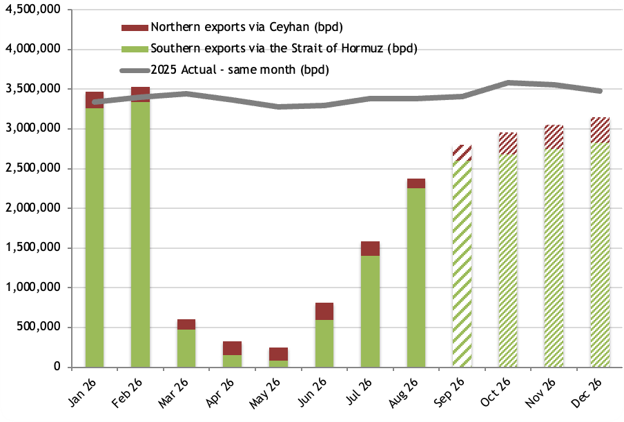 (Source: State Oil Marketing Organization for January-June and August; Iraq Oil Report for July and estimates for September; AFC Research projections for October-December[1])
Actual and Projected Revenues and Expenditures for 2026
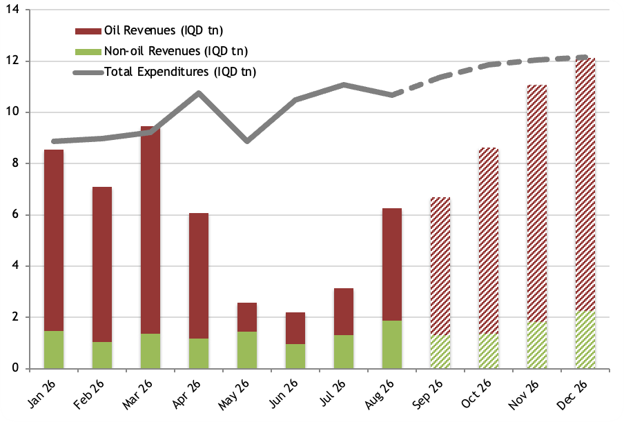 (Source: Ministry of Finance for January-August; AFC Research projections for September-December[1])
The state's expenditures are dominated by rigid current expenditures - made up of public-sector salaries, pensions, social security, benefits, and subsidies - which, reflecting the country's political economy, are exceptionally difficult to reduce even when oil revenues decline below expenditures. As such, the prior government, and the current government in office since May, continued with the usual cash-management toolkit - employed by all prior governments when oil revenues fall below expenditures - such as ad hoc cost savings and accumulating arrears to third parties, including domestic contractors and International Oil Companies (IOCs), together with the freezing of all new capital and investment spending projects. Despite these measures, there was a gap between revenues and expenditures in 2025, which continued into 2026 (chart above), but which increased significantly in April-June, then began to narrow in August, and is projected to narrow further as the year comes to an end (table below).
Actual and Projected Figures for the 2026 Budget

(Source: Ministry of Finance for January-August; Central Bank of Iraq for domestic debt to July, August estimated; AFC Research projections for September-December[1])
Foreign Reserves and the Exchange Rate
The government's continued spending, in particular its current expenditures, sustained domestic consumption, which in turn sustained the demand for imports. Surprisingly, this demand was relatively strong in the context of the disruptions brought by the closure of the Strait of Hormuz, as reflected in cross-border transfers (chart below), which are mostly used to pay for imports and are thus a proxy for domestic consumption. The application of the new automated customs tariff system at the end of 2025 had an initial depressing effect on demand, as reflected in the sharp drop in January, but demand recovered in subsequent months, with the drop in August being a function of new CBI procedures that constrained transfers.
Cross-Border Transfers (USD billion)
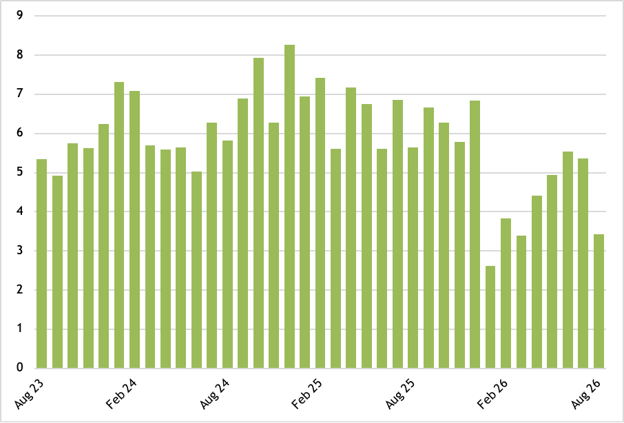
(Source: Central Bank of Iraq, data as of the end of August)
The continued drawdowns of foreign reserves to meet demand for cross-border transfers, not replenished by the conversion of oil revenues from dollars into dinars, led to a sharp decline in reserves, which by the end of September were down 23% from the levels at the end of 2025.[2] However, current levels are healthy, comfortably supporting at least 12 months of imports,[3] and are much higher than those that prevailed prior to the 18.5% devaluation in December 2020. As such, the current decision to devalue the dinar was a proactive one, buying the government time to decide on fiscal reforms, which is in sharp contrast to the historic head-in-the-sand stance of the country's political elite during periods of crisis.
In the near term, the pressures on foreign reserves should ease substantially, as reserves should be replenished by the conversion of increased oil revenues in October-December into dinars, while demand for cross-border transfers should be dampened somewhat by the effects of the dinar's devaluation on domestic consumption.
Foreign Reserves (USD billion)
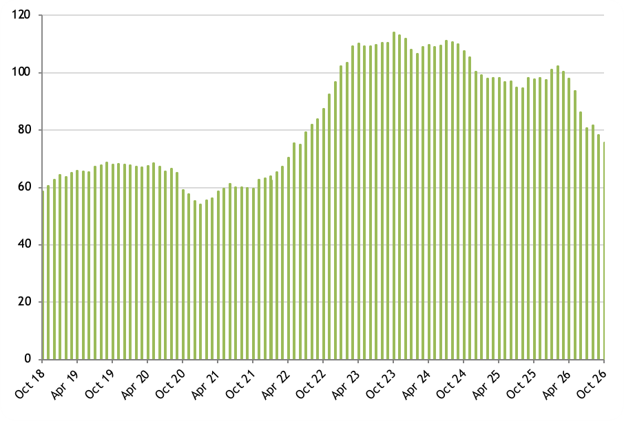 (Source: Central Bank of Iraq, data as of the end of September)
Near-term Outlook
The near-term outlook for government finances, the economy, and foreign reserves is highly dependent on the continuation of the recovery in oil exports and on the continuation of the pause in the tit-for-tat attacks between the U.S. and Iran. While a few strong oil export months do not make a trend, especially in this highly fluid and dangerous period, current market expectations for future oil prices, as measured by Brent futures contracts, promise a measure of stability for all three.
Expectations for future oil prices following the collapse of the Islamabad Memorandum of Understanding have consistently shifted higher, suggesting an acceptance that the current pause in the tit-for-tat attacks between the U.S. and Iran is evolving into a surreal new normal of no-war/no-peace (chart below).
Market Expectations for Future Oil Prices (USD per barrel)
As measured by Brent futures contracts
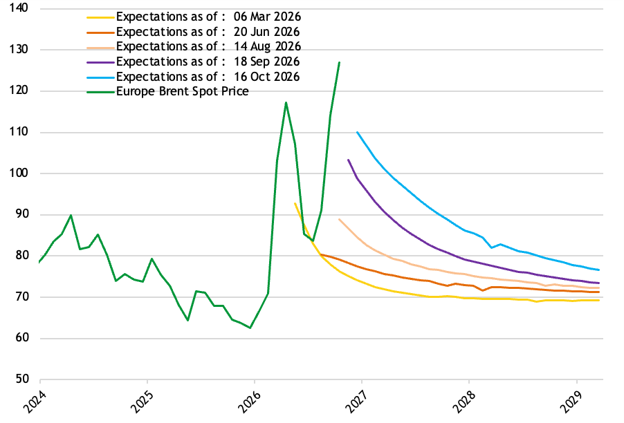 (Source: U.S. Energy Information Administration, investing.com, AFC Research, data as of October 16th)
As such, the combination of likely higher near-term oil prices, continued strong oil export recovery, and the 13.3% devaluation of the dinar would substantially improve the government's financial position for the year (budget table) and provide a measure of stability for the economy and foreign reserves - although reserves would still trend lower, albeit at a much slower rate.
The three positives of higher oil prices, continued strong oil export recovery, and the 13.3% devaluation of the dinar, while necessary, are not sufficient to sustain economic stability without addressing the budget's structural imbalances of rigid expenditures and revenue volatility. Nevertheless, they have provided the government with breathing space to decide on fiscal reforms, in particular those that could come with an International Monetary Fund (IMF) programme, such as the Stand-By Arrangement (SBA) signed in 2016, or, better still, the more substantial Extended Fund Facility (EFF).
Any IMF programme would face extreme resistance from the public and the political elite, who together rejected the White Paper for Economic Reform, which came in response to the financial crisis of 2020 and aimed to address the economy's structural imbalances.[4] That said, the continued need for debt to augment oil revenues, irrespective of the future direction of oil prices, requires the issuance of foreign debt in the form of Eurobonds, which would not come without an IMF programme, to supplement domestic debt - as the issuance of domestic debt on its own will continue the pressure on foreign reserves, while foreign debt will increase them.
Despite domestic resistance to an IMF programme, the proactive decision to devalue the dinar - breaking the historic head-in-the-sand pattern - signals the seriousness of the government's tentative engagement with the Fund over recent months. That engagement has since solidified: at the close of the IMF-World Bank Annual Meetings in Bangkok on October 17th, the IMF's Managing Director confirmed that the authorities had requested a programme, pledging "both money and policy support".
While such an engagement would likely take many months to conclude, the three positives outlined above have opened a window of up to a year for these discussions, as can be seen from the near-term implications of Brent crude prices under the assumption of continued oil export recovery. Current expectations imply an average Brent price of USD 92.5 per barrel (USD/bbl) for 2026, a projected average of USD 95.1/bbl for 2027, and USD 81.2/bbl for 2028, which, for Iraq under the current assumption of no-war/no-peace, means realised prices about USD 32/bbl below Brent for the balance of 2026 and for 2027-2028.
Assuming expenditures over the next two years are in line with those projected for 2026, this suggests that the budget's deficit for 2027 could be better than that of 2026, but that the deficit for 2028 could be worse. In the short term, this would allow domestic debt to fund the deficit without significantly eroding reserves, while in the medium term foreign debt would be needed - all of which support the conclusion of an IMF programme.
Notes
[1] Methodology: Projections for oil exports assume incremental month-on-month increases from September's estimated levels. Blended oil prices for southern oil exports assume a discount of USD 32 per barrel (USD/bbl) to Brent crude prices, while northern oil exports assume a discount of USD 5/bbl to Brent (September reflects actual Brent spot prices; December reflects futures prices as of October 16th; October and November are interpolated between the two). Budget oil revenues are derived from projected export receipts (0.44 x current month + 0.56 x two months earlier), less a 15% haircut, and converted at 1,461 IQD/USD in October and 1,500 IQD/USD in November-December. Projected non-oil revenues assume full-year growth of 16%, down from 24% year-on-year in January-August. Projected expenditures assume continued cost controls; each month's projected expenditures are based on the average of the preceding three months and include oil capital expenditures (15% of oil revenues), which were minimal in January-August.
[2] Reserves are created when the Ministry of Finance (MoF) converts its dollar oil revenues into dinars: the Central Bank of Iraq (CBI) buys the dollars from the MoF and sells it the equivalent in dinars. Cross-border transfers, on the other hand, are the reverse transaction: the private sector, through the banks, sells dinars to the CBI and buys dollars from its reserves. Reserves therefore increase when the CBI buys more dollars from the MoF than it sells to the private sector, and decline when it sells more than it buys. See: (1) Ahmed Tabaqchali, "A Fistful of Dinars: Demystifying Iraq's Dollar Auction," LSE Middle East Centre, April 18th, 2024, pp. 7-11, https://researchonline.lse.ac.uk/id/eprint/122652/; (2) Ahmed Tabaqchali, "The Empire Strikes Back: Trump 2.0 and Iraq's Dollar Accounts at the Federal Reserve," LSE Middle East Centre Blog, March 4th, 2025, https://blogs.lse.ac.uk/mec/2025/03/04/the-empire-strikes-back-trump-2-0-iraqs-dollar-accounts-at-the-federal-reserve/.
[3] Reserves as of the end of September, divided by the 18-month average of cross-border transfers, would cover at least 12 months of transfers. A CBI official at the MERI Forum in Erbil on October 13th stated that reserves cover Iraq's imports for a year or more. See: Al-Mada, "Central Bank: Our Foreign Reserves Cover Iraq's Imports for a Full Year or More" (in Arabic), October 14th, https://almadapaper.net/456706/.
[4] Ahmed Tabaqchali, "Missed Opportunities for Economic Reform," in Iraq 20 Years On: Insider Reflections on the War and Its Aftermath, Chatham House, May 4th, 2023, https://www.chathamhouse.org/2023/03/iraq-20-years-insider-reflections-war-and-its-aftermath/missed-opportunities-economic.
Please click here to download Ahmed Tabaqchali's full report in pdf format.
Mr Tabaqchali (@AMTabaqchali) is the Chief Strategist of the AFC Iraq Fund, and is an experienced capital markets professional with over 25 years' experience in US and MENA markets. He is a board member of Arab Bank Iraq, a Visiting Fellow at the LSE Middle East Centre, Senior Fellow at the Institute of Regional and International Studies (IRIS), and a Senior Non-resident Fellow at the Atlantic Council.
His comments, opinions and analyses are personal views and are intended to be for informational purposes and general interest only and should not be construed as individual investment advice or a recommendation or solicitation to buy, sell or hold any fund or security or to adopt any investment strategy. It does not constitute legal or tax or investment advice. The information provided in this material is compiled from sources that are believed to be reliable, but no guarantee is made of its correctness, is rendered as at publication date and may change without notice and it is not intended as a complete analysis of every material fact regarding Iraq, the region, market or investment.
Posted in Ahmed Tabaqchali, Investment, Iraq Banking & Finance News 2 Comments

Iraqi Bank Sanctioned for Alleged Iran Sanctions Evasion
Posted on 19 October 2026 .
By John Lee.
The US Department of the Treasury has sanctioned Iraq-based International Development Bank for Investment and Finance (IDB) as part of an operation targeting Iran's international financial networks.
According to the Treasury, IDB was designated under Executive Order 13902 for operating in the financial sector of the Iranian economy. The Treasury alleges that IDB was originally established by Iranian companies to support the Iranian economy and supply Iran with US dollars, and that it abused its access to the now-dissolved US dollar wire auction. It also alleges that IDB maintains ties to Iranian government entities and Iran-aligned militia groups in Iraq, and that profits are collected and remitted to Iran monthly in US dollars.
The Treasury further alleges that IDB's current leadership received ownership of the bank from a dual Iranian-Iraqi financier said to have worked for the US-designated Islamic Revolutionary Guard Corps-Qods Force (IRGC-QF), and that this individual continues to exert influence over the bank through family connections.
The Treasury also states that US-designated Bank Melli, formerly located adjacent to IDB in Iraq, transferred its capital to IDB after closing due to US sanctions.
Secretary of the Treasury Scott Bessent (pictured) commented:
"The Department of the Treasury will not relent until the Iranian regime's coffers are empty and every remaining financial lifeline sustaining its war machine has been severed."
Click here to read the announcement.
(Source: US Department of the Treasury)
Posted in Iraq Banking & Finance News, Iraq Industry & Trade News, Politics, Security 0 Comments