

Vodafone Qatar and ITPC in Telecoms Cooperation Deal
Posted on 13 November 2026 .
By John Lee.
Vodafone Qatar and Iraq's Informatics and Telecom Public Company (ITPC) have signed a Joint Cooperation Agreement at Mobile World Congress (MWC) Doha 2026 to establish a framework for collaboration in telecommunications and digital infrastructure.
According to Qatar's state-run news agency QNA, the agreement was signed by Mohamed Mohsin Alyafei, Enterprise Business Unit Director at Vodafone Qatar, and Ali Yassin Dawood, Director General and Chairman of the Board of ITPC, in the presence of Communications Minister Mustafa Jabbar Sanad.
Under the agreement, the two companies will explore potential areas of cooperation, including:
- Transit projects in Iraq
- Internet exchange points (IXPs) and international connectivity
- Interconnection of networks and related infrastructure
- Technical and commercial discussions on joint projects and network operations
(Source: QNA)
Posted in Iraq Industry & Trade News, Iraqi Communications News 0 Comments
New Transit Deals to Route East-West Telecoms Cable through Iraq
Posted on 10 November 2026 .
By John Lee.
Iraq has signed two transit cable agreements with UAE telecoms group Etisalat and Bahrain's Alliance Networks, aimed at linking East and West through Iraqi infrastructure.
The signing was overseen by Minister of Communications Mustafa Jabbar Sanad and took place in Qatar.
(Source: Ministry of Communications)
Posted in Iraq Industry & Trade News, Iraqi Communications News 0 Comments
NIC Chairman Holds Talks with Qatari Investors
Posted on 29 October 2026 .
By John Lee.
The head of Iraq's National Investment Commission (NIC), Adel Dakhil Muhammad al-Yasiri, held a series of investment meetings in Doha on the sidelines of the World Investment Forum 2026, engaging with the Qatar Investment Authority and leading Qatari private-sector firms.
According to the National Investment Commission, al-Yasiri met with a high-level delegation from the Qatar Investment Authority to review investment packages and incentives introduced by the Iraqi government, with a focus on residential and industrial city projects. He invited the Authority and Qatari businesspeople to visit Iraq to assess opportunities firsthand.
Al-Yasiri also met Sheikh Jassim bin Jabr bin Abdulaziz Al Thani, Chief Executive Officer of Ariane Real Estate, one of Qatar's leading real estate developers. The two sides agreed to explore cooperation on future development projects and job creation.
A further meeting was held with Sheikh Nayef bin Eid Al Thani, Chairman of Retaj Real Estate and Retaj Hotels, companies with investment projects in 52 countries in which the Qatari government holds stakes. Discussions covered real estate development, hotel management and commercial market development.
Al-Yasiri also met Moutaz Al-Khayyat, Chairman of Power International Holding, and Ali Kazma, the group's Chief Executive Officer in Iraq. The meeting reviewed the group's existing projects in Iraq and explored new opportunities in sectors supporting economic growth and sustainable development. Al-Khayyat affirmed that Iraq represents a strategic market in the group's plans.
(Source: National Investment Commission)
Posted in Investment 0 Comments

NIC Head Calls for Qatari Factories in Iraq
Posted on 28 October 2026 .
By John Lee.
Talks on expanding investment between Iraq and Qatar took place at a meeting between National Investment Commission (NIC) chairman Adel Dakhil Muhammad al-Yasiri and Sheikh Faisal bin Qassim Al Thani, chairman of the Qatari Businessmen Association, held in the presence of Minister of Trade Mustafa Nizar Jumaa and a number of Qatari investors.
Al-Yasiri called on Qatari companies to establish industrial projects in Iraq, citing available development opportunities and Prime Minister Ali al-Zaidi's commitment to providing facilities and guarantees for economic partnership.
Al-Yasiri also formally invited Sheikh Faisal to visit Iraq at the head of an investment delegation to review the investment map and proposed strategic projects.
(Source: National Investment Commission)
Posted in Investment, Iraq Industry & Trade News 0 Comments
IMF Forecasts Bigger Contraction for Iraqi Economy
Posted on 14 October 2026 .
By John Lee.
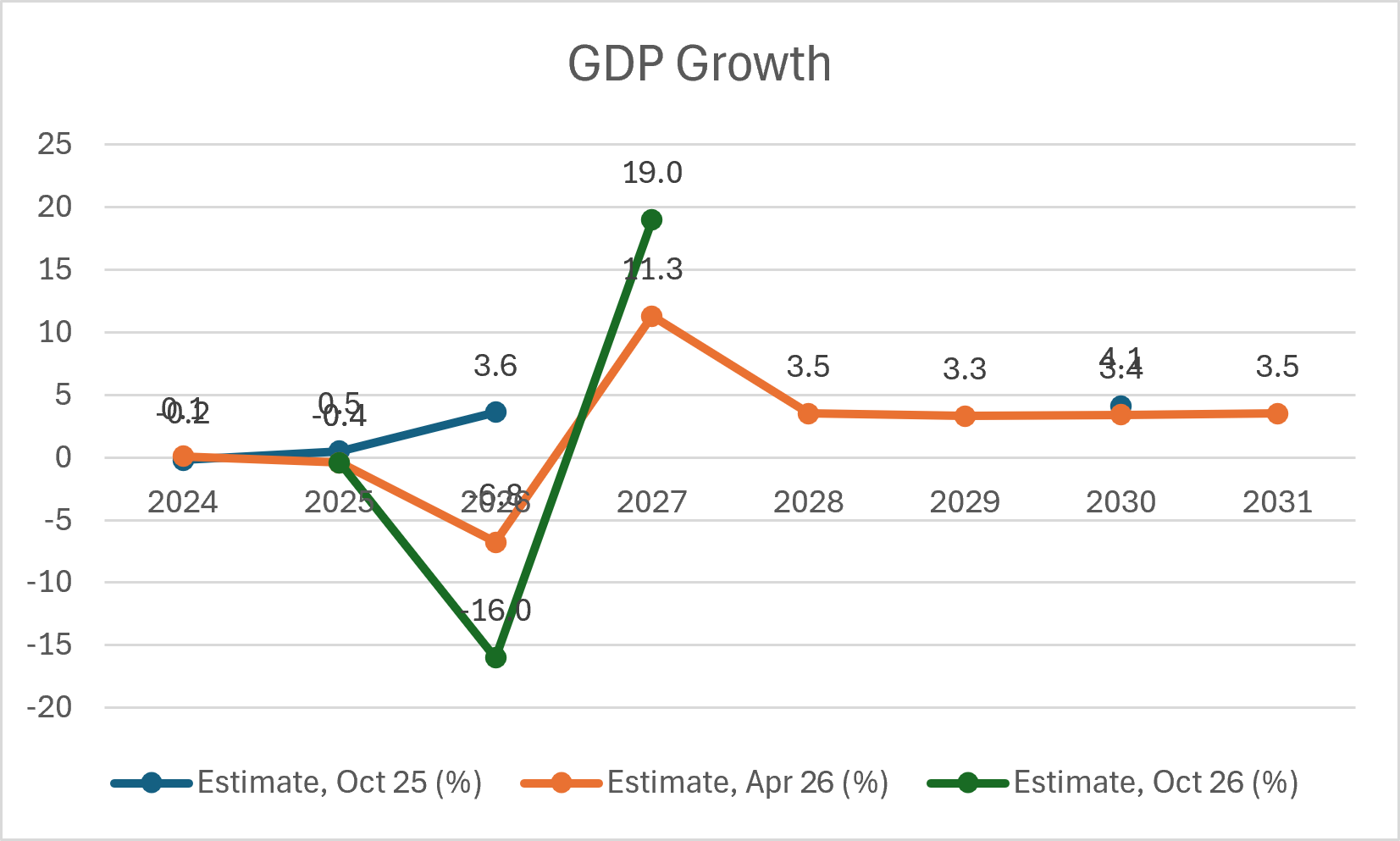
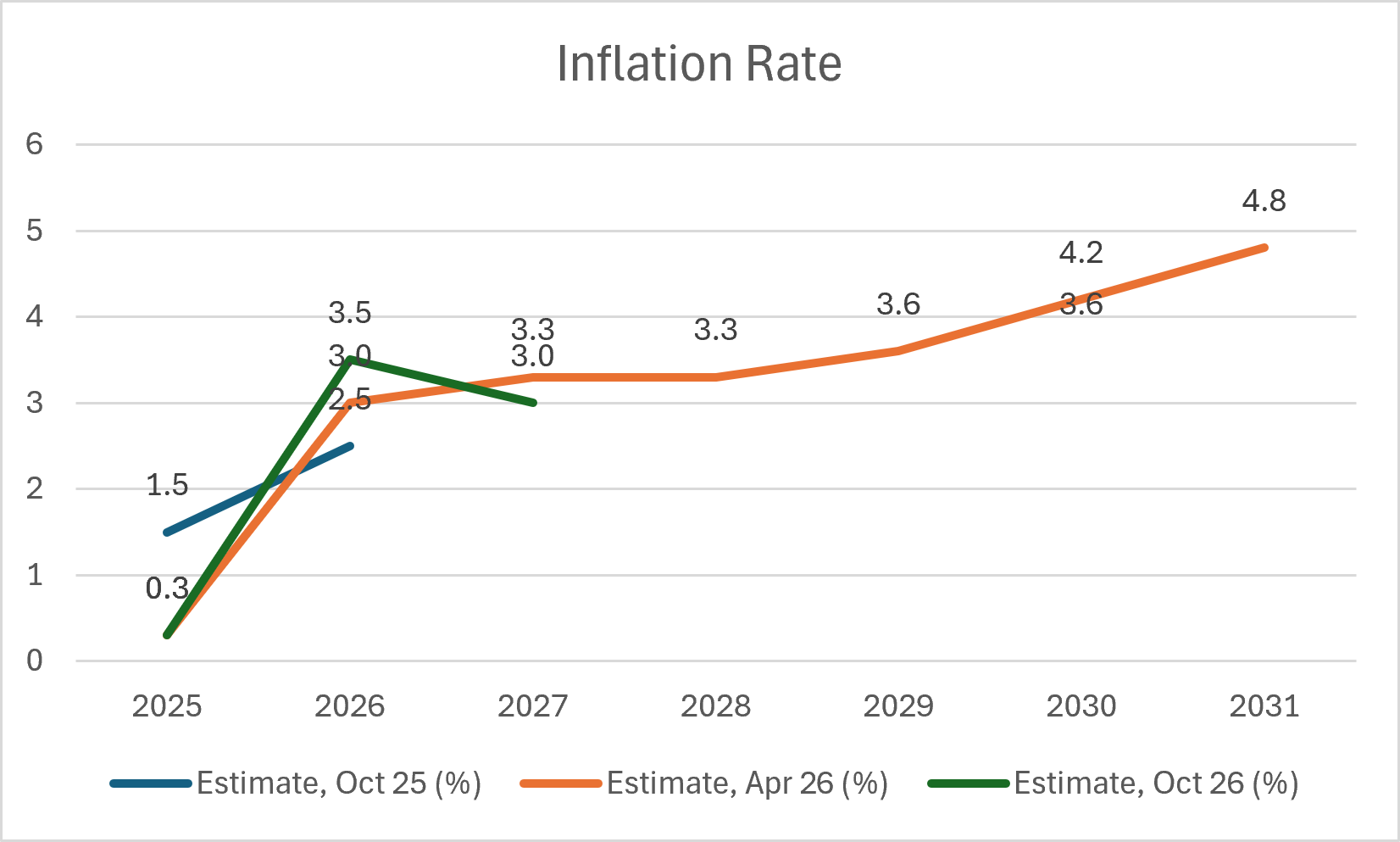
The International Monetary Fund (IMF) has revised its forecasts, considering the ongoing conflict in the Middle East.
According to its latest World Economic Outlook:
"Bahrain, Iraq, Kuwait, and Qatar - commodity producers most affected by disruptions to energy output and transport - are projected to experience double-digit contractions of their economies in 2026, followed by double-digit expansions in 2027 as production, exports, and logistics normalize."
The full report is available here.
To browse our comprehensive library of reports on Iraq, click here.
See also:
IMF sees Short-Term Iraq GDP Slump, then Recovery
(Source: IMF)
Posted in Iraq Industry & Trade News, Politics 0 Comments
New Fibre Route to Link Gulf and Europe via Iraq
Posted on 08 October 2026 .
By John Lee.
A dark fibre agreement has been signed between OFN, the international connectivity arm of Asiacell parent Ooredoo Group, and iQ Networks, an Iraqi fibre-optic infrastructure provider, to enable terrestrial transit connectivity across Iraq towards Türkiye and Europe.
According to Ooredoo Group, the agreement supports the overland component of a planned integrated connectivity route linking Asia, the Gulf, Iraq and Europe. It is intended to complement a separate landing arrangement between OFN and the Iraqi Telecommunications and Post Company (ITPC) for the Fibre in Gulf (FIG) subsea cable system, which is planned to land in Iraq.
FIG is described as the largest subsea cable system ever built in the GCC, with up to 720 Tbps of capacity across 24 fibre pairs, connecting Qatar, Oman, the UAE, Bahrain, Saudi Arabia, Kuwait and Iraq through a single high-capacity Gulf loop.
The agreement was signed at Ooredoo Group's headquarters in Doha. Those present included:
- Dr. Buraq Abdulkareem, Deputy Minister for Technical Affairs, Ministry of Communications
- Bassam Salim Hussein, Minister's Advisor for Technical Affairs, Ministry of Communications
- Ali Yaseen Dawood, Chief Executive Officer, ITPC
- Alaa Obais Hussein, Deputy CEO for Technical Affairs, ITPC
- Aziz Aluthman Fakhroo, Group CEO, Ooredoo Group
- Asoz Rashid, Group CEO, iQ Group
- Khalid Hassan Al-Hammadi, CEO, OFN
- Waseem Amjad, CEO, iQ Networks
- Zhino Qadi, General Counsel, iQ Networks
- Latif Can Ozel, International Sales & Business Development Director, iQ Networks
The combined infrastructure is intended to provide an additional geographical route for international data traffic, serving the connectivity needs of AI providers, hyperscalers, cloud providers, content companies, data centres and telecom operators. Implementation remains subject to regulatory and governmental approvals.
(Source: Ooredoo Group)
Posted in Iraqi Communications News 0 Comments
Qatar-Iraq Business Council Established
Posted on 08 October 2026 .
By John Lee.
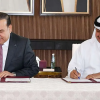
Qatar Chamber and the Federation of Iraqi Chambers of Commerce have signed a Memorandum of Understanding (MoU) to establish a Qatar-Iraq Joint Business Council. The signing took place on Wednesday at a bilateral business meeting in Doha, attended by senior figures from both chambers and prominent business leaders from each country.
The meeting, chaired by Sheikh Khalifa bin Jassim bin Mohamed Al Thani, Chairman of Qatar Chamber, was attended by Amer Khalaf Alawi, President of the Federation of Iraqi Chambers of Commerce, along with Mohamed bin Ahmed bin Twar Al Kuwari, First Vice Chairman of Qatar Chamber, and Dr Mohamed bin Jawhar Al Mohammed.
The MoU aims to strengthen bilateral economic relations, expand communication between businesses and entrepreneurs in both countries, and develop cooperation in the field of small and medium-sized enterprises (SMEs).
The meeting also reviewed around 60 investment opportunities linked to the Development Road project, with an estimated value of $250 billion, spanning sectors including:
- Transport and logistics
- Manufacturing industries and economic zones
- Energy and utilities
- Mining, oil and gas
- Agriculture, ICT, real estate, and tourism
(Source: Qatar Chamber)
Posted in Investment, Iraq Industry & Trade News 0 Comments

Qs and As Regarding the Al-Zaidi Govt's Views on Petroleum Issues
Posted on 06 October 2026 .
By Ahmed Mousa Jiyad. Any opinions expressed are those of the author, and do not necessarily reflect the views of Iraq Business News.
Qs & As Regarding Al-Zaidi Government' Views on Petroleum Issues
Interest in the Iraqi petroleum sector has intensified lately, particularly from energy-focused Western media sources. In response to my articles and presentations since the US-Israeli war against Iran, I have received, through emails and direct discussions on Zoom and Microsoft Teams, many questions and requests for comments and clarification. All of them want to know and understand what the current Al-Zaidi government intends to do on a variety of issues pertaining to the Iraqi petroleum sector. Western inquiries focus on upstream petroleum and the prospects of IOCs, while Iraqi concerns focus on oil export prices, discounts, and the impact and consequences of the continued war on Iran.
This brief article provides answers to the questions and requests, which focused on the following topics*:
- The new higher oil production target.
- The increasing presence of US companies in Iraqi petroleum projects.
- IOCs' dominant role in upstream petroleum.
- The availability of enough resources to support a two-digit production level.
- Matters relating to bureaucracy and transparency in petroleum contracting and awarding decisions.
- The ongoing US war on Iran and its impacts on Iraq.
- New pipeline proposals to diversify export routes.
- Monetising associated gas.
- The prospect of Turkish involvement in the Iraqi petroleum sector.
- SOMO's high discounts on its official selling price.
Before answering the questions, I expressed, through direct communications, my readiness and delight to cooperate and respond professionally and objectively to the related parties. I highlighted that I have an elaborate, well-organised and updated database that covers more than three decades of development in the Iraqi petroleum sector in particular and the national economy in general. I have published numerous articles in Arabic and English, and authored seven books in English documenting the development of the Iraqi petroleum sector. Links to my publications were provided for easy access when needed. Therefore, everything I say or write in due course is verifiable and evidence/fact based. Below are the questions (Qs) and my answers (As).
Q1. On the oil side, Al-Zaidi initially said that the country's goal is to grow oil production to 7 million barrels per day (mbd) from the pre-US-Iran war level of over 4 mbd, most recently upping this target to 8-9 mbd and giving a timeline of six years. Is this feasible?
A1. Based on available data, Iraq (excluding the KRG) currently has an installed oil production capacity of ca. 5 mbd, while actual utilised capacity fluctuates. During the period 2014-2025, the maximum actual production was in 2019: 4.576 mbd (Ministry of Oil (MoO) data) or 4.678 mbd (secondary sources used by OPEC). The annual average during 2025 was 3.775 mbd and 4.011 mbd according to MoO and OPEC data respectively.
Yes, but Al-Zaidi proposed escalating targets reaching 10 mbd within six years! In my view this is unrealistic and probably unattainable.
- Since the signing of the first bid round in 2010, Iraq's installed production has almost doubled, reaching ca. 5 mbd in 2025.
- From 2019, actual production, according to MoO data, declined from 4.576 mbd to 3.775 mbd at the end of 2025.
- Almost all of the production increase is attributable to oilfields offered under the first two licensing rounds.
- Apart from the impacts of COVID-19, geopolitics and market fundamentals, the absence of a coherent, integrated and comprehensive Energy Policy has contributed to complicating and hindering progress in actual oil production. The Al-Zaidi government demonstrates no resolute orientation in its programme to remedy the situation.
- So, if it took the country 15 years to increase its installed capacity from ca. 2.3 mbd to 5 mbd, how is it possible to reach 10 mbd in six years?
Q2. Al-Zaidi appears to know the path to achieve it - bring in US and other international operators to develop legacy and new fields. Does he?
A2. I am not sure he knows the path well! He has absolutely no experience in oil matters, let alone the political economy of international oil contracting with IOCs and the recent historical experience of US IOCs in Iraq.
Materially verifiable evidence suggests the US "Big" oil companies had the "lion's share" in Iraqi upstream petroleum through:
- The Memoranda of Cooperation (MoCs) concluded between IOCs and the Ministry of Oil during 2004-2008.
- The list of IOCs qualified to participate in the bid rounds (2009-2024).
- The companies that participated in the first two bid rounds (2009-2010).
Yet none of the US "Big" oil companies won a contract, as operator, in the open, competitive and transparent bidding events. Through the "back door", yes, but in only one case, which did not last long.
Q3. Foreign-operated fields in Federal Iraq (excluding Kurdistan, where 100% of working fields are in the hands of international oil companies (IOCs)) already account for 75% to 80% of total oil production in the country. Is this so?
A3. Correct, and it could be more than 80%. The number of oilfields operated by "National Efforts" is declining because some of them have been offered to IOCs, such as NOC's four producing oilfields (Kirkuk, Bay Hassan, Jembour and Khabaz) contracted to BP, the Ratawi/Artawi oilfield offered to TotalEnergies, the Himreen oilfield to HKN, and the Nassiriya and Balad oilfields offered to Chevron, among others.
Regretfully, there has been a tendency by the last three governments, of Al-Kadhimi, Al-Sudani and now Al-Zaidi, to offer nationally operated oilfields and exploration blocks to IOCs.
Q4. Does Iraq have a sufficient number of explored fields in place to offer to international oil companies to support 8-9 mbd of production? One could suspect the Majnoon/West Qurna 2 oilfields will be central in achieving this goal, but maybe you can point to other fields that may be instrumental in achieving it? Do you think the goal is realistic at all?
A4. To answer this question, we have to remember that after concluding the contracts for the fields under the first two bid rounds, Iraq's plateau production target/capacity (PPT) was to reach 12 mbd by ca. 2017. The PPTs were revised downwards, and the contracts were revised accordingly in 2014/15.
Iraq, in my humble view, has many options to reach the 10 mbd threshold. But is it advisable to develop a production capacity of such a level while ignoring, as has been the case since 2010, the required parallel expansion of export infrastructure and outlets, associated gas utilisation, international market conditions, OPEC/OPEC+ compliance, and the absence of a coherent, comprehensive national petroleum policy?
That said, Iraq could increase oil production through the following options:
- Expedite oilfield development under the contracts concluded in the first four bid rounds.
- Revise the amended contracts back to, or close to, their originally contracted PPTs.
- Quick and timely conversion of exploration block contracts into oilfield contracts for already discovered oilfields. Exploration Block 10 to the Eridu oilfield is the most obvious example, with its huge discovery and the high possibility of its boundaries extending beyond the contracted area. Another example is the Salman oilfield in Exploration Block 12.
- The agreement with BP could enhance NOC's oil production, gradually.
- The Majnoon and West Qurna 2 oilfields could have significant impacts, but there are legal hurdles in offering them to IOCs under a different contract type and basic fiscal conditions.
As it stands today, Iraq has enough oil.
But the country needs to do more: first, to utilise associated gas, and second, to develop the gas fields, namely Akkas, Mansuria and Siba. Moreover, Iraq is a relatively under-explored country, particularly in its western part.
Evidence suggests a high exploration success ratio. Hence, the focus should be on exploration activities, with priority given to areas with promising natural gas prospects. The required exploration could be done by Iraqi national efforts, with some external assistance when needed.
Q5. It appears from Iraqi news that Al-Zaidi is making strong efforts to cut domestic bureaucracy and simplify the approval process for IOCs, as well as to increase the transparency of tenders and other governmental dealings. More often than not, exemptions from existing regulations are being granted by the Cabinet of Ministers to speed up approvals. So, the question to you is whether you think bureaucracy is indeed becoming less of an obstacle for IOCs, and whether there is a need to implement a wider reform/overhaul of existing regulations/laws to avoid such individual/per-case exemptions, instead putting more robust legislation in place to replace these regulations and laws?
A5. The increasing number of exemptions could reveal different forms of high-level corruption, irregularities or favouritism. This pattern of exemption intensified under ex-PM Al-Sudani. For example, exempting an oil company (x), because it is American, from the qualification criteria and process usually applied by the Ministry of Oil is counterproductive and undermines an established system of qualification.
Moreover, there has been a dangerous lack of transparency, particularly during the last ten years. No basic information has been disclosed regarding the fiscal, economic and legal regime of any contract or agreement the government has signed. Neither the Ministry of Oil nor the related IOCs have disclosed the regime of the signed contracts during the last ten years.
Logically, it is rather unreasonable to expect less bureaucracy in a strictly non-transparent working environment. Lack of transparency covers corruption, inefficiency and rigid bureaucracy.
So far, the Al-Zaidi government, as far as the oil sector is concerned, has not publicly and openly disclosed the basic details of any contract or agreement, or even the status of previously concluded deals. The Oil Ministry website usually shows more photos and a few words on any meeting it reports on; absolutely no substance on the subject matter.
And by the way, Iraq is obliged under the provisions of the EITI to disclose contracts and agreements in the extractive activities of the petroleum sector. And the Minister of Oil is the chair of the Iraqi EITI!!!
Finally, laws in Iraq are promulgated and amended according to the Constitution and through an established process and procedure. But "exemptions" are usually pursued by the executive branch, for justifiable reasons or otherwise, though mostly on unjustifiable premises.
Q6. Another key issue is the Strait of Hormuz and the US-Iran war. While grand plans are announced in Baghdad and IOCs are invited to Iraq, the country is having major issues with oil production/exports. These issues may drag on for months, if not years, as the US-Iran confrontation may last a long time. So, this poses the question of whether you think Iraq and Al-Zaidi remain hostage to the situation in the Middle East, and whether, until there is permanent peace/stability in the region, IOCs may be slow or reluctant to commit billions of dollars of new investment to the country?
A6. Many important issues are relevant for consideration regarding this topic.
First, the Strait of Hormuz remains strategically important not only for seaborne oil transport but also for other petroleum and petrochemical products, LNG, and a wide range of trade and supply chains. It will open again, fully or partly. The question is not if but when, depending on the geopolitical and military standoff prevailing since the end of last February.
Second, I recently proposed a southern-bound joint pipeline: Basrah-Kuwait-Bahrain-Qatar-Saudi Arabia-UAE-Oman, with terminal options on the Gulf of Oman or the Arabian Sea. This new, outside-the-box pipeline could provide a "necessity option" for exporting oil through terminals bypassing, but in addition to, the Strait of Hormuz.
Third, it is helpful to know or remember some data on the current status of Iraq's export outlets. The highest volume through the southern export terminals and the SPMs was 3.627 mbd in December 2018; this tells a lot about the infrastructural limitations on the country's export capacity and, consequently, the time and magnitude of investment needed to expand that capacity if Iraq aims to boost oil production to a much higher level than it has today.
As for exports through Turkey, Iraq, under current domestic and regional conditions and geopolitics, is unable to provide the 758 tbd envisaged by the transitional commercial arrangement, let alone provide 1.5 mbd by next July!
Q7. The pipeline proposals to diversify routes and connect Basrah/southern fields to the existing Iraq-Turkey pipeline and the rebuilt Iraq-Syria pipeline may take several years to complete. So, do you think the diversification of export routes should be completed (or at least started) before major Western investment can start coming into oil developments and higher production?
A7. As I mentioned above, Iraq needs to formulate and implement a harmonised, integrated petroleum policy that coordinates the parallel development of the four sub-sectors of petroleum: upstream, midstream, downstream and international marketing.
Iraq should always have some sort of "Dynamic Oil Material Balance" covering and aiming at the optimisation of oil production, oil exports and domestic requirements (for the refining sub-sector, electricity generation and other uses), which should be reviewed regularly - weekly, monthly or quarterly.
An IOC's attention is usually and mainly "project-focused"; the Ministry's approach should be "sector-wide", i.e., covering the four sub-sectors. Hence, contractual provisions, particularly "Take or Pay", should always be kept in mind when considering upstream petroleum projects.
Q8. Another question is about monetising associated gas. Al-Zaidi has emphasised that a priority is ending Iraq's reliance on foreign natural gas imports, notably from Iran. Do you expect any quick progress on this plan? With decades of gas flaring, declarations on eliminating gas flaring do not appear that easy to implement - and may take years to complete, delaying the desired ramp-up in oil production. But maybe you have your own opinion on the associated gas programme to share...
A8. Gas flaring is, and has been, one manifestation of the MoO's failure so far. The MoO has not published data on associated gas production, utilisation and flaring on its website since the last quarter of 2016.
Data from the World Bank's Zero Routine Flaring Initiative still shows Iraq among the top four countries in gas flaring: Russia, Iran, the USA and Iraq.
Gas provisions in the contracts for oilfields offered under the second bid round were not properly observed, or were even ignored, by the MoO in many oilfields, particularly Majnoon, West Qurna 2 and Gharraf.
Moreover, there are cases indicating confusion and inconsistency in awarding associated gas projects to companies while the related oilfields are operated by other companies.
Basrah Gas Company (BGC), a joint venture comprising SGC, Shell and Mitsubishi, which is supposed to utilise associated gas from six oilfields (Rumaila, West Qurna 1, Zubair, and the three Missan Province fields of Buzorgan, Faqah and Abu Gharab), has not yet reached its contracted target, even after 11 years in operation that followed 7 years of negotiation to finalise the JV agreement.
Finally, by definition and logic, associated gas is a by-product of oil. The exact relationship depends on the Gas-Oil Ratio (GOR) of each type of crude oil. There is, naturally, a strong statistical correlation/regression between the two, with gas dependent on oil. Therefore, if Iraq is unable to utilise associated gas at the current oil production level, it will not be able to utilise the higher volumes of associated gas resulting from higher oil production levels. Unless current gas flaring is ended, new oil production capacity (over 5 mbd) would augment the malpractice of gas flaring and all the negative consequences such flaring causes.
Q9. A question about Turkey. Turkey has strong ambitions of becoming a large regional oil hub by securing 2 mln bpd or more of Iraqi oil transiting the country. It also wants a guaranteed supply of 1 mln bpd to Turkey's refineries. Ankara is ready to jump on this opportunity to increase its regional importance as an oil hub, after securing natural gas transits and imports/exports. Do you think the interests of Baghdad and Ankara align? Do you think that in the long term Turkey may rival the US and China in Iraqi oil and gas developments and influence?
A9. The one-year transitional commercial agreement concluded on 1 August includes a 750 tbd throughput, rising to 1.5 mbd once the comprehensive new agreement is reached by the end of the current transitional commercial agreement.
Many important issues will need to be resolved, depending on what the comprehensive new agreement covers. No specific information has been revealed so far, and there is a good deal of confusion and contradiction even in what has been revealed.
Iraq has to optimise the allocation of oil exports between the four outlet options: Turkey, Syria, the Strait of Hormuz and the southern joint pipeline mentioned earlier.
I do not believe that Turkey has the strength and capacity to rival the US or China in Iraqi oil and gas developments and influence. China already has a strategically consolidated position in the Iraqi petroleum sector; Turkish companies do not pose any challenge to the Chinese.
As for US companies, it is rather early to assess their possible standing in Iraqi petroleum, since what has been concluded so far is a few framework agreements, not definitive contracts. But again, Turkish companies are no match for US "Big Oil" capabilities.
Currently, Turkish involvement in Iraqi upstream petroleum development projects is confined to two fields, through TPAO: a minor (7.5%) participating interest in the Badra oilfield, and a 40% interest in the Siba gas field. But some Turkish companies have a role in the petroleum sector as service companies or sub-contractors, such as in drilling activities.
Nevertheless, in a comparative sense, Turkey has an edge in its negotiations with Iraq: the water issue, the Development Road, the PKK and Turkish military forces in northern Iraq, and trade relations, all in addition to oil matters, including direct links with the KRG.
Q10. Why does SOMO offer high discounts while international oil prices are soaring, markets are tight and seaborne oil trading has been seriously interrupted by the closure of the Strait of Hormuz?
A10. This is an important, timely and complex topic that was raised by different parties, especially from inside Iraq, including journalists, parliamentarians and oil professionals, among others.
To begin with, offering discounts or imposing premiums on oil prices is normal practice for all oil exporters, depending on how they assess market conditions, geopolitical risks, their pricing mechanism/setting formula, their market share and their need for oil export revenues, among other considerations.
The recent discounts in question are primarily related to geopolitical risks that have increased tanker insurance, fuel and operating costs to unprecedented levels. Moreover, "dark" transits of the Strait and "ship-to-ship" round-trip practices increase oil tanker costs, which are compensated for by further discounts.
That said, the main issues in the Iraqi case are the magnitude of the discounts, their duration, which markets they apply to, why, and what the fiscal consequences of these discounts are.
SOMO-based information indicates discounts increased from $14 a barrel to $25/b during July and August respectively, while international sources give a much higher threshold of $30/b for mid-August deals.
Trading sources and Reuters report that SOMO offered September crude at discounts of $15 to $20.80 per barrel to its official selling prices, and some cargoes were sold at even larger discounts. Vitol and ADNOC have been active in concluding Iraqi oil liftings at such discounts; they purchased a total of 70 million barrels for September loading.
The above discounts are themselves significant, as are their fiscal magnitude and ramifications for Iraq's oil export revenues, and assessing them requires real, full and accurate data. But SOMO does/did not disclose the relevant data needed on the following related matters.
First, the reference Official Selling Price (OSP) to which the above discounts applied.
Second, Iraq exports two types of crude from the southern export outlets: Basrah Medium and Basrah Heavy. While the exported quantities of the two types are published occasionally, their prices are not, either in aggregate or for different market destinations.
Third, SOMO announces, on a ministerial monthly basis, the OSP setting formula for the two Basrah crudes destined for the three major international markets: East Asia, Europe and the Americas. The price formula for each market has its own "marker crude", which differs from market to market. Data from international sources indicates a wide margin of variation between the prices of the marker crudes used.
Fourth, Iran has publicly and formally exempted Iraqi oil cargoes from fees or restrictions on transiting the Strait of Hormuz. This implies that SOMO is not compelled to offer discounts when a cargo exemption is on offer.
Fifth, SOMO did not release its Monthly Export Reports for April to July. The August Export Report shows the following: Basrah Medium 55,702,595 barrels; Basrah Heavy 14,052,339 barrels; Kirkuk and KRG oil exported through Turkey 3,932,683 barrels.
The monthly report says nothing about the export price, total revenues, or how much Basrah crude was sold at the reported discount of $25/b during August. If this discount applied to all Basrah crude exports, SOMO lost well over $1.7 billion in August.
The MoO's preliminary estimate of all oil export revenues was $4.5 billion in August, indicating the discount represents 37.8% of oil export revenues. The preliminary average oil export price during August was $64.29 a barrel, indicating SOMO's OSP for Basrah crude could have been $89.29 a barrel at most. Lost oil revenue of more than $1.7 billion in one month is a painful, unacceptable fiscal blow for Iraq.
Sixth, as mentioned above, Vitol and ADNOC have reportedly contracted to lift a total of 70 million barrels during September. Unless oil production and exports from the southern terminals increase above August levels, all oil exports from the south will be earmarked exclusively for Vitol and ADNOC.
The consequences will be both costly and damaging in the short and medium term.
Discounts, if continued at such hefty levels, will remain fiscally heavy, eroding oil export revenues and deepening the fiscal crisis for the current government.
SOMO will not be able to fulfil its "Term Contracts" with all or most of its ca. 40 International Oil Buyers (IOBs); that could damage its reputation as a reliable supplier and could reduce its market share.
Moreover, in-kind payment of IOCs' entitlements could very well be affected, causing further delay in the ramp-up of oil production.
Seventh, the magnitude of the discount in just one month has outraged many inside Iraq, prompting calls to question the MoO on why its affiliated company, the Iraqi Oil Tanker Co. (IOTC), has no capacity to transport Iraqi crude. It has also exacerbated the sharp differences of position that surfaced during August between the Ministries of Transport and Oil when a parliamentary committee debated this issue. More debate is probably forthcoming on two options: offering costly discounts vs. enhancing IOTC's fleet capacity.
*My answers reflect data and information as of mid-September.
Mr Jiyad is an independent development consultant, scholar and Associate with the former Centre for Global Energy Studies (CGES), London. He was formerly a senior economist with the Iraq National Oil Company and Iraq's Ministry of Oil, Chief Expert for the Council of Ministers, Director at the Ministry of Trade, and International Specialist with UN organizations in Uganda, Sudan and Jordan. He is now based in Norway (Email: mou-jiya(at)online.no, Skype ID: Ahmed Mousa Jiyad). Read more of Mr Jiyad's biography here.
Posted in Ahmed Mousa Jiyad, Iraq Oil & Gas News, Politics 0 Comments
Iraq and Oman Sign Anti-Corruption Agreement
Posted on 25 September 2026 .
By John Lee.
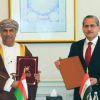
Iraq and Oman have signed a memorandum of understanding (MoU) on bilateral cooperation in integrity promotion and anti-corruption, on the sidelines of the Sixth Session of the States Parties to the Arab Anti-Corruption Convention in Doha, Qatar.
The MoU was signed by Dr Mohammed Ali Al-Lami, President of the Federal Commission of Integrity, and Sheikh Ghassan bin Hilal Al-Alawi, head of Oman's State Financial and Administrative Oversight Authority.
The agreement covers:
- Exchange of expertise and information on anti-corruption strategies and policies
- Sharing of studies on preventive measures against corruption
- Exchange of experience in handling complaints and reports
- Follow-up on mutual legal assistance requests and international asset recovery files
- Cooperation on financial disclosure systems, conflict-of-interest avoidance, and integrity mechanisms
- Exchange of training courses, workshops, and academic research
(Source: Federal Commission of Integrity)
Posted in Iraq Industry & Trade News, Security 0 Comments
New Wave Offshore Energy Wins Contract for AGUP Phase 2
Posted on 23 September 2026 .
By John Lee.
Sinopec (China Petroleum & Chemical Corporation) has awarded a Marine Warranty Survey (MWS) contract to New Wave Offshore Energy in support of the Associated Gas Upstream Project (AGUP) Phase 2 in southern Iraq, part of the Gas Growth Integrated Project (GGIP) operated by TotalEnergies alongside its partners Basra Oil Company (BOC) and QatarEnergy.
Under the contract, the US-based company will provide Marine Warranty Surveyor services for the international transportation and shipment of line pipe packages and related project materials for the AGUP Phase 2 development package.
The scope covers marine transportation engineering, shipment procedures, load-out and load-in operations, transportation routing, weather criteria, and marine transportation risk management for cargoes originating from multiple international supply locations.
AGUP Phase 2 relates to the redevelopment of the Ratawi field, which was launched in September 2025. It is expected to increase production to 210,000 barrels per day by 2028.
(Source: New Wave Offshore Energy)
Posted in Iraq Oil & Gas News 0 Comments