



GE Signs Multi-Million Dollar Agreement with Mass Global
Posted on 23 September 2011 .
12-Year Parts and Repair Exclusive Contract to Ensure Long-Term Reliability and Overall Performance of 18 GE Gas Turbines at Arbil, Sulaimaniyah and Dohuk Power Plants in Kurdistan Region.
Reinforcing its commitment to support Iraq's expanding energy infrastructure, GE has signed a multi-million dollar, multi-year agreement with Mass Global Investment Company, an independent power producer in Northern Iraq.
The agreement is designed to help Mass Global maintain the high reliability and overall performance of the 18 GE gas turbines installed at the Arbil, Sulaimaniyah and Dohuk power plants, located in Iraq's Kurdistan region.
The long-term agreement covers the supply of parts and repairs services for planned outages of the GE Frame 9E gas turbines over a period of 12 years. The agreement also will support the building of local technical expertise with a tailored training program for more than 30 Mass Global engineers.
Ahmed Ismail, chairman of Mass Global, said: "Mass Global continues to be at the forefront of meeting the power requirements of the Northern Iraq region. This new service agreement builds on our growing relationship with GE, a global technology leader, whose proven and reliable advanced energy technology has been employed in our gas power facilities since 2006. The long-term partnership with GE also will enable us to enhance our operational efficiencies as well as develop our staff competencies to help meet the energy requirements in this region."
The key components of the contract also include inter-changeability of the latest parts technology for Mass Global's installed base, joint outage planning to provide the highest reliability, specially expedited parts delivery and customized field training program for Mass Global's engineers.
Joseph Anis, GE Energy's president and CEO for the Middle East said: "This latest service agreement with Mass Global, which includes a tailored training program for local engineers, is designed to ensure real-time support. It builds on our growing relationship with Mass Global, supporting its efforts to enable a reliable supply of much-needed electricity in the northern region of the country. The agreement also reflects our expanding knowledge transfer initiatives and further underlines our commitment to strengthen Iraq's power generation capacity and infrastructure growth with advanced technology and high quality services."
This agreement follows earlier announcements that GE is supplying Frame 9E gas turbines to Arbil, Sulaimaniyah and Dohuk provinces. The GE Frame 9E gas turbines come equipped with flexible fuel handing capabilities, accommodating a wide range of fuels. With these agreements, Mass Global will generate more than 2,250 megawatts of power for the Kurdistan region.
This agreement further reiterates the leading role that GE is playing in supporting the growth of Iraq's energy sector and the strong relationships the company has forged with leading utility providers across the country, GE's long-term service agreements are structured to provide customers with predictable maintenance costs. To date, GE has long-term service agreements in place at more than 700 sites worldwide.
Posted in Construction & Engineering In Iraq, Iraq Public Works News Comments Off on GE Signs Multi-Million Dollar Agreement with Mass Global
Industry Leaders to Discuss Opportunities in Iraqi Energy Sector
Posted on 23 September 2011 .
Commencing on September 26, 2011, Iraq 2011: Future Energy is an industry summit strategically designed to provide stakeholders in the energy sector with a comprehensive understanding on how to develop a highly efficient and profitable industry with a focus on Iraq.
Iraq’s oil and gas, power, electricity and infrastructure sectors have significant opportunities and financial potential. Iraq 2011: Future Energy will be the ideal place to network with some of the leading figures in the energy industry to build strategic relationships and begin Iraq’s quest to reach economic prosperity.
The Energy Exchange recently announced that His Excellency Mr. Taner Yildiz, Minister of Energy and Natural Resources, Turkey, will provide an address on September 27, and ex-US Ambassador to Iraq, Mr. Zalmay Khalilzad will give a key-note presentation to begin day-two of the conference which will focus on how international energy companies can benefit from investing in Iraq.
Sidharth Mehta, Senior Project Manager, The Energy Exchange, said: “The energy industry in Iraq today provides a unique opportunity for foreign companies to capitalise on profitable endeavors. Next week, Iraq 2011: Future Energy will feature a high caliber of speakers to address the variety of issues faced by energy-related companies. The four-day conference will provide an in-depth analysis of the current state of the energy sector and all the necessary strategies and solutions for electric power and oil and gas companies to successfully and efficiently operate. In addition, it provides a significant networking platform to interact with government officials and leading industry experts to potentially build rewarding relationships.”
Recently, Iraqi Deputy Oil Minister Ahmed Al-Shamma stated that Iraq requires US$30 billion in investments to build five oil refineries, giving an insight into the potential of the downstream sector in Iraq, and what can be expected in the future.
Adnan Al Janabi, Chairman of the Iraq Parliament’s Oil and Energy Committee, will address Iraq 2011: Future Energy, giving a detailed presentation on the Draft Oil Revenue Distribution Law and Petroleum Law.
“The most important thing for the Iraqi oil sector is restructuring, part of which involves reinstituting the Iraq National Oil Company and implementing a federal Oil and Gas law,” said Al Janabi. “It is a constitutional requirement to implement article 106, the Revenue Sharing Law. However, this cannot be completed without restructuring the oil sector.”
Simona Marinescu, Senior Economist and Programme Director for Economic Reforms, Iraq, United Nations Development Programme, will also be present at the conference and provide an in-depth and comprehensive presentation on harnessing economic reform in Iraq.
Several leading oil and energy companies will be present and each of them will explain their company’s current and future endeavors in Iraq, along with the abundant opportunities the oil-rich country provides.
Hans Nijkamp, VP and Country Chairman for Iraq at Shell, will highlight the benchmarks for future production at the Majnoon oilfield. Elias Kassis, Managing Director, Exploration and Production for Iraq at Total, will analyze its joint development of the Halfaya oilfield. In addition, development plans for Siba and Mansuriya gas fields will be discussed by Mohammed Aboush, Senior VP, Iraq, of Kuwait Energy Company.
Mohammed Aboush, Senior VP, Iraq, at Kuwait Energy Company, said: “Iraq is probably the largest underdeveloped onshore oil and gas opportunity in the world. We look forward to acquiring more opportunities in this country and the region in the future as we continue to help governments and the people they represent to gain value from their natural resources.”
According to data released by the Organization of Petroleum Exporting Countries (OPEC), Iraq in 2010 was responsible for flaring 268 billion cubic feet of gas, a crucial waste of a valuable resource.
Fabrice Mosneron Dupin, Global Gas Flaring Reduction Advisor to the World Bank, said: “Gas flaring reduction in Iraq represents a huge opportunity. Iraq flares almost 353 billion cubic feet per year, one fourth of the volume flared in the MENA region, and this flaring could increase dramatically with more oil production in the coming years. This flared gas could rather be used to generate much needed electricity, produce LPG, or feed petrochemical plants - all things that are desperately needed for the benefit of the Iraqi population.”
During the event, Dupin will discuss the path to zero flaring and will explore how to efficiently use gas, which is vital to ensure the prosperity of Iraq.
Security also poses a challenge to foreign companies investing in operations in Iraq and Iraq 2011: Future Energy will provide detailed presentations and discussions on security staffing and other on-ground realities and challenges which companies are facing in order to meet demand.
Iraq currently only generates 6 hours of electricity each day. The Ministry of Electricity states that it needs to raise US$29 billion between 2015 and 2030 to meet its strategic plans and fill the gap. Iraq 2011: Future Energy features a dedicated Power and Electricity Summit showcasing the several opportunities and challenges facing the power and electricity industry in Iraq.
The lucrative region of Kurdistan will also have its own dedicated focus day whereby speakers will highlight its significant amount of natural resources and provide attendees with various opportunities to capitalize and profit on.
Speakers confirmed to participate at Iraq 2011: Future Energy include Farman Ghareb, Director General - Sulaymaniyah, Kurdistan Board of Investment, Kurdistan Regional Government; Jon Sargeant, Operations Director, DNO International; Simon Stolp, Senior Energy Specialist, World Bank; Adnan Samarrai, Country Manager - Iraq, Gulf Keystone Petroleum; Brian McFeeters, Economic Minister Counselor, US Embassy – Iraq; Daniel Freifeld, Senior Advisor, Office for the Special Envoy for Eurasian Energy (S/EEE), U.S. Department of State; Luay Khatteb, Executive Director, Iraq Energy Institute; senior representatives from Alstom Power and many more.
To be held at the Elite World Istanbul Hotel in Istanbul, Turkey, Iraq 2011: Future Energy will take place from 26 – 29 September, 2011.
Posted in Iraq Oil & Gas News Comments Off on Industry Leaders to Discuss Opportunities in Iraqi Energy Sector

Head of Baghdad Investment Speaks to IBN
Posted on 21 September 2011 .
The Chairman of the Baghdad Investment Commission, Shaker A. Shabib, spoke recently with Padraig O'Hannelly for Iraq Business News, and outlined the opportunities available in Iraq's capital:
Iraq Business News: I'd like to ask you firstly about the opportunities that are available in Baghdad; we hear a lot about the oil producing regions, but what are the main opportunities for investors in the Baghdad area?
Shakar A. Shabib: There are various opportunities for investors in Baghdad, including production of raw materials for construction, such as bricks and cement.
But also there are some areas of Baghdad where oilfields have been discovered. The area from the east to the south of Baghdad has the potential to produce about 60,000 barrels of oil per day.
There is also potential for industrial projects and factories in sectors including construction, education, health, communications, tourism, and so on.
IBN: And those factories, are they former state industries that will be privatised, or are they already in the private sector.
SS: Basically they are existing factories that can be rehabilitated, and investors can do that, but also there is another area which is allocated to companies which would like to invest in all kinds of industries, such as food, cement factories, steel factories, etc., on terms that are very attractive for investors.
IBN: We all know about electricity shortages in Iraq generally; to what extent is the electricity problem a factor in Baghdad?
SS: Baghdad has a 40% shortage of electricity, as in other cities in Iraq, but recently some projects for investment in Baghdad's electricity have been announced, and the Ministry of Electricity will buy any production from the investors. When it comes to selling them the power, these projects are mainly under the umbrella of the Ministry of Electricity, but in the meantime companies can talk to the BIC.
Posted in Construction & Engineering In Iraq, Employment, Investment, Iraq Education and Training News, Iraq Industry & Trade News, Iraq Oil & Gas News Comments Off on Head of Baghdad Investment Speaks to IBN
KRG Puts Oil Contracts In Public Domain
Posted on 20 September 2011 .
As part of the Kurdistan Regional Government’s ongoing transparency initiative, the Ministry of Natural Resources is putting all signed production sharing contracts (PSCs) for oil and gas in the Kurdistan Region into the public domain.
The move, announced today by Minister of Natural Resources Ashti Hawrami, means that the PSCs, their attachments and amendments are now available to read online at the government website www.krg.org.
Dr Hawrami said, “The Kurdistan Region Oil and Gas Council, headed by Prime Minister Barham Salih, has decided to take the next step in implementing our policy of transparency and commitment to freedom of information in Kurdistan’s oil and gas sector, in line with the Region’s oil and gas law of 2007.”
The fresh release of documents follows the previous publication of the PSCs for the producing oil fields at Tawke and Taq Taq.
Dr Hawrami said that the originals of all PSC contracts have been submitted to the Energy Committee of the Kurdistan Parliament.
“These contracts have put the Kurdistan Region of Iraq firmly on the global energy map, and have helped to internationalise the economy here after years of enforced isolation,” Dr Hawrami said. “As a result, we now know that the Region has potential reserves of 45 billion barrels of oil and 3-6 trillion cubic meters of gas. We are exporting oil from the Region for the first time, with export capacity reaching 200,000 barrels per day by the end of the year.”
Dr Hawrami added, “Our citizens can see that these contracts have provided the right balance between risk and reward, attracting world class international oil companies from 18 different countries. Billions of dollars of inward investment have come to Kurdistan as a result; thousands of jobs have been created; the provision of electricity has vastly improved; and the exploration and discovery process has resulted in discoveries of oil and gas that will continue to benefit the people of Kurdistan and Iraq for decades to come.”
Most of the contracts will available to view today, the rest will be uploaded over the next few days. To access the contracts click here please.
The contracts, their amendments and attachments are organized by block name.
Click on a document and it will open in a new window. Some of the files are quite large, so patience is required if you have a slow connection.
(Source: KRG)
Posted in Iraq Oil & Gas News Comments Off on KRG Puts Oil Contracts In Public Domain
Inspiring Investment Opportunities for Iraq’s Energy Sector
Posted on 19 September 2011 .
Iraq has been devastated by severe conflict for several years. However, rebuilding Iraq will prove to be one of the biggest global investment opportunities for companies involved in the energy sector.
According to a recent article in The National newspaper, Iraq sits on the third largest oil reserves in the world and pumps 2.75 million barrels per day (bpd) of crude. This figure is projected to reach 7 million bpd by 2017 and eventually to 12 million bpd. That would involve drilling 800 to 1,200 new wells a year, estimates Erin Miller Rankin, a construction and project lawyer in Dubai at Freshfields Bruckhaus Deringer. She also stated Iraq has great potential for a boom if its infrastructure obstacles are overcome.
As reported by Bloomberg, Deputy Oil Minister Ahmed Al-Shamma stated that Iraq imports about 10 million liters of gasoline each day to meet domestic demand. Consequently, the nation is seeking an investment of about US$30 billion to add enough fuel-processing capacity to stop depending on gasoline and diesel imports.
Iraq is also in desperate need of electricity – as per Iraqi Prime Minster Nuri Al-Maliki, only 7,000 Megawatts (MW) is currently being generated when the nation’s electricity demand is twice as much. Prime Minister Al-Maliki continues to emphasize that Iraq needs quick solutions to its power woes.
Sidharth Mehta, Senior Project Manager, The Energy Exchange, said: “Iraq is at a point where the government is committed to rebuilding the entire economy and raise living standards. Iraq 2011: Future Energy is the ideal platform for investors, specifically those involved in the energy industry, to network and stay well informed about the overwhelming potential the energy industry of Iraq has to offer.
“Participants of Iraq 2011: Future Energy will be provided with an in-depth and comprehensive look into the oil and gas, power, electricity and infrastructure sectors. Speakers will explore the opportunities available to investors and how they can capitalize on them. In addition, they will highlight the potential drawbacks and provide solutions on how the country and companies can overcome these obstacles. Furthermore, one day will be dedicated to the Kurdistan region to demonstrate how it can be an extremely lucrative region for investors.”
In a recent article in the Financial Times, Ashti Hawrami, Natural Resources Minister, Kurdistan Regional Government (KRG), states that Kurdistan has an estimated 45 billion barrels of oil and between 100,000 – 200,000 billion cubic feet of gas, making it an attractive province for oil companies to profit. The Kurdistan region is also expected to export 200,000 bpd of oil, a rise from the current 175,000 bpd by the end of the year.
Opportunities in Iraq with regards to the oil and gas, power, electricity and infrastructure sectors have significant financial potential. Iraq 2011: Future Energy will be the ideal place to network with some of the leading figures in the energy industry to build strategic relationships and begin Iraq’s quest to reach economic prosperity.
Held in Istanbul Turkey, Iraq 2011: Future Energy will take place from 26 – 29 September 2011 at the Elite World Istanbul Hotel.
Please click here to download the Arabic version of this announcement.
Posted in Iraq Oil & Gas News Comments Off on Inspiring Investment Opportunities for Iraq’s Energy Sector
Aberdeen City Council to Encourage Energy Investment in Iraq
Posted on 18 September 2011 .
Aberdeen City Council has announced a new initiative to encourage North-east companies to explore business opportunities in Iraq.
Upper Quartile, an Edinburgh-based economic development consultancy, will manage the programme, which will target the oil and gas sector, academic institutions and other contractors.
Seminars will be held over the coming months to inform firms of the economic, political and security issues they need to consider before developing a presence in Iraq. Companies will be invited to attend meetings with Upper Quartile’s experts and get the chance to meet key officials from Scotland and Iraq.
Iraq produces two million barrels of oil per day and aims to increase to 12 million within seven years to propel them to second place among the world’s oil-producing nations. Capital spending in oil-field services in 2011 is estimated to be five times that of Saudi Arabia, Bahrain, the United Arab Emirates, Oman, Qatar and Kuwait combined.
In 2010, foreign firms and investors reported over $42 billion in investments, service contracts and commercial activities across Iraq – up almost 50% on 2009. The top sector was new housing, which accounted for 33% of all foreign commercial activity in 2010, followed by transportation infrastructure, electricity and industry, and oil and gas production. Contracts on offer are expected to push the oil services market to $8 billion by 2014.
Aberdeen City Council Enterprise, Planning and Infrastructure director Gordon McIntosh said: “Aberdeen-based companies have a long history of innovation in the oil and gas business and of developing oil and gas production abroad. Their unrivalled experience, therefore, coupled with committed investment can play an important part in rebuilding an economy, whilst also offering profitable business opportunities in the medium and long term.”
Gavin Jones, co-founder and managing director of Upper Quartile, said: “Iraq possesses vast hydrocarbon reserves, but it lacks the infrastructure and expertise to support large-scale commercial extraction and export. It is therefore an ideal time for established Scottish companies to use their skills to help unlock the country’s enormous potential.”
Iraq’s business marketplace remains in post-conflict phase, characterised by few entrants and risk aversion, but companies which can build relationships with senior Iraqis can expect significant rewards.
Iraq has 16 oil sector companies. Oil exports account for 96% of the country’s economy and in the first seven months of this year Iraq earned more than $48bn in revenue.
Production is set to increase substantially over the next few years. In the short term, however, infrastructure is unable to support this growth and Iraq needs to invest in its export terminals, ports, ageing pipelines, storage capacity, and water and power supplies.
For further information on Aberdeen City Council’s new initiative visit http://www.aberdeencity.gov.uk/iti
Posted in 'Your Country' - United Kingdom, Iraq Industry & Trade News, Iraq Oil & Gas News Comments Off on Aberdeen City Council to Encourage Energy Investment in Iraq
IBN Interviews Dr Ali al-Dabbagh - Part 2
Posted on 15 September 2011 .
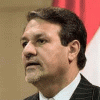
Minister Ali al-Dabbagh, Iraqi Government Spokesman, was interviewed by Padraig O'Hannelly for Iraq Business News at last week's Iraq Mining 2011 conference in London. The first part of the interview can be found here.
In this second part of the interview, Dr al-Dabbagh discusses the Hydrocarbon Law, the valuation of the Iraqi dinar, foreign investment in Iraq, and the future of his country:
Iraq Business News: I'd like to ask you about the hydrocarbon law that is currently with the parliament. The Kurdish side has disagreed with the current wording of that. Do you see a possible resolution that would eventually see Kurdish oil contracts being recognised by Baghdad?
Dr Ali al-Dabbagh: It is too early to say that recognition could be achieved for the oil contracts in Kurdistan. First of all, the oil law is going to be subjected to, I think, long debate, lengthy debate in the parliament, because still it is controversial, but in the end we do need that hydrocarbon law – we can't continue without it. We would like to advise that the structure of the parliament is not as in 2007/2008, so by voting a simple majority could be achieved, so we'd like to ask all of the figures in the parliament to look after the common interest, not to their interests, so the Kurdistan contracts need to comply fully to the oil law.
IBN: We hear a lot from foreign companies about difficulties and delays getting investment licences, also difficulties bringing expats into the country to work – what is your policy with regard to that, and what do you plan to do to ease the way for foreign companies coming into Iraq?
Posted in Investment, Iraq Banking & Finance News, Iraq Industry & Trade News, Iraq Oil & Gas News 2 Comments

Shell Gas Deal Awaits Cabinet Approval
Posted on 15 September 2011 .
The contract for the giant Shell/Mitsubishi project to capture gas from Iraq's southern oilfields has taken a step closer to completion.
Government Spokesman Dr Ali al-Dabbagh told Iraq Business News that Shell has agreed to the changes required by the oil ministry, and that the contract is now awaiting approval by Iraq's Cabinet.
The project will use natural gas that is currently flared off from oil wells to produce electricity.
Posted in Iraq Oil & Gas News Comments Off on Shell Gas Deal Awaits Cabinet Approval

What's Your Advice to Iraq?
Posted on 14 September 2011 .
If you're a regular reader of Iraq Business News, you'll know all about the huge opportunities in sectors such as oil and gas, mining, housing, and electricity.
You'll also be aware of the sorts of challenges facing the country.
But if you could change just three things about Iraq, what would they be? What three pieces of advice would you give to improve Iraq?
Please let us know in the Comments section below.
And remember, if you're looking for advice on doing business in Iraq, please feel free to contact Gavin Jones at Upper Quartile and Adrian Shaw at AAIB.
Posted in Blog 28 Comments

Turkish Businesses Invited to Tender for $7bn Power Deal
Posted on 13 September 2011 .
Turkish entrepreneurs have been invited to bid in a 6,000 megawatt electricity grid tender with a total value of $7 billion in northern Iraq, the Habertürk daily has reported.
The tender for the construction of the grid is due to be open for bids on Thursday.
According to the Turkish daily, the invitation to participate in the tender came from Ahmed al-Mufti, an adviser to the prime minister of Iraq’s northern region, during a meeting on energy organized by the Center for Strategic Economic Social Research (SETAM) in Istanbul.
Energy and Natural Resources Minister Taner Yldz also participated in the meeting and with both al-Mufti and Ashti Hawrami, the Kurdish regional administration’s minister for natural resources.
Iraq has been experiencing problems in electricity power supply over the past few years. The Iraqi government expects to overcome this problem with new energy investments.Habertürk quoted al-Mufti as saying: “Turkey and Iraq are two countries that are currently working in close cooperation. … We have gas resources and Turkey has strong investors with improved technology capacity. We could both benefit in new joint investments.” Referring to the pending tender, Mufti said Turkish investors had greater advantages than their rivals in the region.
More than two-thirds of the 2,000 foreign companies in the northern Iraq are Turkish and the number of Turkish employees in the region recently reached 20,000.
(Source: Today's Zaman)
Posted in Iraq Public Works News Comments Off on Turkish Businesses Invited to Tender for $7bn Power Deal