



Russia's Gazprom Neft interested in Expanding in Iraq
Posted on 18 June 2019 .
By John Lee.
Russia’s Gazprom Neft is reported to be interested in expanding its operations in Iraq.
Reuters says boss Alexander Dyukov told the annual general meeting on Friday that the company, which is already developing the Badra oilfield, is also "looking at" the Mansuriyah gas field near the Iranian border.
It says that Iraqi government is expected to launch a tender to develop Mansuriyah later this year. Iraq Business News understands that the field is currently being developed by TPAO (37.5%), Oil Exploration Company (25%), Kuwait Energy (KEC) (22.5%), and Kogas (15%).
(Source: Reuters)
Posted in Iraq Oil & Gas News Comments Off on Russia's Gazprom Neft interested in Expanding in Iraq

Rosneft and the Future of Iraqi Kurdistan Gas
Posted on 15 June 2019 .
Rosneft’s money might help Iraqi Kurdistan meet its domestic gas demand, but it could also cripple its long-term export ambitions, according to an oil analyst.
In an opinion piece for Energy Reporters, Nick Augusteijn argues that Rosneft’s deals are vehicles for Russia’s "increasingly assertive foreign policy".
Click here to read the full story.
(Source: Energy Reporters)
Posted in Iraq Oil & Gas News Comments Off on Rosneft and the Future of Iraqi Kurdistan Gas

Decision on Russian Wheat Imports "Months Away"
Posted on 12 June 2019 .
By John Lee.
Iraq is reportedly still holding discussions over the possible import of wheat from Russia.
Deputy trade minister Haitham Jameel Ismail al-Khshali told Reuters that a group of experts is looking into the issue, but it could be months before they reach a decision.
(Source: Reuters)
Posted in Agriculture Comments Off on Decision on Russian Wheat Imports "Months Away"

Rosneft plans Geological Survey in Kurdistan in 2019
Posted on 06 June 2019 .
By John Lee.
Russia's Rosneft will reportedly conduct geological exploration in Iraqi Kurdistan this year.
CEO Igor Sechin (pictured) is quoted as telling the annual general meeting:
"The company continues to implement the project to develop fields in Iraqi Kurdistan in the Middle East, where a geological exploration program is scheduled for this year to ensure production in the future."
He added that pilot production at the Bijeel field began in the first quarter.
(Source: Tass)
Posted in Iraq Oil & Gas News Comments Off on Rosneft plans Geological Survey in Kurdistan in 2019

Capstone Wins Order for Microturbines in Basra
Posted on 05 June 2019 .
US-based Capstone Turbine Corporation (Nasdaq: CPST) has announced today that it has secured an order for two C600 Signature Series microturbines to provide 1.2 megawatts (MW) of energy to power a triethylene glycol (TEG) dehydration facility in the Basra region of Southern Iraq.
The order also includes Capstone’s new self-cleaning pulse filtration system which will allow the microturbines to endure the remote and sandy conditions with minimal maintenance. The order was secured by Technical Solutions to Industry FZE (TSI), Capstone’s authorized distributor to Iraq and United Arab Emirates (UAE).
Fueled by available raw gas, Capstone’s two C600S microturbines will power 100% of the new dehydration facility. The new facility is part of a larger 25-year joint venture between local gas and leading oil producer’s efforts to capture, treat and monetize associated gas currently being flared from three southern Iraq oilfields.
Capstone recently developed a new line of self-cleanable severe environment air filtration systems for its Signature Series line of microturbine products to facilitate its expansion into the oil and gas business in the Middle East as part of its overall double digit revenue growth strategy.
The company announced its intentions to expand its business into the Middle East a couple of years ago and has previously delivered successful projects in Oman, Qatar, Saudi Arabia and the UAE. Capstone expects that higher oil prices and the move towards reduced gas flaring will continue to drive demand and should provide a positive backdrop for Capstone’s low emission microturbine solutions.
Darren Jamison, President and Chief Executive Officer of Capstone, said:
“Flaring is the traditional way to dispose of unwanted gas produced during oil exploration activities, but the long standing practice creates an immense amount of carbon dioxide emissions and adds to climate change.
“In Iraq alone, 16 billion cubic meters (bcm) of natural gas is flared annually, making it a wasted resource that could instead provide electricity or other benefits to meet the predicted doubling demand by 2030.”
Iraq is one of the world’s biggest energy producers and is set to become the fourth-largest oil-producer by 2030 behind the United States, Saudi Arabia and Russia according to the IEA report, Iraq’s Energy Sector: A Roadmap to a Brighter Future 2019.
At the same time, 60-70% of gas produced is being flared due to the lack on infrastructure causing Iraq to import natural gas from the neighboring country of Iran. To improve efficiency and help with shortfalls due to rising electricity demand, the Iraqi government is working with international gas companies to capture and utilize its resources versus flaring.
Jim Crouse, Executive Vice President of Sales and Marketing for Capstone, said:
“As pressure for more efficient and environmentally conscious oil and gas production increases, we continue to see an increased demand for microturbines for flare reduction applications.
“Capstone, through its distributor network, is committed to do its part by educating and working with producers and local operators for a more profitable production. Flare reduction applications like this in Basra can have a payback as short as one year which makes it an economic win as well as an environmental win.”
(Source: Capstone)
Posted in Iraq Industry & Trade News, Iraq Oil & Gas News Comments Off on Capstone Wins Order for Microturbines in Basra

Iraq "to Stand by Iran in Sanctions Era"
Posted on 27 May 2019 .
Iraqi Foreign Minister Mohammad al-Hakim said his country would stand by the Iranian nation and government in the era of US sanctions against Tehran.
Iraq stands with Iran and is willing to act as an intermediary between its neighbor and the United States, Hakim said on Saturday speaking in a press conference with his Iranian counterpart Mohammad Javad Zarif in Baghdad.
He added that Baghdad does not believe an "economic blockade" by the US could be fruitful, according to Reuters.
Zarif, for his part, condemned the US sanctions and said Tehran would strongly defend itself against any military or economic aggression and called on Europe to do more to preserve the 2015 nuclear deal between Tehran and world powers.
In May 2018, the US president pulled his country out of the JCPOA, which was achieved in 2015 after years of negotiations among Iran and the Group 5+1 (Russia, China, the US, Britain, France and Germany).
Ever since, the EU has failed to make good on its promise to save the nuclear deal and facilitate Iran’s economic trade with the international community.
The Iranian minister also said that the Islamic Republic wanted to build balanced relations with its Persian Gulf Arab neighbors and that it had proposed signing a non-aggression pact with them.
(Source: Tasnim, under Creative Commons licence)
Posted in Iraq Industry & Trade News, Iraq Oil & Gas News, Politics Comments Off on Iraq "to Stand by Iran in Sanctions Era"

Has Russia begun to Play a Role in Iraq?
Posted on 26 May 2019 .
By Mustafa Saadoun for Al Monitor. Any opinions expressed here are those of the author and do not necessarily reflect the views of Iraq Business News.
Has Russia begun to play a role in Iraq?
Member of the Iraqi parliament's Security and Defense Committee Hakim al-Zamili announced May 9 that negotiations were underway to buy an S-400 air missile system from Moscow.
Russian Deputy Prime Minister Yury Borisov said during his meeting April 26 with Iraqi Prime Minister Adel Abdul Mahdi that “the number of Russian companies in Iraq is on the rise.”
Ihsan al-Shammari, head of the Iraqi Centre for Political Thought, concurred. He told Al-Monitor that “Russia is working to compete with multinational companies in central and southern Iraq, particularly in the field of energy.”
Posted in Iraq Oil & Gas News, Politics, Security Comments Off on Has Russia begun to Play a Role in Iraq?

Iraq's Energy Sector: Roadmap to a Brighter Future
Posted on 13 May 2019 .
Iraq, one of the world's biggest energy producers, can address its current electricity shortfall and growing power needs through immediate action to relieve pressure on the system, according to an in-depth report published Thursday by the International Energy Agency.
It also provides a medium-term strategy that makes the best use of the country’s abundant oil and natural gas resources and solar potential.
Despite the extraordinary challenges of war in recent years, Iraq has made impressive gains, nearly doubling the country’s oil production over the past decade. But the turmoil has also undermined the country’s ability to maintain and invest in its power infrastructure.
The new IEA report, Iraq’s Energy Sector: A Roadmap to a Brighter Future, maps out immediate practical actions and medium-term measures to tackle the most pressing problems in Iraq’s electricity sector.
The analysis finds Iraq has huge potential to cut its electricity network losses, which are among the highest in the world. Reducing these losses by half would help dramatically improve the efficiency of grid supply, effectively increasing available capacity by one-third.
The report also takes a detailed look at the country’s oil and gas sector. It projects that Iraq’s oil production will grow by 1.3 million barrels a day by 2030, accounting for the third-largest increase globally over the period, and soon becoming the world’s fourth-largest oil producer behind the United States, Saudi Arabia and Russia.
The report also notes that more gas can be captured and put to use in efficient power plants. Today, 16 billion cubic meters of gas are flared each year, more than enough to replace Iraq’s current imports.
Dr Fatih Birol, the IEA’s Executive Director met, with Iraqi President Barham Salih on Wednesday in Baghdad, and presented the study’s findings and recommendations. He then met with Prime Minister Adil Abdul-Mahdi to discuss ways forward for the electricity sector, including making best use of Iraq’s significant natural gas and solar resources.
On Thursday, Dr Birol will discuss the report at a press conference with Thamir Ghadhban, the Deputy Prime Minister for Energy and Minister of Oil, and Luay Al-Khatteeb, the Minister of Electricity.
The IEA has worked closely with the Iraqi Ministries of Oil and Electricity to produce the report, and would like to thank the ministers and their staff for their cooperation with this study.
“Operating under extremely challenging circumstances, Iraq has done a remarkable job expanding its oil industry,” said Dr Birol. “Today’s urgent issue is to address the national power sector as the summer heatwave approaches by improving grid maintenance, boosting electricity production with larger mobile generators, and incentivising upgrades of power plants. The IEA is pleased to recommend immediate practical actions for the benefit of the entire Iraqi people, and provide a roadmap for a sustainable power system in the medium term.”
Iraq’s electricity demand is set to double between now and 2030, and its shortfall in electricity supply will widen, as the country’s population grows by more than 1 million people each year.
Without changes to the current structure of electricity supply and improvements to the network, domestic generation, imports and neighbourhood generation would need to double by 2030, for a total supply of over 250 TWh. However, there are many opportunities to improve on this outcome through measures such as investing in transmission and distribution to cut network losses.
Promoting the more efficient use of electricity, including by introducing more progressive tariffs, would play an important role in ensuring that the growth in demand during the summer peak does not continue to outpace supply.
Iraq also needs to take advantage of its abundant renewable energy potential. The analysis shows that expanding the share of solar PV and wind to 30% of electricity supply by 2030 would bring benefits both to the Iraqi consumer, in the form of reduced electricity bills, and to the environment.
Reducing network losses and moving towards an electricity mix where renewables play a more prominent role would free up 9 billion cubic meters of gas for other uses in 2030, plus 450 kb/d of oil for export.
“In addition to oil, Iraq is blessed with some of the richest solar and gas resources in the world but it is yet to take advantage of them,” Dr Birol said. “Turning that potential into fuel for its own economy and for export would help bring about a more sustainable, reliable and affordable energy future.”
The report is the second in-depth study of Iraq’s energy sector following the publication of the Iraq Energy Outlook in 2012.
(Source: IEA)
Posted in Iraq Oil & Gas News Comments Off on Iraq's Energy Sector: Roadmap to a Brighter Future

Immediate Actions to tackle Iraq’s Electricity Problems
Posted on 26 April 2019 .
New IEA report provides practical roadmap to address Iraq’s current electricity shortfall and future energy needs
Iraq, one of the world's biggest energy producers, can address its current electricity shortfall and growing power needs through immediate action to relieve pressure on the system, according to an in-depth report published Thursday by the International Energy Agency (IEA).
It also provides a medium-term strategy that makes the best use of the country’s abundant oil and natural gas resources and solar potential.
Despite the extraordinary challenges of war in recent years, Iraq has made impressive gains, nearly doubling the country’s oil production over the past decade. But the turmoil has also undermined the country’s ability to maintain and invest in its power infrastructure.
The new IEA report, Iraq’s Energy Sector: A Roadmap to a Brighter Future, maps out immediate practical actions and medium-term measures to tackle the most pressing problems in Iraq’s electricity sector.
The analysis finds Iraq has huge potential to cut its electricity network losses, which are among the highest in the world. Reducing these losses by half would help dramatically improve the efficiency of grid supply, effectively increasing available capacity by one-third.
The report also takes a detailed look at the country’s oil and gas sector. It projects that Iraq’s oil production will grow by 1.3 million barrels a day by 2030, accounting for the third-largest increase globally over the period, and soon becoming the world’s fourth-largest oil producer behind the United States, Saudi Arabia and Russia.
The report also notes that more gas can be captured and put to use in efficient power plants. Today, 16 billion cubic meters of gas are flared each year, more than enough to replace Iraq’s current imports.
Dr Fatih Birol, the IEA’s Executive Director met, with Iraqi President Barham Salih on Wednesday in Baghdad, and presented the study’s findings and recommendations. He then met with Prime Minister Adil Abdul-Mahdi to discuss ways forward for the electricity sector, including making best use of Iraq’s significant natural gas and solar resources.
On Thursday, Dr Birol will discuss the report at a press conference with Thamir Ghadhban, the Deputy Prime Minister for Energy and Minister of Oil, and Luay Al-Khatteeb, the Minister of Electricity.
The IEA has worked closely with the Iraqi Ministries of Oil and Electricity to produce the report, and would like to thank the ministers and their staff for their cooperation with this study.
“Operating under extremely challenging circumstances, Iraq has done a remarkable job expanding its oil industry,” said Dr Birol. “Today’s urgent issue is to address the national power sector as the summer heatwave approaches by improving grid maintenance, boosting electricity production with larger mobile generators, and incentivising upgrades of power plants. The IEA is pleased to recommend immediate practical actions for the benefit of the entire Iraqi people, and provide a roadmap for a sustainable power system in the medium term.”
Iraq’s electricity demand is set to double between now and 2030, and its shortfall in electricity supply will widen, as the country’s population grows by more than 1 million people each year.
Without changes to the current structure of electricity supply and improvements to the network, domestic generation, imports and neighbourhood generation would need to double by 2030, for a total supply of over 250 TWh. However, there are many opportunities to improve on this outcome through measures such as investing in transmission and distribution to cut network losses.
Promoting the more efficient use of electricity, including by introducing more progressive tariffs, would play an important role in ensuring that the growth in demand during the summer peak does not continue to outpace supply.
Iraq also needs to take advantage of its abundant renewable energy potential. The analysis shows that expanding the share of solar PV and wind to 30% of electricity supply by 2030 would bring benefits both to the Iraqi consumer, in the form of reduced electricity bills, and to the environment.
Reducing network losses and moving towards an electricity mix where renewables play a more prominent role would free up 9 billion cubic meters of gas for other uses in 2030, plus 450 kb/d of oil for export.
“In addition to oil, Iraq is blessed with some of the richest solar and gas resources in the world but it is yet to take advantage of them,” Dr Birol said. “Turning that potential into fuel for its own economy and for export would help bring about a more sustainable, reliable and affordable energy future.”
The report is the second in-depth study of Iraq’s energy sector following the publication of the Iraq Energy Outlook in 2012.
(Source: IEA)
Posted in Construction & Engineering In Iraq Comments Off on Immediate Actions to tackle Iraq’s Electricity Problems
Iraq, Russia sign New Agreements
Posted on 26 April 2019 .
By John Lee.
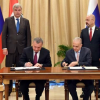
Foreign Minister Mr. Mohamad A. Alhakim Head of the Iraqi side and Russian Deputy Prime Minister Mr. Yury Borisov Head of the Russian side, signed the joint meeting minutes of the eighth session of the joint Iraqi-Russian committee.
They agreed to develop and enhance mutual cooperation in various productive and service sectors, as well as taking all measures to remove obstacles that face trade and investment between the two countries, and identify the mechanism by which bilateral cooperation is activated.
The meeting resulted in the signing of several agreements and memorandums of understanding in various fields, including trade, finance and banking, energy, electricity, mineral wealth, industry, telecommunications, information technology, transportation, agriculture, reconstruction, housing, health, sports, culture and tourism, education and cooperation in other areas.
(Source: Iraqi Ministry of Foreign Affairs)
Posted in Iraq Industry & Trade News Comments Off on Iraq, Russia sign New Agreements