


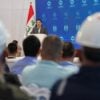
Iraq to Launch 10,000 MW Electricity Mega Project
Posted on 19 August 2024 .
By John Lee.
Prime Minister Mohammed Shia Al-Sudani has said that Iraq will launch a massive project to produce 10,000 MW of electricity.
The project, based on what he described as a "new economic model", is set to be unveiled to the private sector, "after it has been studied by a team of consultants and specialists in electricity."
The Prime Minister made the announcement at the launch of three new power projects in Karbala.
(Source: PMO)
Posted in Iraq Industry & Trade News Comments Off on Iraq to Launch 10,000 MW Electricity Mega Project
New UN Report on Corruption Cases in Iraqi Kurdistan
Posted on 19 August 2024 .
The United Nations Development Programme (UNDP) has released the Trial Monitoring Report on grand corruption cases across the Kurdistan Region of Iraq, marking a significant milestone in curbing corruption in Iraq.
The report highlights substantial progress by the Kurdistan Regional Government (KRG) in combating corruption and offers deep insights into the region's judicial proceedings through comprehensive analysis, while setting forth a number of recommendations to bolster the efforts in achieving transparency and integrity within the judicial system.
Key Findings Reveal Corruption-Prone Sectors and Judicial Improvements
The report, which covers court hearings in Erbil, Sulaymaniyah, and Duhok, is based on the monitoring of over 100 cases from November 2022 to December 2023, along with 50 verdicts issued between 2016 and 2022. The focus of the report is on major corruption cases, including those involving high monetary thresholds, high-ranking officials, and cases of public interest or those against informants and Anti-Corruption advocates.
Key findings of the report indicate that the Ministry of Finance (25%), the Ministry of Electricity (18%), and the Municipal Councils (17%) are among the most affected government sectors by grand corruption. The analysis reveals an increase in convictions compared to acquittals, though the rate of high-level defendants remains low, with few senior government officials being charged.
A significant progress is reported with the exclusion of corruption-related cases from the general amnesty regime. It also notes a notable reduction in trials conducted in absentia and a rise in felonies related to intentional damage through abuse of public office, reflecting the judiciary's progress in anti-corruption efforts. However, it highlights a concerning lack of civil society organizations (CSOs) attending trials as third parties, despite legal provisions allowing their presence.
A cornerstone to bolster the progress
Being a corner stone of UNDP`s Anti-Corruption and Arbitration Initiatives financed by the European Union; the report was published in collaboration with the Judicial Council of the Kurdistan Region of Iraq Human Rights Office of the United Nations Assistance Mission for Iraq (UNAMI).
Speaking at the launching event Auke Lootsma, Representative of UNDP, emphasized the importance of the report for the unified efforts for curbing corruption, `This critical report, the culmination of our joint efforts, represents a significant milestone in our collective quest for enhanced transparency and justice. We stand ready to collaborate to address the recommendations of the report` he said.
Sending a video message, Thomas Seiler, the European Union Ambassador to Iraq has stated, `The Trial Monitoring report offers a very deep insight into how investigations are led and how trials are conducted. Its recommendations will guide us in refining our strategies and enhancing anti-corruption measures.'
Judge Abdel Gabar Aziz Hassan, the head of Judicial Council of the Kurdistan Region of Iraq stated the important role of the report for the judiciary reforms in the region, `While proving our dedication against corruption, the report also provides us with an opportunity to advance our committed practices towards a more transparent and accountable judiciary system,' he said.
Reforms Recommended
The report urges the Government of the Kurdistan Region, the Judicial Council, the Bar Association, and Civil Society and International Community to implement proposed anti-corruption reforms. These include the establishment of specialized courts for major corruption cases, the modernization of the penal code to address current issues such as private sector bribery, and the enactment of legislation to protect whistleblowers and victims. The report also calls for limiting institutional discretion in withdrawing damage claims and strengthening oversight in corruption-affected sectors.
Further recommendations include reforms to criminal procedures to enhance investigative capabilities, the implementation of an electronic case management system, and the standardization of sentencing. Additionally, the report highlights the importance of reinforcing the financial independence of the Public Prosecutor's Office and supporting civil society in anti-corruption initiatives.
Click here to download the report in English
Click here to download the report in Arabic
Click here to download the report in Kurdish
To browse our comprehensive library of reports on Iraq, click here.
For information on Iraqi law, see our Legal Services page.
(Source: UNDP)
Posted in Iraq Industry & Trade News, Politics, Security Comments Off on New UN Report on Corruption Cases in Iraqi Kurdistan
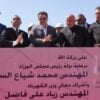
Iraq Begins Three Major Power Projects in Karbala
Posted on 19 August 2024 .
By John Lee.
Iraqi Prime Minister Mohammed Shia Al-Sudani has initiated the construction of three major power projects in Karbala:
- a 132 MW combined cycle gas power plant;
- a 300 MW solar power project; and
- the 400 kV Karbala transmission substation with a capacity of 1500 MVA.
According to a statement from the Prime Minister's office, these projects are part of Iraq's broader efforts to alleviate bottlenecks in its electricity transmission and enhance power generation capacity.
(Source: PMO)
Posted in Construction & Engineering In Iraq, Iraq Industry & Trade News Comments Off on Iraq Begins Three Major Power Projects in Karbala
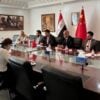
Iraq-China Trade expected to Grow 20% this year
Posted on 17 August 2024 .
By John Lee.
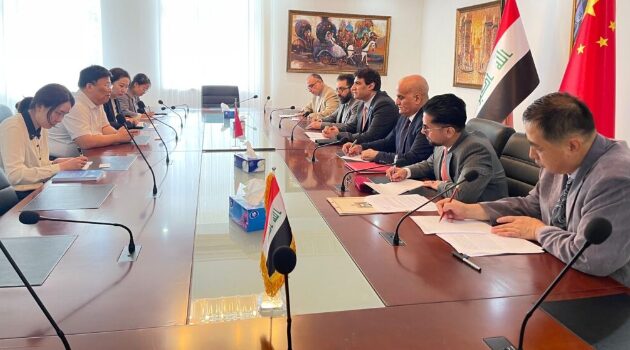
The Ambassador of the Republic of Iraq in Beijing, Mr. Shorsh Khalid Saeed, met with the Chairman of China Council for the Promotion of International Trade (CCPIT), Mr. Chen Xiaofeng and his accompanying delegation, at the Embassy headquarters.
According to a statement from Iraq's Ministry of Foreign Affairs, Ambassador Saeed commended the efforts of the Council in facilitating the procedures for authenticating commercial documents and enhancing cooperation with the embassy in this field, stressing the serious work between the Iraqi and Chinese sides to facilitate trade exchange between the two countries. The Ambassador indicated that the volume of trade exchange between Iraq and China reached 50 billion dollars during 2023, with expectations that this number will increase to about 60 billion dollars in 2024, reflecting China's position as Iraq's first trading partner.
The Ambassador stressed that the initiatives presented by the Chinese side are of great importance to Iraq, noting that Iraq joined the Chinese Belt and Road Initiative since 2015, in addition to Iraq's launch of the Development Road project. These initiatives are of importance to both parties and to the international community as a whole. The Ambassador indicated that many Chinese companies operate in Iraq in the fields of oil, electricity generation, infrastructure and communications, expressing the Iraqi side's willingness to expand cooperation to include other fields.
On his part the Chairman of the Council Mr. Xiaofeng, explained that the China Council for the Promotion of International Trade was established in 1952 as a national body for promoting foreign trade and foreign investment. He pointed out that the Council includes 1,182 local branches in various Chinese provinces, includes about 70,000 member companies across China, and has 33 international branches around the world. The Chairman of the Council confirmed his desire to open a new branch of the Council in Iraq. He added that the Council organizes many Fairs in China to promote international trade, welcoming the participation of Iraqi companies in these Fairs, and urging Chinese companies to participate in exhibitions held in Iraq. He also extended an invitation to the Ambassador to attend the opening session of the upcoming Fair, which will be held in Beijing from November 26 to 30, 2024.
(Source: MOFA)
Posted in Iraq Industry & Trade News Comments Off on Iraq-China Trade expected to Grow 20% this year
Iraq Signs 13 Initial Energy Development Contracts
Posted on 15 August 2024 .
By John Lee.
Iraq's Ministry of Oil, led by Deputy Prime Minister for Energy Affairs and Oil Minister Hayan Abdul Ghani, has signed 13 initial contracts with companies to develop oil fields and exploration blocks as part of the supplementary fifth and sixth licensing rounds.
The deals are expected to add 750,000 barrels per day of oil production and 850 million cubic feet of gas per day, enhancing Iraq's energy sector and supporting electricity generation.
The contracts, which include fields in Basra, Maysan, Nineveh, and other regions, will undergo final approval by the Ministerial Council for Energy before full implementation.
Click here to view the results of the recent licensing rounds.
(Source: Ministry of Oil)
Posted in Iraq Oil & Gas News Comments Off on Iraq Signs 13 Initial Energy Development Contracts
Turkey-Iraq Power Line "part of a broader Strategic Shift"
Posted on 11 August 2024 .
By Umud Shokri for The Middle East Institute. Any opinions expressed here are those of the author(s) and do not necessarily reflect the views of Iraq Business News.
Powering up: Turkey-Iraq transmission line is part of a broader strategic shift
On July 21, 2024, Baghdad inaugurated a new power line connecting Turkey and Iraq to handle Turkish electricity imports.
This 115-kilometer (71-mile) transmission line is expected to deliver 300 megawatts of energy to a power station west of Mosul with the aim of supplying northern Iraq, including the regions of Nineveh, Salahuddin, and Kirkuk.
Posted in Iraq Industry & Trade News Comments Off on Turkey-Iraq Power Line "part of a broader Strategic Shift"
Debes Gas Power Plant Re-opens
Posted on 10 August 2024 .
By John Lee.
Prime Minister Mohammed Shia' Al Sudani inaugurated the Debes [Dibs] Gas Power Plant in Kirkuk via video link, marking the completion of a 320 MW facility that had been stalled since 2004.
Restarted in late 2022, the project overcame significant legal, administrative, and logistical challenges, according to a statement from the Prime Minister's office.
The Prime Minister highlighted the importance of completing delayed infrastructure projects, especially in the electricity sector, to address urgent energy needs amid high temperatures.
The plant, managed by the Northern Region Electricity Production Company, is crucial for Iraq's energy grid and operates on multiple fuel types.
Al Sudani also announced ongoing efforts to develop a new economic model for large-scale energy production projects, set to be unveiled soon.
(Source: PMO)
Posted in Construction & Engineering In Iraq, Iraq Industry & Trade News Comments Off on Debes Gas Power Plant Re-opens
Kuwait Fund Supporting Saudi-Iraq Interconnection Project
Posted on 08 August 2024 .
By John Lee.
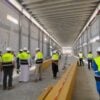
The Kuwait Fund for Arab Economic Development (KFAED) has said it will provide two KWD 35 million (USD 224 million) loans to support the Gulf Electricity Interconnection System Project, which will export electricity from Saudi Arabia to Kuwait and Iraq.
According to a press release from the Fund, the financing constitutes 40 percent of the total cost.
These loans have a 12-year term with a 3-year grace period, repaid in 18 semi-annual installments at a 15.5 percent annual interest rate.
It adds:
"Kuwait stands to gain immensely from this project, with its network capacity boosted by approximately 3,000 megawatts (MW), optimizing operational efficiency. Additionally, the GCCIA will be able to supply 500 MW of electricity to southern Iraq."
The project involves constructing a 300-kilometer 400-kV double-circuit overhead transmission line connecting Saudi Arabia's Al-Fadhili converter station to Kuwait's Al-Wafrah station. It also includes converting an existing double-circuit line between Al-Fadhili and the Al-Zour of Kuwait into a new 25-kilometer 400-kV double-circuit line connecting Al-Fadhili and Al-Wafrah.
Furthermore, the project entails expanding the Al-Fadhili station with electrical circuit breakers to link it to Al-Wafrah, as well as extending overhead lines from Al-Wafrah to Sabah 3 and Sabah 4 stations to integrate with Kuwait's national electrical network.
(Source: Kuwait Fund for Arab Economic Development)
Posted in Iraq Oil & Gas News Comments Off on Kuwait Fund Supporting Saudi-Iraq Interconnection Project
Iraq Restarts First Unit of Doura Gas Power Plant
Posted on 02 August 2024 .
By John Lee.
Iraq's Minister of Oil, Hayan Abdul Ghani, has announced the restart of the first unit of the Doura Gas Power Plant at the Midland Refineries Company (MRC), generating 18 MW of electricity to support the national grid.
Efforts are ongoing to complete the second unit, which will add a similar capacity.
The Minister praised the workers for their contributions to restarting the unit, which had been out of operation since 2019, and highlighted the collaboration between the Midland Refineries Company and the Ministry of Electricity.
(Source: Ministry of Oil)
Posted in Iraq Oil & Gas News Comments Off on Iraq Restarts First Unit of Doura Gas Power Plant
Dr Luay Al-Khateeb joins IBBC Advisory Council
Posted on 01 August 2024 .
From the Iraq Britain Business Council (IBBC):
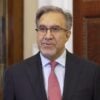
Dr Luay Al- Khateeb is joining IBBCs advisory council and brings his energy expertise to the council.
As a long-standing friend of IBBC Dr Luay has chaired energy panels at IBBC major conferences. As an independent Iraqi politician he was the former Electricity Minister and member of the Federal Energy Council in the Government of Adil Abdul-Mahdi between 2018-2020. Prior to this, he was the founding director of the Iraq Energy Institute, a think tank producing scholarship and analysis on current, historic and future energy, economy and technology trends in Iraq, as well as organizing high-level fora on energy reform in Iraq and the region.
A frequent commentator on Iraq's energy strategic policies and an advocate of sector-wide reforms, Al-Khatteeb is currently a non-resident Distinguished Fellow at the Center on Global Energy Policy (Columbia University-SIPA.), Honorary Professor at the University of Exeter, former foreign policy fellow at Brookings, and has written articles and published reports for a range of publications include The New York Times, Harvard University, Columbia University, CNN, MEES, the Petroleum-Economist and The National among others.
Previously, he served as honorary advisor to the Federal Parliament of Iraq on Energy and Economy. Between 2014 and 2016
Al-Khatteeb has held several longstanding positions on energy in Iraq and the region, being an outspoken advocate of modern gas to power strategies, eliminating gas flaring and providing feedstock for power and linked industries, particularly in Iraq.
In conversation with Dr Al-Khateeb, we asked the following questions:
Q; What are your hopes for involvement with the Advisory council?
A; I look forward to support the IBBC business community in Iraq as well as help guiding the IBBC organisation to navigate its way to explore better opportunities that will contribute to the development of the country and its reconstruction campaign,
Q: Do you have any key issues you'd like to pursue via IBBC such as Energy transition or specific reforms?
A: Energy development, energy security and energy transition are all priority topics on the agenda to promote and strengthening the ties between the United Kingdom and Iraq,
Q: Would you like to comment on the recent Mansion house panel you chaired?
A: The participants at the energy panel that took place at the 15th IBBC annual conference demonstrated the level of progress in the energy sector across Iraq, including gas, power, upstream and downstream as well as renewable energy development. It was great to see such progress and that Iraq will eventually end gas flaring by 2028 while capturing such important commodity and utilising it for industrial development and feedstock supply for power generation, saving Iraq billions of dollars a year from expensive imports and contributing significantly to the country's GDP.
The IBBC advisory council serves to strengthen and spread IBBC's knowledge and influence and allows IBBC to access some of the most experienced minds who have been involved in Iraq over the years. This access allows us to connect where necessary with High-ranking officials, draw on the expertise and experience and develop our thinking and ideas. Recent member additions include Riad Chehayeb of Serco, Professor Frank Gunter of Lehigh University's report on De-dollarisation and Dr Shamal Mohammed of Silal.
Mr Christophe Michels. MD IBBC says' Dr Luay is well known to IBBC members, and we are delighted he is augmenting the advisory council with his expertise in energy and Iraqi politics'
Posted in Iraq Industry & Trade News Comments Off on Dr Luay Al-Khateeb joins IBBC Advisory Council