


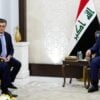
Lukoil in talks with Iraqi PM as US issues Sanctions Waiver
Posted on 18 November 2025 .
By John Lee.
The United States has issued a sanctions waiver allowing continued operations related to Russia's Lukoil until 13th December, following restrictions imposed earlier this month.
Lukoil said on 14th November that it is in negotiations with several potential buyers for its international assets, adding that a deal will be announced once agreements and regulatory approvals are finalised. The company said it aims to maintain uninterrupted operations and energy supplies during the transition and is in regular contact with authorities in all countries where it operates.
Today [Monday] in Baghdad, Prime Minister Mohammed Shia Al-Sudani met with Lukoil's former President, Vagit Alekperov, to discuss mechanisms to stabilise oil production despite the impact of US Treasury measures on the company's investment contracts. Lukoil produces around 480,000 barrels per day (bpd) at the West Qurna-2 field.
Al-Sudani reaffirmed Iraq's commitment to stable global oil markets and to maintaining steady national output levels.
Industry sources previously told Reuters that Lukoil had declared force majeure at West Qurna-2, while last week Switzerland's Gunvor Group withdrew its proposal to acquire Lukoil's international assets following US opposition.
See also:
US Treasury Department statement
Jiyad: Oil Ministry should Brace for Russia's Coerced Exodus
(Sources: PMO / Lukoil / US Treasury / Reuters)
Posted in Iraq Oil & Gas News, Politics Comments Off on Lukoil in talks with Iraqi PM as US issues Sanctions Waiver

Jiyad: Oil Ministry should Brace for Russia's Coerced Exodus
Posted on 10 November 2025 .
By Ahmed Mousa Jiyad. Any opinions expressed are those of the author, and do not necessarily reflect the views of Iraq Business News.
MoO Should Brace for ROCs' Coerced Exodus
The tripartite (UK, EU and US) sanctions against Russian oil companies (ROCs), Lukoil and Rosneft, present direct, immediate and impacting threats to the development of the upstream petroleum sector in Iraq.
US Treasury Department's Office of Foreign Assets Control (OFAC) compels Lukoil to sell its international assets by November 21, and, later, rejects the Gunvor deal. The Ministry of Oil (MoO) and the Iraqi government should act swiftly to address this dramatic imminent eventuality, to minimise the detrimental and long-lasting impacts of such sanctions.
ROCs are integrated international oil giants; their involvement stretched along the global petroleum industry value chain, i.e., from exploration to service petrol stations. Hence, each has a rather wide, large, diversified network of subsidiaries and cooperating entities around the world (some 85 entities).
Analytically, these specific sanctions on the two ROCs were premised on and related to geopolitical and geostrategic aspects of the sanctions endgame to inflicting effective impact on Russia to the extent of becoming a "deterrence" for continuing the war in Ukraine. Views differ widely on such eventuality; an issue that falls outside the focus of this article.
That said, these specific sanctions, have a rather high likelihood of negative, effective, direct, and immediate impacts on Iraq. The imposed sanctions resemble the highest level of global geopolitical rivalries and geostrategic positioning, with significant risk and strategic implication for Iraq.
Though the tripartite sanctions focus, for the time being, on Lukoil and Rosneft, other Russia companies such as Gazprom could be next in the sanctions' pipeline.
This article focuses on the impacts on Iraq due to sanctioning all three ROCs, as the federal MoO and KRG will be impacted, though at different levels and scale, and which of the three ROCs.
After briefly assess the latest status of each project, I proposed a set of options which I think MoO should consider to averting or minimising sanction' risk.
Click here to read the full article.
Mr Jiyad is an independent development consultant, scholar and Associate with the former Centre for Global Energy Studies (CGES), London. He was formerly a senior economist with the Iraq National Oil Company and Iraq's Ministry of Oil, Chief Expert for the Council of Ministers, Director at the Ministry of Trade, and International Specialist with UN organizations in Uganda, Sudan and Jordan. He is now based in Norway (Email: mou-jiya(at)online.no, Skype ID: Ahmed Mousa Jiyad). Read more of Mr Jiyad's biography here.
Posted in Ahmed Mousa Jiyad, Iraq Oil & Gas News, Politics Comments Off on Jiyad: Oil Ministry should Brace for Russia's Coerced Exodus

Gunvor Withdraws Bid for Lukoil Int'l Assets
Posted on 10 November 2025 .
By John Lee.
Swiss-based Gunvor Group has withdrawn its proposal to acquire Lukoil's international assets following opposition from the US Treasury Department.
The Treasury stated that Gunvor would not receive a licence to operate as long as Russia continues its military actions in Ukraine, describing the company as "the Kremlin's puppet."
Gunvor rejected the claims, saying the Treasury's statement was "fundamentally misinformed and false."
The company said it has distanced itself from Russia for more than a decade, ceased trading in line with sanctions, sold off Russian assets, and publicly condemned the war in Ukraine.
Russia's Lukoil had announced plans to sell its international assets to Gunvor before the deal was abandoned.
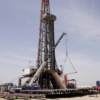
Lukoil has significant interests in Iraq's West Qurna 2 (pictured) and Block 10.
US Treasury Department statement on X:
"President Trump has been clear that the war must end immediately. As long as Putin continues the senseless killings, the Kremlin's puppet, Gunvor, will never get a license to operate and profit."
Gunvor Group statement on X:
"The Treasury Department statement about Gunvor is fundamentally misinformed and false. Gunvor is and has always been open and transparent about its ownership and business, and has for more than a decade actively distanced itself from Russia, stopped trading in line with sanctions, sold off Russian assets, and publicly condemned the war in Ukraine. We welcome the opportunity to ensure this clear misunderstanding is corrected. In the meantime, Gunvor withdraws its proposal for Lukoil's international assets."
See also:
Ahmed Mousa Jiyad: Oil Ministry should Brace for Russia's Coerced Exodus
(Sources: US Treasury Dept / Gunvor Group)
Posted in Iraq Oil & Gas News Comments Off on Gunvor Withdraws Bid for Lukoil Int'l Assets
Swiss Firm to buy LUKOIL's Iraq Assets
Posted on 30 October 2025 .
By John Lee.
Russia's LUKOIL has announced that it will sell its international assets to Swiss-based Gunvor Group.
In an announcement on Thursday, the company said:
"The conclusion of the binding agreement for the transaction is subject to conditions precedent including obtaining OFAC permission by the Purchaser as well as any other applicable licenses, permits and other authorizations in other applicable jurisdictions.
"If necessary, the parties plan to apply for extension of the existing OFAC license and any additional licenses to ensure uninterrupted operations of international assets and their banking servicing for the period until the completion of the transaction.
"The sale of LUKOIL International GmbH is due to restrictive measures of some states introduced against the Company and its subsidiaries."
The sale follows last week's announcement from the US Treasury Department that it will place sanctions on Lukoil and Rosneft.
Lukoil has significant interests in Iraq's West Qurna 2 (pictured) and Block 10.
Registered in Cyprus, Guvnor is an energy commodities trading company with its main trading office in Geneva, Switzerland.
[Correction: Article edited on 10th November 2025 to correct spelling of Gunvor Group].
(Source: Lukoil)
Posted in Iraq Oil & Gas News Comments Off on Swiss Firm to buy LUKOIL's Iraq Assets
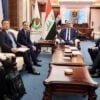
Oil Minister meets Delegation from Lukoil and INPEX
Posted on 09 October 2025 .
By John Lee.
Deputy Prime Minister for Energy Affairs and Minister of Oil Hayan Abdul Ghani Al-Sawad met today (Wednesday) with a joint delegation from Russia's Lukoil and Japan's INPEX.
The discussions focused on cooperation across Iraq's oil, gas, and energy sectors.
The delegation included Ivan Romanovsky, Lukoil Vice President for the Middle East; Elnur Karbanov, General Manager of Lukoil Overseas (operator of the Eridu field in Block 10); Ghassan Saidnafi, Deputy Director of Lukoil Iraq Branch; Munihiro Hosono, Senior Vice President of INPEX; and Shinya Toshi, INPEX Vice President for the Middle East.
(Source: Ministry of Oil)
Posted in Iraq Oil & Gas News Comments Off on Oil Minister meets Delegation from Lukoil and INPEX
Iraq to Compensate for Excess Oil Production
Posted on 01 October 2025 .
By John Lee.
OPEC has said it has received updated compensation plans from several countries, including Iraq, to compensate for excess oil production.
Full statement from OPEC:
OPEC Secretariat receives updated compensation plans from Russia, Iraq, the United Arab Emirates, Kuwait, Kazakhstan, and Oman
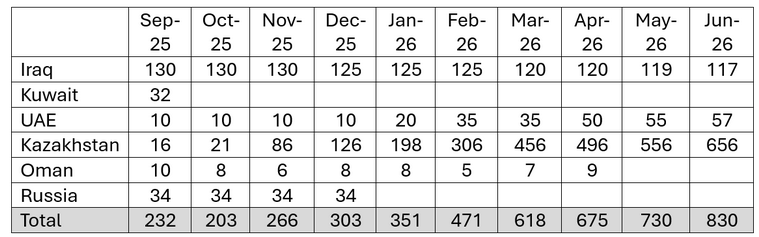
As agreed during the virtual meeting held by the eight countries with additional voluntary adjustments, including Saudi Arabia, Russia, Iraq, the United Arab Emirates, Kuwait, Kazakhstan, Algeria, and Oman, on 7 September 2025, the OPEC Secretariat received updated compensation plans as per the table above.
(Source: OPEC)
Posted in Iraq Oil & Gas News Comments Off on Iraq to Compensate for Excess Oil Production
SOMO "Ends" Kurdish Oil Contracts
Posted on 17 September 2025 .
By John Lee.
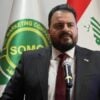
Iraq's State Oil Marketing Organisation (SOMO) reportedly announced on Tuesday that it has concluded all contracts and obligations with buyers of oil produced in the Kurdistan Region. The company emphasised that resuming exports from Kurdistan would restore Iraq's role as a key supplier to the European market.
SOMO Director General Ali Nizar al-Shatri [Shatari] told the state-owned Iraqi News Agency (INA) that current issues in Kurdistan are matters of operational arrangements, noting that Iraqi law applies to all parties. He explained that the federal Ministry of Oil and the Kurdistan Regional Government's Ministry of Natural Resources operate under a single framework, with differences only in the relationship between the regional government and producing companies.
Al-Shatri added that the federal and regional governments, along with producing companies, need to finalise the 2025 budget law implementation mechanism. Advanced understandings have been reached, and efforts continue to allow crude oil flows to Turkey's Ceyhan port for export.
He noted that Kurdish crude is currently consumed locally, with excess quantities planned for export under the 2025 budget law. SOMO has completed all contractual obligations and is ready to receive oil once production resumes. He highlighted that Iraqi oil closely matches Russian crude quality, positioning Iraq as a key alternative supplier amid the Russian-European supply gap. No oil has yet been delivered to SOMO from the Kurdistan Ministry of Natural Resources, and contractual relations remain between the ministry and producing companies.
(Source: INA)
Posted in Iraq Oil & Gas News, Politics Comments Off on SOMO "Ends" Kurdish Oil Contracts
Russia's Shoigu Visits Iraq; sees Increased Cooperation on Security, Trade
Posted on 17 September 2025 .
By John Lee.
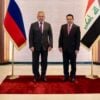
National Security Advisor Qasim al-Araji met on Tuesday with Russian Security Council Secretary Sergei Shoigu and his accompanying delegation, in the presence of the Russian Ambassador in Baghdad.
Al-Araji welcomed the visit, noting that Iraq is pursuing wider cooperation with all countries to serve mutual interests. Discussions focused on strengthening bilateral relations and continuing collaboration across multiple fields.
The meeting comes ahead of the expected talks between Prime Minister Mohammed Shiaa al-Sudani and Russian President Vladimir Putin on the sidelines of the Arab Summit in Moscow, which will be chaired by al-Sudani.
Talks also covered the exchange of expertise, technology transfer, training in border security, cybersecurity, counter-terrorism, and combating narcotics. Both sides discussed recent regional developments and efforts by their governments to halt the conflict in Gaza and seek diplomatic solutions.
Al-Araji emphasised Iraq's commitment to developing security, economic, strategic, and investment ties with Russia. Shoigu expressed gratitude for the warm reception and reiterated Russia's desire to enhance cooperation with Iraq in all areas.
In an interview the previous day with Russia's Interfax news agency, Shoigu emphasised that Russian-Iraqi trade increased by 30% over the past year and a further 35% in the first half of the current year. He added that Russian companies investment in Iraq has surpassed $20 billion.
Russia and Iraq maintain regular contact between their defense, law enforcement, and intelligence agencies, he said, adding that Russia is open to strengthening military-technical cooperation.
Full Interfax interview here (Russian)
(Sources: Office of the National Security Advisor, Interfax)
Posted in Politics, Security Comments Off on Russia's Shoigu Visits Iraq; sees Increased Cooperation on Security, Trade
Jiyad: Turkey Ends ITPA - Blackmail or Preservation of Iraqi Sovereign Rights
Posted on 11 August 2025 .
By Ahmed Mousa Jiyad. Any opinions expressed are those of the author, and do not necessarily reflect the views of Iraq Business News.
Turkey Ends ITPA- Submission to Blackmail or Preservation of Iraqi Sovereign Rights and National Interests
The Turkish government officially ended, on 21 July 2025, the Iraqi Turkish Oil Pipeline Agreement-ITOPA, effective on 27 July 2026.[1] A couple of days later, the Turkish Minister of Energy proposed amending and expanding- ITOPA.[2] Obviously, the Turkish formal position is inconsistent with ITOPA' "2010 Amendment".
So far, no formal position was announced by the Iraqi government on the Turkish move. [3]
The Turkish act was the topic of a debating event, in Arabic, that was convened by "Al-Mushtarac Platform" on 1 August 2025.* Below is a brief of my presentation, with minor updating.
My intervention at the debating event covers the following themes:
- 1. A brief background on ITOPA, focusing on its latest amendment in 2010, which expires in 2026.
- An analysis of the Turkish position in light of the agreement's legal frameworks on the one hand, and the very complex set of economic, geopolitical, and geostrategic considerations on the other.
- 3. The impact of the Turkish decision on Iraq: A critical analysis of what Iraq should have done since 2023, what Iraq have done, and the alternatives currently available for Iraq.
First: A brief background on ITOPA and its latest amendment
ITOPA was signed on August 27, 1973. The pipeline on the Turkish side consists of two parallel lines: a 40-inch line, which is the first expansion of the system that was completed in 1984, and a 46-inch line, which is the second expansion, completed in 1987. This brought total design pumping capacity to 1.6 Mbpd. ITOPA latest amendment was signed in 2010 and became effective in July 2011.
In November 2013, KRG completed the laying of an oil pipeline from Khormala to the metering station at Fishkhabur for the Kirkuk-Ceyhan pipeline, then connected it to the 40-inch pipeline on the Turkish side. In the same month, KRG and Turkey signed 50-year agreements regarding KRG oil export.
On 21 May 2014, the first shipment of KRG oil was loaded for export from the port of Ceyhan. That loading prompted the Ministry of Oil-MoO to invoking arbitration clause of ITOPA amendment before the Paris-based International Chamber of Commerce-ICC on 23 May 2014, and ICC award was delivered on 23 March 2023.
A formal document entitled, "Amendment to the Crude Oil Pipeline Agreement signed on August 27, 1973, and the following related agreements, protocols, minutes of meetings, and annexes between the Government of the Republic of Iraq and the Government of the Republic of Turkey," signed on September 19, 2010. The amendment entered into force in July 2011 and expires in July 2026.[4]
The "Amendment" document consists of 16 pages and includes 11 articles: 1- Definitions. 2- General Provisions. 3- Pumping Capacity and Minimum Obligated Pumping Capacity. 4- Transit Tariffs and Payments. 5- Recovered and Wasted Crude Oil. 6- Ownership of Crude Oil Filling Pipelines and Tank Flors. 7- Iraq Office in Ceyhan Port. 8- Other Issues. 9- Force Majeure. 10- Dispute Settlement. 11- Duration of the Amendment and Date of Entry Into Force.
According to Article 11, the duration/term of "Amendment" is 15 years effective from July 2011, with time-framed four options: 1- amendment, 2- new agreement, 3- automatic extension for five years and 4- end of the amendment term.
Second: Analysing Turkish' action and position
The following analysis is premised on the legal frameworks of ITOPA amendment on the one hand, and the very complex economic, geopolitical, and geostrategic considerations on the other.
From a legal perspective related to international bilateral agreements, Turkey's move does not violate Article 11 of the Amendment, Turkey chose the fourth option. But why?
Theoretically and analytically, Turkey could have waited another five years for ITOPA amendment to expire, and during that period, it could use the pipeline, which has become ready to be operational. However, Turkey may have found that the current overall circumstances-domestic and regional economic, geopolitical, and geostrategic- are conducive to making the decision to terminate the agreement. So, what are they?
The Turkish energy balance indicates the country is oil and gas import dependent. Petroleum consumption-production gap was 800 kbd, and 56% of its gas imports was from Russia and Iran (in 2022). [5]
This is a geopolitical vulnerability if the situation continues in 2025, considering Trump's threatening to energy imports from these two countries.
However, Turkey worked for years to becoming an important transit country and oil and gas pipelines hub from central Asia to Europe, in addition to pipelines from Iraq (including KRG).
Also, Turkey succeeded to making important discoveries offshore (in the Mediterranean and Black Sea) and onshore, especially Gabar oilfield in eastern mountainous area of the country, which was connected to the ITP. [6]
The Iraqi oil through the pipeline have been either very low or was outage for years. This makes Turkey accustomed to the absence of the Iraqi oil. But, on the other hand, Turkey benefits twice; by gaining the minimum-throughput transit fee, i.e., pump-or-pay (PoP) and by charging a much higher transit fee on KRG oil that is pumped through the 40 Inch pipeline of (ITP).
The political reconciliation and agreement with the Kurdish leader Abdullah Ocalan/PKK, have reduced the tremendous security burdens on the Turkish government, and thus discounts or minimise the Kurdish related political and security risk.
The political and geopolitical consequences of the military situation in the Middle East and the USA/Isreal attack on Iran have weakened Russia and Iran geopolitical standing and, consequently, enhanced Turkish regional strategic importance and positioning.
The Turkish President Erdogan is known for his pragmatism and real politic, and such political attitude is probably enhanced by the US President Trump views, policies and actions.
Turkey might find some encouragement by the recently expressed US views regarding the end of "Sykes-Picot Agreement of May 1916" Middle East boarders. Also, there seems to be an echoing sentiment in Turkey hinting to end 1923 Treaty of Lausanne.
In addition to the agreements signed between Turkey and KRG, the latter had offered, in 2016, the sale of many oilfield and exploration blocks to Turkey.[7]
Finally, ICC award might have been triggering the timing of the Turkish action. The award comprises many decisions, some in Iraq's favour while others in Turkish favour and others of operative nature relating to interest rates that both countries are directed to apply and calculate.
Decisions 2, 3 and 5 compel Turkey to pay ca. $1.998billion to Iraq. Decisions 6, 7, 8, 9, 11,12 and 13 award Turkey a total of ca. $5.266billion, mostly related to PoP provisions. Thus, Turkey should pay Iraq a net of $1.471billion.
Decisions 16, 17, 18 and 19 are related to the calculation of accrued interest rates that the countries should follow and apply, without stating the timeframe, how and who to finalise this matter.
While the award was a financial victory for Iraq, many in Turkey interpret it as only related to unauthorised KRG oil pumping to and loading in Ceyhan terminal; this could be avoided by different means in the future.
Third topic: How Could Iraq React to Turkish Decision
Upon the ICC award, I proposed for the MoO to: 1. Implement the award, especially what relates to interest rate issue. 2. Carefully examine the award and learn from its deliberations and consequences. 3. Evaluate Turkish potential future options and how to confront them to preserve Iraq's interests.[8] I have not received feedback or seen any action from the government, the ministry or any information regarding these recommendations. [9]
In my view and as mentioned above, the possibility of the pipeline agreement expiring in July 2026 is included in the amendment document, and therefore Iraq should have been planning since 2014 to confront such eventuality in 2026 or, in the best-case scenario, in 2031.
From my perspective, regarding the strategic importance and geopolitical risks of all Iraqi export outlets, the best alternative is to modernize and expand export capacities at the southern outlets, while simultaneously modernizing and expanding the "strategic pipeline" for transporting northern oil, including KRG oil, to the south. The matter becomes even more urgent after the signing of the Kirkuk field development agreement with BP and the Hamrin field development agreement with the US' HKN.
I am fully aware of the MoO's efforts on these two directions, but the actual facts and statistical data do not indicate at all that sufficient work has been done to complete these two strategic export essential projects. This failure has been the responsibility of the MoO since 2014.
Moreover, the North Oil Company-NOC announced, for a while, that the restoration of the Kirkuk-Feshkhabur pipeline has been completed and that three tests have been conducted, indicating that the pipeline is ready for pumping oil. If this is the case, why hasn't it been operational before July 21, 2025? And why hasn't Turkey taken this into consideration? What's even more surprising is that in recent months MoO has been busy contracting numerous mini projects it classifies as "strategic", in a manner that lacks proper planning and implementation priorities.
The worst and most damaging action Turkey could take and do after July 2026 includes any or all of the following alternatives/possibilities:
- Activating the secret agreements with the Kurdistan Regional Government (KRG), including those reported by wikileaks.org.
- Allocating a portion of the capacity of the Turkish section of the Kirkuk-Ceyhan pipeline to exporting KRG oil or laying a new pipeline exclusively for KRG oil, parallel to the existing two pipelines.
- Proposing and negotiating a new agreement with the Iraqi government aimed at achieving a range of Turkish interests at the expense of Iraqi national interests.
What can the Iraqi government do regarding these three possibilities above? Iraq has two alternatives: submitting to the blackmail or preserving sovereign rights and national interests.
I believe the Iraqi government should adopt the second option, and take the following actions:
- Regarding the two Turkish possibilities (1) and (2) above, it is preferable to resort to activating the tools of international law related to relations between states, the Vienna Convention, the bilateral agreements between Iraq and Turkey, especially the 1946 bilateral friendship treaty between the two countries, and numerous international law instruments.
- There should be a concerted move towards the relevant international bodies for this purpose. The responsibility for such move is entrusted to the Ministry of Foreign Affairs, with ongoing, serious follow-up by the Council of Ministers.
- I see no point in talking about or negotiating any new agreement, as discussed below, if the Turkish side insists on the two possibilities (1) and (2) mentioned above.
Turkey's latest proposals and comments
The Turkish Energy Minister reportedly said, on 29 July 2025, that his country is proposing:
(1) A framework for ongoing negotiations to expand the bilateral agreement in the energy sector.
(2) A "mechanism to ensure full utilization" of the Kirkuk-Ceyhan oil pipeline.
(3) Expanding the amendment to the pipeline agreement to include cooperation in the fields of gas, electricity, and petrochemicals, in addition to oil.
(4) The possibility of extending the pipeline to southern Iraq, as the path to full capacity necessarily begins from the south.
(5) Linking all this to the "Development Highway" project from Basra to the Turkish border and then to Europe.
My preliminary remarks on the reported proposals.
First: Turkey should have submitted these proposals in July 2024, in accordance with the provisions of Article 11 of ITOPA Amendment of 2010 referred to earlier, instead of giving note, in July 2025, ending the validity of the ITOPA.
Article 11 stipulates that either party has the right to propose amendment or a new agreement two years prior to the end of Amendment term/duration.
Therefore, by choosing one option while violating other options of Article 11, this actually reflects inconsistency, by intention or omission, of the Turkish authorities.
Second: Such proposals, whether general or multi-purpose, should be presented within the "Iraqi-Turkish Joint Committee for Economic and Technical Cooperation", which has been in operation for more than 50 years. This Turkish proposal could be a base for a "Frame Agreement," resulting from it, if needs be, a series of "specific agreements" for the topics mentioned in the Turkish minister proposal. It is worth mentioning that this Joint Committee has been one of the most active bilateral committees Iraq has with other countries.
Third: Regarding the crude oil pipeline, I suggest there should be a specific agreement for oil pipeline consisting of two parts: the first is relating to the Kirkuk-Ceyhan pipeline (i.e., the agreement that Turkey have suspended recently-ITOPA), and the second is relating to the proposed new Basra-Ceyhan pipeline, in the event of an agreement have been reached on the implementation, timing and funding of this pipeline and its integration with the Kirkuk-Ceyhan pipeline.[10]
Fourth: The integration of the Kurdistan Region's oil pipeline with the Kirkuk-Ceyhan/Basra-Ceyhan pipeline, with pumping, transporting, and loading of oil falling under SOMO mandate exclusively.
Final remarks
Until recently, the Oil Minister's statements indicated Turkish side's readiness to operate the pipeline. Furthermore, in her recent meeting with parliamentarians, the Minister of Finance did not mention anything related to the Turkish side as a reason for the delay in submitting the budget schedules thus far. Furthermore, the Director General of SOMO recently confirmed the current readiness to export oil through the pipeline, if KRG deliver the oil. Have the Iraqi authorities, the government, and the Ministry of Oil fallen into what can be described as a "trap of deceptive statements" by Turkey and their naive trust in these statements??
While the Turkish decision had actually prompted numerous reactions inside and outside Iraq, including my initiative to convene this event, the matter was not mentioned in the Cabinet meeting on July 29, and not in the regular meeting of the Council' follow-up on oil projects on July 31[11], and not in the seventh session of the Opinion Board held on Wednesday, July 30, at the Ministry of Oil.[12] Nothing relating to the Turkish decision was published on the websites of the Ministry of Oil, SOMO, and the North Oil Company (all of which are executing parties specifically mentioned in the Amendment document of 2010.( Do these Iraqi authorities have no official position on the Turkish move??
I believe that official bodies must stop adopting the policy and practice of "ignoring and turning a deaf ear."
A closing call or cry is due now: To strengthen Iraq's negotiating position, ensure economic security, and protect the national interest, I emphasize the need for the Iraqi government to give immediate and absolute priority to modernizing and expanding oil export capacities at the southern ports and expediting the implementation of the Basra-Haditha pipeline within the concept of a "strategic pipeline" to transport northern oil, including regional oil, to the south.
A dim light at the end of a tunnel still there; recent statements by the Iraqi side, namely by the Minister of Oil[13] and the DG of SOMO[14] indicating eminent resumption of ITP operation, conditional though, upon KRG and its contracted IOCs making enough oil for pumping!!
* The virtual event uses Zoom facility, and its full recording is accessible through the following link: https://youtu.be/RBBlIMjnlzI The Platform uses AI to transfer "sounds into text". Hence, the text of the recording is accessible through the following link: https://www.mushtarek.org/groups/679b938b7fd0bd55baff8b70/posts/post/6890ac39fad20450657e90b8 The Arabic text can be translated into English and other languages by clicking the Translate icon therein. The presentation comprises map, charts, tables and images; they are not included in this brief article. The PowerPoint slides are available upon request in MS or Pdf.
Norway
10 August 2025
Endnotes
[1] https://www.economy-news.net/content.php?id=57729
[2] https://www.economy-news.net/content.php?id=58058
[3] Except a brief statement by unnamed official from the Ministry of Oil to (INA), which was removed later, but till accessible through this link. https://arabic.rt.com/business/1694792
[4] I do possess scanned copies of the Agreement and related formal Iraqi documents, and they are the base of analyses.
[5] Based on data from, https://www.eia.gov/international/analysis/country/TUR
[6] My articles, "Once Again, Turkey Violates the Pipeline Agreement" https://www.iraq-businessnews.com/2024/06/25/jiyad-once-again-turkey-violate_the-pipeline-agreement/?swcfpc=1 and in Arabic,
https://www.sahat-altahreer.com/author/62/
[7] The secret documents were published by Wikileaks.org, but they are not available now. Luckily, I saved them in my database.
[8] My articles, ICC Awards, FSC Decisions and The Three-Years State Budget, https://www.iraq-businessnews.com/2023/05/29/icc-awards-fsc-decisions-and-the-three-years-state-budget/?wcfpc=1 

https://www.mushtarek.org/groups/6135da07aac957001377773e/posts/post/646d0f04d73eb199b4402e78 May 2023
[9] However, an IOR article dated 30 September 2023, "Iraq presses claim to enforce arbitration award against Turkey", provides information on an Iraqi filed case before a US court.
[10] Actually, such a pipeline was proposed in 2012, but the idea did not materialize since then, and I have referred to it in my previous writings many times.
[11] https://www.economy-news.net/content.php?id=58154
[12] https://www.oil.gov.iq/?article=2783
[13] Tareek Al-Shaab, 7 August 2025 and https://www.iraq-businessnews.com/2025/08/06/iraq-to-resume-oil-exports-via-turkiye-this-week/
Click here to read the full article in pdf format.
Mr Jiyad is an independent development consultant, scholar and Associate with the former Centre for Global Energy Studies (CGES), London. He was formerly a senior economist with the Iraq National Oil Company and Iraq's Ministry of Oil, Chief Expert for the Council of Ministers, Director at the Ministry of Trade, and International Specialist with UN organizations in Uganda, Sudan and Jordan. He is now based in Norway (Email: mou-jiya(at)online.no, Skype ID: Ahmed Mousa Jiyad). Read more of Mr Jiyad's biography here.
Posted in Ahmed Mousa Jiyad, Iraq Oil & Gas News Comments Off on Jiyad: Turkey Ends ITPA - Blackmail or Preservation of Iraqi Sovereign Rights
Iraq to Increase Oil Output Amid Healthy Market Conditions
Posted on 05 August 2025 .
By John Lee.
The eight OPEC+ countries, including Iraq, have agreed to the continuing of their phased rollback of 2.2 million bpd in voluntary cuts that began in April.
According to a statement from OPEC, the decision, taken during a virtual meeting on 3rd August, reflects confidence in current oil market fundamentals, including low inventory levels and a stable global economic outlook. The countries reiterated that the adjustment aligns with the 5th December 2024 agreement, which allows for a gradual and flexible return of production, with the ability to pause or reverse adjustments depending on market conditions.
The group also stressed the importance of compensating for any overproduction since January 2024 and confirmed their collective commitment to the Declaration of Cooperation, which is being monitored by the Joint Ministerial Monitoring Committee (JMMC).
Regular monthly reviews will continue, with the next meeting scheduled for 7th September 2025.
Full statement from OPEC:
Saudi Arabia, Russia, Iraq, UAE, Kuwait, Kazakhstan, Algeria, and Oman reaffirm commitment to market stability on current healthy oil market fundamentals and steady global economic outlook and adjust production
The eight OPEC+ countries, which previously announced additional voluntary adjustments in April and November 2023, namely Saudi Arabia, Russia, Iraq, UAE, Kuwait, Kazakhstan, Algeria, and Oman met virtually on 3 August 2025, to review global market conditions and outlook.
In view of a steady global economic outlook and current healthy market fundamentals, as reflected in the low oil inventories, and in accordance with the decision agreed upon on 5 December 2024 to start a gradual and flexible return of the 2.2 million barrels per day voluntary adjustments starting from 1 April 2025, the eight participating countries will implement a production adjustment of 547 thousand barrels per day in September 2025 from August 2025 required production level. This is equivalent to four monthly increments as detailed in the table below. The phase-out of the additional voluntary production adjustments may be paused or reversed subject to evolving market conditions. This flexibility will allow the group to continue to support oil market stability.
The eight OPEC+ countries also noted that this measure will provide an opportunity for the participating countries to accelerate their compensation. The eight countries reiterated their collective commitment to achieve full conformity with the Declaration of Cooperation, including the additional voluntary production adjustments that were agreed to be monitored by the JMMC during its 53rd meeting held on April 3rd 2024.
They also confirmed their intention to fully compensate for any overproduced volume since January 2024. The eight OPEC+ countries will hold monthly meetings to review market conditions, conformity, and compensation. The eight countries will meet on September 7, 2025.
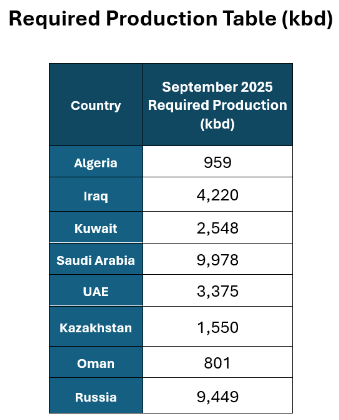
(Source: OPEC Secretariat)
Posted in Iraq Oil & Gas News Comments Off on Iraq to Increase Oil Output Amid Healthy Market Conditions