



Iraq's Scorecard for Mobile Network Excellence
Posted on 19 February 2025 .
By John Lee.
Opensignal has announced the launch of the Global Network Excellence Index, which it describes as a new benchmark that ranks markets around the world on the mobile network experience they provide.
According to data from Opensignal:
- Among large land mass countries, Iraq ranks in 41st place for network excellence. This places it behind Saudi Arabia (20th place), Morocco (36th place) and Egypt (40th place).
- Iraq ranks 21st for 4G Download Speed among large land mass countries: within the Middle East and North Africa region, this ranking places Iraq third behind Oman and Saudi Arabia, and ahead of Morocco, Iran, Egypt, Algeria, Libya and Yemen.
- Among large land mass countries, Iraq is ranked 65th for 4G / 5G Availability: This metric measures how often users connect to a modern network. However, Iraq ranked in 39th place for Excellent Consistent Quality, which evaluates how reliably networks support demanding applications such as video streaming, video calls, and gaming, ensuring a seamless user experience.
The Global Network Excellence Index provides a country-level ranking of mobile network excellence based on direct measures of user experience, evaluating countries across three core pillars: 4G / 5G Availability, Excellent Consistent Quality and 4G / 5G Download Speed.
You can access the full index here.
(Source: Opensignal)
Posted in Iraqi Communications News Comments Off on Iraq's Scorecard for Mobile Network Excellence

New Submarine Comms Cable to Serve Iraq
Posted on 31 January 2025 .
By John Lee.
Qatar-based Ooredoo Group has partnered with France's Alcatel Submarine Networks (ASN) to build the Fibre in Gulf (FIG) submarine cable.
The cable, connecting Qatar, Oman, the UAE, Bahrain, Saudi Arabia, Kuwait, and Iraq, will have a capacity of up to 720Tbps with 24 fibre pairs.
Ooredoo said in a statement that the project will provide all GCC countries a low latency, shorter and secure route to a new corridor connecting Europe.
Ooredoo is the parent company of Iraqi mobile phone company Asiacell.
(Source: Ooredoo)
Posted in Construction & Engineering In Iraq Comments Off on New Submarine Comms Cable to Serve Iraq

Economist: Trump Oil Policy may Harm Iraq, Devalue Iraqi Dinar
Posted on 29 January 2025 .
By John Lee.
A leading Iraqi economist has predicted that US President Donald Trump's pressure to reduce oil prices will harm the Iraqi economy, and could lead to a devaluation of the Iraqi dinar.
In a post on Facebook, Dr Nabil Jaafar Al-Marsoumi, former Professor of Economics at Basra University, and member of the Advisory Board of the Iraqi Economists Network (IEN), said:
"Following Trump's demand for Saudi Arabia and OPEC to reduce oil prices to provide cheap energy and expedite the end of the Russian-Ukrainian war, OPEC Plus's abandonment of its cuts amounting to 4.650 million barrels will be implemented within a few weeks. Oil prices will decrease as Trump planned, and oil revenues for oil-exporting countries will decline.
"However, the greatest harm will be to Iraq. Although its production will increase by approximately 220,000 barrels per day, the drop in oil prices to 60 dollars will put Iraqi finances in severe distress, as it financially means a reduction in Iraqi oil revenues by about 15 billion dollars, which will need to be secured through domestic borrowing.
"If prices drop to 50 dollars, devaluing the dinar will become one of the important options to increase public revenues denominated in dinars to reduce the deficit gap in the general budget!"
(Source: Nabil Jaafar Al-Marsoumi)
Posted in Iraq Banking & Finance News, Iraq Industry & Trade News, Iraq Oil & Gas News Comments Off on Economist: Trump Oil Policy may Harm Iraq, Devalue Iraqi Dinar
Saudi Cafe Chain Opens First Branch in Iraq
Posted on 27 January 2025 .
By John Lee.
Saudi Arabia cafe chain Kyan Café has opened its first branch in Iraq.
The outlet in Basra will initially open from 2:00pm until midnight, but has plans to extend this to 24 hours.
It is Kyan's 356th store worldwide.
(Source: Kyan Café)
Posted in Iraq Industry & Trade News 1 Comment
IEA: Iraq makes "Slow but Steady Progress" on Gas Flaring
Posted on 26 January 2025 .
By John Lee.
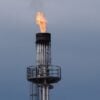
The International Energy Agency (IEA) has issued its Gas Market Report, Q1-2025, in which it describes Iraq's progress towards reducing gas flaring as, "slow but steady."
It says:
"In the Middle East the role of natural gas in the power sector has been increasing in the past decade and oil-to-gas switching continued in 2024, driven by Iran, Iraq, Kuwait and Saudi Arabia,"
adding:
"Iraq has made slow but steady progress towards reducing gas flaring since the early 2010s, but in mid-2024 it still captured only 65% of its gross natural gas output while flaring away 12 bcm annually.
"In early 2024 Iraq committed to reducing crude burning for power generation from May to December 2024 to meet OPEC+ obligations and the government-owned South Gas Company announced an accelerated gas utilisation plan to maximise gas capture volumes and reduce power sector oil use by 2028."
Click here to view the full report.
(Source: IEA)
Posted in Iraq Oil & Gas News Comments Off on IEA: Iraq makes "Slow but Steady Progress" on Gas Flaring
Iraqi PM Receives Chairman of Arab Monetary Fund
Posted on 25 January 2025 .
By John Lee.
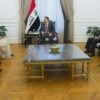
Prime Minister Mohammed S. Al-Sudani met this week with Fahd bin Mohammed Al-Turki, Chairman of the Arab Monetary Fund, to discuss closer collaboration.
- Strategic Partnership and Support: Iraq is committed to supporting the Arab Monetary Fund's activities, emphasizing its role as a founding member and major contributor to the Fund.
- Development Goals: The Iraqi Prime Minister stressed the importance of the Fund's contributions to Iraq's reconstruction and infrastructure development.
- Capacity Building: Iraq seeks expanded participation of Iraqi professionals in the Fund's activities and stronger connections with its financial institutions.
- Regional Collaboration: The Arab Monetary Fund's role in coordinating financial, monetary, and trade policies across the Arab region was highlighted as a key factor in promoting shared regional interests.
- Fund's Commitment: The Chairman of the Arab Monetary Fund reaffirmed the Fund's dedication to supporting Iraq's developmental programs and fostering cooperation in financial and economic sectors.
- Focus on Infrastructure: Both parties acknowledged infrastructure projects as a priority area for development and investment.
Full statement from the Prime Minister's Office:
Prime Minister Mohammed S. Al-Sudani Receives Chairman of the Arab Monetary Fund
Prime Minister Mohammed S. Al-Sudani received today, Thursday, the Chairman of the Arab Monetary Fund, Mr. Fahd bin Mohammed Al-Turki.
At the beginning of the meeting, the Prime Minister congratulated Mr. Alturki on assuming his new role as Chairman of the Fund, wishing him success in his mission.
The Prime Minister affirmed the government's support for the Fund's activities, highlighting Iraq's role as a founding member and the second-largest contributor to the Fund after Saudi Arabia.
Prime Minister Al-Sudani expressed Iraq's aspiration for greater cooperation with the Fund and emphasized the importance of its contributions to Iraq's reconstruction and development efforts, particularly in infrastructure projects. He also expressed Iraq's desire for the Fund to expand the participation of Iraqi professionals in its activities and strengthen ties with Iraqi financial institutions.
The Prime Minister stressed the Arab Monetary Fund's pivotal role in fostering stronger Arab relations by coordinating financial, monetary, and trade policies, thereby promoting shared interests across the region.
For his part, Mr. Alturki expressed his gratitude for the warm reception and reiterated the Arab Monetary Fund's commitment to supporting Iraq and participating in its developmental programs. He also emphasized the Arab Monetary Fund's eagerness to enhance constructive cooperation in the financial and economic sectors.
(Source: PMO)
Posted in Investment, Iraq Banking & Finance News 1 Comment
Saudi's Al-Khorayef explores Energy Collaboration with Iraq
Posted on 23 January 2025 .
By John Lee.
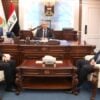
Iraq's Minister of Oil, Hayan Abdul Ghani, met with a delegation from Saudi Arabia's Al-Khorayef Petroleum on Tuesday, including senior representatives Mohammed Al-Dughmi and Khalid Hamza Al-Rikabi.
Discussions focused on enhancing cooperation in the oil, gas, and energy sectors.
Alkhorayef Group joined the Iraq Britain Business Council (IBBC) in 2023.
(Source: Ministry of Oil)
Posted in Iraq Oil & Gas News Comments Off on Saudi's Al-Khorayef explores Energy Collaboration with Iraq
UK, Iraq announce $15bn Trade and Investment Partnership
Posted on 15 January 2025 .
By John Lee.
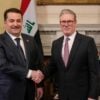
Prime Ministers Keir Starmer and Mohammed S. Al-Sudani have unveiled an ambitious £12.3 billion [$15 billion] UK-Iraq trade and investment package aimed at enhancing prosperity and bilateral economic ties.
The agreement represents over a tenfold increase in trade compared to last year and underscores both nations' commitment to strategic collaboration across key sectors.
Key Projects Announced:
- De-mining Operations: £330 million for UK-led mine removal across Iraq.
- Al-Qayyarah Airbase Rehabilitation: £500 million to boost Iraq's air defence capabilities.
- Water Infrastructure:
- Comprehensive Water Project: £5.3 billion for improved water access and irrigation in South and West Iraq.
- Basra Desalination Project: £3.3 billion for clean water infrastructure benefiting 3 million residents.
- Power Grid Enhancements:
- Iraq-Saudi grid interconnection (£1.2 billion).
- National grid upgrades by GE Vernova (£82 million).
- Telecommunications: Vodafone to lead Iraq's 5G rollout (£410 million).
- Railway and Sanitation Projects:
- £82 million for a new railway.
- £260 million for sewage and water processing in Hilla.
- £655 million for sewage and water processing in Baghdad.
- Emergency Services and Border Security:
- British fire-fighting vehicles (£27.5 million).
- Radio communication systems (£98 million).
- Border security technology (£66.5 million).
The UK will leverage its global financial expertise to aid in the establishment of Iraq's Strategic Investment Fund, the Iraq Fund for Development (IFD). Designed to attract private investment, the IFD aims to finance critical socio-economic infrastructure projects and drive Iraq's long-term economic growth.
The Prime Ministers also welcomed a landmark Iraq-BP agreement for long-term investment, further solidifying the foundation for future collaboration in energy, logistics, and financial services.
Full statement from the 10 Downing Street:
The Prime Minister of the United Kingdom, The Rt Hon Sir Keir Starmer KCB KC MP, hosted the Prime Minister of The Republic of Iraq, His Excellency Mohammed Shia Al-Sudani as part of the Iraqi Prime Minister's official visit to the United Kingdom, from 14-16 January 2025.
Prime Minister Starmer congratulated PM Al-Sudani on the stability and growth that Iraq has enjoyed under his leadership. The leaders reaffirmed their commitment to the vision of a prosperous, sovereign Iraq through a new partnership focused on trade and investment, deepening educational and cultural ties, as well as tackling security, migration and climate change challenges. This visit re-affirms the UK and Iraq's commitment to work together on shared regional and global interests and underlines a shared commitment to the long-term strategic relationship.
The Prime Ministers signed a landmark Partnership & Cooperation Agreement (PCA), a wide-ranging treaty on trade and strategic cooperation and agreed a trade package worth up to £12.3 billion, underpinned by a series of export agreements, to bolster the growing trading relationship between the UK and Iraq.
Prime Ministers Starmer and Al-Sudani agreed to develop and further UK-Iraq co-operation on a wide range of sectors, including:
Trade, Economy and Investment
Prime Ministers Starmer and Al-Sudani discussed their shared objective of increasing prosperity and their commitment to an ambitious expansion of UK-Iraq trade and investment.
They agreed to utilise UK private sector expertise on critical water, energy, telecoms and defence infrastructure, and to secure future investment projects in the clean energy, pharmaceutical, logistics, and financial services sectors. This will be supported through a UK Export Finance (UKEF) Memorandum of Cooperation to boost private sector investment and financing in Iraq, signed by the UK Foreign Secretary and Iraqi Foreign Minister. The Prime Ministers welcomed the recently announced agreement between the Government of Iraq and BP for a long-term investment in Iraq.
The Leaders announced a trade and export package of £12.3 billion, over 10 times last year's total UK-Iraq bilateral trade, consisting of the following UK-led projects in Iraq:
- De-mining: UK Companies have been appointed to remove legacy mines across all of Iraq: a contract worth £330mn.
- Rehabilitation and reconstruction of Al-Qayyarah airbase: UK private sector expertise will deliver the £500mn rehabilitation of Iraq's Al Qayyarah airbase providing Iraq with air defence coverage and capability for North & West of Iraq.
- Comprehensive Water Project: a UK-led consortium will lead a significant water infrastructure project worth up to £5.3bn in UK exports. This will improve water quality, irrigate agricultural land, and provide clean water in the South and West of Iraq, improving living conditions for millions of Iraqis.
- Basra Water Project: a UK company has been appointed to build large-scale infrastructure for desalination and water processing plants, providing clean water for the 3 million Iraqis in the Basra province. This project is worth up to £3.3bn in UK exports.
- Iraq-Saudi Grid interconnection: UK-made power transmission systems will interconnect the Iraq and Saudi grids, a project worth at least £1.2bn.
- Enhancement of the Iraqi National Grid: GE Vernova will supply and install £82mn worth of power substations to improve Iraq's electricity grid.
- 5G rollout: Vodafone has been appointed to design the new 5G network planned by the government in a project set to be worth £410mn over twenty years.
- Iraqi Railway project: A UK company will deliver a £82mn construction project to build a new railway in Iraq.
- Hilla Phase 2: a UK company has been appointed to deliver sewage and water processing solutions serving 3 million Iraqis, worth £260mn in exports.
- Baghdad Sanitation Project: a UK company has been appointed to provide up to £655mn worth of water management, and sewage treatment solutions for the Mayoralty of Baghdad.
- Provision of UK Firefighting vehicles: 62 British-made fire-fighting vehicles will be exported to Iraq, in a UKEF-facilitated £27.5mn export.
- Provision of radio communications equipment: UK firms will export £98mn worth of communications technology to provide the Iraqi emergency services with equipment to tackle emergencies and incidents more efficiently across Iraq.
- Border technology: UK companies will provide £66.5mn worth of border security equipment to the Iraqi Ministry of Interior, to make Iraq's crossings, checkpoints, and airports safer.
The UK is supporting Iraq as it undertakes the bold long-term reforms needed to grow its economy. As a global financial leader, the UK is harnessing expertise to support the establishment of PM Al-Sudani's high ambition for the Iraq Fund for Development (IFD), Iraq's first Strategic Investment Fund. The IFD has the potential to support socio-economic infrastructure development projects in Iraq and provide a gateway to the world for attracting private investment.
Defence and Security
Prime Ministers Starmer and Al-Sudani re-affirmed the strong historical UK-Iraq defence and security relationship. Noting that 2025 marks over ten years of the Global Coalition's military mission in Iraq, both Prime Ministers reflected on the historic successes of the Iraqi Security Forces and the Coalition in achieving the territorial defeat of Daesh in Iraq and honoured the sacrifices made by Iraqi, UK, and other forces in securing this aim.
The Prime Ministers signed the Joint Statement on the Strategic Bilateral Defence Relationship that establishes the basis for a new era in security cooperation and paves the way for a new agreement to reflect the ambition of both countries. This deepens our defence cooperation for the future, including through the provision of UK-Iraq military education exchange, UK advisory support on capability and institutional reform, and the development of defence industrial partnerships. The Defence & Security Joint Statement underlines shared objectives, including counter-terrorism, regional security and stability and a strong and prosperous Iraq. The Prime Ministers Starmer and Al-Sudani jointly highlighted the importance of aviation safety and security standards.
Migration and Organised Immigration Crime
Prime Ministers Starmer and Al-Sudani committed to enhance vital migration cooperation between the UK and Iraq, given the importance of our strategic partnership in disrupting irregular migration upstream, and the significant work being led by the Government of Iraq to provide reintegration support to those returned.
The Prime Ministers agreed the principles of a specific returns agreement that delivers on a joint commitment to ensure those who have no right to be in the UK can be returned swiftly. They discussed the practical next steps on how to do so, building on the Home Secretary's recent visit, in which landmark agreements set out how the two countries will strengthen border security and enhance law enforcement cooperation to tackle people smuggling organised crime organisations.
Both agreed that the increasingly global nature of organised immigration crime underscores the need to stop people smuggling gangs from putting so many lives at risk and that strengthening the border security of our nations is a key part of this effort - UK private sector expertise plays an important role in this, announcing the provision of police communications equipment, border technology and comprehensive training programmes to Iraq's Ministry of Interior, ensuring Iraq has state-of-the-art technology and emergency response capability to support our shared objective of strengthening border security, whilst also contributing to UK growth.
Culture and Education
Prime Ministers Starmer and Al-Sudani noted the importance of educational and cultural exchange in building shared opportunities and mutual trust and understanding and acknowledged strong people-to-people connections between the two countries. They discussed Iraq's history of educational achievement and PM Starmer strongly welcomed Iraq's investment in international scholarships with PM Al-Sudani announcing a significant scholarship scheme enabling over 2000 Iraqi students to study in the UK. They noted the potential for high-quality teaching, learning and research collaboration between UK and Iraqi universities and academics with a number of high-level agreements being signed with UK Universities. They discussed the importance of English language learning and UK international school qualifications, which unlock opportunities for greater educational and cultural exchange, and recognised the work of UK and Iraqi institutions working to widen access.
Women, Peace and Security
Prime Ministers Starmer and Al-Sudani committed to deepening cooperation on the Women, Peace and Security agenda, with PM Starmer welcoming Iraq's plans to launch its third National Action Plan and a network of Iraqi women peacebuilders in March 2025. The Prime Ministers agreed on the importance of supporting women-led and women's rights organisations. They recognised the need for on-going support, justice and accountability for all survivors of Daesh-perpetrated sexual violence, including mothers and their children born of conflict-related sexual violence, and continued efforts to end violence against women and girls. They agreed on the importance of girls completing a quality education and women's economic empowerment, benefitting all of society.
Climate and Environment
Prime Ministers Starmer and Al-Sudani underlined the importance of working together to tackle climate and environmental issues. The Prime Ministers welcomed the Government of Iraq's commitment to end flaring of associated gas by 2028, as a part of its transition towards a cleaner energy system, and dry gas venting, that has negative environmental and economic consequences, and the UK's commitment to clean power by 2030.
The parties signed a Memorandum of Cooperation on Climate Change, the Environment, Energy Transition and the Carbon Economy. This will deepen cooperation on a broad range of climate and environment issues. In particular, it recognises a partnership to enhance co-operation to deliver Iraq's commitment to end flaring.
Sport Cooperation
The two Prime Ministers underlined the importance of developing sports exchange mutual benefit. The leaders encouraged further contact and development of cooperation over sports affairs and encouraged their sports associations to coordinate their activities and strengthen exchange and cooperation, including in sports science and medicine. The Prime Ministers expressed a strong interest in exchanging visits among sport teams of the two countries.
(Sources: 10 Downing Street, PMO)
Posted in Agriculture, Construction & Engineering In Iraq, Investment, Iraq Banking & Finance News, Iraq Industry & Trade News, Iraq Oil & Gas News, Iraq Public Works News, Iraqi Communications News, Politics, Security Comments Off on UK, Iraq announce $15bn Trade and Investment Partnership
Donald Trump and the "Great Iraqi Dinar Revaluation"
Posted on 21 December 2024 .
By a Guest Blogger. Any opinions expressed are those of the author(s), and do not necessarily reflect the views of Iraq Business News.
Anecdotal evidence, including inquiries to Iraq Business News, seems to suggest that supporters of US President-elect Donald Trump are more likely to believe that the Iraqi currency, the Dinar (IQD), will increase in value by an unprecedented multiple, some saying by as much as 1,000-fold!
The correlation between being a Trump voter and believing in a significant revaluation of the Iraqi dinar (often called the "dinar RV" theory) is not rigorously studied, but there are social and cultural dynamics that might help explain the connection between the two groups.
The Dinar revaluation theory emerged after the 2003 Iraq War: The basic premise is that the Iraqi Dinar, which traded at around 3 IQD per USD before the 1991 Gulf War but crashed to roughly 1,310 IQD per USD, would suddenly revalue back to its previous rate or even higher. Believers often hold large quantities of physical Dinar notes, sometimes investing tens of thousands of dollars.
The theory's spread among Trump supporters was facilitated by several factors:
The "Global Reset" Narrative:
- Many believers connected the Dinar revaluation to a broader theory about Trump leading a massive reorganization of the global financial system
- This often tied into QAnon-adjacent beliefs about Trump secretly fighting a "deep state" that was suppressing the Dinar's true value
- Some proponents claimed Trump and his team were directly involved in orchestrating a coming revaluation
Social Media Dynamics:
- The theory spread rapidly through Facebook groups, YouTube channels, and forums that also shared pro-Trump content
- Many of these platforms used similar language about "mainstream media suppression" of both Trump and the "truth" about the Dinar
- Currency speculators and scammers actively targeted these communities, recognizing their receptiveness to anti-establishment financial narratives
Political Context:
- The theory appealed to a desire for both financial windfall and validation of political beliefs
- Some promoters claimed Trump's Middle East policies, particularly regarding Iraq and Saudi Arabia, would trigger the revaluation
- The belief often aligned with broader skepticism of traditional financial institutions and expertise
Psychological Factors:
- The combination of potential financial reward and political validation created a powerful motivational force
- Believers often interpreted skepticism from financial experts as further evidence of a cover-up
- The complexity of international currency markets made it easier for promoters to make plausible-sounding but false claims
- Investment in the theory often strengthened social bonds within these communities, making it harder to abandon the belief
Despite years of failed predictions, the theory continues to circulate; some believers have modified the timeline but maintain their basic conviction. The persistence of this belief system despite contrary evidence and expert warnings illustrates how financial conspiracy theories can become deeply intertwined with political identity and resistant to contrary evidence. Both Trump supporters and proponents of the dinar revaluation theory often demonstrate a tendency toward belief in conspiracy theories or "hidden truths" that challenge mainstream narratives.
For more information on the Iraqi dinar, check out IBN's Dinar Page here: https://www.iraq-businessnews.com/the-dinar-page/?swcfpc=1
The Iraqi Dinar Revaluation Scam: False Hope, Financial Deception
Have you seen a connection between support for Trump and a belief in the revaluation theory? Please let us know in the comments below.
[UPDATE, January 21st 2025: Following Donald Trump's inauguration, let us know your thoughts on Dinar RV in our survey here: https://www.iraq-businessnews.com/2025/01/21/survey-trump-and-the-iraqi-dinar/?swcfpc=1]
See also:
Posted in Iraq Banking & Finance News 29 Comments
Iraq's Central Bank Expands Foreign Transfer Options
Posted on 19 December 2024 .
By John Lee.
The Central Bank of Iraq (CBI) announced an expansion of foreign currency transfer options for local banks, adding the Jordanian Dinar and Saudi Riyal to the list.
Iraqi banks are now also permitted to fund trade with Turkey in Euros, previously restricted to transactions with EU countries. These currencies join the existing options of the US Dollar, UAE Dirham, Chinese Yuan, and Indian Rupee.
This move aims to diversify trade financing options and streamline international transfers at official rates. The CBI highlighted its commitment to facilitating smoother transactions, increasing the involvement of local banks in global transfers, and enhancing economic cooperation with partner nations.
According to a statement from the CBI, this year it has successfully transitioned from an electronic platform to direct transactions through correspondent banks, aligning with global banking practices and earning widespread recognition.
(Source: CBI)
Posted in Iraq Banking & Finance News, Iraq Industry & Trade News 6 Comments