


Positioning Iraq on the World Energy Map
Posted on 15 May 2012 .
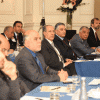
Iraq’s oil exports have reached the highest records in decades. Crude oil exports averaged 2.508 million bpd in April 2012 due to the opening of two new floating terminals, easing export constraints. The Iraq Petroleum 2012 Conference will address this recent increase in crude oil exports, in a key session titled ‘Positioning Iraq on the World Energy Map’ led by members of the Iraqi Government, including: H.E. Thamir Ghadban; H.E. Dr Ali Al Dabagh; and H.E. Dr Adnan Janabi.
The Conference receives support from leading industry experts and government officials, as shown by the participation of its distinguished speakers over the years. Speakers for 2012 include: H.E. Dr Rowsch N. Shaways, the Deputy Prime Minister of Iraq; H.E. Thamir Ghadhban, Chairman of the Advisory Commission to the PM of Iraq; H.E. Dr Selahattin Cimen, Deputy Energy Minister of Turkey; H.E. Dr Ali Al Dabagh, Minister of State and Iraqi Government Spokesman; H.E. Dr Adnan Janabi, Chairmen of the Oil & Gas Committee, Iraqi Government.
Iraq Petroleum is an internationally renowned Conference and provides a platform for key government officials and senior executives to network, discuss current issues and promote innovative ideas surrounding Iraq’s oil and gas sector. Taking place 18-20 June 2012 at the Intercontinental Hotel, Park Lane, London, the Conference is considered the annual meeting place for the industry and is an opportunity for national and foreign companies to strategically engage with key stakeholders.
“Iraq Petroleum 2011 was an excellent opportunity to meet and hear the main players in the Iraqi oil sector” Yazdi Merchant from Saudi Aramco
Supported by the industry, sponsors for the event include; Shell, Lukoil, Total, Genel Energy, Gulf Keystone Petroleum, Occidental, Aspect Holdings; General Exploration Partners, Technology Partners, Clyde & Co, Crescent Petroleum, Motorola and Mubadala.
Posted in Iraq Oil & Gas News Comments Off on Positioning Iraq on the World Energy Map
OPEC Oil Output highest since 2008
Posted on 08 May 2012 .
The output of OPEC in April hit its highest point since 2008 as extra crude from countries such as Libya, Saudi Arabia, and Iraq more than compensated from the loss of Iranian crude supply.
Analysts found that the 12 member countries making up OPEC averaged 31.75 million barrels per day (mbpd). In April it was found that the biggest increase in crude export was from Iraq, this was due to a second export facility coming online, which in turn provided a boost to the countries export capacity.
(Source: Oil and Gas News)
Posted in Iraq Oil & Gas News Comments Off on OPEC Oil Output highest since 2008
Harris to Provide Air Traffic Control System to Baghdad
Posted on 04 May 2012 .
Harris Corporation, the international communications and information technology company, has been awarded a contract to provide a back-up air traffic control system for Baghdad International Airport in Iraq.
Harris will supply a back-up Liberty-STAR™ Voice Communication and Control System (VCCS) to the primary Liberty-STAR™ VCCS previously installed by Harris. Featuring a modular architecture, open-platform software and commercial-off-the-shelf hardware, the Liberty STARTM delivers a reliable, scalable communications solution for ATC towers, airline and area control dispatch, flight service stations, and mobile shelters.
The back-up system at Baghdad International will be equipped with touch-screen operator positions, radio interfaces, telephone interfaces, and a System Maintenance, Administration and Reconfiguration Terminal (SMART) POSITION™. Harris' in-country contractor will install the system and provide operation and maintenance training for Iraqi air traffic controllers and technical staff.
"This latest award expands the company's presence in the rebuilding nation and provides Baghdad International with another mission-critical service," said John O'Sullivan, vice president, Harris Mission Critical Networks. "The Liberty-STAR provides ATC personnel with a powerful, cost-effective back-up solution that they are familiar with, enabling them to concentrate on maintaining safe and secure airways in and around Baghdad."
Harris has extensive experience developing mission-critical solutions that support civil and military air traffic control operations worldwide, including more than 200 customers in 50 countries. In addition to Baghdad, Harris has supplied ATC communications systems to other cities in Iraq including Basra, Taji and Tikrit. Regionally, Harris has provided systems to other countries, including Afghanistan, Oman, Yemen, and Saudi Arabia.
(Source: Harris)
Posted in Iraq Transportation News, Iraqi Communications News Comments Off on Harris to Provide Air Traffic Control System to Baghdad
Starwood/Sheraton to Build New Hotel in Erbil
Posted on 30 April 2012 .
Starwood Hotels and Resorts Worldwide has signed an agreement with BCD Co. to manage a new-build Sheraton hotel in Erbil, Iraq. Scheduled to open in 2015, the Sheraton Erbil Hotel will mark the re-entry of Starwood in the country after 20 years.
Located in the new part of the city, approximately 10 minutes from Erbil International Airport, the Sheraton Erbil Hotel is situated along the new ring road offering guests easy access to the city and its key attractions such as the historic Citadel, Sami Abdul Rahman Park, the largest green area in the region, and downtown Erbil.
“We are delighted to partner with BCD as we re-introduce Starwood to Iraq with Sheraton, our most iconic brand,” said Roeland Vos, President, Starwood Hotels & Resorts, Europe, Africa and Middle East. “The opening of the new Sheraton Erbil Hotel further underlines Starwood’s commitment to growth and expansion in the region.”
Mr. Saad Aldoski, Partner, BCD Co. commented: “We are excited to work with Starwood and the Sheraton brand on our first hotel development in Erbil. We believe that our partnership with a globally recognised hotel operator such as Starwood will set new hospitality milestones in Iraq and that Sheraton’s strong reputation will assist in further supporting Erbil as the country’s commercial hub.”
Posted in Iraq Industry & Trade News, Leisure and Tourism in Iraq Comments Off on Starwood/Sheraton to Build New Hotel in Erbil
Getting Along With Your Neighbours
Posted on 11 April 2012 .
Iraq's improved relations with its neighbours have been particularly evident in recent times.
Following Prime Minister Nouri al-Maliki's two-day visit to Kuwait in March, Iraq agreed to go ahead with the Iraq-Kuwait Boundary Maintenance Project, and to transfer its share of funds allocated for the completion of this project to the UN.
The two governments also agreed during the visit to hold a second high-level meeting later this month to review all pending issues between the two countries, including Iraq's outstanding obligations under Chapter VII.
The relationship was no doubt helped by the attendance of the Emir of Kuwait, His Highness Sheikh Sabah al-Ahmed al-Sabah, at the Arab League Summit in Baghdad, an event described by UN Special Representative Martin Kobler as marking "Iraq's re-emergence as a major actor in the region".
Meanwhile, its relations with Saudi Arabia also continue to improve, with Riyadh's appointment of an envoy to Iraq, and discussions on the opening of the Ar Ar border post between the two countries.
With external relations strenthening, it is all the more disappointing that internal relations within the country are deteriorating. Tensions between the political blocks are impeding progress, while the stand-off between the Kurdistan Region and the Baghdad government causes much uncertainty.
All parties need to apply the same level of commitment to resolving these problems as they have to bolstering international relations, for the sake of their common futures.
Posted in Blog Comments Off on Getting Along With Your Neighbours
Najaf Attracts $7 Billion in Foreign Investment
Posted on 11 April 2012 .
Azzaman reports that the holy city of Najaf has turned into a hub for foreign investments, mainly in areas of housing and tourism, as numbers of foreign pilgrims to the city surge.
The head of Najaf Investment Commission, Wafi al-Bahhash, said an estimated $7 billion had been invested, adding that his commission granted new licences for entrepreneurs to construct a $247 million housing complex in the city.
“We have so far given 176 licenses and more applications are waiting for approval,” Bahhash said.
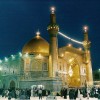
Karbala and Najaf are Muslims’ most sacred sites outside of Saudi Arabia. Najaf is the site where Imam Ali, Shiite Muslim’s most revered saint, is buried.
(Source: Azzaman)
[Picture: Imam Ali Mosque, Najaf]
Posted in Construction & Engineering In Iraq, Iraq Industry & Trade News, Leisure and Tourism in Iraq Comments Off on Najaf Attracts $7 Billion in Foreign Investment
Border Crossing Between Iraq and Saudi to be Opened
Posted on 11 April 2012 .
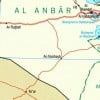
The commercial attaché at Iraq's embassy in Saudi Arabia, Ali Jaberal- al-Utti, has reportedly announced the start of negotiations between the two sides to open the Ar Ar [Ara'ar, Arar] border crossing between the two countries.
The town is situated in the north of Saudi Arabia, the Iraqi city of Karbala, The nearest town to the Ar Ar border crossing on the Iraq side of the border is An Nukhayb.
Al-Utti predicts a doubling of trade between Saudi Arabia and Iraq.
Posted in Iraq Industry & Trade News Comments Off on Border Crossing Between Iraq and Saudi to be Opened
Karbala International Passenger Terminal Opens
Posted on 11 April 2012 .
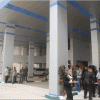
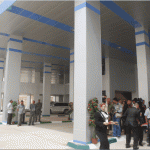
The Director General of the Private Transport Section of the Ministry of Transport, Mr. Abdullah Laibi, outlined the opening of the new $14 million passenger terminal adjacent to Karbala airport.
Designed to ease congestion between Najaf and Karbala, the new 2,000 car parking facility integrates accommodation, restaurant facilities making access to the airport for pilgrims from Syria, Iran, northern Iraq and Saudi Arabia. It is expected that 10,000 people a day will use the facility, and more at peak religious festivals.
The design has been completed by the University of Baghdad and the construction by an Iraqi construction company “done by Iraqi’s for Iraqi’s”.
A similar facility will be built in Najaf this year and then others built in all the major passenger hubs.


Posted in Construction & Engineering In Iraq, Iraq Transportation News 1 Comment

Hellenic Petroleum Considers Buying Iraqi Crude
Posted on 03 April 2012 .
Greece's top refiner, Hellenic Petroleum, is said to be considering taking supplies of Iraq's Kirkuk crude oil, following its suspension of purchases of Iranian crude as a result of sanctions on Tehran.
According to the report from Reuters, Greece's financial difficulties had made Athens reluctant to reduce its purchases of cheap Iranian crude ahead of a EU-wide embargo from 1st July, but no European Union banks were willing to handle the business any more, forcing it to suspend buying this month.
The company is now buying crude grades similar to Iranian oil, mainly Urals crude from Russia, as well as Saudi Arab Light grade, although the high official selling prices for the latter have capped April purchases at just one cargo.
(Source: Reuters)
Posted in Iraq Oil & Gas News Comments Off on Hellenic Petroleum Considers Buying Iraqi Crude
After the Baghdad Summit: Implications Regionally and in Iraq
Posted on 02 April 2012 .
The following article was published by Reidar Visser, an historian of Iraq educated at the University of Oxford and currently based at the Norwegian Institute of International Affairs. It is reproduced here with the author’s permission. Any opinions expressed are those of the author, and do not necessarily reflect the views of Iraq Business News.
The Arab League summit in Baghdad is over and it is time to take stock.
Given the essentially international character of the summit in Baghdad, it is natural to start with the regional implications. And, in many ways, the degree of representation at the level of heads of state is a useful indicator of how things went. Altogether, 10 countries were represented by their rulers: Tunisia, Libya, Sudan, Djibouti, Somalia, Comoros, Palestine, Lebanon and Kuwait in addition to Iraq.
In one way, those who came to Baghdad can be crudely summarized as the “Maghreb Spring” countries (Tunisia, Libya), the very poor in need of any help they can get (Comoros, Sudan, Somalia, Djibouti, Palestine), and “others” not so easily classified (Kuwait and Lebanon). The absence of most of the GCC leaders can be attributed to continued aversion to the Maliki government in Iraq, whereas the failure of the rulers of Egypt and Yemen to show up may reflect the messiness of their own domestic situations as much as any clear policy on Iraq.
But there is more to this than the apparent preference of poor republics for building ties with the new Iraq. True, the gap between Iraq and the Gulf countries remains wide, but if the Iraqi government can build ties with non-GCC countries, it could form an alternative regional bloc within the Arab League. The one obvious disappointing absence for Iraq in this respect must have been that of Algeria.
Posted in Politics Comments Off on After the Baghdad Summit: Implications Regionally and in Iraq