



Growing Iraqi Car Market has "Huge Potential"
Posted on 30 March 2012 .
Bloomberg reports that Iraq is attracting the attention of global automakers including General Motors, Ford and Volkswagen.
Western cars were shut out of the Iraqi market by sanctions during the Saddam Hussein era, and even today there are many old VW Passats that were shipped to Iraq from Brazil between 1983 and 1990 in exchange for oil.
Now rising incomes and safer streets are fueling demand for new cars such as Chrysler's Dodge Charger (pictured), nicknamed "Obama" after the U.S. president by Iraqis.
Another car popular among Iraqis is the Samand, a sedan manufactured by Iran Khodro Company.
With a population of more than 30 million people and a growing economy, Iraq's auto market has "huge potential," said Stefan Mecha, VW's managing director for the Middle East, projecting industrywide sales to rise by a third this year to 120,000 vehicles. Demand could get much bigger.
In neighboring Saudi Arabia, which has a population slightly smaller than Iraq's, there are about 6.5 million registered cars, according to IHS Automotive. That's about five times the 1.35 million vehicles in Iraq, according to Hamid Algharbawi, owner of a high-end car dealership in Baghdad. Official data aren't available.
Iraq holds "a lot of promise," said Larry Prein, Ford's managing director for the Middle East. Ford expects sales to double this year after tripling to 2,000 in 2011.
Niva Car Ltd., Ford's dealer in Iraq, plans to invest $200 million over the next three years to open new outlets to tap the rising demand, said Mohammad Fuad Alanaswah, the dealer's chief. "It's a tough market to be in, but it is growing," said Alanaswah. "We believe in our market. That's why we are expanding."
GM plans to invest in new showrooms and service centers in Iraq after initially entering the market in 2003 by selling to the government, U.S. forces and aid organizations, said John Stadwick, head of GM's Middle East operations.
Last year, GM's sales surged 68 percent to 32,000 cars, making Iraq its second- largest market in the region after Saudi Arabia.
(Sources: Bloomberg, Digital Trends)
Posted in Iraq Industry & Trade News, Iraq Transportation News Comments Off on Growing Iraqi Car Market has "Huge Potential"
Iraq Seeks Arab Debt Forgiveness
Posted on 29 March 2012 .
Iraq has asked its Arab neighbours to forgive its pre-invasion debts, urging them to follow the United Arab Emirates and Algeria which have already written off what they were owed, according to Reuters.
"We've asked Saudi Arabia, Kuwait, Qatar, Libya, Jordan, Sudan, Egypt and Morocco to help Iraq in closing up its debt situation," Iraqi Finance Minister Rafie al-Esawi [Rafie al-Issawi, Rafi Hiyad al-Issawi, Rafia al-Issawi] said on the first day of the Arab League Summit in Baghdad.
The Paris Club of 19 rich creditor nations agreed in 2004 to write off 80 percent of some $40 billion debt to help Iraq recover from the 2003 U.S.-led invasion. Debt forgiveness talks with non-Paris Club nations are still under way.
"It needs more cooperation from Arab countries regarding the cancelling of debt," Esawi said, thanking the UAE and Algeria for agreeing to cancel 100 percent of debts.
Iraq's external debt was between $130 billion and $140 billion in 2003, much of which was settled through the 2004 Paris Club agreement.
That deal required Iraq to seek similar settlements with all its other creditors. But some commercial creditors won legal judgements and have refused to comply with the settlement.
Saudi Arabia last year was owed $30 billion by Iraq and Kuwait is owed around $22 billion in additional to war reparations for the 1991 Iraqi invasion of Kuwait.
China has written off 80% of the debt it was owed by Iraq.
(Source: Reuters)
Posted in Iraq Banking & Finance News Comments Off on Iraq Seeks Arab Debt Forgiveness

Baghdad's Historic Summit Meeting
Posted on 22 March 2012 .
Next week's Arab League Summit in Baghdad is a very significant moment in Iraq's development.
Quite apart from any discussions and resolutions at the conference itself, the staging of the event in Iraq for the first time since 1990 demonstrates the acceptance of an independent Iraq into the community of Arab states.
Preparation for the summit has also provided an opportunity for Iraq and other nations to tidy up some loose ends, such as the re-appointment of an Ambassador from Saudi Arabia to Baghdad, and the resolution of some long-standing issues with Kuwait.
But the conference comes with costs, the most obvious of which is the human cost of the terrorism intended to disrupt the event. For several days, Baghdad will effectively be on lockdown, with security the top priority. Our Expert Blogger, John Drake, has advice for anyone staying in the capital over this period.
In the meantime, Iraq Business News will keep you up to date with developments.
Posted in Blog Comments Off on Baghdad's Historic Summit Meeting
Iraq Approves Hormuz Oil Exports Contingency Plan
Posted on 19 March 2012 .
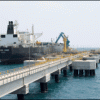
In an attempt to deal with any potential crisis should Iran close the Strait of Hormuz, Iraq has approved a plan to expand its oil export routes by adding capacity from its northern fields and building a pipeline to ship oil from southern oilfields to the Turkish port of Ceyhan (pictured), according to Reuters.
"Short and mid-term plans will be through boosting crude pumping and upgrading export capacity via Ceyhan port in Turkey. Also to increase the number of trucks that are shipping crude," government spokesman Ali al-Dabbagh said on Sunday.
He added that "the oil ministry suggested accelerating work to complete building the north strategic pipeline and connect it to the Kirkuk-Ceyhan pipeline to export oil from Basra via Ceyhan port".
Last year, Iraqi and Jordanian officials agreed in principle to build a pipeline to supply Jordan with crude oil in future. Iraq transports 10,000-15,000 bpd of crude exports in trucks to Jordan, but there have been difficulties with this in recent times.
Dabbagh said the plan also encouraged talks with top OPEC oil exporter Saudi Arabia to ship Iraqi crude to Yanbu on the Red Sea.
Iraq has also been moving ahead with building a 680 kilometre pipeline able to transport 1 million bpd of crude from southern oilfields around Basra to a main pumping station in Haditha in the west.
"We managed to complete constructing 200 km of the pipeline with plans to finish all work in 2013. We will have the flexibility of shipping Basra crude to various destinations, including towards Ceyhan port," an oil ministry spokesman said.
Under the contingency plan, Iraq may also revive the Iraq-Syria pipeline as a long-term measure to ship crude from southern fields to Banias in the Mediterranean. Plans to build a pipeline to transport crude to Jordan's Aqaba port were also considered.
(Source: Reuters)
Posted in Iraq Oil & Gas News Comments Off on Iraq Approves Hormuz Oil Exports Contingency Plan
Toward a New Partnership with Iraq
Posted on 19 March 2012 .
Remarks by Antony Blinken, Deputy Assistant to the President and National Security Advisor to the Vice President, Center for American Progress, Washington, DC, March 16, 2012:
Thank you, Rudy. It is great to be here at the Center for American Progress with you and with John Podesta, a great leader at the White House during the Clinton administration and the founder of this remarkable institution.
Like many in the Administration—including, I suspect, the dozens of your alumni among my colleagues—I look to CAP for sound policy ideas and analysis.
So it is pleasure to have the opportunity to try to return the favor and share some of our thinking with you.
Sunday will mark nine years since the start of the Iraq war, and three months since the last American troops crossed the border into Kuwait, ending one of our nation's longest, and most divisive, conflicts.
The wisdom of going to war in Iraq will continue to be debated for years —I’ll leave that to the historians.
But what is beyond debate—and what news coverage of Iraq too often fails to acknowledge—is that Iraq today is less violent, more democratic and more prosperous—and the United States more deeply engaged there—than at any time in recent history.
Those of us who have been working on Iraq for a long time—including Brian Katulis, Larry Korb and others from CAP—know that this progress, while far from complete, also was far from inevitable.
It was the result of the extraordinary, awe-inspiring success and sacrifice of our troops; the resolve and resilience of the Iraqi government and people; and the steady, intense engagement of our diplomats and civilians, which continues to this day.
I appreciate the opportunity to take stock of how far Iraq has come; the profound challenges that remain; and where we hope to go in building a new, more normal relationship between Iraq and the United States.
President Obama and Vice President Biden came to office with this commitment: to end the Iraq war responsibly.
Both parts of that sentence are critical.
“End the war.”
“Responsibly.”
Posted in 'Your Country' - United States, Iraq Industry & Trade News, Politics, Security Comments Off on Toward a New Partnership with Iraq

Iraq Reviews Oil Pipeline to Saudi Arabia
Posted on 16 March 2012 .
Among the options being considered by Iraqi lawmakers to reduce dependence on the Strait of Hormuz, is the reopening an oil pipeline to Saudi Arabia that's been closed since the Gulf War in the 1990s.
Currently, most of Iraq's oil exports are shipped by tanker from Basra through the Strait of Hormuz, but Iran has threatened the strait in response to economic pressure from the West.
The Radio Free Europe/Radio Liberty's bureau in Iraq reports that a committee in the Iraqi Parliament has called for talks to re-open an oil pipeline to Saudi Arabia that was shut down after Iraq invaded Kuwait in 1990.
The 626 km pipeline, built in 1986 by Mitsubishi of Japan and OTF of Hungary, has capacity to export nearly 1.5 million barrels per day to the Saudi port of Yanbu on the Red Sea.
(Sources: RFE/RL, AKnews, UPI)
Posted in Iraq Oil & Gas News Comments Off on Iraq Reviews Oil Pipeline to Saudi Arabia
Iraq Hopes Arab Summit Will Boost Its Role
Posted on 16 March 2012 .
This article was written by Abeer Mohammad, and was originally published by the Institute for War and Peace Reporting, iwpr.net. It is reproduced by Iraq Business News with permission. Any opinions expressed are those of the author, and do not necessarily reflect the views of Iraq Business News.
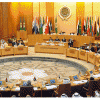
Iraqi officials are hoping that hosting the first Arab League summit after the wave of revolutions that swept through the Middle East and North Africa will increase their country’s standing in the region.
“It is very important for Iraq to host this particular summit at this particular time,” Ali al-Mosawi, a media advisor to the Iraqi government, said. He noted that this meeting would see “some officials meet others for the first time” – a reference to new leaders who have emerged from revolutions in Arab states over the last year.
Mosawi said the three-day forum in Baghdad, starting March 29, would discuss the continuing unrest in Syria and Bahrain, and Palestinian issues. Syrian president Bashar al-Assad has not been invited.
The agenda also includes restructuring the Arab League itself, after criticism of the way it has acted over the last year.
“Its hierarchy will be reviewed for the first time since it was established more than 50 years ago,” Mosawi said.
For Iraq, the meeting – especially coming at such crucial moment for the region – presents an opportunity to bolster its relations with the rest of the Arab world.
Posted in Iraq Industry & Trade News, Politics, Security Comments Off on Iraq Hopes Arab Summit Will Boost Its Role

Iraq to Nominate Thamar Ghadban to Lead OPEC
Posted on 07 March 2012 .
Iraq is expected to challenge the Saudi contender for the post of Secretary General of Organisation of Petroleum Exporting Countries (OPEC), according to a report from Middle East Oil & Gas.
An Iraqi official told the Gulf Times: “Iraq is working to nominate Thamer Ghadban for this position”. Ghadban is currently the top energy adviser to Iraqi Prime Minister Nouri al-Maliki, and was Iraq’s oil minister from 2004-05.
OPEC may ask its current secretary general, Abdullah al-Badri, to remain in the post for an unprecedented third term should the group fail to reach consensus. If he were willing to stay on, OPEC would need to make an exception to its statute that says the secretary general can only serve two three-year terms. Delegates say this is possible.
"The issue will be discussed during the coming OPEC meeting [in June] and the option of Badri staying on is still on the table," a anonymouse delegate from a Gulf OPEC country said.
"If the Saudi delegate doesn't get support from all the member-countries then Badri might remain as secretary general and that would be the best solution for the time being," a second delegate said.
(Source: MEOG)
Posted in Iraq Oil & Gas News Comments Off on Iraq to Nominate Thamar Ghadban to Lead OPEC
Cash Only: Why the Messy Banking Sector Endangers Iraqi Development
Posted on 02 March 2012 .
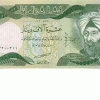
Iraq could be one of the richest countries in the world. Yet over three quarters of Iraqis do not have bank accounts. So where do they keep that wealth, asks this article from NIQASH, and can the Iraqi banking system be dragged into the 21st century?
Any opinions expressed are those of the author, and do not necessarily reflect the views of Iraq Business News.
The banking sector in Iraq reflects the economic mess that the country is in. Basic modern banking practices – like electronic funds transfers for payroll or other banking needs - are almost non-existent and credit facilities are hard to come by. Automatic teller machines remain a novelty while mortgages and loans are a rarity.
Iraq has only a few banks with the ability to transfer funds electronically and the number of branches able to undertake this sits at around 240. Transferring funds directly to Iraqi banks remains a patchy process and it is more often done through other banks in the region, such as more reliable sister bank in Jordan or the United Arab Emirates.
Latest research estimates that around 80 percent of Iraqis do not have a bank account or even access to one. The public's trust in the Iraqi banking sector remains low. Which is why most banks in Iraq simply act as a glorified safety deposit box.
Meanwhile Iraq is on track to become one of the wealthiest countries in the world, with the fourth largest oil reserves in the world and the potential to be one of the globe's leading oil exporters, eventually matching, or even surpassing, Saudi Arabia, currently one of the largest oil exporters in the world. But despite incoming revenue and the potential for growth, economic progress remains slow - and this is partly due to dysfunctional banking sector. There is talk of sector reform and new electronic banking systems - yet this vital sector is still underdeveloped.
Posted in Iraq Banking & Finance News 4 Comments
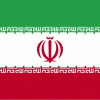
Iran vs EU: Iraq Plays Go-Between in Oil Export Crisis
Posted on 24 February 2012 .
Iraq is demonstrating its unique position in the Middle East again, flexing its new diplomatic muscle to resolve an oil exporting crisis between the West, OPEC and Iran, according to this article from NIQASH. But who’s behind these efforts: Iran, the US or Iraq itself?
Any opinions expressed are those of the author, and do not necessarily reflect the views of Iraq Business News.
As the current head of OPEC, Iraq is testing its diplomatic mettle further, by mediating between the oil exporters in the Gulf countries, the EU and neighbouring Iran.
The crisis that Iraq is dealing with involves Iran and Saudi Arabia and oil exports from throughout the region. Recently, the countries of the European Union agreed to impose sanctions on Iran’s oil exports, banning the signing of any long term oil export contracts come July 1, 2012. The move was intended to put pressure on Iraq because if its plans to build up nuclear capacities.
And the July deadline was supposed to give the EU members nations time to find alternative supplies. However Iran then decided to cease oil exports to the UK and France earlier, as way of increasing pressure on the Europeans, pre-empting their ban – although apparently the gesture was largely symbolic as both nations had already stopped buying Iranian oil.
The other thing that Iran has done is threaten to close the Hormuz Strait, one of the most important shipping channels in the world; around one fifth of all crude oil passes through the narrow shipping channel, which lies between the Gulf of Oman and the Persian Gulf.
Posted in Iraq Oil & Gas News, Politics 1 Comment