


Saipem Wins Contract for Basra Oil Export Expansion Project
Posted on 19 October 2011 .
Iraq's South Oil Company has awarded Italy's Saipem the EPIC contract for the Iraq Crude Oil Export Expansion Project – Phase 2, within the framework of the expansion of the Basra Oil Terminal (ABOT), off the Al Faw Peninsula in the Arabian Gulf, approximately 550 kilometres south-east of Baghdad.
The contract encompasses the engineering, procurement, fabrication and installation of a Central Metering and Manifold Platform (CMMP), to be installed in a water depth of 28 metres, along with associated facilities.
Fabrication of the CMMP topsides will be carried out at Saipem’s yard in Karimun (Indonesia), while the jacket and piles will be fabricated at the Saipem Taqa Al-Rushid (STAR) yard in Dammam (Saudi Arabia). Offshore activities will be performed in the third and fourth quarter of 2013.
(Source: Saipem)
Posted in Iraq Oil & Gas News Comments Off on Saipem Wins Contract for Basra Oil Export Expansion Project
Whitby & Mohajer Target Iraqi Market
Posted on 17 October 2011 .
Iran and Iraq will be major target markets for Dubai’s newest engineering consultancy, Whitby & Mohajer, says the company’s MEP director.
While the usual target markets of Saudi Arabia, Qatar and the UAE will still be areas of interest, Louise Collins told MEP Middle East said that the intense competition for MEP contracts in those markets was a deterrent.
“A lot of the bigger companies are wary of Iraq right now, but it’s got a lot of money and is looking to rebuild. The Americans are already in there, it seems to be the British and European companies that are hanging back, (being) a little bit more insecure. But there’s certainly a lot of money out there,” she said.
Whitby and Mohajer are currently working on two major projects in Iraq, one a six hundred bed hospital and the other the Council of Ministers building.
“There’s a lot of iconic stuff in Iraq, but we have to be careful how many projects we take in that region. In Iran, it’s the same thing. But you’ve got to spread your risk when you’re going into those kinds of places.”
“Kuwait and Saudi Arabia are flying along and we’re getting a lot of fit outs here in Dubai, so that’ll sustain smaller companies (like us) for a while. There’s going to be a lot of fighting for big projects in Abu Dhabi by the bigger companies, but that’s not going to pick up for a while,” Collins said.
(Source: Construction Week Online)
Posted in Construction & Engineering In Iraq Comments Off on Whitby & Mohajer Target Iraqi Market

Powerwall sees Potential in Iraq
Posted on 13 October 2011 .
A Scottish manufacturer of prefabricated buildings has embarked on a major push into the Middle East as it targets construction projects in countries such as Libya and Iraq.
Powerwall, which runs a ten-acre production site in Wishaw and employs about 80 staff, is also locked in talks with potential partners in a string of markets, including Egypt and Syria.
The firm’s fabricated structural frames, reaching up to 22 storeys, can be used in housing developments, schools and hospitals and are said to offer major time and cost savings over traditional building techniques. Its concerted push east comes on the back of two deals in the region.
The company, which began developing its modular building technology in the early 1990s, has just formed a partnership with a Saudi group to form Powerwall Arabia.
It will manufacture and market products under a licensing arrangement in Saudi Arabia and Qatar.
Powerwall has also entered into a partnering agreement with the Al Badie Group in Abu Dhabi to market its building system in a number of “key locations” in the Middle East.
Global sales director Joe Pacitti said the region in general was in a growth phase, with older infrastructure in need of upgrading or replacement. “The whole of the Middle East is looking to increase investment in quality housing, hospital, schools, hotels and the like,” he said.
Powerwall’s global sales director told Scotland on Sunday earlier this year he was confident the firm could build up between £50 million and £100m of international business over the next five to ten years.
Powerwall’s “volumetric” building system is also said to have attracted interest from oil and gas explorers operating in remote regions.
In addition to its main plant near Glasgow, the company has a facility in Udine, in Italy, and employs up to 40 sub-contractors. It turns over some £15m, but is projecting growth of 60 per cent-plus in the next couple of years as the number of licensees multiplies.
(Source: Powerwall)
Posted in Construction & Engineering In Iraq, Iraq Oil & Gas News Comments Off on Powerwall sees Potential in Iraq

SGS Comments on Import Inspection (ICIGI)
Posted on 06 October 2011 .
By Rickie Cole of SGS, in response to our Iraq Business News article on importation inspection:
On 1st May 2011, the Central Organisation of Standardisation and Quality Control (COSQC) in Iraq implemented the Pre-Importation Inspection, Testing & Certification of Goods to Iraq (ICIGI) programme. This programme is designed to monitor the quality of regulated goods being imported into Iraq. SGS has been mandated by COSQC to provide inspection and certification services in line with this new programme.
In the months since the programme’s implementation, SGS has been working closely with the Iraq Commercial Attaché, the Arab-British Chamber of Commerce and the Joint Arab-Irish Chamber of Commerce to ensure that UK exporters are aware of the new requirements. SGS has already assisted many companies with ensuring that their exports comply with the programme. However, despite our efforts there is still a lot of confusion surrounding the programme.
Should you require any assistance in complying with the programme, please contact SGS on +44 (0) 1276 697 773 or email [email protected].
What is Product Conformity Assessment?
With the ever present threats and risks associated with the growing international trade of sub-standard and counterfeit goods, there is a growing need for international governments to ensure that imported goods are genuine and of a suitable quality.
Product Conformity Assessment (PCA) programmes assist governments worldwide in verifying the quality of imported goods and are already popular in the Middle East & North Africa with long standing programmes in place for countries such as Saudi Arabia, Algeria, Kuwait, Kenya, Nigeria and Syria.
PCA services provided by independent third party bodies such as SGS ensure the safety and overall performance of imported goods with a view to protecting the end-users’ health, safety and security. Some clear benefits of these programmes to the government and citizens in the importing country are:
- Increased ability to monitor the quality of goods entering the country
- Assistance in reducing the incoming flow of sub-standard and counterfeit goods
- Greater assurance that imported goods are not harmful to the public or environment
Why Choose SGS?
SGS is the world’s leading inspection, verification, testing and certification company. Recognized as the global benchmark for quality and integrity, we employ more than 64,000 people and operate a network of over 1,250 offices and laboratories around the world.
SGS is constantly looking beyond customers’ and society’s expectations in order to deliver market leading services wherever they are needed. As the leader in providing specialized business solutions that improve quality, safety and productivity and reduce risk, we help customers navigate an increasingly regulated world. Our independent services add significant value to our customers’ operations and ensure business sustainability.
SGS also provide inspection and certification services in line with PCA programmes in Algeria, Kenya, Kazakhstan, Kuwait, Nigeria, Russia, Saudi Arabia and Syria – for further information please contact SGS on +44 (0) 1276 697 773, email us [email protected] or visit our website www.uk.sgs.com.
Posted in Iraq Industry & Trade News Comments Off on SGS Comments on Import Inspection (ICIGI)

A Special Issue: Oil in Iraq
Posted on 01 October 2011 .
By Ahmed Mousa Jiyad. Any opinions expressed are those of the author, and do not necessarily reflect the views of Iraq Business News.
The international Journal of Contemporary Iraqi Studies-IJCIS has just released it is special issue on “Oil in Iraq”.
Many prominent Iraqi and non-Iraqi scholars have contributed articles to this timely and important volume, which makes it an invaluable scholarly work to understanding the complexities of oil in Iraq.
The following is my introduction, as the guest editor of this special issue of IJCIS.
Three unprecedented and interrelated developments have taken place in the Iraqi petroleum sector since the 2003 invasion. Wide openness of all petroleum sub-sectors (upstream, midstream and downstream) for foreign investment; offering, through three bid rounds, the most prized oil and gas fields for an international auction resulting in contracting almost 60 per cent of the country’s proven petroleum reserves for at least 20–25 years; and finally, these contracts would expand oil production and export capacities by fivefold in less than seven years.
Such an opening could lend support to the notion that, ‘the invasion was all about oil’ and provoke legitimate questions on why a country, with incomplete sovereignty due to the presence of occupying forces and still under Chapter Seven of the UN Charter takes such unwarranted drastic actions; how it is going to manage such a massive undertaking; and what is it going to do with the influx of huge revenues, and mitigate the consequences.
Though many, and for variety of convincing reasons and powerful arguments, doubt very much the feasibility of attaining such production targets at such a fast pace under structural weaknesses and prevailing conditions in the country. However, even with half-success, this would, by all standards, be very significant indeed, and with far-reaching implications domestically, regionally and internationally.
Expanding production (and by logic, intentions and necessity) and export capacities would lead to a tremendous augmentation of the economic rent (or windfall) for the state due to expected higher oil prices, with or without the Peak Oil argument, in relation to the comparatively low production (or extraction) cost.
Domestically, such a huge influx of foreign exchange is bound to face three interrelated and theoretically enforcing hurdles: absorptive capacity limitations, Dutch disease and resource curse attacks. Each has its own dynamics and requires policy options to mitigate consequences. Thus, Iraq needs to devise sound development policy and modalities to mange effectively the plenty generated from its depleting natural resources.
In addition to the above macroeconomics structural difficulties, weak institutional capacities, ambiguous legal and constitutional frameworks, lack of suitable infrastructural facilities and fragmented political climate, all represent formidable domestic determinants.
Posted in Ahmed Mousa Jiyad, Iraq Oil & Gas News Comments Off on A Special Issue: Oil in Iraq
Iraqi Stock Market in the Spotlight
Posted on 27 September 2011 .
With most Middle East stock markets having been dragged down by the turmoil unleashed by the Arab spring and a sputtering global economy, some adventurous fund managers have started exploring opportunities in the tiny Iraqi market, according to a report from Bloomberg.
The Iraqi Stock Exchange, or ISX, says its main market index has surged some 65% so far this year, making it one of the world's best-performing markets. Though many doubt the accuracy of the ISX's main index, fund managers who follow the country agree that Iraqi share prices have risen about 15% in 2011—still outperforming most global peers.
Investors have been attracted by the relative political stability following the formation of Prime Minister Nouri al-Maliki's coalition government last year, as well as the promise of higher oil revenues and the reconstruction of the economy. The International Monetary Fund estimates that Iraq's economy will grow at 9.6% this year and likely expand by 12.6% in 2012.
"Foreign buying has picked up in the past 18 months or so with inflows estimated at about $130 million in this period," said Shwan Ibrahim Taha, chief executive of Rabee Securities, whose weekly stock market reports are published by Iraq Business News.
"The fact that it is one of the best performing markets this year, with further potential upside as the economy develops, is definitely whetting investor appetite," he said.
The Iraqi bourse's gains this year compare well to the performance of other indices in the region. Saudi Arabia, the Middle East's biggest market, is down some 7% so far this year. Egypt, the most open market in the region, has dropped 38% in the wake of the January revolution that toppled former President Hosni Mubarak.
Posted in Investment 1 Comment
Iraq's Biggest Construction and Electricity Trade Fair
Posted on 26 September 2011 .
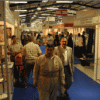
Last week Erbil hosted for the fourth time the Project Iraq construction trade exhibition, together with the Elenex Iraq energy and electricity show. This year's construction fair was the largest so far, attracting exhibitors from 20 countries and thousands of visitors.
Project Iraq 2011, the 4th International Trade Exhibition for Construction & Environmental Technology for Iraq, was held concurrently with Elenex Iraq 2011, the first exhibition entirely dedicated to energy, taking place at the Erbil International Fairground from 19-22 September.
At the opening of the exhibitions, the Kurdistan Regional Government (KRG) ministers for Housing and Reconstruction and for Electricity welcomed all the participants. Minister Kamaran Ahmed Abdullah and Minister Yasin Sheikh Abu Bakir Mawati said that they were delighted that the trade shows are betting bigger every year, attracting visitors from all over Iraq.
The speakers at a press conference to launch the trade show included Engineer Nahro A. Assadi, deputy Minister, Ministry of construction & Housing, Mr. Hama Amen Hawramy, Advisor of the Minister of Electricity, Mr. Aziz Abdo, Director General of Trading in the Ministry of Trade and Industry , Mr. Fady Jreissati, representing IFP Iraq, The conference was attended by a number of government representatives, diplomats and business leaders, and enjoyed strong media coverage.
Mr. Jreissati gave an overview of the exhibitions and their importance, praising government efforts towards economic development and accelerated growth all over Iraq and in the Kurdistan region particularly. He expressed his gratitude to the representatives of the Kurdistan Regional Government, in particular the Ministries of Electricity and Construction and Housing, for their support to the company's events, and commended the management of Erbil International Fairground, proudly underlining its cooperation with IFP Iraq.
Posted in Construction & Engineering In Iraq, Iraq Industry & Trade News Comments Off on Iraq's Biggest Construction and Electricity Trade Fair

Iraq “The Next Saudi Arabia”: MAN Trucks
Posted on 20 September 2011 .
Iraq’s extensive rebuilding requirements could make it “the next Saudi Arabia” for contractors and suppliers, according to an executive at MAN Trucks.
Construction Weekly reports that Dave van Graan, vice president of sales at the German heavy vehicle giant, said the gradual pick up in demand for machinery to help develop Iraq has already given the company “four-fold” what it had earned in income in the previous five or six years, with a lot more potentially to come.
“We see a number of the long-awaited government spending projects come to fruition, and those companies that stood the test of time that maintain the infrastructure, they are the ones that will be with the boom,” he told an audience at a construction industry round table in Dubai last week.
Saudi Arabia is currently the chief market for the truck maker on the back of high construction activity from state-sponsored programmes to build new airports, housing projects, financial centres and economic cities along with a rise in private-sector development.
Van Graan said the country’s size, population density and oil reserves created an ongoing pipeline of projects, and these attributes can be applied to Iraq.
“Saudi will be very strong but the next that follows will be in that region, purely by way of population density and it is a rich country; [Iraq] has money to spend,” he said. “If you’re developing a pipeline and you have the staying power to handle the economical and political challenges there, then obviously you will benefit. So it’s [a question of] how long you’re strategically thinking: is it six months, or five years?”
Contractors, consultants and suppliers across the Gulf have been divided as to the potential and reality of working in the Iraq market, which has many billions of dollars worth of projects planned in the wake of the international conflict in the country since 2003 that has stymied development. Infrastructure such as ports and airports, as well as hotels and shopping centres make up an active market, though concerns remain about the security costs.
Demand for trucks and other vehicles remains high. Earlier this year the country extended its $42m deal made in 2008 with vehicle giant Scania to include the production of 5,000 trucks and buses over a five-year period. Further deals with Mercedes and Renault mean that Iraq has boosted both its vehicle production and parts manufacturing industry in the past 12 months, and hopes to produce trucks domestically within the next ten years.
(Source: Construction Weekly)
Posted in Construction & Engineering In Iraq, Iraq Transportation News Comments Off on Iraq “The Next Saudi Arabia”: MAN Trucks

Tamimi Global to Pay $13m for KBR Kickbacks
Posted on 20 September 2011 .
Tamimi Global will pay $13 million to settle U.S. criminal and civil allegations that it paid kickbacks to a KBR employee and improper gratuities to a U.S. Army sergeant, according to a report from Bloomberg.
The Dhahran-based unit of the Saudi Arabian construction and manufacturing Tamimi Group, gave kickbacks to get Army logistical support subcontracts from Houston-based KBR for work in Iraq and Afghanistan, according to the U.S., and improperly gave the gratuities to Sergeant Ray Chase in Kuwait, the U.S. said.
The company, through its lawyers, entered a deferred prosecution agreement with the U.S. in a hearing in Illinois.
“Kickbacks and collusion in military contracting corrode the process of supplying our men and women in uniform with the quality supplies they need and deserve,” Assistant U.S. Attorney General Tony West said in an e-mailed statement.
Tamimi will pay $5.6 million as part of that pact and, separately, agreed to pay $7.4 million to settle claims it paid kickbacks to obtain favorable treatment in the awarding of a Baghdad Palace dining facilities subcontract.
The misconduct took place more than five years ago, and the company says that it has adopted new compliance protocols.
(Source: Bloomberg)
Posted in Security Comments Off on Tamimi Global to Pay $13m for KBR Kickbacks

FMG Iraq Fund Continues to Outperform
Posted on 19 September 2011 .
The FMG Iraq Fund continues to outperform world stock markets. The fund was up some +2.0% in the month of August and it has risen by +25% since its launch in May 2010. The current size of the fund is now $20 million under management.
FMG offers a retail share class for a minimum investment in the three share classes of US $10,000, (CHF) Swiss Francs 9,000 or GBP Sterling £6,000. Investment into the Iraq Fund is an attractive proposition for UK investors, as gains will be taxed as capital gains at 28% and not as income tax rate at 50% as the fund has H.M. Revenue & Customs “Reporting Status”.
Henrik Kahm, fund manager of the Iraq Fund, said: “FMG’s Iraq fund is sensibly positioned to benefit from the Iraqi growth story and fuelled by a growing confidence in the country's stability”.
Iraq has the third largest oil reserves in the world. The country is one of the least explored in the region and oil experts say the country probably has 200-300 bn bbl of oil i.e. at par with Saudi Arabia. Iraqi oil is easy to access and costs only a few dollars per barrel to extract. The Iraqi government signed 11 oil contracts in 2009 with IOCs such as SINOPEC, Petronas, Shell, Exxon, ENI, Sonagol with the aim to explore and develop oil fields. Over 90% of oil revenues go to the Iraqi government, one of the highest royalty rates in the world. Value of the oil in the ground can be estimated to $10 trillion. World market capitalization is around $50 trillion. Iraq Stock Exchange market capitalization is $4bn. FMG thinks this is the most undervalued stock market in the world.
The proceeds from oil will be used by the Iraqi government to improve infrastructure and other related projects. FMG’s Iraq fund is carefully positioned to benefit from that new money coming into government and consumer spending, with exposure to a diverse range of Iraqi quoted stocks.
The amount of new foreign investment deals is on track to double this year, according to a report by Dunia Frontier Consultants. In just the first half of this year, Iraq attracted $45.6 billion in foreign investment, $3 billion greater than the total for the whole of 2010. On the macro side FMG has noticed that Iraq's oil revenues surged by 62 percent to $41.3bn in the first six months of 2011 compared with $25.4bn in the first half of 2010, according to a report published by Arab Oil and Gas. The massive revenue increase was attributed to both higher oil prices and a significant increase in volumes.
(Source: FMG)
Posted in Investment Comments Off on FMG Iraq Fund Continues to Outperform