



The Miran West-2 well was initially designed as an appraisal well for the Cretaceous section and was subsequently modified to assess the exploration potential of the deeper formations, eventually being drilled to a total depth of 4,426 metres. The well results have confirmed three additional pay zones within Lower Cretaceous and Jurassic formations, in addition to the pay zone identified in the Upper Cretaceous in the Miran West-1 well.
Additionally, well results have established that the Miran Field contains two hydrocarbon systems, with oil in the shallower Upper Cretaceous section and wet gas/condensate within the deeper Lower Cretaceous and Jurassic formations. This has resulted in the previously anticipated prospective oil resources in the Lower Cretaceous, identified on the basis of oil shows in the Miran West- 1 well, being proven to be wet gas/condensate.
The Miran West-2 well has been suspended as a future producer.
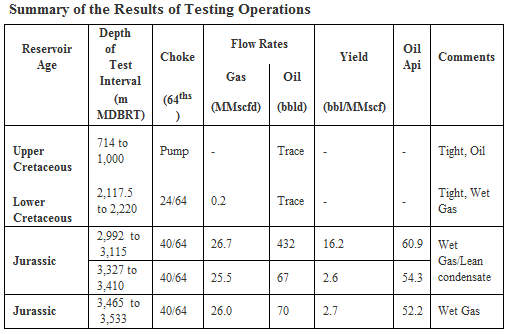
The test rates were constrained by the capacity of the surface equipment and the well test data indicate that individual test intervals could produce at rates of 40 MMscfd with the well capable of producing at a rate of over 100 MMscfd when it is placed on production. The proven hydrocarbons in the Upper Cretaceous can be accessed commercially on the structure as demonstrated by the 8,000-10,000 bopd potential of the Miran West-1. Furthermore, future drilling techniques will maximise the benefit from the fracture networks in order to achieve optimal production rates.
In-Place Hydrocarbon Volumes
Following completion of the test programme, the hydrocarbon volumes of the Miran Field have been re-evaluated and management estimates in-place volumes for the Miran West structure to have a P90-P50 range of 6.8-9.1 TCF, with an upside P10 potential of 12.3 TCF of gas. Miran East has an additional estimated P90-P50 gas in-place range of 0.6-0.9 TCF with a P10 upside of 1.3 TCF.
The extensive coring programme linked with wireline log analysis in Miran West-2 has indicated the presence of matrix porosity within the Cretaceous and Jurassic formations. Management estimates, based on initial evaluation of the well, that Heritage has mean risked contingent and prospective resources in Miran West and Miran East of 744 mmboe, based on a 75% working interest. The Regional Government of Kurdistan has a back in right which could, if exercised, reduce Heritage's working interest to 56.25%. Management estimates that mean net risked contingent resources have increased from 53 MMbbls to 605 MMboe following completion of the Miran West-2 well.
Forward Programme and Development
Comments are closed.