


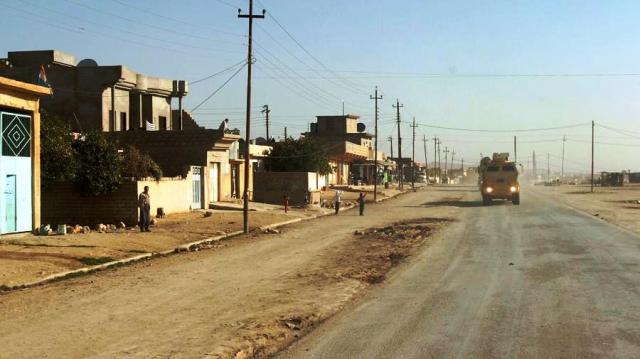
At this last stop for Yousef in Sinjar, he explains that the Kurdish border guards here have ties with the smugglers but that they will not allow foreigners to bring vehicles into the area. This is why the local men must transfer the contraband to other vehicles and then take them into the town proper. At this point Yousef’s job was done. “The goods will find their way into Syria with others,” he declared.
NIQASH’s correspondent however continued, following the path that the smugglers would take and eventually encountering a police patrol. The patrol, headed by Lieutenant Said Khader, was stationed only a few meters away from the Iraq-Syria border.
And the lieutenant was quick to deny what insiders had already said: that border police charged US$1 for every master case of cigarettes they see carried by smugglers.
“The smuggling is illegal,” Khader said. “But it does not harm the local economy. On the contrary, it’s bringing in foreign currency, stimulating commerce here and providing unemployed villagers with employment opportunities,” he explained.
Khader said he knew how badly local villagers needed work and explained that he would actually prefer to be far more lenient on the smugglers. However he was concerned that if he was, this might also aid would-be terrorists and militant extremists.
“We fear that the profits from smuggling would be used to finance terrorist acts or as a cover for the smuggling of more dangerous items such as guns and drugs,” Khader concluded.
The last stop on the cigarette smuggling route is a village just 500 meters away from Syria. After the sun sets, hundreds of porters start their work day, loading the cigarettes onto their backs, preparing to complete the last leg of the contraband’s journey by foot.
One of the porters, Sabah Shammo, 21, told NIQASH that since he had started working for the smugglers he had not had a peaceful night’s sleep. “Every night I carry four cases of cigarettes on my back. They weigh around 60 kilograms and I get IQD75,000 [around US$63] for that. Sometimes I carry two loads and earn double,” he boasted.
As the policeman Khader had said, there was little alternative for many of the young people like Shammo, living in the remote area and coping with high unemployment. “Hundreds of families live on the income from smuggling,” Khader explained. “If the smugglers were not here, then I think people would join the gangs of thieves here and become bandits.”
(Source: Niqash)
Comments are closed.