


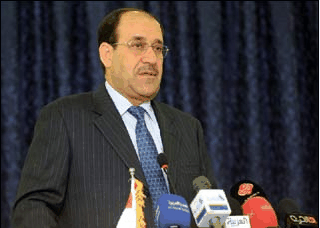
Additionally the relationship between al-Maliki and al-Hashimi has never been a happy one. There has been a rift ever since al-Maliki’s first government was sworn in, in 2006.
Banned from travelling out of Iraq, Al-Hashimi is currently in the partially independent state of Iraqi Kurdistan – the state, generally considered safer than most of Iraq, has its own government and its own military and the Kurdish seem to be playing the mediator role in this crisis.
Al-Hashimi has always cast aspersions on the integrity and professionalism of the Iraqi security forces and the Iraqi judiciary and he has said he would be willing to be trialled in Erbil, the capital of Iraqi Kurdistan, on the charges of terrorism that al-Maliki is levelling against him.
Meanwhile Al-Maliki has publicly asked the government of Iraqi Kurdistan to send al-Hashimi back to Baghdad to face trial although at the time of writing, al-Hashimi was still in Iraqi Kurdistan.
The penalty for the crimes of which al-Hashimi is accused is death. Article 4 of Iraq’s 2005 Anti-Terrorism Law states that: “anyone who committed, as a main perpetrator or a participant, any of the terrorist acts stated in the second and third articles of this law, shall be sentenced to death. A person who incites, plans, finances, or assists terrorists to commit the crimes stated in this law shall face the same penalty as the main perpetrator.”
The warrant was signed by five judges and according to a spokesperson from the Ministry of the Interior, it remains in effect. Representatives of al-Maliki’s party told the al-Jazeera television network that the trial must be held in Baghdad because the crimes were committed in Baghdad.
As for al-Maliki’s instigation of a parliamentary no-confidence vote in his deputy prime minister al-Mutlaq, this also has some history. Al-Mutlaq has accused him of being “a dictator”, al-Maliki said. Al-Mutlaq has also talked about how difficult it is to work with al-Maliki.
Comments are closed.