


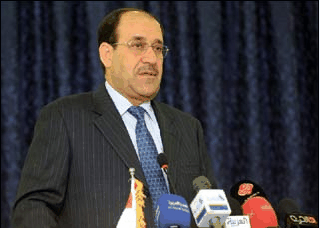
“It is just not reasonable to have some individuals participating in this government,” MP Hussein al-Asadi, a senior member of al-Maliki’s State of Law coalition, explained to NIQASH. “They say they will work with the government but at the same time, they criticize it at every opportunity. That is what al-Mutlaq is doing.”
Al-Asadi pointed out the hypocrisy in the situation where politicians were participating in the coalition government and enjoying the privileges that came with their senior position, yet they were then continuously critical of the leadership.
“Anyone who is not happy with the government’s performance is welcome to leave and to join the opposition,” al-Asadi stated. “This would allow the government to work better as a team, to implement its programmes and to achieve its goals. This would be better than having two teams at work where one builds and the other only destroys.”
And there are also other forces at work. Only hours after the crisis began, al-Maliki held a meeting with what is known as “the White Iraqiya” bloc or simply “the White Bloc”. This group split from the main Iraqiya list earlier in March 2011 and has ten MPs. A spokesperson for the White Bloc, who had previously spoken about their support for al-Maliki’s government, said that they would be happy to fill any power vacuum left by the withdrawal of the main Iraqiya bloc from government.
As for Ayed Allawi, the leader of the Iraqiya bloc, he has yet to make any statements to the media. He did leave a note on his Facebook page though. “Democracy is now threatened in Iraq,” Allawi wrote. “It has been blown apart completely and we fear that this will lead to more sectarian bloodshed, especially if we take into account the current circumstances elsewhere in the region." The assumption is that he is referring to the unrest in the Middle East, due to various Arab Spring revolutions and ongoing crises in nations like Syria, all of which look set to change the sectarian power balance between Shiite and Sunni Muslim in the region.
Political observers in Iraq say the timing of this outburst by al-Maliki is particularly bad for the country. They say that despite general popular antipathy toward the US, the presence of US troops was clearly something of a buffer between the various parties in Iraq. Now that the physical US support for the unwieldy power-sharing arrangement has left the country, so, it seems has the desire to continue negotiating and fighting over every single legislative topic and over the powers and privileges that come with being an MP in Iraq.
Comments are closed.