


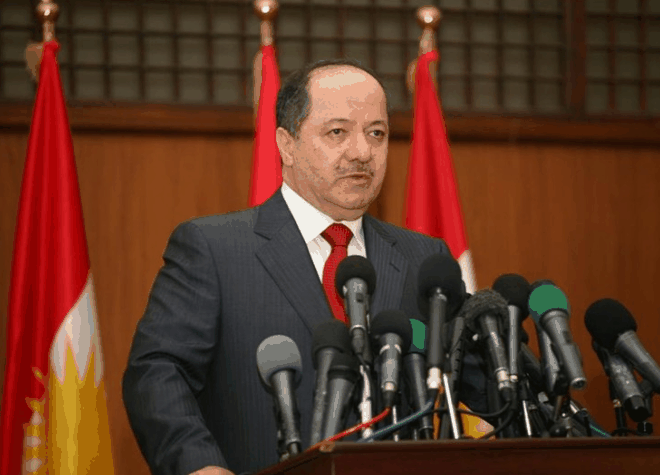
The announcement on Feb. 19 that the Discriminatory Authority of the Justice and Accountability Commission vetoed the decision to exclude Mahmoud from government may not end the battle between Maliki and his opponents — the Kurds, the Iraqi List and the Sadrists. But it certainly demonstrates some of Maliki's aspirations in advance the upcoming meeting in Erbil.
The announcement of a prospective conference in Erbil to resolve the crisis, just a month before the provincial elections and less than a year before the parliamentary elections, raises questions about how useful temporary compromises are in an atmosphere with almost no attention to reform or comprehensive state-building.
According to public opinion, Iraq needs comprehensive consensus over reforms on all disputed national issues, including the constitution if required. Meanwhile, there are mounting fears that temporary agreements will fail.
The success or failure of the prospective Erbil meeting depends on whether it can shift the political mood in Iraq from discussions of partial solutions toward solving the major differences that regularly arise. Those include the form of government, the powers of authorities, the boundaries of a federal system, the distribution of wealth, judicial, military, and security reforms, systematic solutions to corruption, and foreign-relations reform.
Bushra Al Mudhafar is a writer and journalist from Baghdad working in both Iraqi and Arab media.
Comments are closed.